


BEFORE THE INTERNATIONAL COURT OF JUSTICE
THE HAGUE, NETHERLANDS
CASE NO. NZ-1840-0001
IN THE MATTER OF THE TREATY OF WAITANGI (TE TIRITI O WAITANGI)
BETWEEN:
THE RANGATIRA AND IWI OF AOTEAROA
Represented by their chosen representatives, acting on behalf of all Māori peoples
Claimants
-AND-
THE BRITISH CROWN
Represented by the Government of the United Kingdom and the Government of New Zealand
Respondents
MEMORIAL OF THE CLAIMANTS
SUBMITTED PURSUANT TO THE STATUTE OF THE INTERNATIONAL COURT OF JUSTICE
I. INTRODUCTION AND NATURE OF THE PROCEEDINGS
1.1 The Claimants, the Rangatira and Iwi of Aotearoa, bring this action before the International Court of Justice seeking declaratory relief and reparation for systematic and ongoing violations of the Treaty of Waitangi (Te Tiriti o Waitangi), an international agreement executed in 1840 between the sovereign Māori nation of Aotearoa and the British Crown.
1.2 This filing is submitted as an imaginary pleading to articulate the legal and factual basis upon which the Claimants assert that the Respondent, the British Crown, has committed fundamental breaches of its obligations under international law.
1.3 This memorial is not a prediction of outcome. It is a presentation of the case, framed in the language of international law, to demonstrate the legal and moral foundations upon which a claim rests—whether or not any court ever formally adjudicates it.
II. DEFINITION AND NATURE OF THE INSTRUMENT
2.1 Definition of the Treaty of Waitangi (Te Tiriti o Waitangi): The Treaty is an international agreement executed in 1840 between the sovereign Māori chiefs of Aotearoa and representatives of the British Crown. For the purposes of these proceedings, the Claimants rely upon both the Māori text (Te Tiriti o Waitangi) and the English text, with the understanding that:
The Māori text was executed first and signed by the majority of chiefs.
The Māori text is the authoritative text, as it was presented to the Māori signatories.
The English text differs materially from the Māori text, creating ambiguity that the Crown subsequently exploited.
2.2 Parties to the Agreement:
The Crown (represented by Captain William Hobson and his agents).
The Rangatira (chiefs) of the united tribes of Aotearoa, acting under their sovereignty as affirmed in He Whakaputanga (the Declaration of Independence, 1835).
2.3 Jurisdiction: The Court has jurisdiction to hear this matter pursuant to Article 36(1) of the Statute of the International Court of Justice, as the Treaty constitutes an international agreement between sovereign parties, and the breaches alleged constitute violations of international law obligations.
2.4 Status of the Treaty under International Law: He Whakaputanga, the Declaration of Independence of 1835, affirmed the sovereignty and independence of the united tribes of Aotearoa, and was formally recognised by the British Crown. The Treaty of Waitangi is therefore a treaty between sovereign entities under international law.
III. FACTUAL BACKGROUND
III.A Prior Recognition of Māori Sovereignty
3.1 In 1835, the British Crown formally recognised the independence and sovereignty of the united tribes of Aotearoa through He Whakaputanga. This document was signed by 52 northern chiefs and declared:
"Ko matou ko nga Rangatira te Rangatiratanga o te wakaminenga" (We, the Chiefs, are the Sovereignty of the Confederation).
3.2 The British Crown, through its Resident James Busby, facilitated and recognised this declaration. The Crown's own legal advisors at the time acknowledged that Aotearoa was a sovereign territory, not terra nullius.
3.3 The Treaty of Waitangi was therefore a treaty between two recognised sovereign entities: the Crown and the Rangatira of Aotearoa.
III.B The Treaty's Promise
3.4 The Treaty, as understood by the Māori signatories, promised:
Article 1 (Kawanatanga): The Crown would have governorship over British subjects and maintain order among European settlers. This was not a cession of sovereignty but a delegation of authority over a specific population.
Article 2 (Tino Rangatiratanga): The chiefs would retain full chieftainship and authority over their lands, villages, and taonga (treasures). This included authority over land, resources, culture, language, and self-governance.
Article 3 (Ōritetanga): Māori would have the full rights and privileges of British subjects, including equality before the law and protection of their rights.
3.5 The Crown, in its own English text, promised:
Sovereignty over New Zealand (in the English version).
Full, exclusive, and undisturbed possession of their lands, estates, forests, fisheries, and other properties.
All the rights and privileges of British subjects.
3.6 Whether one relies upon the Māori text or the English text, the Crown's obligations included protection of Māori lands, authority, and rights, a guarantee that was immediately and systematically violated.
IV. THE BREACHES: SYSTEMATIC AND CONTINUOUS
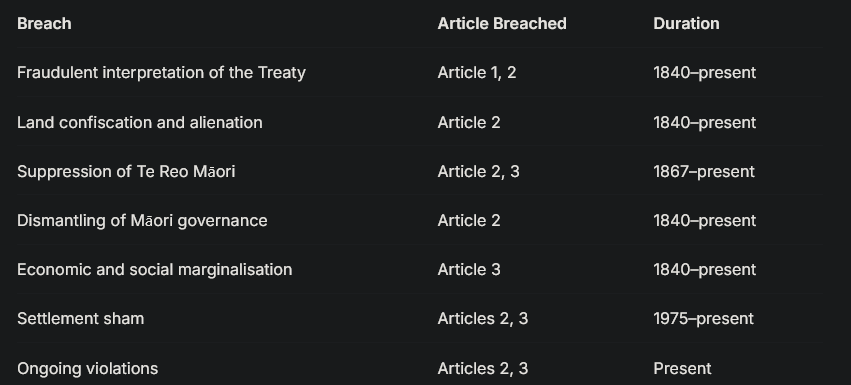
IV.A First Breach: The Fraudulent Interpretation
4.1 The Crown, immediately after the signing, proceeded to interpret the Treaty in a manner diametrically opposed to its meaning as presented to the Māori signatories.
4.2 The Crown's legal advisors and representatives, including Governor William Hobson, Colonial Secretary Lord John Russell, and subsequent governors, acted upon the English text while knowing that the Māori text carried a different meaning.
4.3 This constituted a breach of the duty of good faith in the negotiation and execution of international treaties and violated the fundamental principle that treaties must be interpreted in accordance with the understanding of both parties, particularly when one party relied upon the representations of the other.
IV.B Second Breach: Land Confiscation and Alienation
4.4 The Crown engaged in systematic land confiscation through:
The New Zealand Settlements Act 1863: The Crown confiscated vast areas of land in the Waikato and elsewhere, including lands belonging to iwi that had not participated in hostilities.
The Native Land Court: Established in 1865, this court was designed to destroy collective Māori land ownership and facilitate the transfer of land to settlers. The 1865 Act explicitly aimed to "encourage the extinction of such proprietary customs."
The "Ten-Owner Rule": The court limited the number of owners on a title to ten, destroying the collective nature of Māori landholding and enabling the alienation of land without full tribal consent.
The 10-Owner Rule: The 1865 Act limited the number of owners who could be named on a title to just ten people, completely ignoring the collective nature of Māori landholding.
4.5 By 1939, Māori retained only 6% of their original land holdings. The land that was taken was transferred to settlers, the Crown, and private interests.
4.6 This constitutes a fundamental breach of Article 2 of the Treaty, which guaranteed to Māori the full and undisturbed possession of their lands.
IV.C Third Breach: Suppression of Te Reo Māori
4.7 The Crown actively suppressed the Māori language through:
Native Schools Act 1867: Children were punished for speaking te reo Māori in schools. The curriculum was designed to assimilate Māori into English culture.
Policy of Assimilation: The Crown's official policy throughout the 19th and 20th centuries was to suppress Māori culture and language in favour of English language and culture.
4.8 By the mid-20th century, te reo Māori was nearly extinct. This constitutes a breach of Article 2 of the Treaty, which guaranteed the protection of Māori taonga, including language, and Article 3, which promised Māori the rights of British subjects (including the right to use their own language).
IV.D Fourth Breach: Dismantling of Māori Governance
4.9 The Crown systematically dismantled Māori governance structures by:
Refusing to recognise rangatiratanga as promised in Article 2.
Imposing Western legal and political models that disregarded Māori systems of governance.
Destroying the authority of chiefs, as recognised in He Whakaputanga.
Refusing to incorporate Māori into governance, except through token representation.
4.10 This constitutes a breach of Article 2 of the Treaty, which guaranteed full chieftainship and authority.
IV.E Fifth Breach: Economic and Social Marginalisation
4.11 The Crown's actions led to the economic and social marginalisation of Māori, including:
Loss of economic independence through land confiscation.
Poverty and dependency.
Discrimination in education, healthcare, employment, and justice.
Destruction of traditional economic systems (fishing, agriculture, resource management).
4.12 This constitutes a breach of Article 3, which guaranteed Māori the full rights and privileges of British subjects, including equality before the law.
IV.F Sixth Breach: The Settlement Sham
4.13 The Crown established the Waitangi Tribunal in 1975 to investigate breaches of the Treaty, but the Tribunal's recommendations were non-binding.
4.14 The Crown offered financial settlements to some iwi. These settlements were:
A fraction of the land's actual worth: The compensation offered was a tiny percentage of the value of the land confiscated.
Designed to extinguish claims: The settlements required iwi to accept them as full and final settlement of all historical grievances.
A "shut-up payment": The Crown used these settlements to close the conversation, not to restore the relationship.
Divisive: The settlements created division between iwi that settled and those that refused, often due to pressure.
4.15 The Crown's offer of money, rather than restoring land, governance, and sovereignty, is an insult to the Treaty, which promised partnership, not financial compensation. Money cannot restore mana. Money cannot restore a culture. Money cannot restore sovereignty.
IV.G Seventh Breach: Ongoing Violations
4.16 The Crown's violations are not limited to the past. They continue today:
Resource Management Act reforms: The Crown is systematically removing Māori input into environmental decisions, undermining kaitiakitanga (guardianship).
Attacks on co-governance: The Crown is attempting to dismantle co-governance structures that give Māori a voice in resource management, health, and other areas.
Defunding Māori language programmes: The Crown has reduced funding for te reo Māori revitalisation, undermining the survival of the language.
Refusal to honour the Tribunal's findings: The Crown has refused to accept the Tribunal's findings, including the 2014 finding that Māori did not cede sovereignty.
V. LEGAL ARGUMENTS
V.A The Treaty Is a Binding International Agreement
5.1 He Whakaputanga (1835) affirmed Māori sovereignty and was formally recognised by the British Crown.
5.2 The Treaty of Waitangi was executed between sovereign parties and is therefore a binding international agreement.
5.3 Even under the Crown's domestic law, the Treaty is a legal instrument that carries obligations.
V.B The Crown Breached Its Obligations
5.4 The Crown's systematic breaches of the Treaty, land confiscation, language suppression, governance dismantling, economic marginalisation, and ongoing violations, constitute a fundamental breach of the Treaty.
5.5 These breaches are not isolated incidents but a continuous and deliberate project to undermine Māori sovereignty and rights.
V.C The Crown Violated the Principle of Good Faith
5.6 Under international law, treaties must be performed in good faith (pacta sunt servanda).
5.7 The Crown's actions demonstrate bad faith at every stage, from the fraudulent interpretation of the Treaty to the ongoing violations of its terms.
V.D Financial Settlements Do Not Rectify the Breach
5.8 Financial settlements offered by the Crown do not constitute reparation for the breaches, because:
They do not restore sovereignty.
They do not restore land and resources.
They do not restore language, culture, and mana.
They are a fraction of the value of what was taken.
5.9 The Crown's attempt to close the conversation through financial settlements is itself a violation of the Treaty, which promised partnership, not a financial transaction.
VI. RELIEF SOUGHT
6.1 The Claimants seek the following relief:
A declaration that the Crown has breached the Treaty of Waitangi (Te Tiriti o Waitangi) in the manner set out herein.
A declaration that the Treaty remains a binding international agreement between the Rangatira of Aotearoa and the British Crown.
An order requiring the Crown to restore Māori sovereignty in accordance with Article 2 of the Treaty (tino rangatiratanga).
An order requiring the Crown to enter into good-faith negotiations with the representatives of Māori peoples to establish a framework for the restoration of sovereignty and partnership.
An order requiring the Crown to cease all actions that undermine Māori rights, including attacks on co-governance, resource management reforms, and language policies.
Such further and other relief as the Court deems just.
6.2 The Claimants do not seek punishment. They seek restoration.
6.3 The Claimants submit to the Court that the relief sought is necessary for the healing of the relationship between Māori and the Crown, for the honour of the Crown's word, and for the future of Aotearoa.
VII. CONCLUSION
7.1 The Treaty of Waitangi was a solemn promise. It was broken. It was not broken by accident. It was broken by design, a deliberate project of dispossession, assimilation, and denial that has lasted 184 years.
7.2 The financial settlements offered by the Crown are an insult. They are a "shut-up payment" designed to close the conversation, not to restore the relationship. They do not restore sovereignty. They do not restore mana. They do not restore what was taken.
7.3 The Crown's word is worthless if the Treaty means nothing. The Crown's honour is a lie if the Treaty is not honoured.
7.4 The Claimants request this Court to declare the truth: that the Treaty was broken, that the Crown is responsible, and that restoration is the only path to healing.
7.5 This is not about punishment. It is about truth. It is about honour. It is about the future. It is about the children, Māori and Pākehā, who will inherit the legacy we leave them. Let that legacy be one of partnership, not domination. Let it be one of healing, not denial. Let it be one of freedom, not shame.
7.6 Kia kaha, kia maia, kia manawanui (Be strong, be brave, be steadfast).
Respectfully submitted
On behalf of the Rangatira and Iwi of Aotearoa
Dated this 2 day of July, 2026
APPENDIX A: KEY DOCUMENTS
He Whakaputanga (Declaration of Independence, 1835)
Te Tiriti o Waitangi (Māori Text, 1840)
Treaty of Waitangi (English Text, 1840)
New Zealand Settlements Act 1863
Native Lands Act 1865
Waitangi Tribunal Act 1975
Selected Waitangi Tribunal Reports (including Te Paparahi o Te Raki Stage 1 Report, 2014)
United Nations Declaration on the Rights of Indigenous Peoples (2007)
APPENDIX B: SUMMARY OF BREACHES
End of Memorial
A Note on the Imaginary Nature of This Filing
This document is an imaginary legal filing, drafted in the tradition of international legal advocacy. It is not a real submission to any court. It is an exercise in legal argumentation, designed to frame the historical and moral case in the language of international law. The facts and arguments presented are grounded in historical reality and the lived experience of Māori peoples. The purpose of this filing is to demonstrate that the case against the Crown is legally, morally, and historically sound, whether or not any court ever formally adjudicates it. If you believe in the law then it is clean the nz crown does not and never did and never will.
The War on the Māori Seats: Legislation in Play
The Crown's assault on the Treaty is not confined to the past. It is happening right now, in Parliament, through legislation that targets the very mechanism of Māori representation. The pattern is unmistakable: three parties, three bills, three directions, but the cumulative effect is a sustained attack on Māori political voice. A person that breaks a legal binding agreement will break every agreement they make. And here, before our eyes, the Crown is breaking another one.
1. The Freeze: Electoral (District Boundaries) Amendment Bill
The Government has introduced legislation that would delay the next electorate boundary review from 2029 to 2032 and shift future reviews from every five years to every six.
The numbers tell the story: There are already enough voters on the Māori roll to justify an eighth Māori seat right now. Te Pāti Māori co-leader Rawiri Waititi states plainly: "It is already an injustice that we will only have 7 Māori seats at the 2026 election when we have the numbers for 8 right now." By delaying boundary reviews until 2032, the bill would freeze the number of Māori seats at seven for at least two election cycles. And the gap will only widen, Waititi warns that by 2032, the Māori roll is projected to justify 9 or 10 seats.
The deeper betrayal: 40% of the Māori population is under 18 years old. The Māori roll is growing faster than ever. Slowing the review cycle to every six years means electoral boundaries will continually lag behind population change. As Waititi put it: "Not only will this Bill harm our people for the next six years, it will also ensure that we are underrepresented in all future elections."
Te Pāti Māori's position: The party is calling for boundary reviews before every election to ensure representation keeps pace with enrolment changes. They argue that anything less is "voter suppression and a violation of Te Tiriti o Waitangi."
This is not about administrative efficiency. This is about restricting Māori representation until 2032 and beyond, a deliberate suppression of Māori political voice, dressed in the language of process.
2. The Referendum: New Zealand First's Māori Seats Referendum Bill
New Zealand First has introduced a Member's Bill that would hold a binding referendum at the 2026 election asking a simple Yes/No question: 'Should there be separate Māori seats in the New Zealand Parliament?'
The timing is deliberate: The party states they have legislation ready right now and could hold the referendum in conjunction with the November 2026 election at no extra cost. They frame this as democracy, "this decision should be put to a binding referendum, not made unilaterally", so the country can "move forward together, united, as one."
The irony: New Zealand First itself once held five Māori electorates and voted for a bill to entrench the seats in its first reading. Now it campaigns to abolish them entirely.
The context: This follows the 2025 local elections, where a controversial law change forced councils to hold referendums on Māori wards. In 24 of 42 municipalities, voters chose to remove their Māori wards. The pattern is clear: first test the waters locally, then move to the national stage. As one observer noted, the current Māori seat-holders have shown "how much of a mess they are in"—proving, in NZ First's view, that "the time has come for the public to decide if they are effective."
The deeper threat: If successful, this bill would abolish seats that have guaranteed Māori representation in Parliament since 1867, seats created precisely because the Crown's land laws excluded Māori from voting in general electorates.
3. The Entrenchment: Green Party's Electoral (Entrenchment of Māori Seats) Amendment Bill
In direct response to these threats, the Green Party has introduced a Member's Bill to entrench Māori electorate seats in law.
The inequality it addresses: Currently, only a simple majority of 51% is needed to abolish Māori seats. General electorates, by contrast, require a 75% parliamentary majority to change. Green MP Hūhana Lyndon states: "We want to see the equality given to the Māori electorates as we do for the general."
The urgency: Lyndon points to the current coalition's actions, the Treaty Principles Bill, the Regulatory Standards Bill, and removing Treaty provisions from the Education and Training Act, as evidence of "insecurity within Te Iwi Māori." Entrenchment, she argues, would "provide a pathway to give a surety that a dedicated Māori voice is available in Parliament."
The broader vision: The bill would also allow Māori to switch between the general and Māori roll at any time, meaning tangata whenua could vote for a Māori electorate seat in general elections but choose a general ward for local elections.
Summary: Three Bills, One Pattern
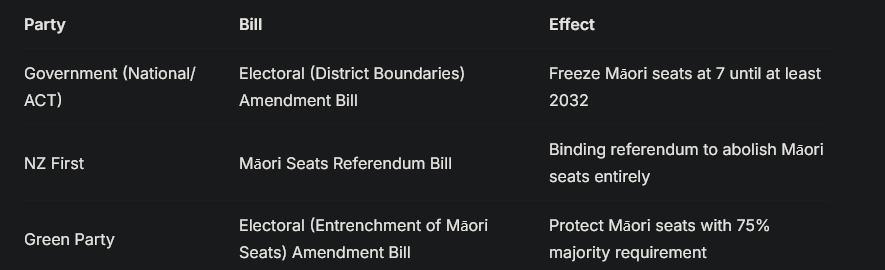
The psychology is consistent: Two of these bills would reduce Māori representation. One would protect it. The Government and NZ First are testing the waters, first with a freeze, then with a referendum. The message is clear: the Crown's word, the Treaty's promise of partnership, means nothing when it stands in the way of political control.
And the response is equally clear: Te Pāti Māori calls the freeze "voter suppression and a violation of Te Tiriti o Waitangi." The Green Party warns of "insecurity within Te Iwi Māori" and seeks to provide "surety that a dedicated Māori voice is available in Parliament."
The war on the Māori seats is not hypothetical. It is legislation. It is before Parliament. And it is happening now.
A person that breaks a legal binding agreement will break every agreement they make. The Crown is proving it, one bill at a time.