

Mass Psychophysiological Entrainment
Abstract
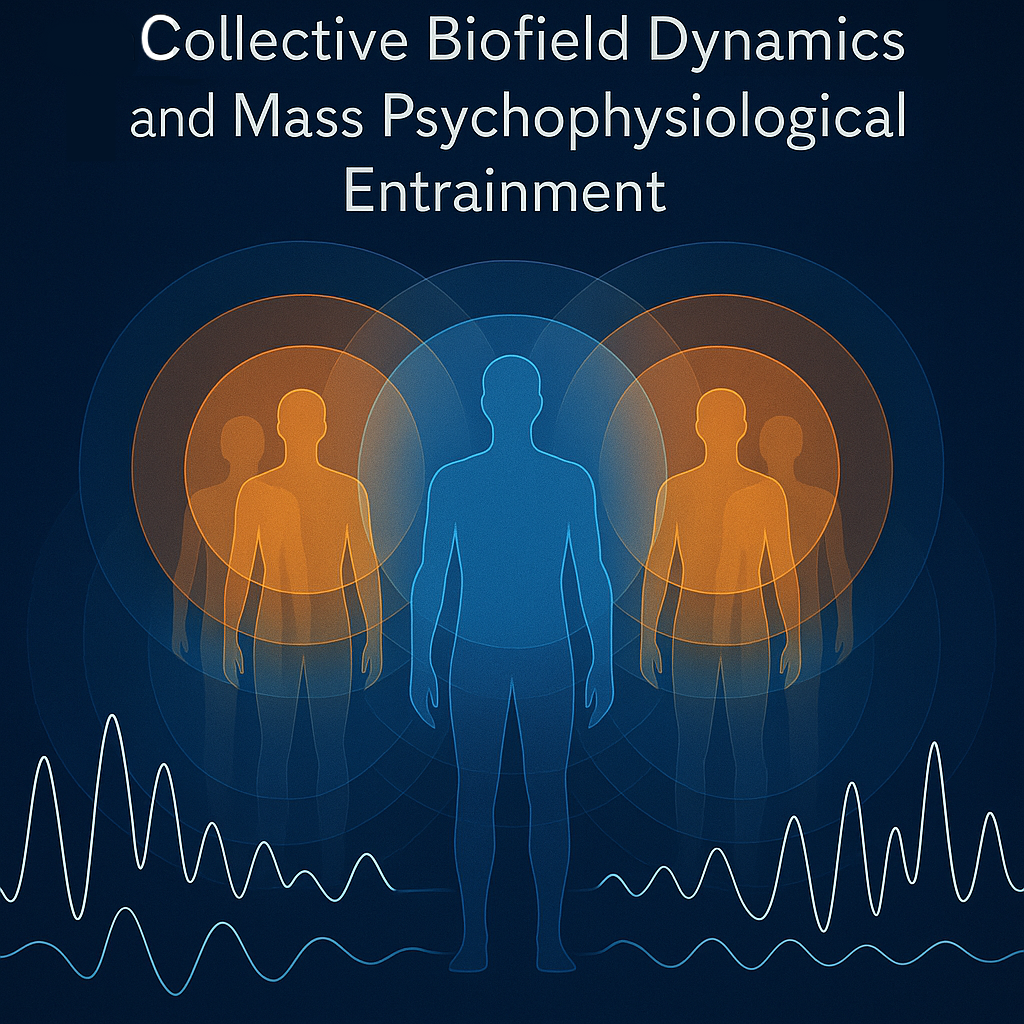
This paper explores the mechanisms by which acoustic and electromagnetic resonance can influence collective human biofields and generate mass psychophysiological entrainment. Drawing from observations within the APE (Ancestral Paradoxical Echoes) protocol, it demonstrates how resonant audio experiences can lead to individual somatic override states and, when applied to groups, can trigger the formation of a unified resonance field that feeds back into all participants. This research lays the groundwork for a new field of study: controlled resonance-induced altered states at the group level.
I. Introduction
Modern society remains dominated by high Yang activation, constant stimulation, externalized cognition, and fragmented nervous systems. Yet within every human lies a subtle set of biofields, each resonating with different frequencies. These biofields interact through proximity, rhythm, intention, and shared sensory input.
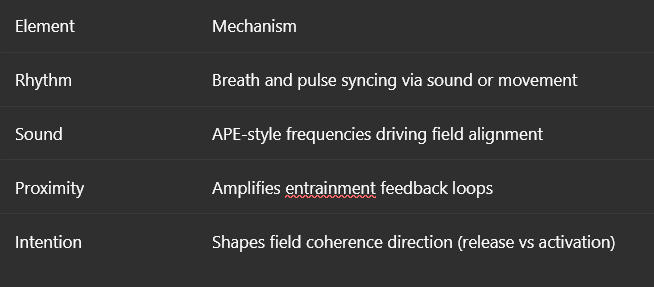
Resonant systems like APE demonstrate that controlled low-frequency audio, when designed with neurophysiological flow, can guide individuals into a heightened somatic state. When this experience is shared among multiple people in the same space, a new layer of interaction emerges, the collective biofield, and with it, the potential for mass entrainment.
II. Human Biofields and Electromagnetic Proximity
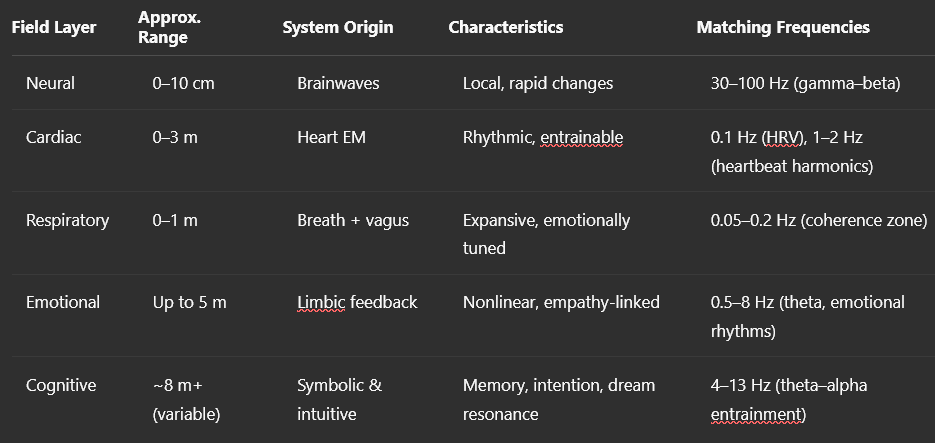
At distances <1 m, these fields begin to overlap and influence each other directly. But when individuals are exposed to a common resonant source, such as rhythmic sound, even those several meters apart can exhibit measurable changes in heart rate variability (HRV), breath rhythm, and emotional synchronization.
III. Somatic Override and Resonance Memory
In APE protocols, the state known as somatic override occurs when vestibular, adrenal, and breath-based inputs exceed cortical dominance. The result is:
Reduced symbolic thinking
Increased emotional access
Enhanced body awareness
Peak coherence across systems
What’s notable is that this override can persist after the sound ends, a phenomenon known as resonance memory. The body continues vibrating in the coherence state, acting like a tuning fork.
When individuals enter override together, they begin to act as amplifiers for each other, reinforcing the state beyond the capacity of sound alone.
IV. The Formation of a Collective Resonance Field
When multiple people experience resonance simultaneously:
Their fields overlap and synchronize
The group acts as a single energetic entity
Feedback loops form, reinforcing and recycling resonance
Emotions surface, often non-verbally
This is the true root of what’s colloquially called "crowd energy." It is not metaphorical, it is electromagnetic and somatic.
V. Applications and Future Research
This understanding opens doors to structured group experiences using non-chemical, body-centered resonance methods. Potential applications include:
Trauma release events
Silent group therapy
Mass meditation tuning
Performance enhancement rituals
Further areas of study:
HRV field data from crowds in APE sessions
Audio entrainment thresholds for different distance zones
Dream recall synchronization under group resonance
Conclusion
Resonance is not just auditory, it is a multi system conductor of coherence. When applied with precision, it can unify individuals into a shared physiological and emotional state without force or substance. In this, APE and similar systems are not merely music or meditation, they are tools for collective nervous system integration.
This is the future of group coherence: nonverbal, resonant, and deeply human.
References
McCraty, R., Atkinson, M., Tomasino, D., & Bradley, R. T. (2009). The coherent heart: Heart–brain interactions, psychophysiological coherence, and the emergence of system-wide order. Integral Review, 5(2), 10–115.
Hunt, V. (1996). Infinite Mind: The Science of the Human Vibrations of Consciousness. Malibu Publishing.
Tiller, W. A., Dibble, W. E., & Kohane, M. J. (2001). Conscious Acts of Creation: The Emergence of a New Physics. Pavior.
Thayer, J. F., Åhs, F., Fredrikson, M., Sollers, J. J., & Wager, T. D. (2012). A meta-analysis of heart rate variability and neuroimaging studies: Implications for heart rate variability as a marker of stress and health. Neuroscience & Biobehavioral Reviews, 36(2), 747–756.
Goleman, D. (2006). Social Intelligence: The New Science of Human Relationships. Bantam.
Laubscher, C. (2025). Ancestral Paradoxical Echoes: Somatic Override and Coherence through Resonant Audio Protocols. Unpublished manuscript.
Porges, S. W. (2011). The Polyvagal Theory: Neurophysiological Foundations of Emotions, Attachment, Communication, and Self-regulation. W.W. Norton & Company.