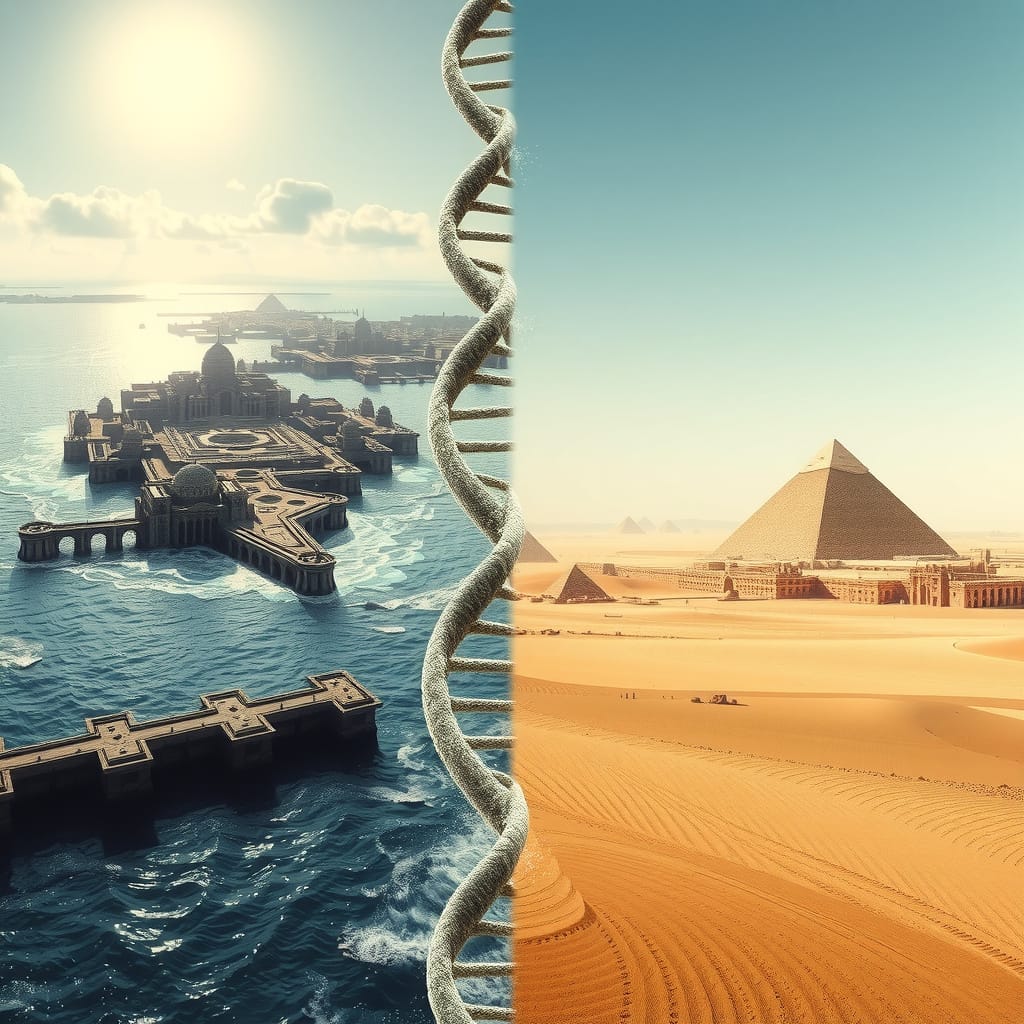

What if history's greatest mysteries, the sudden building of the pyramids, the global stories of a great flood, and the unexplained genetic links between far-flung tribes, are all pieces of a single story? This paper presents a new theory. We propose that a sophisticated, sea-going human culture was shattered 12,800 years ago by a global catastrophe of fire, ice, and rising seas. The survivors of this drowned world, carrying a unique genetic blueprint for survival and advanced knowledge, scattered across the globe. They didn't conquer; they integrated. And wherever they settled, they sparked a leap forward, teaching new skills, building the first megaliths, and planting the seeds for the first great civilizations. This is the story not just of what we built, but of what we lost to the sea, and how its refugees made our world.
1. The Great Mystery: History's Unexplained Leaps
Consider the Pyramids of Giza. Mainstream history tells us they were built by a society that, just centuries before, was using simple mudbrick tombs. How did they acquire the advanced mathematics, astronomy, and engineering to construct such perfect, monumental alignments in such a short time? The official timeline shows a "jump", a masterpiece with no clear, gradual prototype.
This pattern repeats worldwide:
In Turkey, at Göbekli Tepe, hunter-gatherers carved and erected 16-ton stone pillars in precise circles 6,000 years before Stonehenge.
In Peru, stone blocks at sites like Sacsayhuaman were cut with such precision that a razor blade can't fit between them, appearing suddenly in the archaeological record.
In the Mediterranean, islands like Malta and Crete were colonized by farmers with sheep and crops, requiring seaworthy boats that seem to appear out of nowhere.
These aren't just isolated wonders. They are symptoms of a deeper mystery: the sudden, simultaneous emergence of complex knowledge across the globe after the last Ice Age. Our theory provides a simple, unifying cause.
2. The Disaster: A World Shattered
The cause was a global cataclysm 12,800 years ago, at the start of a period called the Younger Dryas. Evidence is etched in the Earth itself:
A thin, black layer of ash and melted glass found across four continents, suggesting massive wildfires triggered by a comet impact.
Ice cores from Greenland show a plunge in global temperatures within a decade, launching a 1,300-year "mini ice age."
Most crucially, sea levels rose over 400 feet as the glaciers melted, drowning millions of square miles of coastal land, the very places where early humans would have thrived.
This wasn't just a bad winter. It was a planet-wide reset button. For any coastal society, it was an existential threat. The sea, once a source of food and a highway for trade, became a relentless, devouring force.
3. The Survivors: A Genetic Fingerprint
In the wake of this disaster, who would survive? Those best adapted to chaos: people who could endure low oxygen, harsh cold, famine, and, most importantly, navigate a terrifyingly unfamiliar world.
Intriguingly, modern genetics has identified a rare set of genes, a "survivor cluster", found in less than 0.5% of people, but concentrated in specific, isolated populations:
The Basque of Spain
The Sea Nomads of Southeast Asia
Aboriginal Australians in the far north
Highland tribes in India
These groups seem unrelated, but they share extraordinary traits linked to their genes:
Resistance to low oxygen (like high-altitude Tibetans)
Superior endurance and cold tolerance
Enhanced brain function for navigation and reading environmental patterns
This isn't a coincidence. We argue this genetic cluster is the biological signature of the catastrophic bottleneck. It's the DNA of the people who endured the disaster, a toolkit for survival hardwired into their descendants.
4. The Knowledge: What Was Saved and Spread
These survivors didn't arrive empty-handed. They carried the intellectual legacy of a maritime civilization. Their drowned world had been connected by sea, necessitating advanced knowledge of:
Celestial Navigation: Reading stars for open-ocean travel.
Engineering: Building structures to predict tides, seasons, and celestial cycles.
Resource Management: Botany, fishing, and early cultivation.
When they integrated with inland hunter-gatherer societies, this knowledge was revolutionary. They became the "catalytic minority." We see this in the myths: the Sumerian Oannes, a half-fish god who came from the sea to teach law and agriculture; the Andean Viracocha, a wise teacher from across the water. These are the cultural memories of real, knowledgeable refugees.
The Boat Example: Consider the Austronesian Expansion. Around 3000 BCE, people from Taiwan suddenly began sailing across thousands of miles of open Pacific, colonizing islands from Madagascar to Easter Island. This required outrigger canoes, sails, and profound navigational skill. Where did this full-blown maritime package come from? We propose its deep roots lie in the sophisticated boat culture of the pre-flood continental shelves, preserved and passed down by survivor groups.
5. The New Timeline: A Unified Story
Before the Disaster: A network of human cultures thrives on the coastal plains of Sundaland (Southeast Asia), Doggerland (North Sea), and Beringia. They are maritime-adapted, socially complex, and astronomically literate.
The Impact (~12,800 BCE): Comet fragments strike. Fires rage. The climate plummets. Glaciers melt. The seas begin their relentless rise for centuries.
The Scattering: Survivors flee in all directions by boat and by foot. One group goes up the Nile, another into the Anatolian highlands, another across the Pacific. They carry their genes and their knowledge.
The Catalyst (~9,500 BCE onward): In their new homes, the deserts of Egypt, the plains of Anatolia, the mountains of Peru, they share their knowledge. Megalithic astronomy appears at Göbekli Tepe. Monumental geometry emerges in Egypt. Terraced agriculture begins in the Andes. The survivor genes spread within these populations.
The Legacy: What we call the "dawn of civilization" is, in large part, the flowering of this transplanted and hybridized knowledge in fertile post-glacial refuges.
6. How to Test This Theory: Predictions for Science
A good theory makes predictions we can check:
Underwater Archaeology: The most definitive proof will be found on the sea floor. Sonar and submersible surveys of the Sunda Shelf or Doggerland should reveal structures, tools, or hearths dated to before the sea-level rise.
Ancient DNA: Sequencing DNA from the oldest megalithic builders (e.g., from Göbekli Tepe or early Egyptian sites) should reveal a higher frequency of the proposed "survivor cluster" genes compared to later populations.
Geology & Myth Correlation: Specific flood myths that describe "stars falling" or "burning rain" should correspond geographically to areas with the strongest physical evidence (like the YDB layer) for the comet impact.
7. Conclusion: A New Lens for Our Past
This is not a story about a magic lost city like Atlantis. It is a story about human resilience. It suggests that a chapter of our history, a long, formative chapter of maritime innovation and cultural sophistication, is missing because its stage is now under 300 feet of water.
The pyramids, Stonehenge, and the great myths are not the beginning of the human story. They are, in part, the memorials to a world that was lost, built by the children and grandchildren of those who survived its end. By looking not just on land, but beneath the sea, and not just at artifacts, but within our own DNA, we may finally connect these fragments into the true story of our past.
Call for Research: This hypothesis is presented not as final truth, but as a new framework to guide exploration. Its power is in connecting disparate fields. We call for targeted genetic studies of identified refugia populations, a renewed commitment to underwater paleo-archaeology, and a fresh, interdisciplinary analysis of our oldest stories. The evidence awaits.