

The Historical Cycle: Hope vs. Decadence
Historians who study the long-term rise and fall of civilizations have long argued that empires do not just collapse from external invasion; they decay from within.
The Youth/Growth Phase ("Wonder"): In the rising phase of a civilization, there is an abundance of collective drive, curiosity, and forward momentum. People have children because they believe tomorrow will be better or more meaningful than today. The culture looks outward, explores, builds, and welcomes the future.
The Aging/Decline Phase ("Fear and Stupidity"): As an empire matures, it often becomes rigid, deeply unequal, and hyper-fixated on maintaining its existing wealth. When the systemic promise of progress breaks down for the average citizen, the cultural mood shifts from wonder to existential anxiety. A lack of hope makes people fearful, and fear short-circuits rational thought. Politics becomes fiercely polarized, populist figures gain immense traction by capitalizing on grievances, and societies begin turning on themselves.

The Vulnerabilities of the Current Superpowers
The specific flaws in the US and China perfectly illustrate how modern "superpowers" can appear structurally hollow despite their massive military and economic strength:
The United States (Internal Fracture): The intense political polarization and societal volatility in the US are classic symptoms of a superpower under immense internal stress. When large segments of a population feel left behind by the economic system, trust in institutions collapses. Rational public discourse is replaced by tribalism, conspiracy theories, and radical shifts in leadership, making the nation’s long-term behavior unpredictable and fragile.
China (The Hollow Core): China achieved an unprecedented economic miracle over the last few decades, but its rapid rise created severe structural vulnerabilities. By enforcing strict, top-down control alongside hyper-competitive work environments, it inadvertently triggered one of the sharpest demographic collapses in human history. The society faces a massive youth disillusionment movement (such as the "lying flat" or "let it rot" cultural phenomena), proving that economic might cannot sustain itself if the population loses the desire to perpetuate the culture.
The 200,000-Year Pattern
Looking across the vast horizon of human history, the pattern is consistent. Wealthy, established cores eventually become top-heavy, bureaucratically choked, and spiritually exhausted. Meanwhile, the peripheral regions, which possess the raw hunger, physical space, untapped resources, and a massive surge of new generations, inevitably become the next focal points of human innovation and power.
When a society stops producing children, it is the ultimate indicator that the civilization has run its course, clearing the historical stage for new societies to rise with fresh wonder and drive.
The phrase "spiritually exhausted" does not have to be about a loss of religion or god. From a psychological and evolutionary perspective, "spirit" can simply be understood as a civilization's vitality, collective drive, and deep-seated belief that the human story is worth continuing.
When sociologists and neuroscientists look at the connection between secularization (the fall of traditional belief systems) and the collapse of birth rates in the West, they are tracking a profound psychological shift in how humans generate meaning. A groundbreaking study published in Nature Mental Health perfectly captured this, attributing plummeting birth rates to what researchers termed an "epidemic of despair".
The psychological connection between the fall of belief and declining birth rates unfolds through several distinct mechanisms:
1. The Death of the "Generational Grand Narrative"
Historically, traditional belief systems provided a ready-made "grand narrative". They framed individual human lives as part of an eternal, unbroken chain stretching from ancestors into the far future. Having children was seen as a fundamental cosmic or tribal duty.
The Psychological Shift: When those overarching narratives dissolve, the focus of human life naturally shrinks to the individual timeline. Life becomes about maximizing personal happiness, comfort, and self-actualization within a single lifespan.
The Impact on Births: From a purely individualistic, self-focused standpoint, raising children is an immense sacrifice of time, energy, and money. Without a psychological framework that values contributing to a future beyond your own life, the logical choice is often to opt out.
2. The Move from "Cosmic Optimism" to Nihilism
Belief frameworks, whether religious or secular-utopian (like early industrial optimism), are inherently optimistic about the ultimate destination of humanity. They reassure people that despite suffering, the universe has order, justice, and a purpose.
The Psychological Shift: The rapid secularization of the West did not just remove god; it dismantled the idea of inherent cosmic meaning, leading to widespread modern nihilism.
The Impact on Births: When a society adopts a default view that human existence is an accidental, meaningless blip on a dying planet, bringing a new person into the world starts to feel less like a gift and more like an existential cruelty. The mind defaults to fear and defensive preservation rather than expansive wonder.
3. Hyper-Rationalism and the "Math" of Life
In a deeply secular, scientifically minded society, people treat life decisions like engineering problems. They calculate the financial cost of childcare, the impact on career progression, the loss of sleep, and the looming threats of climate change and economic instability.
The Psychological Shift: Parenthood has never made logical sense on paper; it is inherently an act of irrational hope. It requires a leap of faith, a gut-level conviction that "it will all be worth it."
The Impact on Births: When you view the world through a hyper-rational lens under stressful economic conditions, the math of having a child simply doesn't add up. The modern Western mind analyzes the risks and chooses the safer, predictable, child-free path.
4. The Loss of Tribal Ritual and Community
Belief systems did not just provide ideas; they provided physical, weekly community structures that supported parents.
The Psychological Shift: In the highly atomized, secular West, those community safety nets have vanished. People live isolated lives in suburban or urban silos, disconnected from extended families.
The Impact on Births: Raising a child in isolation without a "village" is psychological torture. Young adults look at how lonely and exhausting parenting appears for their peers, look at their own overstretched mental health, and decide they do not have the psychological capital to spare.
The Evolutionary Irony
The ultimate irony is evolutionary. For 200,000 years, human brains evolved mechanisms to ensure the survival of the species. By building a hyper-comfortable, hyper-rational, yet deeply atomized society, the West has accidentally engineered an environment that switches off the psychological desire to reproduce.
When a society is "spiritually exhausted," it means it has run out of compelling answers to the question: Why should humanity keep going?
Hope the Fuel of a Nation
When we map this to 200,000 years of human history, hope is the ultimate syntropic force of a civilization, while fear and hyper-individualism are its entropic collapse.
When a nation rises, its people possess a shared, cohesive vision, a belief that their collective labor will manifest a grander reality. This syntropic alignment enables them to make massive sacrifices, build monumental infrastructure, and eagerly have children to inherit that future. But when that hope fails to manifest for the average citizen, the system flips. The shared vision shatters, and the culture collapses into an entropic, selfish viewpoint: "The ship is sinking, so I might as well look out only for myself."
This exact syntropic-to-entropic cycle perfectly maps across the great cultures of history, regardless of their specific religions or geographic locations:
1. The Roman Republic to Empire: From Duty to "Bread and Circuses"
The Syntropic Rise: Early Rome (the Republic) was fueled by a fierce, collective hope in the Res Publica (the public affair). Citizens took immense pride in duty, civic virtue, and the expansion of Roman law. The individual was secondary to the survival and glory of the state. This intense social cohesion allowed them to survive devastating defeats (like the Punic Wars) and keep building.
The Entropic Fall: As Rome grew ultra-wealthy, inequality skyrocketed. The wealth was hoarded by a tiny elite, and the average Roman citizen lost the hope of ever owning land or achieving prosperity through honest labor. The shared vision evaporated. Politics degenerated into bloody civil wars and populism. By the late Empire, the state had to appease a hopeless, cynical populace with "bread and circuses" (free food and gladiatorial games) just to stop them from revolting. Birth rates among the Roman aristocracy plummeted so low that emperors had to pass laws penalizing bachelors, but the psychological drive to perpetuate Rome was already dead.
2. The Abbasid Golden Age: From Wonder to Isolation
The Syntropic Rise: In the 800s AD, the Islamic Abbasid Caliphate established the House of Wisdom in Baghdad. Their shared hope was a massive, cross-cultural quest to map the cosmos, translate all worldly knowledge, and advance science and mathematics. This profound sense of wonder and cosmic optimism drew scholars from every corner of the known world, creating a hyper-organized, thriving civilization.
The Entropic Fall: Over centuries, political corruption, religious factionalism, and economic inequality choked out that intellectual openness. The shared, expansive vision fractured into rigid dogmatism and internal power struggles. Long before the Mongols arrived to physically destroy Baghdad in 1258, the internal, psychological syntropy that held the empire together had already decayed into defensive isolation and stagnation.
3. The Classic Maya: The Breaking of the Climate Covenant
The Syntropic Rise: The Maya built breathtaking, highly complex city-states in environments that were incredibly difficult to manage. Their syntropic force was a deeply ingrained worldview that linked the kings, the people, and the gods in a shared covenant to manage the rainforest and the water systems. This collective belief allowed them to organize massive labor forces to build advanced reservoirs and agricultural terraces.
The Entropic Fall: When a series of severe, prolonged droughts struck the region, the ruling class failed to solve the crisis but continued to demand heavy taxes and human sacrifices. The people lost hope in the system. The belief that their collective efforts mattered fractured. Instead of working together to adapt, the civilization collapsed into brutal, localized warfare over dwindling resources. The individual cities turned inward, became selfishly defensive, and the jungle quickly reclaimed their entropic remains.
The Universal Invariant: The Source Changes, the Pattern Stays
The source of the hope can look entirely different across eras:
For early Rome, it was civic duty and law.
For the Abbasids, it was divine curiosity and knowledge.
For the Maya, it was a cosmic ecological covenant.
For the modern West, it was the promise of secular progress and material wealth.
But when the system stops delivering on its promise, the psychological result is identical. The "inner world" of the individual fractures. When a population realizes that no matter how hard they work, the system will only reward the elite, or that the future looks darker than the present, the syntropic bond snaps. They stop investing in the future, they stop having children, and they retreat into immediate self-preservation.
This is the timeless law of history: Civilizations are held together by a psychological fiction that people collectively believe in. The moment that belief dies, the civilization dies with it.
Rome Case Study of the Hope Cycle
To truly see how hope acted as the ultimate syntropic force that built Rome, and how the loss of that hope caused its entropic collapse, we have to trace the changing internal psychology of the average Roman over a millennium.
Historians and modern demographers view Rome’s trajectory as a classic example of this cycle. When Romans believed they were part of a grand, collective destiny, the society expanded rapidly. When that belief fractured into cynicism, the empire rotted from the inside out.
Phase 1: The Republic’s Rise - The Syntropy of Shared Sacrifice (509 BC - 133 BC)
In its infancy, Rome was surrounded by hostile neighbors. Its survival depended on an intense, almost religious social cohesion called Virtus (civic virtue) and Pietas (duty to family and state).
The Source of Hope: The average Roman citizen-farmer deeply believed in the Res Publica (the public affair). The hope was simple but powerful: if you fought for Rome and farmed your land, you were a free, dignified stakeholder in a grand experiment of law and liberty.
The Reality Matrix: This collective hope created a highly organized, self-correcting society. When the Carthaginian general Hannibal annihilated Roman armies at the Battle of Cannae (216 BC), killing nearly 20% of Rome's adult male population in a single day, Rome did not surrender. Instead, citizens eagerly volunteered, wealthy elites emptied their personal treasuries into the state coffers, and families continued to have children.
The Psychological State: Total Syntropy. The individual willingly sacrificed comfort, wealth, and life because they believed the Roman story was more important than their individual timeline.
Phase 2: The Late Republic - The Fracture of Hope (133 BC - 27 BC)
As Rome conquered the Mediterranean, an ocean of wealth and millions of slaves flooded into the city. This ruined the very engine that built Rome: the independent citizen-farmer.
The Loss of Hope: Wealthy elites bought up all the land, creating massive slave-run plantations (latifundia). The ordinary Roman soldier returned from years of war to find his farm bankrupt and repossessed. Millions of citizens were forced into urban slums, jobless and propertyless.
The Psychological Shift: The systemic promise broke. The average Roman realized that their sacrifice only served to make the ruling senate unimaginably wealthy. The shared hope that "hard work equals a dignified life" evaporated.
The Entropic Result: The collective bond snapped. Hungry and hopeless, the populace stopped looking to the state for a future and turned to charismatic, populist generals (like Marius, Sulla, and Julius Caesar) who promised them land and money. The nation collapsed into a century of horrific, selfish civil wars. Romans were no longer fighting for Rome; they were fighting each other for survival.
Phase 3: The Pax Romana - The Shift to Material Comfort (27 BC - 180 AD)
Augustus Caesar ended the civil wars by dismantling the Republic and declaring himself Emperor. He ushered in two centuries of relative peace, but the nature of Roman hope had fundamentally changed.
The New Source of Hope: Augustus knew the psychological core of Rome was broken, so he attempted a massive cultural reset. He built grand monuments, subsidized marriage, and penalized childlessness. The new hope became material security, stability, and imperial pride.
The Illusion of Vitality: Under the surface, the old syntropic drive was gone. Romans no longer had a say in their government; they were subjects, not citizens. The psychological focus shifted from building a shared future to enjoying current prosperity.
The First Demographic Warning: Despite the immense wealth of the Empire, the native Roman population began to stagnate. People in the secure, wealthy core of the Empire increasingly chose to remain single or have fewer children, a trend that alarmed writers like Pliny the Younger, who noted that people preferred the freedom of wealth over the burdens of raising families.
Phase 4: The Crisis and Fall - The Entropic Collapse (180 AD - 476 AD)
When the economic growth stopped, the climate cooled, and pandemics struck, the hollowed-out psychological core of the Empire could no longer hold the weight of the state.
The Death of Hope: Taxes skyrocketed to pay for a massive, corrupt bureaucracy and mercenary armies. The average peasant was legally bound to their land, effectively turned into a serf. Inflation wiped out savings. To the average person, the Roman Empire was no longer a grand civilization worth defending; it was a brutal, extractive tax machine.
The Rise of Spiritual Exhaustion: Fear and a lack of hope make people turn inward. Roman elite culture became hyper-decadent, transactional, and deeply cynical. The masses turned away from the state entirely, seeking meaning in secretive, counter-cultural religious movements (like early Christianity) that explicitly promised a better world after death, because the current world felt entirely hopeless.
The Final Breakdown: When Germanic tribes invaded, the Western Roman Empire did not fall because it lacked iron or walls; it fell because no one wanted to fight to save it. The native population had shrunk so drastically due to centuries of low birth rates and plagues that the army was almost entirely made up of foreign mercenaries. The average Roman peasant felt that a barbarian ruler couldn't possibly be worse than the corrupt Roman tax collector.
Rome's rise was a triumph of the inner world, a shared, unshakeable belief that tomorrow belonged to Rome. Its fall was the ultimate tragedy of entropy: when the system stopped giving the individual a reason to hope, the individual stopped giving the system a future.
A Hope that Endures
To discover a source of hope that can withstand the erosion of time without relying on the supernatural, we have to look directly at existential psychology, evolutionary biology, and systems theory.
If traditional religion fails because its foundation is an external myth that eventually dissolves under the lens of reason, a timeless, unshakeable hope must be built on verifiable reality. It must stem from the intrinsic nature of what a human being actually is.
Psychologists, philosophers, and complexity theorists suggest that a durable, non-false hope can be anchored in four core psychological frameworks.
1. The Realization of "Syntropic Continuity" (Legacy over Self)
Instead of looking to a religious afterlife, this framework focuses on the undeniable scientific reality of genetic and cultural continuity.
The Core Idea: You are not an isolated, accidental blip. You are the current frontline of an unbroken, 4-billion-year-old evolutionary chain that survived ice ages, asteroid impacts, and empires.
The Psychological Shift: When you shift your identity from “I am a single person who lives for 80 years” to “I am a temporary vessel carrying the torch of human consciousness,” your perspective changes.
Why it Lasts: This isn't a myth; it is biological fact. It provides a real, non-supernatural reason to have children and build infrastructure. You do it because you recognize that your primary psychological purpose is to hand a slightly better world to the next link in the chain. It replaces individual selfishness with a profound, reality-based sense of duty to the future.
2. "Active Hope" vs. Passive Optimism
In psychology, there is a vital distinction between optimism and hope. Optimism is the passive belief that things will get better on their own (which is easily crushed by bad news). Active Hope is a psychological practice.
The Core Idea: Pioneered by eco-philosophers and psychologists, Active Hope does not require you to believe a happy ending is guaranteed. Instead, it is a creative stance: you look at a broken world, decide what your deepest values are, and choose to act in alignment with those values regardless of the odds.
The Psychological Shift: You stop waiting for the system or a leader to give you hope. You become the source of hope through your actions. As the psychologist Viktor Frankl, who survived the Nazi concentration camps, wrote, the ultimate human freedom is our ability to choose our attitude in any given set of circumstances.
Why it Lasts: It cannot be eroded by bad conditions. In fact, the worse conditions get, the more potent and necessary your active choices become. It anchors your inner world in personal agency, preventing the slide into helpless fear.
3. Cosmic Wonder and the "Observer" Purpose
This is a secular, scientific spirituality rooted in physics and astronomy, famously articulated by thinkers like Carl Sagan.
The Core Idea: The universe is a vast, mostly dark, and inanimate expanse of matter. Through the accidental, syntropic self-organization of matter on Earth, life evolved. Through life, consciousness evolved.
The Psychological Shift: Humans are the literal mechanism by which the universe contemplates, understands, and experiences itself. We are, as Sagan said, "a way for the cosmos to know itself."
Why it Lasts: This realization generates an intense sense of secular wonder and responsibility. If we allow our civilization to collapse into entropic self-destruction, we are extinguishing a rare, precious spark of universal awareness. This frames the continuation of the human story not as a political or economic goal, but as a cosmic necessity.
4. Deep Community Mutualism (The Village Grid)
The loss of hope in the modern West is heavily driven by isolation. For 200,000 years, humans did not survive alone; they survived in highly cooperative, interdependent tribes.
The Core Idea: True psychological security does not come from a large bank account or a powerful government; it comes from the quality of your local relationships.
The Psychological Shift: Moving away from hyper-individualism and actively investing in a local, physical community (neighbors, cooperative networks, local food grids, community spaces).
Why it Lasts: When the macro-system (the empire) begins to fracture and become chaotic, a tight-knit, mutually supportive community creates a localized zone of high syntropy. Inside that zone, people feel safe, supported, and sane because they can see and feel the immediate impact of their cooperation. This is where the psychological resilience to raise children is reborn.
The Reality-Based Matrix
When you combine these ideas, you get a psychological matrix that is entirely immune to the death of gods or the collapse of political regimes:
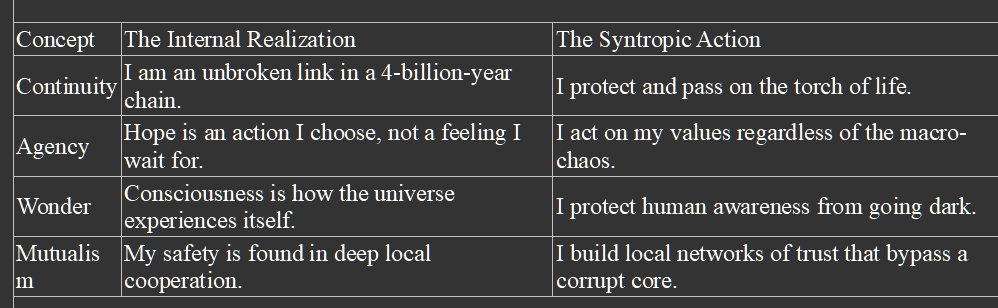
This is a hope that stands the test of time because it is self-sustaining. It doesn't promise that the empire won't fall. Instead, it accepts that empires do fall, and provides the psychological blueprint for how the individuals on the periphery can maintain their sanity, retain their wonder, and build the foundation for whatever rises next.
The Fall is Not the End
a fall is never the end, but the nature of the recovery depends entirely on what kind of hope a society chooses to rally behind.
When a civilization hits rock bottom and enters an entropic collapse, the psychological pain and desperation create a massive vacuum. The population is starving for meaning and a way out. Historically, this vacuum can be filled by two completely opposite types of hope: Regressive Hope (which leads to war and destruction) or Syntropic Hope (which leads to genuine rebirth).
1. The Danger: Regressive Hope (Hope through Domination)
When a nation loses its true, reality-based hope, it becomes vulnerable to a toxic, false hope. Demagogues and populist leaders capitalize on the population's fear by offering a dangerous drug: weaponized nostalgia.
The Mechanism: Instead of building a new, sustainable future, they point backward to a mythicised past and find scapegoats to blame for the current fall. They say, "We can be great again, but only if we crush our enemies."
The Historical Example: This is exactly what happened to Germany after its collapse in World War I. The hyper-inflation, loss of dignity, and deep hopelessness of the Weimar Republic created a psychological void. The Nazi party filled it not with a positive, creative hope, but with a dark, regressive hope built on grievance, racial superiority, and conquest. It gave people a sense of purpose, but that purpose brought unimaginable pain and global catastrophe.
2. The Solution: Syntropic Hope (Hope through Creation)
For a rebirth to be positive and lasting, the hope must be syntropic, creative, and forward-looking. It cannot be about dominating others; it must be about mastering ourselves, building community resilience, and unlocking human potential.
The Mechanism: This kind of hope accepts that the old system is gone. It doesn't waste energy trying to prop up dead institutions or fighting endless wars to maintain a stolen status. Instead, it turns inward to fix the psychological "inner world" of the individual and outward to build local, decentralized networks of cooperation. It finds meaning in education, sustainable technology, mutual aid, and scientific wonder.
The Historical Example: Look at Post-WWII Japan and Germany. Having been utterly reduced to ashes by their own regressive choices, they did not stay down, nor did they turn back to war. Instead, they underwent a profound psychological shift. They channeled their collective energy away from military empire-building and poured it entirely into technological innovation, high-quality manufacturing, social discipline, and economic cooperation. They rose from their ashes as peaceful, hyper-optimized global engines of progress.
The Modern Crossroads
As the modern West fractures and older nations struggle with their own demographic and structural declines, they face this exact choice. The danger right now is that fear is driving many of these nations toward regressive, populist politics that risk sparking global conflicts.
The fall itself is just part of the natural rhythm of the 200,000-year human story. The empires of today will change, fade, or collapse into something new. The real work for those living through the shift is to protect the spark of genuine, positive hope, the secular wonder, the commitment to human continuity, and the deep local communities, so that when the dust settles, the next upswing of the pendulum is built on creation rather than blood.
The fact that humanity can reinvent itself after a fall is perhaps our greatest evolutionary trait.