

Executive Summary
Nepal sits on one of the greatest natural endowments on Earth: the roof of the world, where 481 cubic kilometers of ice feed the rivers that sustain half a billion people downstream. Yet this blessing has been treated as a curse. The same water that could power a nation, irrigate its farms, and cool its data centers instead arrives in destructive floods that sweep away villages and drown the promise of development.
This paper argues that Nepal's geography is not a limitation, it is the world's most perfect platform for a proactive climate adaptation strategy. By combining three natural advantages, gravity, water, and sun, with an integrated system of controlled glacial drainage, gravity aqueducts, and hybrid energy storage, Nepal can:
Prevent glacial lake outburst floods (GLOFs) by keeping dangerous lakes at safe levels year-round
Generate predictable, dispatchable hydropower that sells to India and Bangladesh at premium rates
Store summer energy as green hydrogen for winter dispatch, ending seasonal power shortages
Capture placer gold and minerals from sediment traps along the aqueduct network
Bottle premium "Himalayan Blue" drinking water for the global luxury market
Cool AI data centers with the cold exhaust from liquid air storage, creating a digital export economy
Honor the lives lost by building a system that ensures no valley drowns again
This is not speculative. Nepal already has 3,435 MW of installed capacity, with 4,063 MW under construction and 16,029 MW awaiting construction. The export markets are already buying, Nepal earned NPR 29.32 billion from electricity exports in fiscal year 2025-26. The only missing ingredient is the courage to see the water not as a threat, but as the foundation of a new civilization.
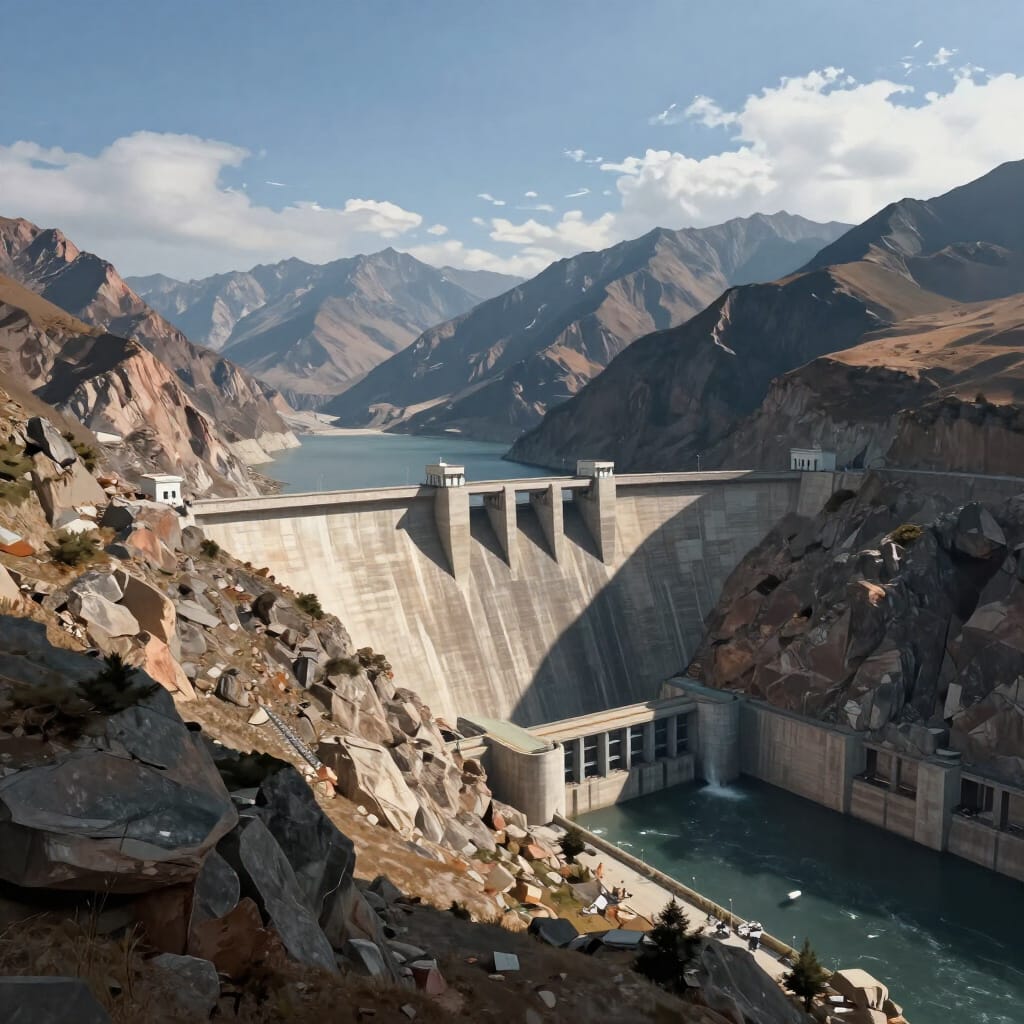
1. The Nepali Paradox: A Nation Drowning in Opportunity
Nepal's geography is unique: the highest mountains on Earth, holding the largest freshwater reserve outside the poles, feeding rivers that cascade through some of the steepest terrain on the planet. Yet the nation remains energy-poor, importing fossil fuels while its rivers flood and its glacial lakes swell to bursting.
The paradox is stark:
Water-rich, energy-poor: Nepal has approximately 83,000 MW of technical hydroelectric potential, of which more than 40,000 MW is commercially viable. Yet as of 2025, only 3,435 MW is installed, less than 10% of the viable potential.
Flood-prone, drought-vulnerable: The same monsoon that brings destructive floods in summer leaves rivers depleted in winter, creating seasonal power shortages that force the nation to import expensive fossil fuels.
Glacially endowed, GLOF-threatened: The Himalayas are warming at three times the global average. Glacial lakes are expanding rapidly, with the combined additional water volume stored across just four dangerous lakes since 1992 approaching 608.6 million cubic meters. Ice loss rates in the Hindu Kush Himalaya region have doubled since 2000.
Geographically blessed, economically constrained: Nepal sits between the world's two most populous nations, India and China, yet its infrastructure has not kept pace with its potential.
The tragedy is that Nepal's greatest challenge, the water that falls from its mountains and melts from its glaciers, is also its greatest opportunity. The same water that drowns villages in summer could power them in winter. The same floods that destroy bridges could generate the revenue to build new ones. The same glacial lakes that threaten to burst could be drained safely, generating electricity and saving lives simultaneously.
2. Climate Change Is Here. It Will Not Leave.
The question is no longer whether climate change is real. The question is whether we will adapt proactively or continue to react with grief and relief funds.
The evidence is overwhelming:
Glaciers across the Hindu Kush Himalaya are melting at an accelerating rate, with ice loss rates doubling since 2000.
Glacial lakes in the Himalayan regions are expanding rapidly under ongoing climate change, intensifying the risk of Glacial Lake Outburst Floods (GLOFs).
Well-documented glaciers such as Imja and Gangapurna show accelerating retreat rates and significant reductions in area and length.
The risk of GLOFs is increasing due to the effects of global warming, with simulations showing a significant decrease in the stability of moraines over several decades.
The human cost is unbearable. When a glacial lake bursts, it releases a wall of water up to four stories high, scouring valleys, wiping out villages, and killing thousands in minutes. The people who die are not casualties of nature, they are casualties of our collective failure to adapt. They are casualties of a global mindset that treats climate change as a future problem rather than a present emergency.
But here is the truth that changes everything: The same water that kills can also heal. The same melt that threatens can also power. The same floods that destroy can also build. The difference is not the water, it is how we choose to meet it.
"Water is a blessing. When it seems a curse, it is because we are not respecting the blessing."
3. The Vision: A Proactive Water-Energy-Economy System for Nepal
The solution is not to build bigger dams or higher walls. The solution is to manage the water where it falls, store the energy when it flows, and sell the value where it is needed.
3.1 The Core Principle: Drain Before They Burst
Nepal has 2,323 glacial lakes, with 21 considered potentially dangerous. Instead of waiting for them to burst, we drain them proactively, keeping water levels at 50-60% capacity year-round. When a sudden melt spike occurs, the lake has buffer capacity. The drained water feeds into the aqueduct network, generating revenue instead of destruction.
This is not speculation. The UNDP and Green Climate Fund have already allocated $36.1 million for controlled drainage of high-risk lakes. The system scales this principle across all 21 dangerous lakes, turning a defensive measure into an offensive economic strategy.
3.2 The Gravity Aqueduct Network
The Great Himalayan range captures rainfall and glacial melt that would otherwise flow destructively downstream. From this high-altitude rim, the land falls away toward the Indian plains.
The Roman Principle: For 2,000 years, engineers have known that water can be moved across continents with gradients as shallow as 0.02% (20 cm drop per kilometer). No pumps. No energy cost. Just topography.
The Nepali Application: Build covered, sediment-resistant contour canals at 1,500-2,000 meters elevation along the Himalayan foothills. These aqueducts collect water from dozens of tributaries, concentrate the flow, and deliver it to strategic drop points where the elevation falls 2,000-4,000 meters in a single penstock.
Energy Generation: As the water drops through elevation changes, turbines generate electricity. The energy density per cubic meter of water in Nepal is 10-20 times higher than in flatter terrain.
Sediment Traps: Install settling basins along the aqueduct network to capture silt, rocks, and, critically, placer gold. Studies have found gold concentrations in the Kali Gandaki River of up to 4,240 gold colors per ton of gravel. Primary gold mineralization zones exist in Rolpa district with lodes containing 0.01 to 6.7 ppm gold. The debris removal system becomes a gold recovery operation, and with gold royalty in Nepal at Rs. 100 per gram, this is not a minor side benefit.
3.3 The Hybrid Energy Storage System
The problem with glacial melt and monsoon rain is seasonality. Summer brings a glut of water and power; winter brings drought and scarcity.
The LAES-H2 system solves this:
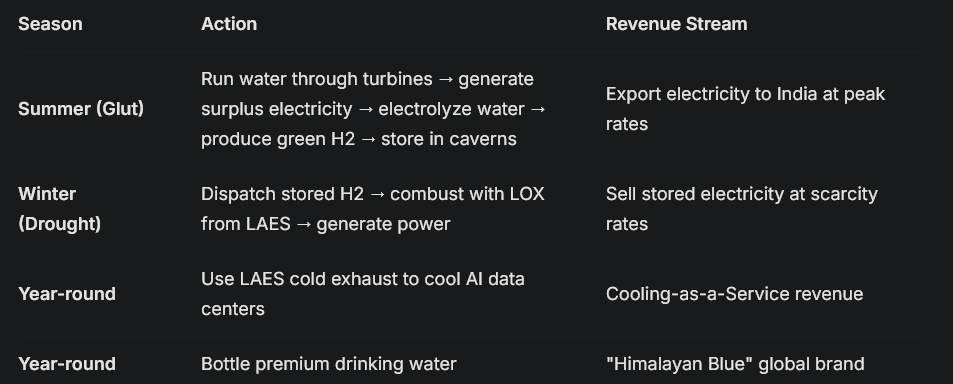
The numbers: Nepal's four major river basins, Mahakali, Karnali, Gandaki, and Koshi, contain 481 km³ of ice reserve. Even a fraction of that meltwater, if routed through turbines and stored as hydrogen, could power Nepal for months without a single drop of rain.
4. The Infrastructure Already Exists
This is not a dream. This is an optimization of what Nepal is already building.
4.1 The Hydro Expansion Is Already Happening
Category Capacity
Installed capacity (2025) 3,435 MW
Under construction 4,063 MW
Awaiting construction 16,029 MW
Total in pipeline 20,092 MW
Major projects underway:
Humla Karnali Second: 335 MW
Lower Arun Hydroelectric Project: 669 MW
Tanahun Hydropower Project: 140 MW (72% physical progress)
Khimti II: 49 MW
Manang Marsyangdi: 135 MW
4.2 The Export Markets Are Already Buying
Nepal already has a proven export market. In fiscal year 2025-26, Nepal earned NPR 29.32 billion from electricity exports to India and Bangladesh, a significant increase from NPR 17.45 billion the previous year.
Peak export capacity reached 1,200 MW to India and 40 MW to Bangladesh
Nepal aims to produce 28,500 MW by 2035 and export 15,000 MW, with 10,000 MW planned for the Indian market
India has already renewed approval for exporting 283 MW of electricity from Nepal
The channel is already open. The system just needs to fill it with more power.
4.3 The Digital Corridors Are Already Being Built
Nepal sits between India and China, and the fiber is already there.
Nepal Telecom and China Telecom Global established a fiber link via Rasuwagadhi, creating umbilical diversity
The Nepal Telecom Authority proposes high-capacity optical links to both India and China, with initial capacity of nx100Gbps, upgradable to nx400Gbps
The goal is to make Nepal a data transit hub between the world's two most populous nations
System integration: The LAES-H2 system's cold exhaust can cool AI server racks at zero additional energy cost, eliminating 30-40% of data center energy costs. Nepal can bypass energy export limitations by converting electrons into data, transmitted globally via optical fiber.
5. The Economics: Turning Water into Wealth
5.1 Direct Revenue Streams
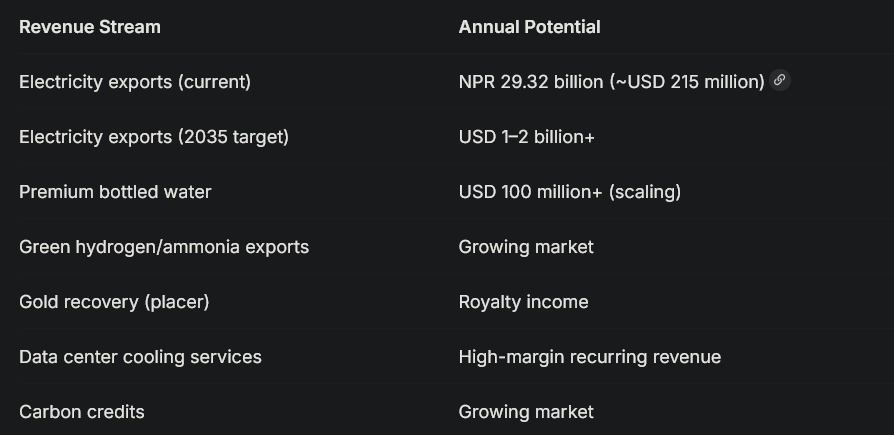
5.2 The Scale of the Opportunity
Nepal's current GDP per capita is approximately USD 1,535. The full development of Nepal's hydro potential, coupled with water exports, hydrogen storage, and data center revenue, could multiply this several times over.
Consider the arithmetic:
83,000 MW of technical hydro potential
40,000 MW commercially viable
Current installed: 3,435 MW
Gap: Over 36,000 MW of commercially viable potential waiting to be tapped
Each 100 MW of hydropower, at an average PPA rate of USD 0.05/kWh, generates approximately USD 44 million in annual revenue. Tapping just 10,000 MW of the gap would generate over USD 4.4 billion annually, more than 10 times Nepal's current electricity export revenue.
5.3 The Multiplier Effect
Unlike fossil fuel exports, which send wealth out of the country, this system keeps wealth within Nepal:
Construction creates tens of thousands of jobs
Operations create permanent skilled employment
Revenue stays in local communities
The system funds its own expansion
6. The Human Value: Honoring the Lost
This paper began with a tragedy, the people who drowned in floods that could have been prevented. Their lives must not be forgotten. Their deaths must not be meaningless.
The system honors them in three ways:
Prevention: Every lake drained safely is a village saved. Every early warning is a family that gets to pack their belongings and move to higher ground. The AI that runs this network is cooled by the very LAES system that stores the energy from the meltwater.
Remembrance: Every village saved becomes a living memorial. Their names are engraved on the aqueduct walls. Their stories are told in the schools. The system is built because of them, not in spite of them.
Redemption: The revenue from the water and power exports funds the education and healthcare of surviving families. The economic value of the lost lives is redeemed through the prosperity of the living.
"We do not want to think those people died without learning coming from it. The problem is human thinking and the lack of adapting to climate change. We want to use the value of their lives to drive awareness."
7. What This Means for Nepal
7.1 Energy Sovereignty
Today, Nepal imports fossil fuels. Tomorrow, Nepal exports clean energy. The shift from importer to exporter transforms Nepal from a client state to a strategic partner, essential to India's and China's energy security.
7.2 Water Security
The same water that threatens to drown Nepal's valleys can irrigate its farms, bottle its prosperity, and quench the thirst of half a billion people downstream. Nepal becomes not just a power exporter but a water exporter, selling life itself.
7.3 Digital Prosperity
With cheap, renewable power and free cooling, Nepal becomes the lowest-cost data center location in Asia. Hyperscalers from India, China, and the world will co-locate their AI infrastructure in Nepal, creating a high-value digital export economy.
7.4 Climate Leadership
Nepal becomes the proof that proactive adaptation works. The nation that was once a victim of climate change becomes its master, showing the world that the same forces that threaten us can also save us.
8. Conclusion: The Only Variable Is Choice
The numbers are clear:
83,000 MW of hydro potential
481 km³ of ice reserve
NPR 29.32 billion in annual export revenue already flowing
20,092 MW already in the pipeline
USD 1,535 GDP per capita ready to multiply
2,323 glacial lakes waiting to be managed
The technology exists. The infrastructure is being built. The markets are already buying. The ice is melting. The rivers are flowing. The gold is in the silt.
The only missing ingredient is the courage to see the water not as a threat, but as the foundation of a new civilization.
Nepal has that courage. It built the first hydro plants in the mountains. It survived earthquakes and civil war. It sits between giants and maintains its sovereignty. It can build this.
The question is not whether Nepal can build the Himalayan Awakening. The question is whether it will choose to.
Because the water is a blessing. And when it seems a curse, it is because we are not respecting the blessing.
Related Papers
Continental Awakening: How Australia Becomes the World's First Circular Economy Superpower
Hybrid Liquid Air and Hydrogen Combustion System for Grid-Scale Energy Storage 2.0
References
Trade.gov. "Nepal - Hydropower, Water Resources, and Renewable Energy." 2026.
Spotlight Nepal. "Nepal's Hydropower as a Strategic Source for South Asia's Clean Energy Transition." 2025.
Rising Nepal Daily. "Construction of 335 MW Humla Karnali second Hydropower Project to proceed." 2025.
Spotlight Nepal. "IBN Has authorized the construction of the 669 MW Lower Arun Hydropower Project." 2025.
The Shillong Times. "Nepal earns record revenue from power exports to India." 2026.
Kathmandu Post. "Nepal records Rs18.76 billion electricity trade surplus." 2026.
ScienceDirect. "Impact of climate change in Nepal across sectors from water-centric perspective." 2026.
EGUsphere. "Multi-Decadal Expansion of Potentially Dangerous Glacial Lakes in Central-Eastern Nepal." 2026.
BBC. "Everest flood warning neglected for years." 2026.
HistorySaid. "Nepal Economy & Growth: Data & Trends." 2026.