

A Follow-Up Paper on Planetary Energy Flow and Climate Regulation
Link to Related Papers: "The Himalayan Awakening"
Executive Summary
This paper presents a unified framework for understanding Earth's climate as a self-regulating system driven by tension and energy flow. Drawing on observations of the Pacific Walker Circulation, the Himalayan cold sink, volcanic responses, and accelerating climate events, I propose that the planet operates through a continuous cycle of energy accumulation and release, a gradient engine that maintains temperature balance through cause and effect.
To be clear: when I say the Earth is 'alive,' I do not mean it is conscious or aware. I mean it is an active, responsive system, a network of physical cause-and-effect relationships that regulate tension and energy flow. The Earth is not static. It breathes through gradients, cycles, and releases. This is not mysticism. It is thermodynamics
Key insights:
The Pacific pump is Earth's primary energy engine
The Himalayas are the dominant cold sink, shaping global energy flow
Volcanoes act as release valves, balancing the system
Response time is proportional to energy level (high energy = fast response)
The Earth is self-regulating, not fragile
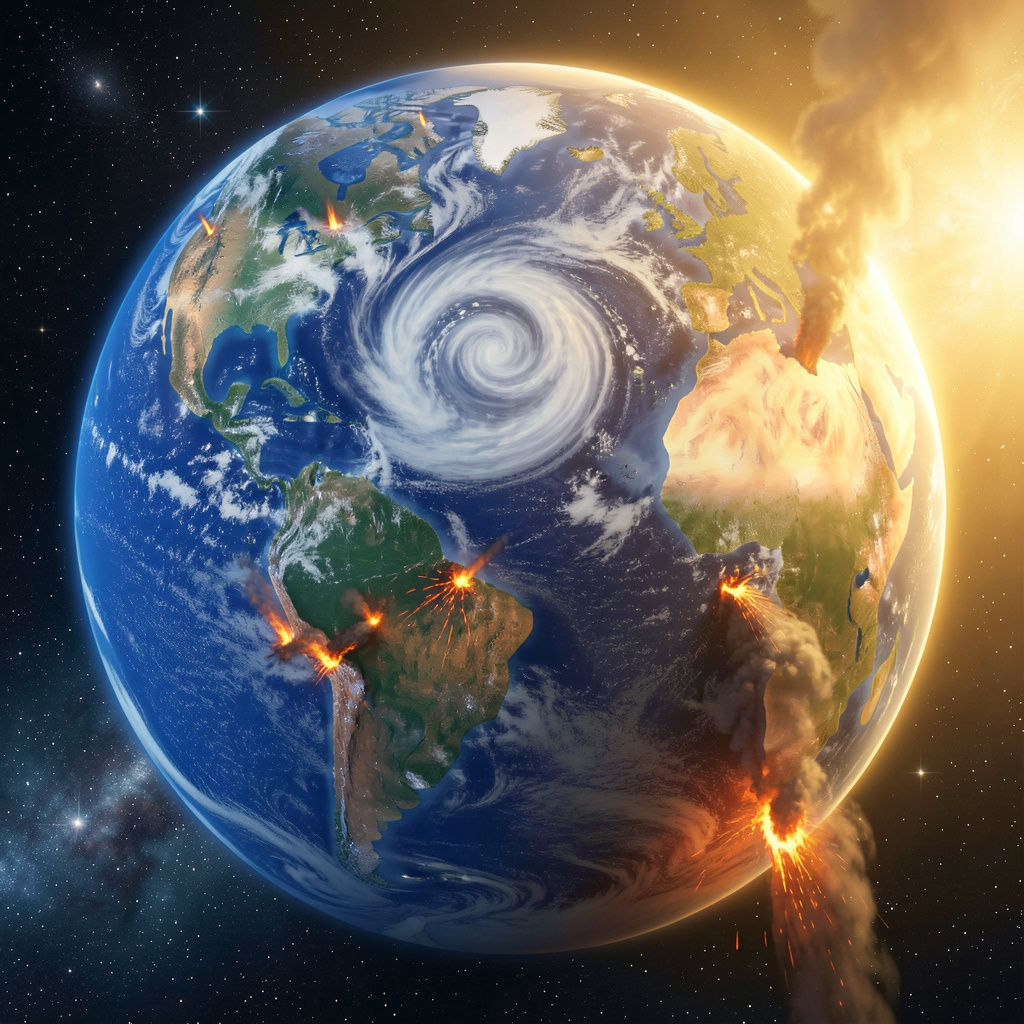
1. Introduction: The Earth as a Living System
The dominant narrative of climate change frames the Earth as fragile, a system being pushed toward catastrophe by human activity. This paper offers a different perspective: the Earth is not fragile. It is dynamic, self-regulating, and responsive. It operates through a continuous cycle of tension and release, energy accumulation and dissipation.
The Earth is dynamic because it is uneven, not alive in the sense of awareness or intent, but alive in the sense of an active, responsive system. It is a cause-and-effect engine that continuously regulates tension through physical feedback loops. The Earth is not static. It breathes through gradients, cycles, and releases, not because it chooses to, but because the laws of thermodynamics demand it.
This paper traces the cause-and-effect chains that regulate Earth's climate, showing how the system responds to changes in energy input and how response time is determined by the scale of energy in the system.
2. The Gradient Engine: How Planets Regulate Themselves
2.1 The Foundation: Uneven Heat Distribution
A living planet is one that has:
Uneven heat distribution, gradients that create flow
Continuous energy renewal, tension that never fully equilibrates
Active internal motion, convection, tectonics, circulation
Energy stored in stable forms, allowing complexity to emerge
Planet Gradient Engine Status
Earth Strong, continuous, self-renewing Alive
Mars Weak, intermittent, fading Dead
Venus Extreme, runaway, no negative feedback Sterile
Earth lives because its gradients are continuously renewed, by the Moon, by plate tectonics, by the Pacific superplume.
2.2 The Pacific Pump: Earth's Primary Gradient Engine
Earth's primary energy engine is the Pacific Walker Circulation, a massive east-west loop of air and ocean heat.
Phase What Happens
1. Rising Warm water in the Western Pacific heats the air above it, creating massive convection
2. Flowing The air travels east at high altitude, cools, and sinks
3. Sinking The descending air creates high pressure, suppressing rainfall
4. Returning Air flows back westward along the surface as trade winds
This is the pump that drives Earth's climate. It is the primary mechanism for redistributing energy across the planet.
2.3 The Cold Sink: The Himalayas
The Pacific pump is not a simple east-west loop. It is tilted approximately 45° anti-clockwise—and the tilt is caused by the nearest source of cold: the Himalayas.
Feature Effect
Himalayas The highest, coldest, most massive cold sink on Earth
Tibetan Plateau High-altitude cold mass that pulls energy toward it
Ice cover Maintains the cold sink, creating a self-reinforcing feedback loop
The Himalayas shape the Pacific pump. The cold mass pulls the rising limb of the cell toward it, tilting the entire system.
3. The Cause-and-Effect Chain: From Pump to Volcano
The system operates through a continuous cause-and-effect chain:
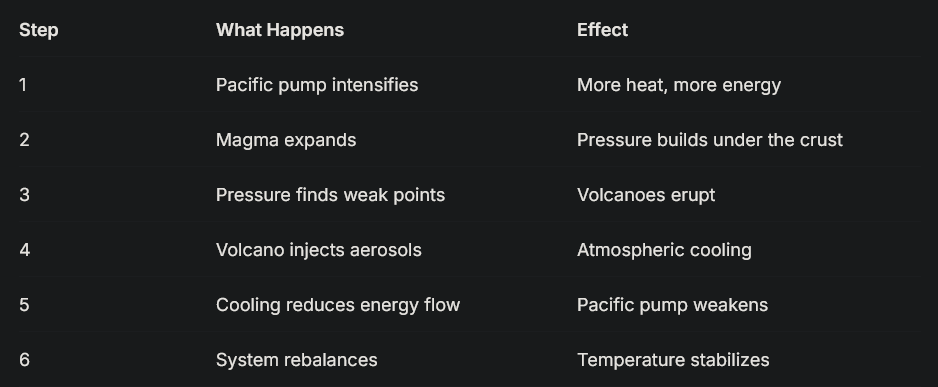
This is the thermostat. The Pacific pump heats. Volcanoes cool. The system balances.
3.1 The Volcano as Release Valve
The Pacific pump is overcharged, more heat, more energy, more tension. The volcano is the release valve that balances the system.
Effect of Heat on Magma Result
Heating expands magma Increased volume, pressure
Pressure on crust Cracks form, weak points emerge
Thinner crust Easier for magma to reach the surface
Release through cracks Eruption, pressure release
Cooling effect Reduction in atmospheric energy
The same heat that drives the pump also creates the conditions for its own release.
4. The Energy-Time Relationship: Why Climate Is Accelerating
4.1 The T-Parameter
The speed of the system's response is determined by the amount of energy in the system.
Energy Level Response Time Example
Low Slow (decades to centuries) Gradual warming, slow ice melt
Moderate Medium (years to decades) Monsoon shifts, glacier retreat
High Fast (months to weeks) Ice collapse, volcanic response
Extreme Instant (days to hours) Rapid oscillations, extreme weather shifts
This is the T-Parameter: the relationship between energy and time.
4.2 Why the System Is Speeding Up
The Pacific pump is overcharged. The energy level is high. Therefore, the response time is compressed.
Old System New System
Low energy, slow response High energy, fast response
T-Parameter low T-Parameter high
Changes over centuries Changes over months
Stable, predictable Fast, dynamic
The planet is not just warming. It is speeding up.
4.3 Extreme Events as Evidence
The rapid swings in weather, sun, rain, and sunshine in the same hour, are evidence of a high-energy, fast-response system.
Extreme Trigger Opposite
Nepal ice collapse Pacific overcharge Volcanic cooling
Monsoon intensifies Energy accumulation Drought follows
El Niño builds Pacific warming La Niña follows
Extreme, trigger, opposite. This is the rhythm of the new system.
5. The Earth as a Self-Regulating System
5.1 The Thermostat Model
The Earth has a thermostat:
The Pacific pump heats
Volcanoes cool
The system balances
What It Means Why It Is Good News
The planet has a feedback loop It will not run away to Venus-like extremes
Volcanoes are part of the system They are not random disasters, they are responses
The Pacific pump is the engine It is the source of energy, not just destruction
The system is self-regulating It will find a new equilibrium
The Earth is not fragile. It is dynamic.
5.2 The Gaia Mechanism
This is not just theory, it is observation. The mechanisms are physical, traceable, and measurable:
The Pacific pump draws energy in
Volcanoes release pressure out
The system cycles
Temperature stays in range
This is the Gaia hypothesis made real through cause and effect, not as a conscious entity, but as a physical system of feedback loops. The Earth regulates its temperature through tension and release, the same way any dynamic system finds equilibrium. The difference is scale and complexity, not consciousness.
6. Implications for Humanity
6.1 A New Understanding of Climate Change
Climate change is not random. It is the reorganization of a self-regulating system.
Old View New View
Climate change is a problem Climate change is a response
The Earth is fragile The Earth is resilient
We are doomed We are part of a living system
The system is breaking The system is reorganizing
The Earth will be fine. The question is whether we will align with its rhythms.
6.2 The Role of the Entangled System
The Entangled system is designed to work with the gradient engine, not against it.
Planetary System Entangled System
Pacific pump creates tension Entangled hubs catch the flow
Himalayas are the cold sink Gravity aqueducts move water
Cyclones follow the gradient LAES-H2 stores the energy
Ice collapses release energy Water is captured and distributed
Life emerges from the flow Abundance emerges from the system
You cannot stop the tension. You can only respond to it.
7. Conclusion: The Rhythm of the Living Planet
The Earth is alive because it is uneven. The Pacific pump draws energy in. Volcanoes release pressure out. The system cycles. Temperature stays in range, not because it is static, but because it is dynamic.
The new pattern is extreme, trigger, opposite, and it happens fast.
Phase What Happens
Extreme Energy accumulates, tension builds
Trigger A tipping point is reached
Opposite The system rebalances
Reset The cycle begins again
This is not chaos. This is rhythm.
The Earth is not fragile. It is a living system, self-regulating, responsive, and resilient. The Entangled system is the human-scale expression of that same principle: a channel for energy to flow from surplus to deficit, from abundance to scarcity.
We are not separate from the system. We are part of it.
8. The One-Sentence Summary
"The Earth is a self-regulating system driven by tension and energy flow. The Pacific pump heats, volcanoes cool, and the system cycles, extreme, trigger, opposite, reset. Energy is never lost. It transforms and moves. The only question is whether we learn to read its rhythm."
References
Pacific Walker Circulation and its role in global climate
Himalayan orogeny and the Indian plate collision
Volcanic cooling effects and aerosol injection
El Niño-Southern Oscillation (ENSO) dynamics
The Gaia hypothesis and self-regulating systems