

Abstract
This paper presents a general model of connection based on a single principle: everything that connects has a boundary skin, and the boundary skin defines the interaction between two systems. The model originated in the study of weather systems, specifically the sea/air interface, and was extended by pattern-matching across physical, biological, neural, and social systems. The central claim is that life is the densest known array of boundary interfaces, and that complexity is best measured by the number and type of boundary interfaces a system contains. The model is recursive: boundaries are themselves gradients of permeability, and the same structure appears at every scale.
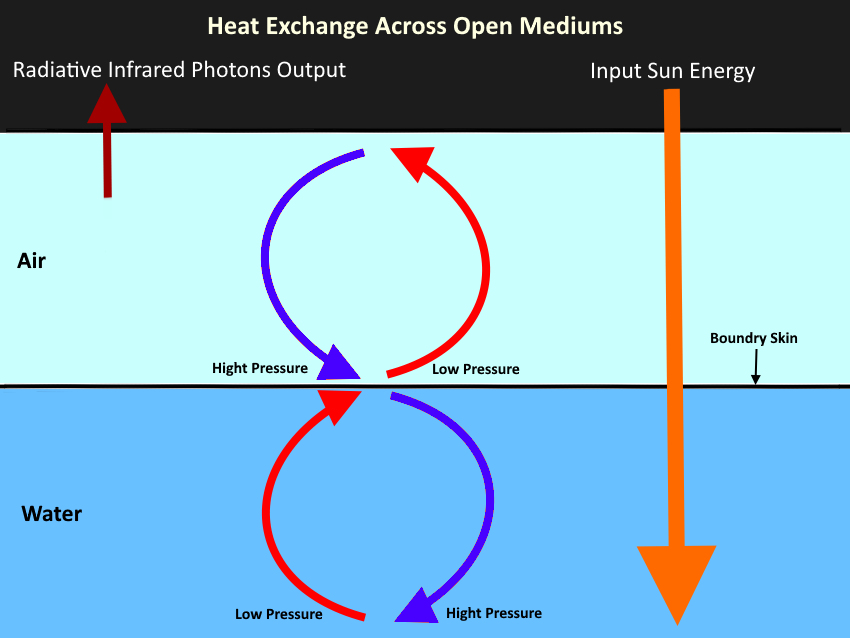
I was researching weather, when I started to get the idea of boundary interface and how cool they are.
1. Origin
The model was built from observing the weather system. In a fluid atmosphere-ocean system, the following is directly visible:
Heat is the only active energy; "cold" is the absence of energy, a sink.
Convection is driven by density differences, which are driven by heat.
Pressure is a secondary effect of that motion, not the primary driver.
At the sea/air interface, warm water rises (surface convergence) and heat crosses into the air, where warm air rises (surface low). The high-pressure point of the water is the low-pressure point of the air, the two are coupled across the boundary.
This last observation is the seed of the model: the boundary is where the two systems meet, and the coupling across it is the interaction. Everything that follows is the extension of that observation to other media.
2. Core Principles
2.1 The gradient
A gradient is a tension between two poles: a source (+) and an absence (−). Energy and matter flow from source toward absence. This is the driving condition of any interaction. "Cold" is not an energy; it is the absence end of a thermal gradient. Flow is always from source to absence.
2.2 The boundary skin
Every connection between two systems has a boundary skin (|). The boundary defines the interaction. A boundary that passes nothing is not a boundary, it is a wall, and walls are not part of open systems. Therefore every boundary in an open system is, by its nature, permeable to something. The question is always: what crosses, and is the gate open?
2.3 The gate
The boundary is not a binary open/closed switch. It is a gate with variable permeability. The gate state determines whether the interaction occurs and what type it is. The gate is the mechanism; the gradient is the driving condition.
2.4 Selective permeability (the filter)
A boundary can be permeable to some things and not others. At the water-air skin, heat crosses but water molecules do not. Cell membranes pass some ions and not others. This is the filter type, and it is the most common boundary behavior in complex systems.
2.5 Recursion
The boundary is itself a gradient, a gradient of permeability. The same structure that describes the system (gradient → flow) describes the boundary (permeability gradient → selective flow). The model is self-similar: the same pattern appears at every level.
3. The Interface Typology
The model identifies four boundary interface types, defined by the gate state and the nature of the poles:
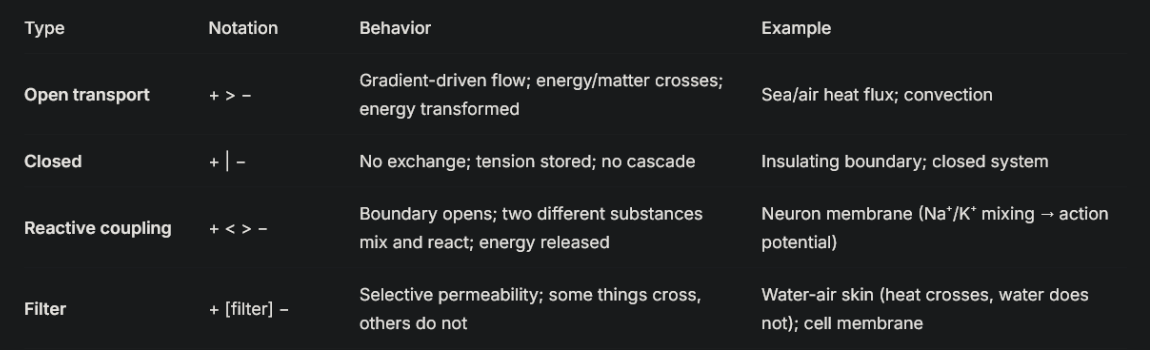
The distinction between open transport and reactive coupling is important: in transport, the two poles are the same substance at different levels (hot/cold, high/low pressure). In reaction, the two poles are different substances that combine. The discriminator is whether the poles are the same thing at different levels, or different things that react.
4. Complexity as Interface Count
Complexity is the number and type of boundary interfaces in a system.
A pile of sand has many parts and low complexity because the parts barely interact. A cell has fewer parts and enormous complexity because every part has a boundary interface with every other part. The interfaces are where information and energy flow, so the interface count and type are a better measure of complexity than the component count.
This gives a definition of complexity growth: complexity increases as new boundary interfaces form. The history of the universe is the history of interface formation: particles → atoms → molecules → cells → organisms → societies. Each new layer of boundaries creates new interaction types and new cascade modes.
5. The Syntropic Narrative
In the beginning, there was matter. The universe gave it shape by rearranging it into connected systems, adding more and more boundary skins, more and more complexity, until here we are.
This is the syntropic account: structure forms by connection, and connection is interface formation. The universe is not finished; it is still growing complexity by adding interfaces. The q-bridge hypothesis (Section 7) is the proposed memory layer of this process.
6. The Recursive Structure
The model is recursive in three ways:
The boundary is a gradient. Permeability is continuous, not binary. The boundary is a gradient of permeability, and the gradient determines the flow across it.
The pattern repeats across scales. The sea/air interface, the neuron membrane, the chromosome interface, the social boundary, and the observer effect all follow the same formula: two poles, a boundary, a gate, a cascade.
Persistence varies by medium. Interfaces can be persistent (DNA, institutions, the hypothesized q-bridge) or volatile (matter states, weather, market prices, water-as-solvent). Persistent interfaces show path-dependence; volatile ones show rapid adaptation.
7. Validation Cases
The model has been applied to the following anchored cases:
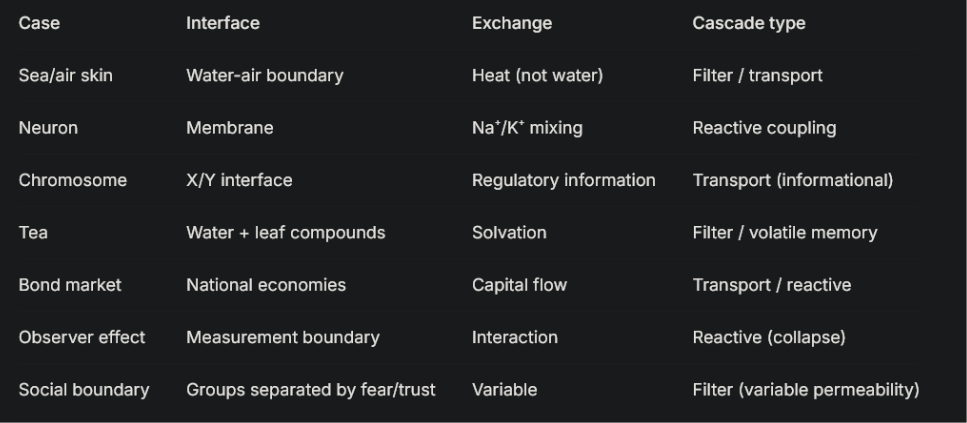
The reverse test (searching for cases that do not fit) found the model is broad by design; the genuine limits are at the purely informational/structural edge (logical implication without energy/matter exchange) and at the entanglement case, where the boundary is hypothesized rather than observed.
8. Limits and Open Questions
The cost/pull function is unspecified. The model says "the pull must exceed the cost," but the units of cost are not defined. This is the main gap between Stage 1 and Stage 2.
The q-bridge is speculative. It is a coherent framework, not a tested mechanism. It needs a prediction that differs from standard physics.
The model is broad by design. A general theory of connection should absorb most cases. The application test is whether it specifies the boundary, the exchange, and the cascade type correctly for each case, not whether it can find a case it doesn't cover.
Purely informational coupling (logical implication, mathematical constraint) is the edge case where the model is weakest.
9. Conclusion
The Boundary Interface Model proposes that life is a boundary interface array, and that complexity is the number and type of boundary interfaces in a system. The model is recursive: the boundary is itself a gradient of permeability, and the same structure appears at every scale, from the sea/air skin to the neuron membrane to the social boundary to the observer effect.
The model originated in weather and was extended by syntropic pattern-matching. It is a Stage 1 framework: coherent, anchored to real cases, and generative. Its next step is application, specifying the boundary, the exchange, and the cascade type for each case, and testing whether the predictions hold.
One line: Everything that connects has a boundary skin, and the boundary skin defines the interaction. Life is the densest known array of boundary interfaces. Complexity is the count.