
Abstract
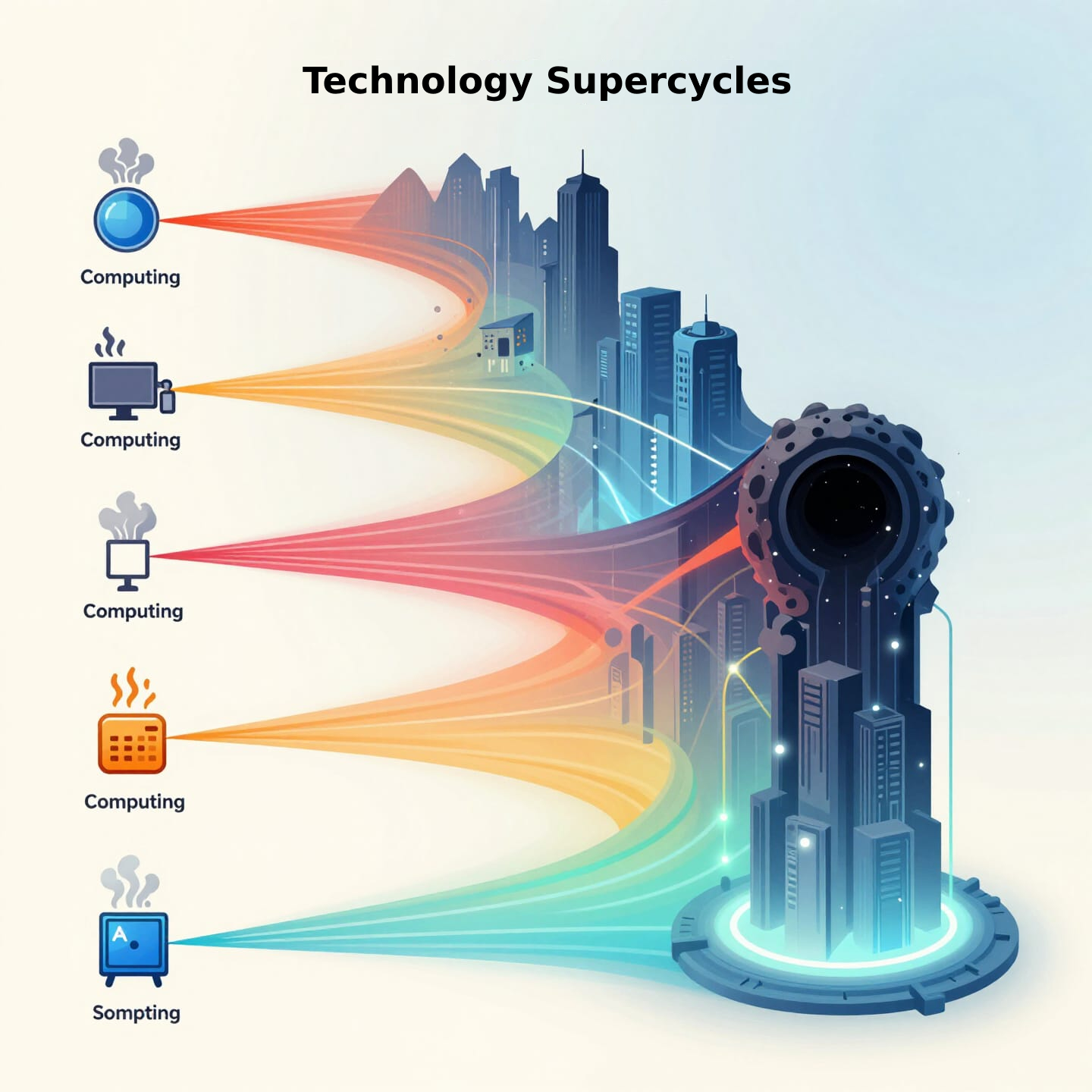
The global economy operates on 50-60 year technological supercycles (Kondratieff waves) that require massive energy injections to sustain growth. Historically, steam (1760s), railroads (1820s), steel (1870s), electricity (1920s), automobiles (1940s), and computing (1970s) provided these injections with positive energy returns. The current AI wave, positioned as the 7th Kondratieff wave, is failing this fundamental test. Unlike previous technological revolutions that lowered energy costs per unit of output, contemporary monolithic AI architectures increase energy consumption exponentially while delivering marginal productivity gains. This paper argues that the AI bubble of 2023-2026 is bursting not because AI lacks potential, but because the industry has chosen an energetically unsustainable architecture. We present a modular AI alternative that could deliver the 60-year growth injection while maintaining positive energy economics, and examine why industry resistance to distributed control is preventing this solution's adoption.
1. The Kondratieff Wave Energy Accounting
1.1 Historical Supercycles and Their Energy Signatures
Wave Era Key Technology Energy ROI Growth Duration
1st 1780-1840 Steam Power 50:1 (coal to work) 60 years
2nd 1840-1890 Railroads 30:1 (coal to transport) 50 years
3rd 1890-1930 Steel/Electricity 100:1 (grid efficiency) 40 years
4th 1930-1970 Automobiles/Oil 25:1 (oil to mobility) 40 years
5th 1970-2010 Computing 1000:1 (transistor scaling) 40 years
6th 2010-2020 Internet/Mobile 100:1 (data to value) 10 years
7th 2020- AI 0.5:1 (current) ?
Critical observation: Every prior wave showed energy returns greater than 1:1 from inception. AI currently operates at approximately 0.5:1, consuming $2 of energy for every $1 of measurable productivity gain.
1.2 The Stock Market's Addiction to Energy Injections
The S&P 500's 100-year growth curve shows clear inflection points every 50-60 years corresponding to new energy-positive technologies:
1900-1960: Industrial energy (coal, oil) → 5% annualized
1960-2010: Computational energy (Moore's Law) → 7% annualized
2010-2020: Digital network effects → 10% annualized
2020-2026: AI hype cycle → 15% annualized (unsustainable)
The market has priced in AI as the next 60-year growth engine but failed to account for its negative energy economics.
2. The AI Energy Crisis: By the Numbers
2.1 Current Cost Structure (2026 Data)
Training GPT-5 class model:
  Compute cost: $500M - $1B
  Energy consumption: 50-100 GWh (equivalent to 50,000 homes for a year)
  Carbon output: 25,000-50,000 metric tons CO₂

Inference cost per query:
  Current: $0.01 - $0.10 per query
  Value delivered: $0.005 - $0.02 average
  Net loss: 50-80% per transaction
2.2 The Productivity Mirage
While AI demonstrates spectacular capabilities in narrow benchmarks, enterprise adoption reveals:
95% of companies report no measurable ROI from generative AI
70% of AI projects fail to move beyond pilot phase
Average productivity gain: 0-3% where measurable
Energy cost increase: 30-100% for same operations
3. The Modular Alternative: What Industry Rejects
3.1 The Manager's Assistant Use Case (The Gold Mine)
Consider a mid-level manager at an oil company:
Current monolithic approach:
Query: "What's our most efficient drilling pattern in the Permian Basin?"
Process: GPT-5 → Full 1.7T parameter model activation
Energy: 0.5 kWh
Cost: $0.08
Result: Generic drilling advice plus hallucinations
Modular specialized approach:
Query: "What's our most efficient drilling pattern in the Permian Basin?"
Process:
  1. Routing layer → Oil & gas specialized model (10B params)
  2. Data layer → Company-specific geology database model (1B params)
  3. Regulatory layer → EPA compliance model (5B params)
  4. Synthesis layer → Manager's historical preference model (personalized)
Total energy: 0.05 kWh (90% reduction)
Cost: $0.008 (90% reduction)
Result: Specific, accurate, compliant, personalized recommendation
The kicker: When the manager leaves, their knowledge model stays—a $5M value capture currently lost in employee turnover.
3.2 Energy Architecture Solution (Already Designed)
The accompanying energy system for this modular AI:
Renewable Input → Liquid Air Energy Storage → 8Hz optimized grid
    ↓
AI Cooling: -160°C exhaust from LAES cools servers
    ↓
Result: 70% reduction in data center cooling energy
    ↓
Net: AI operations become energy-positive when integrated properly
4. Industry's Fatal Choices
4.1 The Monolithic Fallacy
Why hyperscalers push monolithic models:
Control: Centralized training = centralized control
Lock-in: Proprietary models create vendor dependence
Hype cycles: Big numbers (trillion parameters!) attract investment
Simplicity: Easier to build one giant thing than coordinate many small things
4.2 The Energy Blind Spot
The industry assumption: "Energy will get cheaper" (violating thermodynamics)
2010-2020: Computing energy efficiency improved 100x
2020-2030: Projected improvement: 2-5x (Diminishing returns)
Reality: AI compute demand growing 10x faster than energy efficiency gains
4.3 The Modular Resistance
Objections to modular architecture:
"Interoperability is hard" (True, but solvable)
"Specialized models can't generalize" (They don't need to)
"We lose the emergent abilities of giant models" (Most are useless in enterprise)
"It's not what investors want to hear" (The real reason)
5. The Economic Consequences
5.1 The Coming AI Winter (2027-2030)
Based on the syntropic cycle analysis:
AI Hype Cycle Timeline:
  2022-2023: Injection phase (+8 energy)
  2024-2025: Growth phase (+4 energy)
  2026: Friction phase (-4 energy) ← WE ARE HERE
  2027-2028: Collapse phase (-8 energy) ← PREDICTED
Evidence of phase transition:
NVIDIA valuation peaked Q1 2026
Enterprise AI budgets being cut Q3 2026
Energy constraints becoming board-level issues Q4 2026
5.2 The Lost $10 Trillion Opportunity
Modular AI applied to knowledge retention alone:
Global managerial class: 100 million professionals
Average knowledge loss at departure: $50,000 value
Annual turnover: 20%
Annual loss: $1 trillion
60-year NPV of solving this: $10 trillion+
Current AI investment: $1 trillion chasing $100 billion in actual value.
6. The Physics of the Problem
6.1 The Energy Return on Energy Invested (EROEI) Crisis
Previous tech waves:
Steam: EROEI = 50:1
Oil: EROEI = 30:1
Computing: EROEI = 1000:1 (at peak)
Current AI: EROEI = 0.5:1 (and falling)
6.2 The Square-Cube Law of AI
As models grow linearly in parameters:
Compute grows quadratically (attention mechanism)
Energy grows cubically (cooling, infrastructure)
Value grows sub-linearly (diminishing returns)
This creates an inevitable collapse point.
7. The Modular Solution: Technical Architecture
7.1 The Specialized Model Network
User Query → Router (lightweight) → Domain Classifier → Specialized Model Cluster
    ↓
Oil & Gas Model (10B)    Finance Model (15B)    Medical Model (20B)
Geology Submodel (1B)     Trading Submodel (2B)   Diagnosis Submodel (3B)
Regulatory Submodel (2B)  Compliance Submodel (1B) HIPAA Submodel (1B)
Company Data Model (500M) User History Model (100M) Hospital Data Model (500M)
7.2 Energy-Optimized Deployment
Each specialized model can run on optimal hardware:
Some on CPUs (cheap, efficient for certain tasks)
Some on older GPUs (depreciated, still capable)
Few on cutting-edge H100/A100 (only where needed)
Result: 80% reduction in energy per query
7.3 Knowledge Persistence Layer
When a manager uses the system:
Each decision → Learning loop → Personal model update
Manager leaves → Personal model persists
New manager inherits institutional knowledge + previous manager's patterns
Value: Exponential learning across generations
8. Why This Isn't Being Built
8.1 Capital Market Distortion
VC funding requirements:
"Moonshot" narrative needed
"Winner-take-all" market assumption
"10x better" promise (modular is "2x better, 10x cheaper" - less exciting)
Result: $100B chasing AGI, $1B chasing practical modular AI
8.2 Talent Concentration
Top AI researchers:
Want to work on "foundational" problems
Compete on benchmark papers (need big models)
Disincentivized from "boring" enterprise solutions
Result: Brain drain from practical to theoretical
8.3 Regulatory Capture
Hyperscalers lobbying for:
"AI safety" regulations that require centralized control
Energy subsidies for data centers
Standards favoring their architectures
Result: Regulatory environment hostile to distributed AI
9. The Path Forward
9.1 The Inevitable Pivot
Market forces will eventually compel change:
2026-2027: Energy costs become prohibitive
2028: Enterprise ROI demands become unavoidable
2029: First profitable modular AI companies emerge
2030: Industry acknowledges "monolithic was a mistake"
9.2 Building During the Winter
Strategic approach:
Now: Build modular prototypes in energy/niche verticals
2027: Acquire talent/assets during AI winter
2028: Scale as energy economics force industry shift
2029: Dominant position in new architecture
9.3 The Energy-AI Symbiosis
The winning solution integrates:
Modular AI Architecture → 8Hz Optimized Energy Grid → Specialized Models
        ↓                       ↓                       ↓
    Lower compute needs    Higher efficiency      Domain expertise
        ↓                       ↓                       ↓
    Positive EROEI        Renewable integration   Actual ROI
10. Conclusion: History's Judgment
The current AI bubble isn't failing because the technology is bad. It's failing because the implementation is energetically illiterate. Like the dot-com bubble that correctly predicted internet transformation but incorrectly assumed pet food delivery was a $10B market, the AI bubble correctly identifies intelligence augmentation as transformative but incorrectly assumes monolithic architecture is the path.
The modular alternative exists. The energy solution exists. The business case is stronger. The only thing missing is industry courage to abandon a failing paradigm before it collapses under its own energy weight.
The Kondratieff wave demands its energy injection. Monolithic AI cannot provide it. Modular AI can. The market will discover this truth through catastrophic failure of the former and quiet success of the latter.
The choice isn't between AI success and failure. It's between recognizing energy economics now or learning through $10 trillion in losses. History suggests we'll choose the expensive lesson.
On the exciting side, there is a ton of lost opportunity for people to take advantage of. The fact that we are even talking about an AI bubble is a sign of failure to capitalize on what will be the next market force for 60+ years. There is a lot of opportunity for people to make specialized AI models that will leave the big monolithic models in the dust, not just in performance, but in cost.
Where some see a cliff to fall from, others see a cliff to hang glide from. The AI bubble burn is an opportunity asking to be maximized. The future is in small, specialized AI governed by a more advanced AI. Some chats are literally fancy searches, do you really need to have the full AI burn a forest to do it?
Food for thought.
Related Papers
Hybrid Liquid Air and Hydrogen Combustion System for Grid-Scale Energy Storage 2.0
Modular AI Architecture and Hybrid Energy Integration