

Why English must abandon its historical chaos and embrace phonemic consistency

1. The Problem: English spelling is a fossil
English is a living language, it grows, borrows, shifts pronunciation, and adapts to new uses. Yet its spelling system is essentially frozen in the 15th century, just after the printing press arrived and just before the Great Vowel Shift changed how nearly every word was pronounced.
The result? A child or second‑language learner sees through, though, tough, thought, cough, thorough and must memorise six different pronunciations for the same letter sequence “-ough”. A computer cannot reliably predict sound from spelling. Dyslexic readers face an unnecessary maze.
English spelling is not a reliable guide to pronunciation; it is a museum of dead sounds, borrowed spellings, and random historical accidents.
2. The Cost of Inconsistency
Education: English‑speaking children take 2–3 years longer to learn basic literacy than children learning languages with consistent spelling (e.g., Finnish, Italian, Korean).
Dyslexia: Inconsistent sound‑to‑letter mappings make English particularly challenging; consistent spelling would reduce cognitive load.
Global communication: Over 1.5 billion people speak or learn English. Most will never master its chaotic spelling. A simpler system would democratise access.
Technology: Text‑to‑speech, speech recognition, and language models waste resources handling irregular spellings that serve no purpose.
3. The Solution: One sound, one spelling
We propose a phonemic spelling system for English:
Every phoneme (distinct sound) has exactly one written form.
No silent letters.
No double or alternate spellings for the same sound.
Foreign loanwords are respelled phonetically when adopted.
This is not new. Many languages have done exactly this: Turkish, Finnish, Serbian, and Korean (Hangul) all reformed or created writing systems to match speech. English can do the same.
4. Objections and Answers
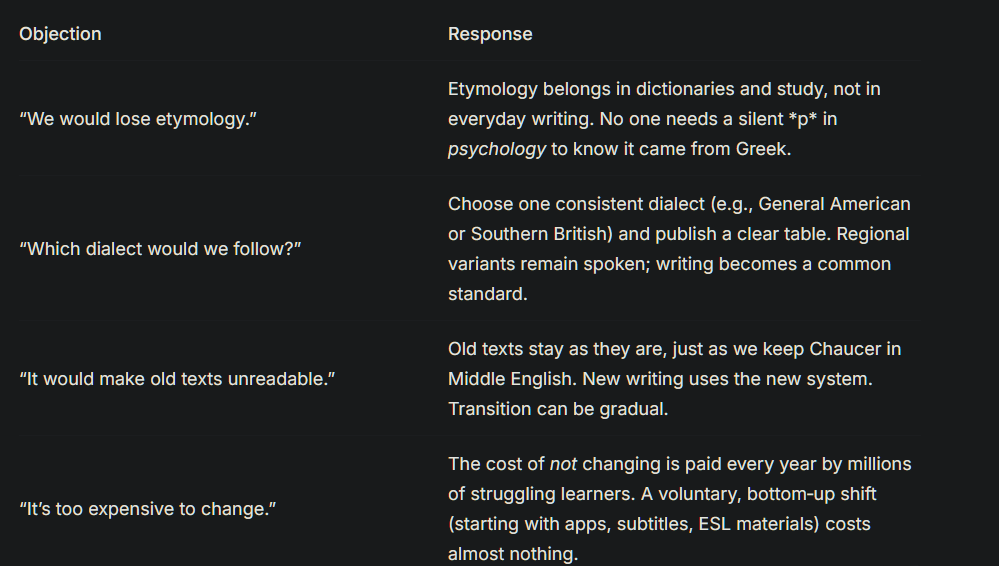
5. A Concrete Example
Current spelling:
Though I walked through the rough neighbourhood, I thought I knew the way to the beach.
Proposed phonemic spelling (Scottish/US base):
Tho ie wookt thru dhe ruf naybuhruud, ie thot ie nuu dhe way tuu dhe beech.
Every letter represents a sound. A learner reads exactly what they say. No guessing.
6. Why Now?
English is no longer the property of England or America. It is the world’s lingua franca. A spelling system that requires years of rote memorisation is a barrier to equity and opportunity. As a living language, English has always changed, vocabulary, grammar, pronunciation. Spelling is the last holdout.
The printing press froze spelling in the 1500s. The internet can unfreeze it. We have the tools: Unicode, digital dictionaries, automated converters, and a global community ready for simplicity.
7. Call to Action
We do not ask for a government mandate. We ask for voluntary adoption in specific domains:
Phonics workbooks for children
ESL teaching materials
Machine‑generated captions and subtitles
Informal digital communication (where people already write thru, nite, luv)
From there, a new generation can grow up with spelling that makes sense. Within a generation, the old chaos becomes a historical curiosity.
English deserves a spelling system as intelligent as its speakers. Let us build it.
“Simplicity is the ultimate sophistication.” - often attributed to Leonardo da Vinci (but even that quote’s origin is messy - just like English spelling).