

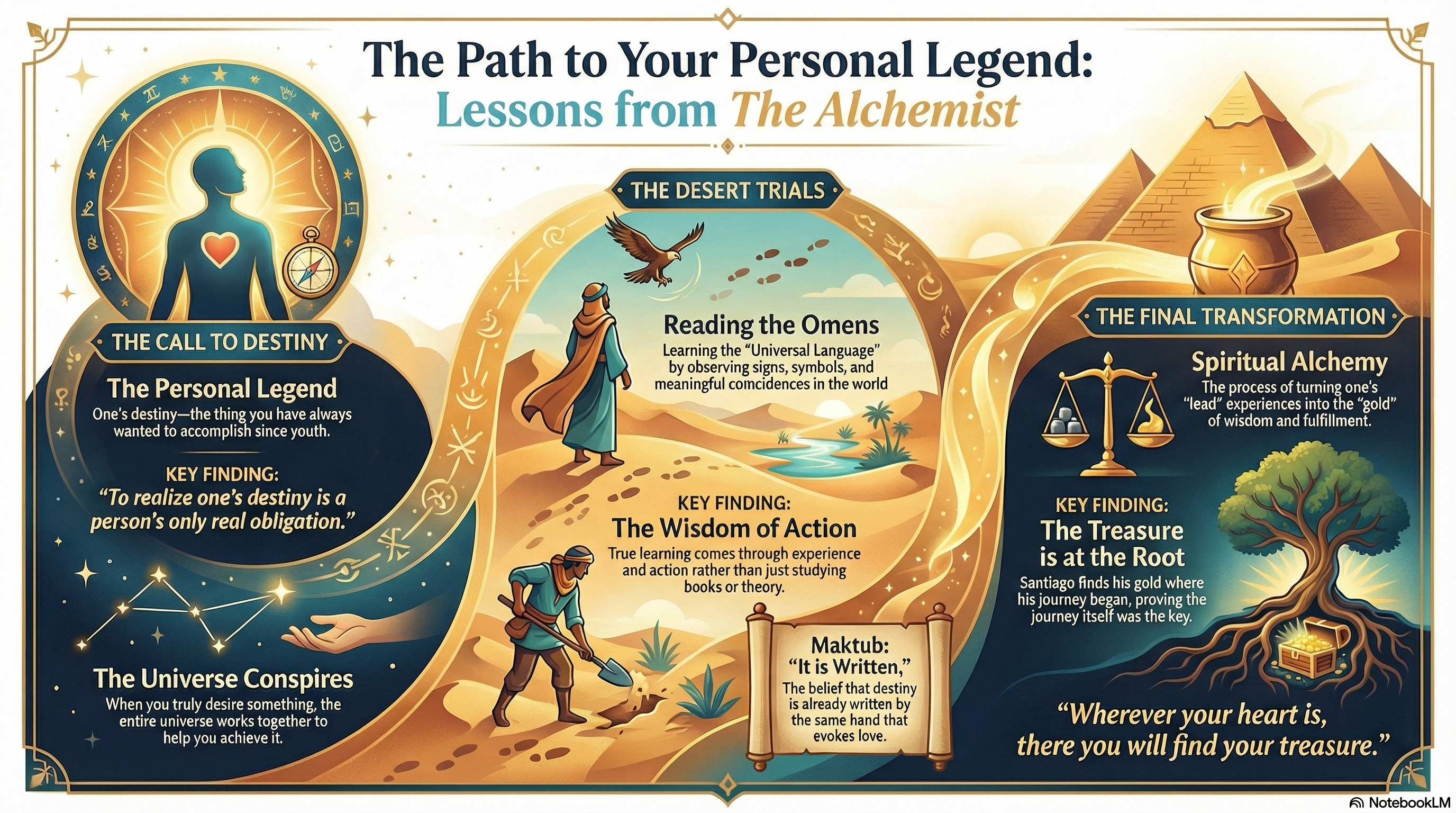
Beyond the Pyramids: 5 Counter-Intuitive Lessons from The Alchemist on Finding Your Way
1. The Shepherd’s Dilemma
Security is the most seductive form of stagnation. We often mistake the comfort of a known routine for a life well-lived, clinging to the safety of our own "flocks" because the alternative demands a terrifying degree of agency. Stagnation is a quiet desperation, a slow erosion of the self that occurs when we prioritize certainty over the calling of our own potential.
In Paulo Coelho’s The Alchemist, this tension is personified in Santiago, a young Andalusian shepherd. His journey begins not with a grand ambition, but with a recurring dream of treasure at the Egyptian Pyramids—a dream that disrupts his content, if narrow, life. Santiago’s quest is a search for his "Personal Legend," Coelho’s term for one’s true destiny. Yet, the wisdom of this fable isn't found in the gold at the end; it is found in the paradoxes encountered along the way. To find our path, we must first unlearn the logic of the crowd.
2. The Illusion of Fate and the "World’s Greatest Lie"
Early in his travels, Santiago meets Melchizedek, the King of Salem, who identifies the primary psychological barrier to personal growth: the belief that our lives are dictated by external forces. Melchizedek calls this the "World's Greatest Lie."
"At a certain point in our lives, we lose control of what's happening to us, and our lives become controlled by fate. That's the world's greatest lie."
This lesson is counter-intuitive because fate is a profound comfort. If we are victims of circumstance, we are absolved of the responsibility to act. We use "fate" as a shield against the pain of failure, labeling our inertia as "destiny." Reclaiming your life requires the intellectually rigorous admission that it is never too late to change. We are the primary drivers of our trajectories; the "mysterious forces" that seem to hold us back are usually our own fears masquerading as the inevitable.
3. The Universe’s Loan: Why Early Success is a Down Payment on Future Trials
When we commit to a new path, we often experience a rush of "beginner’s luck." Coelho identifies this as the "Principle of Favorability." It is the universe’s way of providing the initial momentum required to abandon one's comfort zone.
The Trap of Early Ease However, the Soul of the World is a demanding teacher, and favorability is not a gift—it is a loan. The initial ease of a journey can become a trap if the traveler expects the entire path to be effortless. The source material warns that the Soul of the World eventually "tests everything that was learned along the way." It provides beginner’s luck to encourage the start, but it reserves the greatest trials for the end to ensure the seeker has mastered the lessons required to sustain the treasure. Many fail because they "die of thirst just when the palm trees have appeared on the horizon," mistaking a temporary challenge for a sign to stop.
4. The Secret of Happiness is Two Drops of Oil
To explain the balance required for a meaningful life, Melchizedek recounts the fable of the "Oil on the Spoon." A boy is sent to a wise man’s castle and told to explore its marvels while carrying a spoon containing two drops of oil. If he focuses only on the oil, he misses the castle's beauty; if he focuses only on the marvels, he spills the oil.
“The secret of happiness is to see all the marvels of the world, and never to forget the drops of oil on the spoon.”
This is the central paradox of the Personal Legend. You must maintain a grand, distant vision (the "marvels") while remaining meticulously attentive to your present-day responsibilities (the "drops of oil"). To ignore the oil is to be reckless; to ignore the castle is to be a servant to routine. Fulfillment is found in the narrow space between the dream and the duty.
5. Why True Love Never Hinders a Legend
In the modern romantic narrative, "settling down" is often the end of the quest. Santiago faces this when he meets Fatima at an oasis. He is tempted to abandon his journey, believing his love for her is a sufficient destination. However, the Alchemist offers a radical correction: "Love never keeps a man from pursuing his Personal Legend."
This challenges the concept of love as an anchor. Fatima, characterized by the stoicism of the desert, encourages Santiago to leave. She understands Maktub—the idea that if their union is "written," it cannot be erased by his departure. True love is a catalyst, not a cage. If a relationship requires you to abandon your destiny, it is not the love of the heart, but a shadow of it.
6. The Great Irony: The Treasure is Where You Started
The final twist of Santiago’s journey is a masterclass in irony. After crossing the desert and surviving tribal wars, he discovers that the gold was buried under a sycamore tree at the ruined church in Spain where he first slept—the very place his journey began.
This reveal is not a cruel joke; it is a lesson in "spiritual alchemy." Santiago had to travel to the Pyramids to gain the eyes necessary to see the treasure at home. Without the journey, he would have lacked the wisdom to recognize the gold beneath his feet. Through his actions, he acquired:
• The ability to read omens: Recognizing the signs the universe uses to guide the watchful.
• The Universal Language: Learning the "language without words"—the language of the heart that connects all things.
• Inner Wisdom: The courage to trust intuition over the "book knowledge" that paralyzed others.
• Resilience: The understanding that the fear of suffering is far more debilitating than the suffering itself.
Conclusion: The Alchemy of the Present Moment
The ultimate transformation in The Alchemist isn't the turning of lead into gold, but the turning of a search for the future into an appreciation of the now. Santiago learns that if one can concentrate always on the present, life becomes a "grand festival."
To speak the Universal Language is to be fully present. The "gold" is hidden in the "rocks" of our ordinary lives, but it remains invisible until we have the courage to pursue our Personal Legend. We go to the Pyramids not to find treasure, but to become the kind of person who can find it anywhere. You will be able to purchase the guides from our shop soon.
Regarding your own life: What is the "Personal Legend" you have been treating as a mere dream rather than your only real obligation?