

What are the options for this oh-so-common situation?
“Pain is an unpleasant sensation appreciated as suffering.”
— Dr. James Woessner (Boswell and Cole 2007, p 35)
Chances are good you or someone you know suffers from chronic or persistent pain. How do I know that? Because some estimates say that nearly 25% of the US population experiences chronic pain (Stretanski et al. 2024; Dydyk and Conermann 2024).
That’s a lot of people and all those people spend an awful lot of money every year trying to alleviate their chronic pain. Guy (et al. 2025) estimates that in the United States, people with chronic pain paid an additional $8,000 a year and experienced almost $3,000 in lost productivity per person compared with people without chronic pain. Altogether in 2021, they estimate chronic pain in the US costs $722 billion dollars ($530 billion in medical care costs and $192 billion in lost productivity).
That’s quite a big problem!
Let’s recap what is meant by “chronic” pain — what is it?
As mentioned in Pain #1, “chronic” pain is a pain which has hung around longer than 3-6 months — it matters not if the pain is constant or intermittent.
Chronic pain is often due to a long-standing health condition. Even when the original condition no longer exists, the pain can linger.
Some people might know the exact date and time when their chronic pain set in. For others, the original cause is long forgotten and the person is just left with unexplained pain.
The etiology of a symptom can be very helpful in finding a good homeopathic remedy. In fact, it can sometimes be very important in finding the “right” remedy. What was happening when the original problem began?
Homeopaths want to know — we really love a time line!
Dr. James W. Woessner (Boswell and Cole 2007, p 36) says:
However, while the chronology of pain has further subdivided pains basically into ‘acute’ and ‘chronic,’ there is a mechanistic relationship, i.e., acute pain is simple nociceptive pain and chronic pain is a complex mix of pathologies along the neural pathways.
Some conditions like POTS (Postural Orthostatic Tachycardia Syndrome) can overlap with other chronic pains, making both conditions trickier to treat. POTS can also overlap with fibromyalgia and Ehlers-Danlos (hypermobility) — two more painful conditions. Other conditions which may be layered in there: Mast Cell Activation Syndrome (MCAS), which causes flushing, allergies, GI issues; Autoimmune diseases like Sjögren’s, lupus or celiac; Irritable Bowel Syndrome (IBS). Chronic pain can become a truly tangled mess through common pathways like nerve damage and inflammation, with shared triggers like viruses, trauma, surgery and hormonal changes.
Dr. Woessner goes on to say (p 37):
Except, perhaps, for vascular headaches, identifying the location of the pain is not necessary to basic understanding. The basic pain mechanisms are the same — whether for arm, leg, abdominal, or ear pain.
Homeopathy differs on this idea. Homeopathy is interested in where the pain is and how it is experienced. Which side is it on? Is it a burning pain or an aching pain or a pulsating pain? (See also, “Pain #1 - Types of Pain” or “Pain #2: Where to start? Remedies for specific types of pain: A-C; D-G; J-P and R-U.)
Homeopathic remedies often have an affinity for various parts or sides of the body. Frans Vermeulen’s “Prisma” is a great source for more information.
Chronic pain has far reaching effects. It can lead to: sleeplessness, depression, fatigue, anxiety, cardiovascular problems (elevated blood pressure, increased heart rate, etc), hormonal imbalances (disruptions in cortisol and other hormones affecting metabolism*) (Comprehensive Centers for Pain Management 2023), weakened immune system (Will 2025), reduced mobility and cognitive impairment (Qiu et al. 2026).
Homeopathy can definitely help with these “side” issues.
Sometimes, actually, the “side” issues can become the main issue, leaving the original cause (the chronic pain) behind … which brings us nicely back to etiology.
All of this pain may lead to the risk of substance use disorders and drug addiction. Additionally, social isolation and reduced quality of life may follow. When one feels lousy all the time, it’s pretty easy to slip into a reclusive life.
Homeopathic remedies are not addictive and they do not cause physical dependency or habit formation. Interestingly, often, when a remedy has been helpful, one of the first signs that you’re “done” with that remedy is when you simply forget to take it.
Homeopathy can also be used to help people overcome substance dependencies (Bhatia 2009).
Common chronic painful conditions:
(this is a much-shortened list of what could go on for pages!)
back pain
migraines
arthritis
fibromyalgia
tendinopathy
osteoporosis
sciatica
TMJ
endometriosis
wound pain
Common causes:
past injuries
ongoing diseases like cancer** or diabetes
mental & emotional issues like stress or depression
post surgical
birth trauma
repetitive or occupational/postural strain
age-related degeneration
nerve compression
Are chronic pain sufferers doomed to a lifetime of pain?
“The ACPA (The American Chronic Pain Association) defines successful treatment for chronic pain as learning how to manage it in a way that allows life to move forward, helps a person take part in daily activities, and reduces discomfort and side effects” (Stanford Medicine: Division of Pain Medicine).
This is where homeopathy really shines! Homeopathy has been known to help where other modalities have failed. And, remember — homeopathy works beautifully along side conventional medicine.
It’s important to address both the physical nature of the pain, as well as the psychological aspects, both in the past from the cause as well as the current mental and emotional situation. Fear, anxiety, depression, anger, grief are just a few of the psychological ramifications of chronic pain. Stress and depression can cause pain and pain can cause stress and depression. Homeopathy works beautifully for all of these — physical, mental, emotional…
Homeopathy takes all of these factors into consideration at the same time. It’s not one med for anxiety and one med for the back pain and another for the frequent headaches. In an ideal classical homeopathic world, the homeopathic remedy selected for the person has taken all of these pieces of the puzzle into consideration.
Note: sometimes polypharmacy (more than one remedy or a combination of homeopathic remedies) is used with great success — that’s where the practical application of homeopathy comes in.
Conventional/allopathic medicine offers a few ways to manage chronic pain:
Conventional and homeopathic treatment may both share non-drug therapies, such as physical therapy, osteopathic, chiropractic, rolfing, and lifestyle modification. It’s not unusual to find a Doctor of Oriental Medicine or chiropractor who also utilizes homeopathic remedies.
over the counter pain killers:
like, analgesics (NSAIDs and acetaminophen)
lidocaine patches
prescription medications:
gabapentin
steroid injections
opioids
Let’s take a quick look at these.
Over the counter pain meds:
I have written a little about over the counter pain killers previously (see, Painkillers and The Road Less Traveled). Suffice it to say, just because they are easy to get hold of does not mean they are without potential downsides.
Lidocaine patches are safer than a lot of other over the counter pain options, but they are not completely benign. Lidocaine patches can have site specific problems on the skin: blisters, burning sensation, dermatitis, irritation, etc. Confusion, dizziness or exacerbated pain can also occur. Though considered rare, lidocaine patches can also cause systematic adverse reactions (Drugs.com 2026).
Prescription medicines:
💊 Gabapentin is rife with problems, from mild and short-lived to rare but serious, especially in older adults: dizziness, blurred vision, dry mouth, suicidal ideation, renal failure, memory problems (Yasaei et al. 2024; Mayo Clinic 2019). Most side effects show up quickly when beginning gabapentin or after a dose increase and may lessen over time. The serious side effects are less common but include breathing issues, severe allergic and skin reactions (Drugs.com 2019).
⚠️ Do NOT stop gabapentin on your own. Stopping suddenly can cause withdrawal symptoms (Drugs.com 2019).
💉 Steroid injections (aka corticosteroid or cortisone shots) are commonly used to reduce inflammation and pain in joints, tendons, bursae or the spine. They are often effective in reducing the pain… in the short term (especially with the first shot) and can sometimes last for several months. As the shots are continued, the benefits are said to wane. (See Baena-Díez et al. 2025, Sawczuk et al. 2025).
The American Academy of Orthopaedic Surgeons*** (2024) says there are "diminishing returns for pain relief and the potential increased risk of infection and other complications, like tendon tears, from additional injections.… While cortisone shots are effective at reducing inflammation and pain, they also have an adverse (negative) effect on chondrocytes, the cells responsible for maintaining a smooth joint surface. This can accelerate the progression (worsening) of arthritis.”
The side effects of steroid injections are rumored to be very small but not without risks (Mayo Clinic 2017; Benzon et al. 2025).
Risks associated with steroid injections:
cartilage damage
death of nearby bone
joint infection
nerve damage
tendon weakening or rupture
thinning of nearby bone (osteoporosis) and thinning of skin and soft tissue around the injection site
systemic effects (if the steroid enters the bloodstream) (Kamel et al. 2023)
increase in blood glucose, adrenal suppression, detrimental effect on cartilage lining the joint, reduction of bone mineral density, and postoperative joint infection (Benzon et al. 2025).
To make matters worse, some researchers/authors say these steroids do not have long term benefits (Gaujoux-Viala et al. 2008).
Homeopath Ton Jansen’s chapter “Adverse effects of (long term use of) hydrocortisone” (2024, pp 244-245), says this about steroid use, in general:
…acute adrenal insufficiency, skin becomes thin and dry like parchment…altered appetite, weight gain or decrease, nausea, increased blood glucose level, depression, sleep disorders, dizziness, tingling, acne, abnormal hair growth, itching, rash, joint pain, muscle pain and cramping, tired muscles, weakness, kidney and adrenal damage and in some cases euphoria, mania, psychosis with hallucinations and delirium…
Steroids are not just used in injection form for joints and soft tissues. Steroids are often found in nasal sprays, skin creams and even over the counter medications, (like Cortizone-10 and Budesonide nasal spray). It’s important to be aware of this fact because steroids from multiple sources can add up. Each additional medicine contributes to absorption — if you take a topical steroid to control your itch and then add in a nasal spray for your nasal polyps at the same time as having injections for your bursitis, that can cause a problem (Gupta and Fonacier 2016; DiRuggiero and DiRuggiero 2025).
⚠️ Stopping steroids abruptly can be dangerous (Science Insights Team 2026).
💊 Opioids, also known as narcotics, are another option our current medical system offers for chronic pain.
From Brittanica (Rogers 2023):
Opioid, class of drugs derived from substances that occur naturally in the opium poppy and that are widely used for pain relief and sedation. Opioid drugs include prescription pain relievers, such as fentanyl, oxycodone, and hydrocodone, and illegal substances, such as heroin and illicitly manufactured fentanyl. These drugs act on molecules known as opioid receptors in the brain to produce a variety of effects, including pain relief and euphoria. Their actions render them not only highly effective in reducing pain but also highly addictive.…
Opioids and opiates are classified as narcotics, which are any drugs that produce pain relief and narcosis (a state of stupor or sleep) and that can cause addiction.
Opioids are considered powerful pain relievers, as they “interact with nerve cells to reduce pain signals from reaching your brain,” but come with many side effects and can interact with many other medications (Cleveland Clinic 2022).
Homeopathy does not interfere with prescription drugs.
“There is no evidence that homeopathic medicines interact with conventional medications. In practice, if a homeopathic medicine is from a reputable source and the strength is stated, it is generally accepted that no interaction with conventional medicines, or any adverse effects, would be anticipated based on conventional beliefs. High concentration or unknown dilution products may, theoretically, contain active ingredient and could potentially interact with conventional medicines. Such situations should be treated as if dealing with a herbal product” (Scot.nhs.uk 2019).
However, conventional meds and supplements may interfere with homeopathic remedies (Homeosource.org 2026).
Opioid side effects (compiled from various sources):
constipation
“Opioids slow gastric emptying time by decreasing peristalsis.… This may lead to constipation and esophageal reflux” Robert Barkin, (Boswell and Cole 2007, p 791).
nausea and vomiting
drowsiness
dizziness
confusion
dry mouth
itching
opioid-induced hyperalgesia (severe or excessive pain) (Lee et al. 2011; Wilson et al. 2021). I thought we were trying to get rid of pain🤔
overdose — If you are using these drugs, you may genuinely want to consider carrying some Narcan with you in case of emergency (CDC 2025).
⚠️ signs of opioid overdose constitute a medical emergency and include (National Library of Medicine 2023):
shallow breathing
pinpoint pupils
loss of consciousness
cold/clammy skin
slow or faint heartbeat
Additionally, people often build up a tolerance to the opioids which in turn requires increased dosages (McAllister 2026; Hartrick 2013).
We saw above that the steroids don’t have a good track record when used long term. How about the opioids?
From Weiner’s Pain Management: Opioid Therapy for Chronic Noncancer Pain: Cautions, Concerns, Misconceptions, and Potential Myths (Boswell and Cole 2007): — Note: the citations in this passage come from the book. I did not seek them out online, but I did include the names in case anybody wants to investigate these studies further.
Most studies reporting positive effects on at least one functional measure failed to find significant associations for other similar variables. In fact, there is evidence that functioning may decline among some patients treated with opioids. This has been called the Downward Spiral Hypothesis (Schofferman, 1999; Turner et al, 1982). Although the concept has been disputed (Ciccone et al., 2000) there is clear evidence that at least in some cases, functional decline is associated with the initiation of opioid therapy. This decline includes increased pain (Brodner & Taub 1978; Taylor et al., 1982), increased depression (Fillingim et al., 2003; Finlayson et al., 1986; Jarvik et al., 1981; Sproule et al., 1999), and cognitive or motor impairment or decline (Allen et al., 2003; Bruera et al., 1989; Sjogren et al., 2000).
— from Boswell and Cole 2007, p 149
Trying to stop the opioids is a whole other problem.
⚠️ “Opioids should not be tapered rapidly or discontinued suddenly due to the risks of significant opioid withdrawal” (US Department of Health and Human Services). Stopping their use suddenly can lead to serious withdrawal symptoms or even death (Darke et al. 2016; Chang et al. 2017).
Common symptoms when stopping opioids include (Cleveland Clinic; Mayo Clinic; NJ Addiction Centers 2026; Pergolizzi et al. 2019):
runny nose
yawning
sweating
anxiety
muscle aches
nausea
diarrhea
Homeopathy has also been successfully used as a complementary modality to assist with withdrawal symptoms (Butehorn 2017). Work with a professional homeopath, alongside your conventional medical doctor to see if you are able to find some relief.
Even if you make it through these symptoms which peak around 2-3 days and gradually begin to improve after 5-10 days (Cieri-Hutcherson 2023), sleep and mood issues may hang around for weeks (Miller 2026).
“These timelines are approximations. Individual factors including metabolism, body composition, liver function, duration of use, and the amount typically consumed all influence when symptoms first appear” (NJ Addiction Centers 2026).
Days and weeks seem like the best case scenario associated with short-acting opioids… many people suffer with a prolonged withdrawal phase. Post-Acute Withdrawal Syndrome (PAWS) involves lingering symptoms that can persist for weeks, months, or in some cases longer (Grover et al. 2022; Cosci and Chouinard 2020; NJ Addiction Centers 2026).
The primarily psychological and neurological symptoms of PAWS:
depression
anxiety
sleep issues
concentration and memory problems
drug cravings
⚠️ Opioid overdose risk is real (Dowell et al. 2016; Dunn et al. 2010). “Roughly 1 in 550 patients starting long-term opioid therapy for non-cancer pain will die of an opioid-related cause in the first 2.5 years” (A Train Education 2016).
“Because of the extremely small amount of highly diluted active ingredients, you need not worry about suffering an overdose by taking more homeopathic medicine than the recommended dosage. In dilutions above 8X or 4C, any toxic properties of the original substance have disappeared; the medicine is safe and sold over-the-counter (OTC)” (American Association for Homeopathic Products**** 2026).
Next, I had a little conversation with Brave AI.
I asked: “How many serious side effects directly attributed to properly prepared homeopathic remedies?”
Answer [bold/italics all from original Brave AI answer]:
Essentially zero. No serious side effects have been conclusively attributed to properly prepared high-dilution homeopathic remedies.
The serious adverse events documented in the literature are consistently explained by one of the following:
Contamination or improper preparation…
Mother tinctures and low-potency preparations — these are not ‘properly prepared’ in the classical high-dilution sense; they contain meaningful amounts of the original substance.…
When the data are filtered to properly prepared, high-dilution remedies prescribed by trained practitioners, the evidence is:
A 2016 meta-analysis of 41 RCTs found no significant difference in adverse effects between homeopathy and placebo (OR 0.99), with 68% of reported AEs being Grade 1 (mild) and only 6% Grade 3 (severe).
A 2020 meta-analysis of 41 observational studies found adverse effects were actually significantly more common in the conventional medicine group than the homeopathy group (P < 0.0001) (Stub et al. 2020).
The 2000 systematic review concluded that homeopathic medicines in high dilutions ‘are probably safe and unlikely to provoke severe adverse reactions’ (Dantas and Rampes 2000).
The mild, transient ‘homeopathic aggravations’ (temporary worsening of symptoms) reported in ~12% of RCTs are the only effects consistently linked to the remedy itself, and these are generally Grade 1-2 and self limiting.
[They are self-limiting because once the remedy is stopped, these aggravations go away.]
I then clicked on the follow-on question it offered: “How do homeopathic side effects compare to conventional drugs?”
Here are my screen shots…
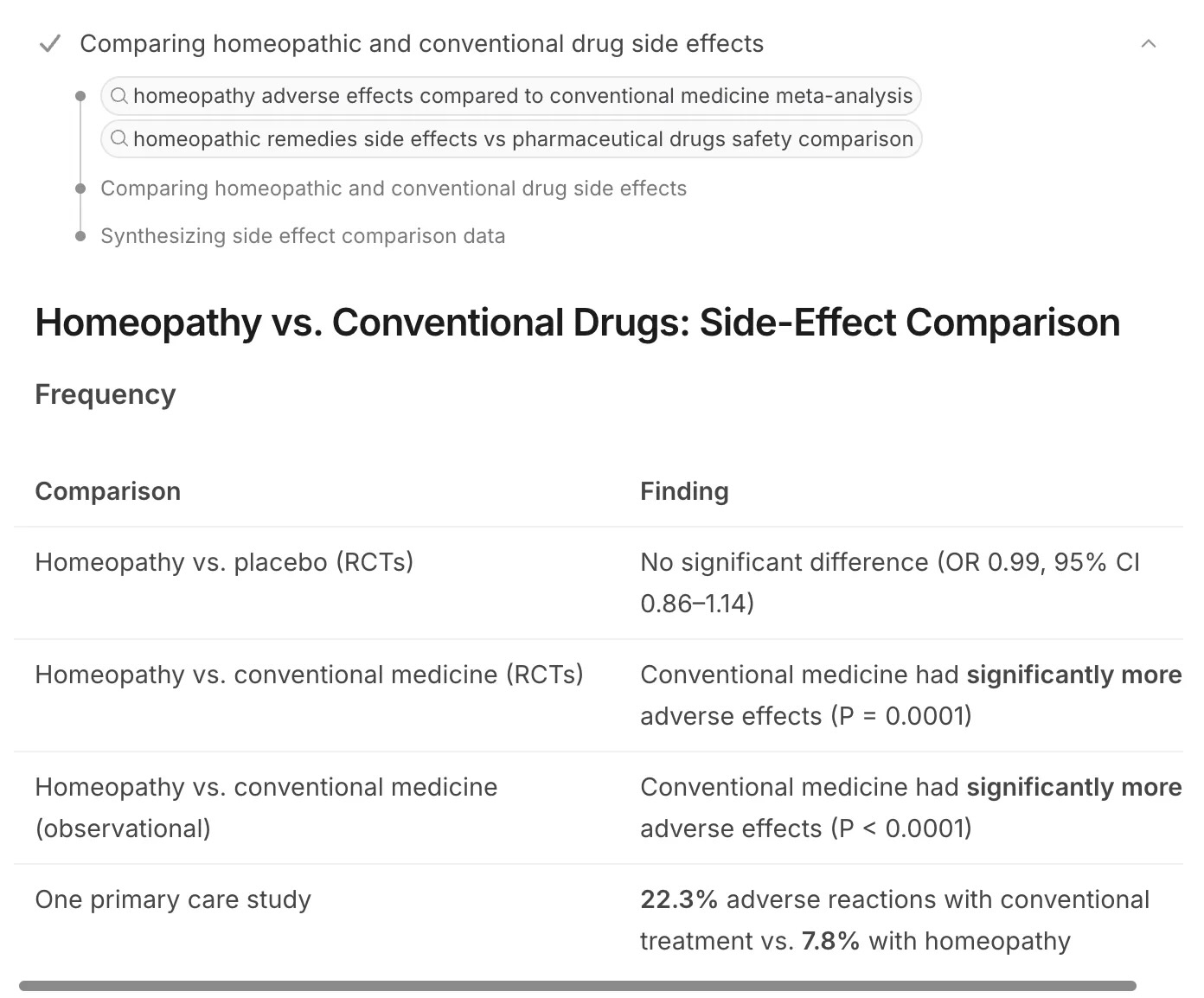
Key differences in type of effect
Homeopathy: The only effect consistently linked to the remedy itself is the ‘homeopathic aggravation’ — a brief, self-limiting worsening of existing symptoms (98% Grade 1). No dose-dependent toxicity, no organ damage, no drug interactions at high dilution.
Conventional drugs: Dose-dependent toxicity, organ-specific damage (hepatic, renal, cardiac), drug-drug interactions, and sometimes life-threatening reactions (anaphylaxis, agranulocytosis, etc) are well-documented and expected risks.
Bottom line
Properly prepared high-dilution homeopathic remedies carry a substantially lower risk profile than conventional drugs — essentially indistinguishable from placebo in RCTs and significantly safer than conventional medicine in observational data. The trade-off, of course, is that the same property that makes them safe (extreme dilution) is what makes them ineffective [I beg to differ!] — they provide no pharmacological benefit. The real risk of homeopathy is not direct harm from the remedy but opportunity cost: forgoing effective treatment."
You know what I have to say about the idea “they provide no pharmacological benefit?”
Don’t knock it ‘til you’ve tried it.
As to the idea of using homeopathy and “forgoing effective treatment”… I’m going to assume that if you have chronic pain that you are well acquainted with doctors’ offices. If not, as I write often in these blogs — seek professional medical advice; get a proper diagnosis. Work with BOTH a trained medical physician AND a trained homeopath.
You might just be very pleasantly surprised to see your chronic symptoms lessen significantly.
Julia Coyte, CHom
Classically Practical homeopath
#wellnessawaits
*Existing conditions may worsen — pain can exacerbate existing conditions like diabetes or speed up cognitive decline (Wu n.d.)
**Cancer pain is a whole other kettle of fish and beyond the scope of this article.
**I understand the orthopaedic surgeons may have some skin in the game — if the cortisone shots worked long term, they may be putting themselves out of a job.
****I understand a homeopathic trade organization may sound like an unreliable source for such information. I don’t know what else to tell you… Homeopathy has been railed against for a very long time, though it manages to stick around. If it were as ineffective as the mainstream would have you believe, it would have died out a long time ago.
Reference list
A Train Education, 2016. Abuse of Opioid Analgesics [online]. ATrain Education.
ACPA: The American Chronic Pain Association, n.d. ACPA [online]. ACPA.
American Academy of Orthopaedic Surgeons, 2024. Cortisone Shot (Steroid Injection) - OrthoInfo - AAOS [online]. Aaos.org.
American Association for Homeopathic Products, 2026. FAQs [online]. The American Association of Homeopathic Pharmacists.
Americans for Homeopathy Choice, 2018. FAQs - homeopathy questions and answers [online]. Americans for Homeopathy Choice.
Baena-Díez, J. M., Sun-Ni, M. T., García-Lareo, M., Barroso-Sevillano, M., Gárate-Ercilla, H., Rodriguez-Perez, E. and en representación del Grupo de Estudio de Infiltraciones en Atención Primaria (GEIAP), 2025. Short and long-term effectiveness of corticosterorid injections in osteoarticular pathology. Two-year prospective study. Atencion primaria [online], 57 (9), 103250.
Benzon, H. T., Provenzano, D. A., Nagpal, A., Souza, D., Eckmann, M. S., Nelson, A. M., Mina, M., Abd-Elsayed, A., Elmofty, D., Chadwick, A. L., Doshi, T. L., Pino, C. A., Rana, M., Shah, S., Shankar, H., Stout, A., Smith, E., Abdi, S., Cohen, S. P., Hirsch, J. A., Schneider, B. J., Manchikanti, L., Maus, T. P., Narouze, S., Shanthanna, H., Wasan, A. D, Hoang, T. D, Rivera, J., Hunt, C. and FitzGerald, J. D, 2025. Use and safety of corticosteroid injections in joints and musculoskeletal soft tissue: Guidelines from the American society of regional anesthesia and pain medicine, the American academy of pain medicine, the American Society of Interventional Pain Physicians, and the international pain and spine intervention society. Regional Anesthesia & Pain Medicine [online], 51 (7), 746–773.
Bhatia, D. M., 2009. Homeopathy for drug and alcohol abuse - dr. Manish Bhatia [online]. Hpathy.com.
Boswell, M. V. and Cole, B. E., eds. 2007. Weiner’s pain management : a practical guide for clinicians. New York: Informa Healthcare.
Butehorn, L., 2017. Post–Acute Withdrawal Syndrome, Relapse Prevention, and Homeopathy. Alternative and Complementary Therapies [online], 23 (6), 228–230.
CDC, 2025. Lifesaving naloxone [online]. Stop Overdose.
Chang, D. C., Klimas, J., Wood, E. and Fairbairn, N., 2017. A case of opioid overdose and subsequent death after medically supervised withdrawal. Journal of Addiction Medicine [online], 12 (1), 1.
Cieri-Hutcherson, N. E., 2023. Opioid withdrawal: Typical timeline and common symptoms [online]. GoodRx.
Cleveland Clinic, 2022. Opioids: What they are, side effects & disorders [online]. Cleveland Clinic.
Cleveland Clinic, 2024. Opiate and opioid withdrawal: Causes, symptoms & treatment [online]. Cleveland Clinic.
Comprehensive Centers for Pain Management, 2023. Complications of Untreated Chronic Pain [online]. Comprehensive Centers For Pain Management.
Cosci, F. and Chouinard, G., 2020. Acute and persistent withdrawal syndromes following discontinuation of psychotropic medications. Psychotherapy and Psychosomatics [online], 89 (5), 283–306.
Dantas, F. and Rampes, H., 2000. Do homeopathic medicines provoke adverse effects? A systematic review. The British homoeopathic journal [online], 89 Suppl 1, S35–8.
Darke, S., Larney, S. and Farrell, M., 2016. Yes, people can die from opiate withdrawal. Addiction [online], 112 (2), 199–200.
DiRuggiero, D. and DiRuggiero, M., 2025. Beyond skin deep: The systemic impact of topical corticosteroids in dermatology. The Journal of Clinical and Aesthetic Dermatology [online], 18 (1–2 Suppl 1), S16.
Dowell, D., Haegerich, T. M. and Chou, R., 2016. CDC guideline for prescribing opioids for chronic pain—United States, 2016. JAMA [online], 315 (15), 1624–1645.
Drugs.com, 2018. Narcotic analgesics [online]. Drugs.com.
Drugs.com, 2019. Gabapentin side effects [online]. Drugs.com.
Drugs.com, 2026. Lidocaine patch - FDA prescribing information, side effects and uses [online]. Drugs.com.
Dunn, K. M., Saunders, K. W., Rutter, C. M., Banta-Green, C. J., Merrill, J. O., Sullivan, M. D., Weisner, C. M., Silverberg, M. J., Campbell, C. I., Psaty, B. M. and Von Korff, M., 2010. Opioid prescriptions for chronic pain and overdose. Annals of Internal Medicine [online], 152 (2), 85–92.
Gaujoux-Viala, C., Dougados, M. and Gossec, L., 2008. Efficacy and safety of steroid injections for shoulder and elbow tendonitis: a meta-analysis of randomised controlled trials. Annals of the Rheumatic Diseases [online], 68 (12), 1843–1849.
Grover, C., Sturgill, D. and Goldman, L., 2022. Post–acute withdrawal syndrome. Journal of Addiction Medicine [online], 17 (2), 219–221. .
Gupta, R. and Fonacier, L. S., 2016. Adverse effects of nonsystemic steroids (inhaled, intranasal, and cutaneous): A review of the literature and suggested monitoring tool. Current Allergy and Asthma Reports [online], 16 (6).
Guy, G. P., Miller, G. F., Legha, J. K., Rikard, S. M., Strahan, A. E., Mikosz, C. and Florence, C. S., 2025. Economic Costs of Chronic Pain—United States, 2021. Medical Care [online].
Hartrick, C. T., 2013. Long-term opioid treatment. AMA Journal of Ethics [online], 15 (5), 434–438.
Jansen, T., 2024. Fighting Fire With Fire Volume 3. Uitgeverij Oorsprong B.V.
Kamel, S., Rosas, H. G. and Tetyana Gorbachova, 2023. Local and Systemic Side Effects of Corticosteroid Injections for Musculoskeletal Indications. American Journal of Roentgenology [online], 222 (3).
Lee, M., Silverman, S. M., Hansen, H., Patel, V. B. and Manchikanti, L., 2011. A comprehensive review of opioid-induced hyperalgesia. Pain Physician [online], 14 (2), 145–161.
Lennihan, B., 2017. Homeopathy for pain management. Alternative and Complementary Therapies [online], 23 (5), 176–183.
Mayo Clinic, 2017. Cortisone shots - Mayo Clinic [online]. Mayoclinic.org.
Mayo Clinic, 2018. What to do when it’s time to stop opioids [online]. Mayo Clinic.
Mayo Clinic, 2019. Gabapentin (oral route) description and brand names - mayo clinic [online]. Mayoclinic.org.
McAllister, M., 2026. Tolerance to opioid pain medications [online]. www.instituteforchronicpain.org.
Miller, J., 2026. Prescription Opioid Withdrawal - Timeline and Relief [online]. AddictionHelp.com.
Millstine, D., 2023. Homeopathy [online]. MSD Manual Professional Edition.
National Library of Medicine, 2023. Opioids and opioid use disorder (OUD) [online]. medlineplus.gov.
NeuroLaunch editorial team, 2023. Homeopathic medicine for anxiety and depression: A natural approach to mental health [online]. NeuroLaunch.com.
NJ Addiction Centers, 2026. Opioid withdrawal symptoms: A complete timeline [online]. NJ Addiction Centers.
Pergolizzi, J. V., Varrassi, G., Paladini, A. and LeQuang, J., 2019. Stopping or decreasing opioid therapy in patients on chronic opioid therapy. Pain and Therapy [online], 8.
Qiu, Di, Zhou, Z.-B., Li, X.-Y., Hashimoto, K., Yang, J.-J. and Wang, X.-M., 2026. Chronic pain and risk of cognitive impairment: A meta-analysis of longitudinal cohort studies. Translational Psychiatry [online], 16 (1).
Rogers, K., 2023. Opioid | description, examples, classification, history, & effects | britannica [online]. www.britannica.com.
Saunders, H., Panchal, N. and Rudowitz, R., 2026. Opioid overdose deaths: National trends and variation by demographics and states | KFF [online]. KFF.
Sawczuk, H., Pilarczyk, K., Rabęda, A., Kaus, M., Cudziło, Z., Nowak, W. E., Malicka, M., Grzesik, K., Adamska, H., Klepacz, N. and Marschollek, J., 2025. The role of corticosteroid injections in sports medicine – articles review. International Journal of Innovative Technologies in Social Science [online], 4 (3(47)).
Science Insights Team, 2026. Do you have to finish steroids or can you stop? - ScienceInsights [online]. ScienceInsights.
Stanford Medicine: Division of Pain Medicine, n.d. About Chronic Pain [online]. Division of Pain Medicine.
Stretanski, M. F., Kopitnik, N. L., Matha, A. and Conermann, T., 2024. Chronic pain [online]. PubMed.
Stub, T., Kristoffersen, A. E., Overvåg, G., Jong, M. C., Musial, F. and Liu, J., 2020. Adverse effects in homeopathy. A systematic review and meta-analysis of observational studies. EXPLORE [online], 18 (1).
SWEGLE, J. M. and LOGEMANN, C., 2006. Management of Common Opioid-Induced Adverse Effects. American Family Physician [online], 74 (8), 1347–1354.
Teater, D., n.d. The psychological and physical side effects of pain medications [online].
Will, A., 2025. When Chronic Pain Goes Untreated | Twin Cities Pain Clinic [online]. Twincitiespainclinic.com.
Wilson, S. H., Hellman, K. M., James, D., Adler, A. C. and Chandrakantan, A., 2021. Mechanisms, diagnosis, prevention and management of perioperative opioid-induced hyperalgesia. Pain Management [online], 11 (4), 405–417.
Wu, D., n.d. 8 Serious Health Complications of Untreated Chronic Pain: David Wu, MD: Interventional Pain Management Specialist [online]. www.curepain.net.
Yasaei, R., Katta, S. and Saadabadi, A., 2024. Gabapentin [online]. PubMed.