

As I opened my new book, I made a very conscious decision to put myself in the mind of someone who had zero experience with homeopathy, and it appears that was the exact right thing to do with this book.
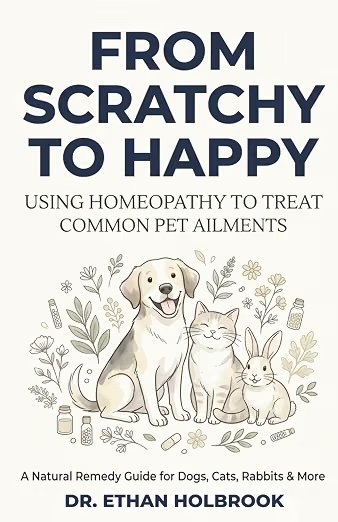
Dr. Ethan Holbrook tells us right away (on page 3) what this book is all about:
This book is a practical guide to using homeopathy for common pet ailments. It is written for pet owners — people who love their animals and want to be active, informed participants in their health — not for veterinary professionals or homeopathic practitioners.
You do not need a background in medicine, herbs, or natural health to use this book. If you can read a label and follow simple instructions, you can use homeopathy for your pets. That’s the beauty of it.…
When you hold this book, you are holding something I wish had existed when I first started on this path.
I have seen a dog with chronic ear infections finally find relief after years of rounds of antibiotics. I have watched a frighted, thunder-phobic terrier walk calmly during a storm — for the first time in her life — after a few doses of the right remedy. I have supported an aging arthritic cat through his final years with dignity and comfort, minimizing pain without the heaviness of pharmaceutical interventions.
I have also seen the limits. I have seen situations where homeopathy was not enough — and I have learned to recognize them.
That is the promise of this book: honesty. We will show you what works. We will be clear about what doesn’t — and when to seek help. You will never be guessing.
Like all homeopathy books for “newbies,” Dr. Holbrook then includes a few short pages explaining “Like Cures Like” and “The Minimum Dose” and how to choose the correct potency.
Chapter 3 explains how to observe the pet in order to learn what to really look for. Yes, your pet is not his usual self, but as with all things homeopathy, there is more to it than just “limping, scratching, vomiting, or hiding.” There are clues which can help lead you to the best remedy for your pet’s discomfort. He then gets into the technicalities of homeopathic remedies: what to buy, where to buy them and how to administer them.
He then jumps right into the nitty gritty: Skin & Coat Issues; Digestive Troubles; Respiratory and Ear Issues; Behavioral & Emotional Health; Joint & Mobility; Minor Injuries & First Aid; Eye & Dental Health. Each chapter has a nice chart to sum up common remedies for each condition as well as the all-important “When to Call Your Vet” guidelines.
I paid particular attention to the “Joint & Mobility” section because this is where my beloved Rufus suffered most. In fact, I just learned Rufus wasn’t alone and “that over 80% of dogs over the age of eight show radiographic signs of osteoarthritis, even if they are not yet showing symptoms.” The book then guides your attention to pertinent questions about the onset and history, the location and the homeopathic-relevant “Pain Characteristics.”
Dr. Holbrook spends a few pages breaking down the major remedies and what to look for. In the joint & mobility case, Rhus tox, Bryonia and Arnica are listed first, followed by a little chart differentiating Rhus tox and Bryonia. He then continues to break down further remedies: 9 in total for this chapter.
Following the materia medica, he describes specific conditions: Arthritis (Chronic Osteoarthritis); Hip Dysplasia; Cruciate Ligament Injury; Elbow Dysplasia; Spondylosis and Tendon and Ligament Injuries.
The end of each chapter describes how to build a support plan or maintenance routine. In the Joint & Mobility section, there are common sense suggestions, like providing orthopedic bedding and exercise as well as a list of supplements to consider, followed by how best to use the homeopathic remedies.
Chapter 11 returns to more guidance on the prescribing process and how to monitor the remedy response as well as when to switch and when to escalate.
Next is a walk-through of an example case with a page dedicated to keeping simple records — a piece of the puzzle we so frequently forget to do (but is so very important!)
Case studies are then followed by a chapter on Safety, Ethics & Limits, including good guidelines of what homeopathy can do and what homeopathy is not able to do; what constitutes an emergency and how to work with your veterinarian.
Honestly, this is a very thorough book and I would absolutely suggest this to any pet owner interested in helping their pets naturally. I only scratched the surface of what is included in these 200+ easy to read and follow pages.
Julia Coyte, CHom
Classically Practical homeopath
#wellnessawaits
*I have no affiliation with this book or the author — I stumbled upon it and it impressed me enough that I thought I needed to bring it to your attention!