
The following DISSERTATION was submitted in May 2024 in partial fulfilment of the requirements for the degree of MASTER OF SCIENCE (MSc) in MAD STUDIES at QUEEN MARGARET UNIVERSITY, EDINBURGH.
It seems that this is beyond the word limit of a post on this website. For the complete PDF version click here.
ACKNOWLEDGEMENTS
To all those throughout history who have been courageous enough to play with madness and let madness play with them. Including all those at QMU, who for a very brief time made it possible there.
ABSTRACT
Inspired by a story of its impact on lived experience, the metacommunicative frame of play is explored as an alternative to the over-serious hegemonic discourse on madness. First, key theoretical assumptions are outlined in establishing the importance of discourse as ontology, which means that it shapes all phenomena, including madness. Second, an attempt at a descriptive statement regarding the nature of madness across cultures is made, suggesting it can best be understood as denoting a disruption in con-sensus. It is argued that Western discourse provides two main vocabularies of being for those who live through such disruptions: the language of psychiatry and the language of spirituality. In keeping with the spirit of play, the author draws on his own multi-dimensional pedagogical practice, to physically move the reader around the analysis of these discourses. This is metastructured, along the y axis, by a multi-level critical discourse analysis that considers the social practice of these languages at three levels of analysis which are connected to three physical positions: the macro standing up, the meso sitting down and the micro lying down. The reader is first, along the x axis, requested to move to the geographic West to explore the language of psychiatry at these three levels of analysis. Second to the East to explore the language of spirituality. Then, along the y axis, to the North to consider how together their shared over-seriousness constitutes a form of hermeneutic-ontologic injustice at each level. The reader then moves South to consider the metacommunicative frame of play as an antidote at each level: a dis-course of re-creation. Finally, the reader is asked to move outside the box, beyond the restrictions of their work space, to consider case studies that demonstrate the practical impact of the frame of play for madness across the three levels of analysis, first to the micro in the street, to the meso in the park, and to the macro up a tree. This returns the reader to the liberating interpretive activities that led to the story that initiated the research. A conclusion summarises the key lessons, emphasising that madness-as-play is a dis-course of re-creation that opens up intriguing possibilities.
Word Count: 12,099
SOUNDTRACK TO MADNESS
To accompany your reading, please put the following song on repeat:
Can I play with madness? The prophet stared at his crystal ball
Can I play with madness? There's no vision there at all
Can I play with madness? The prophet looked and he laughed at me, ha, he said
Can I play with madness? He said, "You're blind, too blind to see"
Can I play with madness?
(Iron Maiden, 1988)
A PROLOGUE: “GO AND PLAY”
He is in some kind of altered state in rural Taiwan – after days of extraordinary experiences involving trances, seeing hungry ghosts, and self-exorcism – that Western psychiatry would probably call psychosis, but the experience is heavily bound up in Eastern spirituality, not psychology. As he reaches the top of one of the largest Taoist temples in the country – dedicated to the “Supreme Mother of the Earth” – he collapses onto the offerings table. “You can’t lie there.” Based on Her gesturing, he presumes this is what the woman (was she The Mother?) is saying in Taiwanese. He drags himself up as she appears to say, “go and play” pointing to the jungle behind the temple. He’s confused, “go and play?” he says to himself. He turns around and begins to scale a series of steep, concrete ledges that make up the back of the temple. It’s not easy, as he’s paranoically brought both his backpack – complete with his laptop and passport – and guitalele along for the ride. He eventually reaches the top and sits in awe at the view below. “I’m finally above the gods,” he thinks to himself. He climbs into the dense, immensely steep jungle, where he spends the next six hours so immersed in the now, the Way, the Tao, the Play, that he almost entirely loses consciousness, no longer sure of the boundary between self and habitat, between human and animal-leopard cat…
INTRODUCTION
A DISCURSIVE WORLDVIEW
The profound influence of culture on subjectivity is best demonstrated in those that have largely developed outside of human society. Feral children show that with greater freedom from the structuring effect of human discourse, the subject (such as “The Wild Boy of Aveyron” (Shattuck, 1976)) can demonstrate that aspects of the world presumed to be part of an objective reality, such as temperature, dimensionality and the discrimination and relative strength of the senses (Classen, 1991), are all fundamentally a product of a contingent ‘con-sensus - that is a sensing along with others’ (Howes, 2013, p.9). Ultimately, perception itself is always a translation of the raw data of reality into language, which is always also necessarily an interpretation into a particular culture. Importantly, this work is an interactionist process of
social kindling…[in which] the implicit and explicit ways in which a local social world gives significance and meaning to sensation…will alter not only the way those sensations are interpreted but the likelihood and the quality of the sensation itself (Tanya M Luhrmann et al., 2015, p.658).
When we refer to the way a social world does this, we are talking about discourse, which refers not only to spoken or written language but to any system of practices that construct the world. This includes symbols, rituals, laws, institutional practices, and other forms of social interaction. Meaning is always constructed through discourse, there's no way to access a world outside of the frameworks these practices provide for us to understand it. . This makes phenomena, like those we associate with madness, ‘inseparable from hermeneutic interpretive activities’ (Duran, 2022). Discourse plays a fundamental role in shaping our very being itself, to the extent that culture resides in the body as powerfully as it resides in the mind (Cerulo, 2018). This aligns with a post-structuralist ontology, where entities do not pre-exist their discursive construction. This is a theoretical frame that links the phenomenal and political. This is, according to the anthropologist Desjarlais, something we are in ‘dire need’ of (Desjarlais, 2012, p.25) and something that is ‘marginalized within the field of psychiatry’ (Friesen, 2022, p.600).
MADNESS AS DISRUPTION
If we reduce madness to its most minimal interpretation that tries to transcend the varying ways it is interpreted within and between cultures both historically and geographically, we conclude that it denotes a disruption in con-sensus. This is madness understood ‘as that which lies outside the realm of the symbolic order held by the body politic’ (Schenk, 2020, p.134). The symbolic order corresponds to the discourse, the con-sensus, in which ‘people understand themselves and others in terms of rules and standards that one should obey’ (Ribolsi, Feyaerts and Vanheule, 2015). This generally includes the characteristic positive symptoms of schizophrenia as per the DSM V i.e. delusions, hallucinations, disorganised speech and behaviour (Rahman and Lauriello, 2016), but also other activity, such as that associated with mania. Importantly, what counts as con-sensus and a disruption to that varies immensely within and across cultures. For example, what we construct as hallucinations may rather be perceived as legitimate states of reality elsewhere (Keifenheim, 1999; Rameka, 2016). The notion of disruption, drawn from the work of Saville-Smith, attempts to provide a descriptive ‘placeholder…pre-differentiated and prior to interpretation’ (2017, p.40). The interpretation always occurs through and as discourse.
We see two main approaches to “madness” in contemporary discourse: ‘the language of psychiatry and the language of spirituality’ (Duran, 2022). Importantly, these are not only different ways of categorising disruptions in con-sensus, but are themselves
distinct con-sensual positions…cosmic orders…different comprehensive cultural orientations, expectancies, and modes of evaluating what is significant or insignificant… aspirational or problematic, worthy or unworthy of even being brought up to discussion to begin with (Duran, 2022)
To use a term from the Zen Buddhist poet Jane Hirshfield, they constitute different ‘vocabularies of being’ (Harris, 2023). In short, a hermeneutic-ontologic view.
REFRAMING THE FRAMEWORK
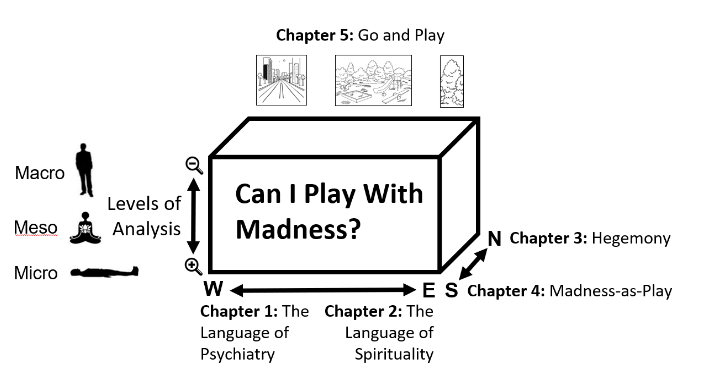
This thesis draws on elements of an innovative multi-dimensional architectural approach to pedagogy (Bailey, 2022). The fundamental point of this metastructure is to encourage the subject, via a playful engagement in disruption, to reflect on how discourse is bound to their body, sociocultural location, and the physical environment. This in the spirit of Mad Studies which ‘needs to have as part of its end goal the shaking up, the disturbing, of all forms of academic knowledge’ (Ingram, 2016). The focus here is physical position and spatial change, asking the reader to literally move around the discourse. First, the y axis invites the reader to move from a lying position, to a seated position, to a standing position to explore each discourse and its implications at the three levels of society: the micro, the meso and the macro respectively. The micro considers the way the discourse is articulated for and by the individual; the meso considers it in the community; and the macro considers the broader cultural context. Secondly, the reader is asked to combine the y and the x axis, asking them to physically move from West to East in an exploration of the dominant discourse of contemporary society. Chapter 1 deconstructs the language of psychiatry as the height of Western understanding. Chapter 2, deconstructs the romantic vision of the language of spirituality strongly associated with Eastern wisdom. Third, the reader is asked to combine the y and the z axis, which requires them to move from North to South, encouraging them to think about the ways the dominant discourse constitutes a ‘hegemonic articulation’ (Laclau and Mouffe, 2001). Chapter 3 deconstructs this over-serious dominant discourse, associating it with the colonial Global North. Chapter 4, constructs a substantial alternative through the metacommunicative frame of play, an approach that is linked to the Global South. Lastly, in Chapter 5, case studies are discussed in order to consider the practical implications of the frame of play for madness. In recognising architecture itself as a powerful form of spatial discourse (Grosz, 2001), the reader is invited to move outside the box of their office, first to the street to consider individuals who have framed madness-as-play, second to the play park to consider communities that have done so, and lastly to climb up a tree to consider ludic cultures. The diagram below gives a complete picture of this overall theoretical framework and structure. The reader will require reading this thesis either on paper or on a mobile device.
CHAPTER 1: GO WEST – THE LANGUAGE OF PSYCHIATRY
Wherever you are, work out your geographical position. Physically move due West and think about how the language of psychiatry constructs madness.
MACRO – UNREALITY
Now stand up. Think about how this language operates at the broadest cultural level. Jot down any thoughts. Then read.
Psychiatry equates disruptions in con-sensus to psychosis, which, it claims, corresponds to what ‘has always been called and legitimately continues to be called madness’ (Lacan and Miller, 1993, p.4). This is principally characterised by an apparent loss of touch with reality, a failing to ‘distinguish adequately between the real and the imaginary in [treating] the imaginary realm as if it were real’ (Sass, 1995, p.2). Fundamentally the ‘epistemic imperialism of science’ (Harrison, 2015, p.190) is founded on a ‘disenchanted’ (Federici, 2004, p.174), and colonising, ‘metaphysical catastrophe’ (Maldonado-Torres, 2016) that engineers an absolutist dualism between imagination and reality (Liebert, 2018, p.110) that we predominantly tend to live by. The truth of this reality is constituted as a Cartesian certainty and anything that challenges this certainty is penalised by the wider society and labelled as “irrational”, “delusional,” “unreal” and “false”’ (Humpston, 2022). This sanist discourse therefore constructs disruptions in con-sensenus as ‘ontologically impossible experiences [which] are quite physically beyond what the intersubjective world can accommodate’ (Humpston, 2022). At its most extreme, psychiatry steps in to defend this Truth by violently closing this activity down with ‘restraint, seclusion, and weapons’ (Friesen, 2022).
MESO – INCOMPREHENSIBILITY
Sit down at your desk. Think about how the language operates at the community level in its effects on relations between people. Jot down any thoughts. Then read.
At the community level, this discourse affects relations between individuals by generating what symbolic interactionism calls ‘role-taking failure’, which leads to the collapse of human interaction; ‘if other people cannot comprehend what is going on in the actor's mind, they cannot communicate with him or her’ (Rosenberg, 1984, p.289). But what we consider incomprehensible is a result of the boundary drawn between what is real and imaginary in the first place. This is evident in the constitution of madness as being tied to incomprehensibility in thought, affect or behaviour. This is the ‘gulf which defies description’ (Jaspers, 1997, p.447) that produces in an observer the “praecox feeling”, of an unease or bizarreness, caused by ‘a fundamental inaccessibility of the patient to empathic understanding’ (Gozé et al., 2019). As Cooper summarises, ‘the violence of psychiatry can only be understood on the basis of its fundamental dogma: if you don’t understand what another human being is doing diagnose it!’ (1978, p.109). This discourse is the origin of the social control functions of psychiatry that equates incomprehensibility with danger, its ‘guiding thread’ (Foucault, 1988, p.188). This has been accurately characterised in terms of paranoia, as a ‘psycurity’ which ‘directs a rationalizing, controlling, and othering desire-to-know entangled with a fear-of-regressing to the irrational, uncontrollable, and other within’ (Liebert, 2018, p.13). This explains why psychiatry proactively engages in a ‘war on the imagination’ (Liebert, 2018, p.135) through which, much like in any war, it doesn’t just discover, but ‘actually creates experiences [or “others”] that fit its pathological narratives’ (Wantoch, 2023, p.116). At the meso-level, the language of psychiatry operates a stifling policing function that neutralises difference. This discourse creates communities underpinned by a climate of fear, in which any departure from the con-sensus is tied to the fear of incarceration in psychiatric ‘correctional facilities’ (Arrigo and Williams, 1999, p.179).
MICRO – ILLNESS
Find a space and lie down, either on a bed or on the floor. Think about how the language operates at the individual level. Jot down any thoughts. Then read.
The language of psychiatry shapes madness by framing it within the broader stigmatizing, colonizing and normativizing (Metzl, 2010) discourse of “health” and more narrowly within medicine. Contemporary psychiatry sees madness in terms of ‘working memory deficits, functional and structural alterations of the striatal-frontal circuitry, and subcortical dopamine dysregulation’ (Tost, Alam and Meyer-Lindenberg, 2010). Phenomenologically speaking, the ‘language in which people could experience their bodies [and minds] is turned into bureaucratic gobbledegook’ (Illich, 1976). Crucially, refusal to understand the phenomena in this way is taken by psychiatry ‘to be a sign of lacking in clinical insight, which is seen as a further symptom of illness’ (Roe et al., 2008). This hermeneutic-ontologic injustice is defended by force in that lack of insight is ‘the most significant factor in justifying involuntary treatment decisions’ (Furgalska, 2023, p.9). This fatalistic discourse condemns individuals to understanding their life in terms of a mechanical determinism. It sees them as passive victims of their biology, ignoring that many patients are ‘partly or fully “responsible” for onset, and actively involved in the shaping and elaboration of positive symptoms’ (Jones et al., 2016). Such disempowerment is essential in manufacturing madness, via reification, into a permanent disorder from which no one ever truly recovers, such that ‘schizophrenia represents a self-fulfilling prophecy associated with diagnostic criteria that require chronicity, rather than being an intrinsic characteristic of the disorder’ (Tranulis, Corin and Kirmayer, 2008, p.229).
This discourse has rightly been described in terms of rational emotive behaviour therapy (REBT) as ‘awfulizing’ (Unger, 2013). Applying REBT, the discourse promotes a belief that ‘nothing could be worse’ than psychosis, that it is ‘100% bad’, that ‘no good could possibly come from’ it, and that it ‘cannot be transcended or surmounted’ (Dryden, 2020), ultimately because it is a permanent physical disorder. Psychiatry is a thoroughly deficit model that sees madness ‘entirely in terms of the loss of higher or more quintessentially human capacities of mind and spirit’ (Sass, 2001, p.56), failing to consider any possible benefits despite that psychotic individuals themselves ‘often experience more freedom, instead of less, and they feel their consciousness is not troubled or darkened, but they report all kinds of experiences that are phrased with positive light metaphors’ (Kusters qtd. in Aftab, 2021). This becomes a self-fulfilling prophecy. Iatrogenically, it increases suffering: the “paradox of insight” shows that individuals who subscribe to a disease conceptualization have ‘higher rates of demoralization, depression, and lower quality of life than those who “lack insight”...and people who recover from schizophrenia are those that are able to dis-identify with being sick’ (Brown, 2020).
CHAPTER 2: MOVE EAST – THE LANGUAGE OF SPIRITUALITY
Now, physically move due East and let's think about how the language of spirituality constructs madness.
MACRO – MEANING
Now stand up again. Think about how this language operates at the broadest cultural level. Jot down any thoughts. Then read.
There are a variety of psychological approaches to disruptions in con-sensus that instead of emphasising rationality focus on the meaning of the phenomena. Nevertheless, with notable exceptions, they continue to see it in pathological terms. The most common popular “vocabulary of being” that doesn’t is the language of spirituality. In Western discourse, such an approach is readily, albeit problematically, associated with the mysticism of “Eastern philosophy”. “Spirituality” as understood here, typically refers to some kind of transcendence of everyday consciousness, involving a profound connection to one's inner self, the universe, or a higher power. Disruptions in con-sensus are then usually framed in terms of their being a ‘spiritual crisis’ or ‘spiritual emergency’, defined as ‘critical and experientially difficult stages of a profound psychological transformation that involves one's entire being’ (Grof and Grof, 1995, p.31). This language, unlike psychiatry, crucially does not relegate such phenomena to ontological impossibility, but rather sees ‘the world of the imagination – the world of the soul – and of the spirit is just as real as physical reality’ (Anzaldua, 1987, p.37). Duran’s data shows in the case of meditative cultures
that those who inhabit [them], through spiritual discourses, situate sensations of “unreality” as elements in a path to “transcendence”; those diagnosed with depersonalization/derealization, on the other hand, describe dissociative states of “unreality” as pointless — inexcusable detachments from a “normal” world. (Duran, 2022, p.897)
MESO – INSTRUMENTAL
Sit down on the floor in a meditation posture. Think about how the language of spirituality operates at the community level. Jot down any thoughts. Then read.
Those approaching madness in this language of spirituality generally inhabit or draw from communities in which they develop a variety of different vocabularies, frameworks and support networks for navigating the phenomena in this purposeful, teleological way.
In terms of relating to madness, the subject’s disruptions, hallucinations, delusions, depersonalisation etc. are consequently not treated by the individual or community as inherently unintelligible symptoms in need of a corrective return to con-sensus, but rather ‘as acceptable and, often, as instrumental states’ on the path to spiritual growth (Duran, 2022, p.892). At the community level, as one can also observe cross-culturally (Brown, 2020), the language of spirituality does not involve the explicit shutting down of madness as does psychiatry. Rather, it operates in a more totalizing way by assimilating the phenomena, encouraging the individual to channel it in a transformative process toward greater spiritual realisation. In a society dominated by psychiatry, there is of course limited access to such resources and spiritual approaches are relegated to methods of ‘coping with the illness’ (Grover, Davuluri and Chakrabarti, 2014) rather than ontologies in their own right. Nevertheless, communities like the Spiritual Crisis Network (SCN, 2024) and Spiritual Awakenings International (SAI, 2024), emphasise that disruptions in con-sensus can often be better understood and supported outside of psychiatry.
MICRO – SOTERIOLOGY
Find an appropriate space and lie down. Think about how the language operates at the individual level. Jot down any thoughts. Then read.
In comparison to the outright pathological language of psychiatry, there is an important emphasis in the spiritual discourse of ‘both the danger and opportunity inherent in such states…they are both emergency and emergence’ (Grof and Grof, 1995). Instead of fatalistic biomedical reductionism remedied with chemical straight-jackets, the language of spirituality provides ‘an arsenal of metaphysical speculations’, such as the Buddhist concept of no-self, ‘through which…episodes may come to be rendered either acceptable or teleologically aspirational’ (Duran, 2022). This can actively facilitate ‘people’s ability to cope with and endure disruptive sensations’ (Duran, 2022). As Castillo notes based on studying depersonalisation in meditators, ‘if the individual holds catastrophic interpretations of this state, such “I’m going crazy, then a panic/anxiety response may result. However, if…the individual interprets the episode with the thought, “I am having a sacred experience,” then an entirely different…response may develop, characterised by lack of arousal and parasympathetic dominance”’ (1990).
Despite the apparent benefits of this approach, the language of spirituality is caught in teleological expectations about the soteriological potential of such disruptions to lead to a ‘more expanded way of being…and a sense of deeper connection with other people, nature, and the cosmos’ (Grof and Grof, 1995, p.41). This ‘sets impossibly high goals for humans…to transcend humanity’ (Taylor, 2007, p.623). By tying disruptions to spiritual meaning, and ultimately to the divine itself, the discourse imbues them with a significance and grandiosity that can be immensely demanding. As Taylor rightly argues, this approach ‘cannot but end up mutilating us; it leads us to despise and neglect the ordinary fulfilment and happiness which is within our reach’ (Taylor, 2007, p.624). Indeed, by implying that disruptions in con-sensus can lead to greater spiritual attainment, it positions the normal subject in which such phenomena is absent as lacking in some way, corollarily psychiatry positions the abnormal subject as deficient when this phenomena is present.
CHAPTER 3: HEAD NORTH – HEGEMONY
Now, find and physically move due North. Think about what these two languages have in common. Jot down any thoughts. Then read.
Despite their differences, these two discourses are both central to the operation of hegemony, understood in Gramscian terms as ‘the key concept in understanding the very unity existing in concrete social formation’ (Laclau and Mouffe, 2001, p.7). This is ‘an order in which a common social-moral language is spoken, in which one concept of reality is dominant, informing with its spirit all modes of thought and behaviour’ (Femia, 1987, p.25). Hegemony is always contingent, there is always antagonism inherent from within and outwith hegemony or otherwise ‘there would be nothing to hegemonize’ (Laclau and Mouffe, 2001, p.134). From within, the epistemic imperialism of science is real in its view of itself as an inherently superior view: the objective, value-free language of psychiatry. However, in order to demonstrate such a position it must be differential to something else, its inverse: the subjective, value-laden language of spirituality. A ‘hegemonic relation is nothing other than the situation where a particular signifier has assumed the status of an empty signifier’ (Selg and Ventsel, 2010). Analysing the dominant discourse of madness at the level of metadiscourse/metatheory reveals that both its main languages problematically constitute madness as such a signifier.
MACRO – THE LOGIC OF SUBLIMITY
Now stand up again. Think about how this hegemony operates at the broadest cultural level. Jot down any thoughts. Then read.
Both the language of psychiatry and the language of spirituality see madness as sublime, ‘as something that exceeds or exists beyond our capacity for comprehension and representation’ (Woods, 2011, p.8). Psychiatry sees it as ‘visible (as a clinical picture) but fundamentally obscure (as a disease process of unknown origins)’ (Woods, 2011, p.46). Spirituality assigns ‘schizophrenia an ontological status that is at once transcendent, mystical, and superior to an alienated existence. In so doing, it exposes and affirms psychiatry's construction of schizophrenia as sublime’ (Woods, 2011, p.143). Broadly speaking, in the “rational” language of psychiatry, we see the sublimity constructed as devoid of meaning, via negativa. In the “meaning” laden language of spirituality we see the sublimity constructed as an excess of meaning, via positiva. At a metadiscursive level, both share the ‘logic of sublimity’ (Woods, 2011, p.31) by positioning the phenomena as negatively, or positively beyond discourse. Hence its status as an empty signifier that ultimately lacks any fixed meaning. It is this construction that is hegemonic by unsettling ‘every locus of power, destabilizing the very discursive structures whose expansion it enables’ (Woods, 2011, p.31). The lack of meaning generating a desire for meaning. This is evident in how the language of psychiatry simultaneously produces endless theories and treatments for madness despite them ever succeeding to fully comprehend or cure it (Woods, 2011, p.31). Or how the language of spirituality simultaneously sees the phenomena as on the path to transcendence without ever being able to substantiate in discourse what that actually means. Laclau rightly argues that empty signifiers are a necessity to social order (Robinson and Tormey, 2008), which is evidently true in the case of the social control functions of “madness”. However, this assumes that social order is necessary in the first place. Empty signifiers are thus better understood in Deleuzean terms, as despotic signifiers in that although they lack any fixed meaning they nevertheless demand one – their meaning must be halted (Robinson and Tormey, 2008). This is evident in the fact that both languages, at the level of common-sense, demand that the phenomena be treated with a degree of seriousness that is unavailable to almost any other phenomena.
MESO – GRAVE OVER-SERIOUSNESS
Now sit down. Think about how this hegemony operates at the community level. Jot down any thoughts. Then read.
Stelzer argues in the political world that ‘the once fluid boundaries between play and seriousness exist in diminishing returns. A shift to grave over-seriousness…has smothered the previously playful culture of Older Europe’ (Stelzer, 2022). He associates over-seriousness with the rise of totalitarianism, although it can be observed in state capitalism in general (Graeber, 2015, p.204). These systems necessitate an explicit demarcation between play and seriousness to substantiate despotic commitments to literalism, characterised by a lack of openness, of possibility, of flexibility, of joy. This is typified in a Schmittian “state of emergency” situation, which is the metacommunicative climate in which disruptions in con-sensus are understood. This is the most important way in which a discourse becomes a form of hermeneutic-ontologic injustice. It is not at the level of discourse/knowledge itself, but rather the significance given to that discourse/knowledge that this occurs; it is a metaepistemic injustice not epistemic injustice that leads to the hermeneutic-ontologic one. When something is seen within the frame of “this is serious!”, just as we see so often used in political discourse, there is an implicit teleological demand, “We must do something about it”; the state of emergency becomes a permanent state of exception. Both discourses constitute the ineffability of disruptions in con-sensus as idiomatic of distress, as indicative of a crisis that requires some kind of resolution, medical or spiritual.
MICRO – LITERALISM
Now lie down. Think about the impact this discourse has at the personal level. Jot down any thoughts or drawings you have. Then read.
Within this frame the phenomena must be understood literally. It means that the associated changes in thought and behaviour are taken to denote directly what they appear to denote. This process is paradoxical: the phenomena is understood as sublime, as beyond signification but is radically confined to signs. As Goffman notes, ‘in our society the very significant assumption is generally made that all events-without exception-can be contained and managed within the conventional system of beliefs [i.e. hegemony]. We tolerate the unexplained but not the inexplicable’ (1986, p.30). In the case of the language of psychiatry, this might be understanding conspiracies about a royal coup d’etat as literally paranoid delusions emerging from a defective brain. Or in the case of spirituality, this might be the case of understanding a loss of minimal self as literally revealing something about the nature of the divine. This frame wraps the subject into a literal-mindedness, a vocabulary of epistemic certainty and determinacy that is simply overwhelming. There is no pinch of salt. Something fundamental is maligned in the dominant approaches to madness: play.
CHAPTER 4: DUE SOUTH – MADNESS-AS-PLAY
Now, find and physically move due South. Think about what an alternative might look like. Jot down any thoughts or drawings you have.
Play is seen as a metaepistemic challenge to Western metaphysics because it fundamentally undermines the certainty and seriousness necessary to its direct access to the Truth. Play is consequently constituted by colonialism as a lack in the most significant way possible; by making it the primary ‘medium for fixing a child’s identity as a future adult, the child required to become that which it is currently not…children need to grow up and out of play’ (Lester, 2013, p.135). The divide between childhood and adulthood is the most significant bifurcation in our society; all hegemony is first adult hegemony. This is evident in how our objectification of humanity through the psy-disciplines begins with the child (Foucault, 2003, p.308), who we construct as ‘a non-axiomatic subject whose impetus is the infinite creative expression [i.e. play] of its idiosyncratic constitution. It is expressly such a child that must be denied within regimes of sovereign control [i.e. hegemony] through the denial of its status as a common attribute in all human subjectivity’ (Tarulli and Skott-Myhre, 2006). Subjugation of other groups is always in relation to their proximity to this becoming-child at play, ‘both the child and the colonized…envisioned as representing imperfect specimens of the enlightened European man…[as] irrational becomings’ (Nieuwenhuys, 2013) in need of control.
Contra Laclau, alternatives to hegemony do not require counter-hegemony. To do so implies that we simply replace the existing despotic order of signs with a new one. This is a colonialist attitude that ignores the possibility of alternatives without master signifiers (Robinson and Tormey, 2008). The metacommunicative frame of play presents such a possibility in relation to madness. Rather than a ‘reactive construct’ it facilitates an ‘active intensity’ (Robinson and Tormey, 2008): a dis-course of re-creation. Philosophy is rightly argued to be ‘the art of…inventing…concepts’ (Deleuze and Guattari, 1994, p.2). The concept of madness-as-play is itself ‘‘playful’ through injecting disturbance into…common sense to produce new and exciting possibilities’ (Lester, 2013, p.132).
Despite the son of the creator of the term declaring in 1978 that ‘the smile of the schizophrenic….has been afforded too little attention’ (Bleuler, 1978, p.488), the possibility of madness being understood from within the frame of play continues to receive little explicit attention in the literature. There are a variety of limited therapeutic modalities that see playful activity as a way of treating the phenomena (Rosenzweig and Shakow, 1937; Butler, 2012), but nevertheless accept the pathological language of psychiatry. There is also some limited work on the impact of framing effects as it relates positively to those who do not return to hospital (Corin and Lauzon, 1994). Nevertheless, only Unger seems to give serious consideration to the idea that ‘madness should not be taken too seriously’, arguing that ‘lots of what happens within what we call “psychosis” could best be understood as being related to play’ (2013). He raises the crucial question, ‘does an exclusive focus on seriousness really allow us to understand what is happening, and does it really work best in helping people..?’ (Unger, 2013). To which I now turn.
MACRO – METACOMMUNICATION TO METAPHYSICS
Now stand up again. Think about how the frame of play affects our understanding of madness at the cultural level. Jot down any thoughts or drawings you have.
Play offers ‘a joyous cosmology’ (Watts, 2013) that liberates us from the over-seriousness of the languages of spirituality and psychiatry. The ludic perspective of play provides an alternative ‘beyond the imperatives of meaning and rationality’ (Taminiaux, 2021) respectively. It does so by demarcating a context ‘in which the constituent acts have a different sort of relevance and organisation from that which they would have had in non-play’ (Bateson, 1979, p.125). This is play understood at the level of metacommunication not as the name of an act or action, but rather the frame for action (Bateson, 1979, p.139). Within this frame ‘these actions, in which we now engage, do not denote what would be denoted by those actions which these actions denote’ (Bateson, 1955, p.69). The signal “this is play” can frame activity or frame attitudes; it is either both a verb and a noun or neither. For example, it frames the activity of fighting as play fighting, but it also frames the attitude of the player in that fighting of not taking it too seriously but seriously enough. If we frame the phenomena of madness in this way, both the individual’s disruptive activity and attitude can be seen as play. Their activity of giving alleged demons flowers can be seen as denoting that but not literally that. Their attitude of approaching everything with hidden meaning can be seen as denoting that but not literally that. Such as their belief about a royal coup d’etat denotes a belief but a playful belief not a fully literal belief. Within the frame of play, things never fully mean what it would be suggested they mean, they are meaningfully meaningless and meaninglessly meaningful.
The most definitive feature of play ‘resides in its paradoxical nature regarding the assumed incompatibility between what is real and what is imagined’ (Göncü and Vadeboncoeur, 2017, p.427). It is assumed that within the frame of play that all actions are understood as imaginary, connoting nonliteralness. However, it is also imperative that they have the potential to be (mis)understood as fully real, connoting literalness. According to the language of psychiatry, the disruptions in con-sensus at the heart of psychosis result from treating the imaginary as real. It is assumed that those who have delusions, hallucinations, etc. approach them ‘with the same sense of objective reality that normal people ascribe to the facts of their actual and consensual worlds’ (Sass, 1995, p.2). If we understand madness as occurring within the frame of play, we arrive at a simple answer to Sass’s problem of the ‘the strange tendency of such patients to accord great importance to their delusions while nevertheless seeming to experience these same delusions as being, in some sense, irrelevant or unreal’ (1995, p.5). Sass’s suspicion that the mad ‘are somehow only playacting’ (emphasis added, 1995, p.4) is itself real not imaginary. The paradox of play explains the paradox of delusion.
This results from a false dichotomy between the real and imaginary which leads to what occurs within the frame of play as being misunderstood as fantasy, as unreal, in some way. However, in its own way, fighting, conspiracy theory, or loss of self is no less real for those involved than literal fighting or an actual cannibal – both ultimately involve intense commitments and have real effects even if they don’t have concrete, literal, existence. Indeed, delusions and hallucinations often have a ‘certain quality of perceptual concreteness that rivals that of the real world’ (Sass, 1995, p.24). In the same way images in a cinema or a dream give rise to experiences of full intensity in which there is no questioning of their reality (Bateson, 1955, p.71). Indeed, the best play is that which is as close to being actual without being so, such that play truly ‘fulfils its purpose only if the player loses himself in play’ (Gadamer, 2004, p.103). Unger argues that lots of what happens within psychosis ‘is play that is not conscious of itself being play’ (Unger, 2013). Bateson’s work suggests that would be because within the frame of play, as in dreams, we do not operate with the metastatement “untrue”. This facilitates an immersion that is crucial to its very function, just as ‘within the dream the dreamer is usually unaware that he is dreaming, and within "play" he must often be reminded that “This is play.”’ (Bateson, 1955, p.72). This moves us to viewing lack of insight in a very different frame, seeing madness as ‘caught up in imagination and play without enough awareness that it is play’ (Unger, 2013).
It’s been rightly argued (Olsson, 2009, p.191) that the frame of play is better understood to invoke virtuality rather than fantasy (or unreality). This is play understood through the Deleuzian distinction actual/virtual rather than the real/possible of Western metaphysics. Rather than seeing reality as absolutely present and other possible worlds as lacking reality (Deleuze, 2001, p.31), reality is understood to contain two dimensions, a virtual and an actual, neither of which is any less real than the other. The actual refers to concrete existence, the virtual to the generative realm of multiplical potentialities. Instead of a stagnant conception of reality in terms of the fixed identity of being, reality is understood in terms of a creative difference of becoming. Olsson suggests we see play as a ‘plunging into an intense actualization of virtuality’ (2009, p.192). Importantly this process of actualisation, unlike the realisation of possibility, ‘does not result from any limitation of a pre-existing possibility’ (Deleuze, 2022, p.212). The dominant real/possible view sees the possible or fantasy as always resembling, and being constrained by, the real from which it is constructed. Whereas seeing play and madness in terms of actual/virtual, we see it as not so constrained, for there are often radical elements that do not adhere to the real at all. Within the frame of play, what would otherwise be seen as ‘ontologically impossible experiences’ (Humpston, 2022) in madness i.e. hallucinations, delusions, special powers etc. are accepted, or indeed celebrated. The frame of play creates a time/space ‘where one is exempt from life’s customs, methods and decrees’ (Ackerman, 2000, p.6), which is to say ‘a movement away from order, stability and predictability’ (Lester, 2013, p.136) in which we are, in a sense producing/actualising, our very own realities/virtualities rather than following predetermined pathways. Thus from within the frame of play, disruptions in con-sensus are, far from (imaginary but real) negative signs of sickness or (real but imaginary) positive signs of spiritual insight, its everyday, principal activity. Madness becomes re-creation.
MESO – BIZARRENESS AND THE DARK SIDE OF PLAY
Now stand up again. Think about how the frame of play affects our understanding of madness at the community level. Jot down any thoughts or drawings you have.
At the meso level, the central sociological challenge of madness is its incomprehensibility. Coincidently, Bulkeley points out that the major issue of debate in dream research is ‘how to account for aspects of dreaming that seem strange, unrealistic, impossible, or bizarre’ (Bulkeley, 2019). However, when understood as being within the frame of play, this reframes the problem:
Consider a kitten stealthily stalking a leaf or a human child immersed in setting up a miniature house for a family of dolls. Do these activities reflect malfunctioning brains? Are they evidence of cognitive deficiencies or diminished mental capacities? Not at all. These are natural play behaviors that engage the mind in a mode of functioning different from, but not inferior to, its ordinary waking condition. Exactly the same can be said of dreaming. (Bulkeley, 2019, p.13)
Exactly the same can also be said of madness. Even within the language of psychiatry ‘recent psychological, tomographic, electrophysiological, and neurochemical data [that] confirm the functional similarities’ (Scarone et al., 2008) between dreaming and psychosis and, by extension, between madness and play. This approach provides compelling alternatives to the way we talk about madness, ‘discontinuities in dream content are evidence of how far our minds can be stretched, how widely our imaginations can range across multiple possible realities’ (Bulkeley, 2019, p.13). This challenges the logic of sublimity that is at the heart of the dominant discourse. When understood within the frame of play, the activity of madness may or may not be beyond our comprehension, just as it is in child’s play, but it doesn't evoke the same overwhelming sense of awe or potential fear associated with the sublime. It is just play. Comprehensibly incomprehensible and incomprehensibly comprehensible.
Problematically, as a society, our construction of play (and childhood) is an idealised one. We fetishize play, as we do the child. This is a desiring-repression (Olsson, 2009): ‘childhood the name of vitality itself, of that force, captured at birth, which we continually betray in ‘developing’ ourselves’ (Zourabichvili, 1997, p.211). For this reason, play as a dis-course for approaching madness might be misunderstood as another form of romanticising. However, such a view on play is itself colonialist, by ‘uncritically celebrating all play that is pleasurable and excluding experiences of play that are hurtful, painful, and even traumatic’ (Trammell, 2023, p.39). Children frequently play in this way in terms of bullying and humiliation. So too do adults, in terms of BDSM and, as Trammell is keen to note, torture. If we constitute pain as an outside to play we simply maintain its elevated status as somehow more real than the pleasure we experience in play. We also erroneously see pain and pleasure as mutually exclusive, ignoring that in play ‘a sense of wellbeing can be maintained, even in the presence of mental distress’ (Tonkin and Whitaker, 2016, p.107). In general, the ‘potentially terrifying’ (Graeber, 2015) side of play is necessary to its very function; it wouldn’t be so fun if the danger of dangerous misunderstanding wasn’t present. The same stick dog might break loose and start attacking others. Or the man driving past in the car might become a cannibal. Seeing madness in this way helps us to reconcile that it is often lived in very much this kind of dynamic, as well as taking into account the varying ways madness is lived, in terms of the more painful associations of schizophrenia and the more pleasurable ones of mania.
MICRO – BECOMING-DIFFERENT
Now lie down. Think about how the frame of play affects our understanding of madness at the individual level. Jot down any thoughts or drawings you have.
The Deleuzian play theorist Stuart Lester argues that at an ontological level play is a ‘becoming-different’ (2013, p.131). Importantly, to play in this sense is to be a ‘sign-producer’ (Wąsik, 2022). This is a ‘line of flight that passes through and beyond the binary distinctions that define and confine our lives’ (Sotirin, 2011, p.120). This understanding of play corresponds directly to a depathologised reading of Lacanian psychoanalysis. In this case, the psychotic has escaped, rather than foreclosed, the metaphysical tyranny of the symbolic order imposed by the despotic master signifier. In psychosis as in play, ‘the slippery movement of signification is endless, and stable meanings dissolve altogether’ (Evans, 2002, p.193). This is the schizophrenic understood as ‘the universal producer’ (Deleuze and Guattari, 1983, p.6) courtesy of being a ‘free man, irresponsible, solitary, and joyous….a desire lacking nothing, a flux that overcomes barriers and codes’ (Deleuze and Guattari, 1983, p.131). In play and madness, ‘instead of relying on the framework of given symbolic meanings and consensual social narratives..psychotics...find their own way of articulating existing symbolic elements’ (emphasis added, Hook, 2020, p.129). In other words, the subject doesn’t so much produce entirely new signs, but rather reconfigures extant signifiers and signifiers in the chain. This is the work of signification, the work of psychosis, the work of play. In play, the subject, as we see evident in child’s play – unconstrained by the over-serious, inflexible literalness of the master signifier that says “these actions do denote what would be denoted by these actions” – is capable of producing entire worlds of their own in this way. Such as one in which sticks are dogs, climbing frames are sharks; or one in which certain people are historical figures and car licence plates indicate whether one is a spy. In short, the subjectivity of madness and the child at play as a becoming-different is identical in the way it ‘deliberately scrambles all the codes’ (Deleuze and Guattari, 1983, p.15). Ultimately, this subjectivity exposes the arbitrary nature of signs, which is to say the arbitrary, authoritarian nature of our con-sensus, that things could be constructed in radically different ways from the way they are. This is ‘what all societies dread absolutely as their most profound negative: namely, the decoded flows of desire’ (Deleuze and Guattari, 1983, p.171).
CHAPTER 5: GO AND PLAY
Assuming social kindling to be correct, if we approach madness through this frame of play it will lead to a radically different lived experience. How does this entirely different cosmo-ontology play out across the levels of analysis?
MICRO – MAD PLAYERS
Now get up and head out into the street. Think about how the frame of play might affect the way you approach yourself at this level. Jot down any thoughts or drawings you have.
At the individual level, those who frame life in terms of play tend to appraise situations ‘in such a way as to provide oneself (and possibly others) with amusement, humor, and/or entertainment’ (Barnett, 2007). There are, of course, positive and negative consequences to such a framing. It’s been noted that such an attitude is what is primarily missing in psychosis, where subjects often seem to end up ‘obsessed by the compactness of their being’. They are trapped in over-seriousness. Conversely, a playful attitude is ‘associated with positive withdrawal, and has been found to be present in patients that avoid readmission’. This is attributed to their seeing the ‘possibility of playing in some way with the rules, of reopening the signifiers and of infusing some interstitial space’ (Corin and Lauzon, 1994, p.45).
A candidate for someone who saw madness within the frame of play is Robin Farquarhson, a key figure in the ‘early life of radical [mad] activist groups, including People Not Psychiatry (PNP) and the first mental patients’ unions’ (Gallagher, 2023, p.423) who was repeatedly hospitalised throughout his life. Despite seeming to accept his diagnosis as manic-depressive, he appeared to approach his madness from the perspective of play (Legge, 2019). Seeing it from within this frame allowed him to see madness as part of a wider ‘dropping out’ from con-sensus rather than in over-serious terms as a pathology or spiritual growth process. Thus madness became, like psychedelics, seen as ‘a highly creative act…[an] opportunity to explore, in freedom, your own true potentialities’ (Farquharson, 1971). At the individual level, framing madness-as-play becomes a political act in that it refuses to take fully seriously the one thing you are not allowed to be in this society, mad. This can of course lead to a potent disregard for the existing social order as it did in Farquarhson’s case, revealing that the psychic frame of play demands a physical one to go with it.
MESO – PLAYGROUNDS FOR THE MAD
Now walk to the park. Think about how the frame of play might affect or has affected the way we approach madness in our communities. Jot down any thoughts or drawings you have.
The frame of play is spatialised, as we see with the ‘ghettoization’ (Tarulli and Skott-Myhre, 2006) of this subjectivity, represented in childhood, to playgrounds and playwork. This is driven by the political dimension of space: ‘the exercise of regulatory social authority is inconceivable without recourse to a legitimizing spatial ideology’ (Susen, 2014). Madness can be seen as essentially playing in the wrong way at the wrong time in the wrong place. The madman, unlike the child, has nowhere to play: As Yeo asks, ‘Can you go to the park and scream or howl to the moon? Not if there are others there…Is the hospital the only venue for the screams of the soul to be released?’ (2021). The madman instead ends up subject to the ‘adaptation police’ (Deleuze and Guattari, 1983, p.95) which is exactly what produces his “madness” as illness.
If we see madness-as-play then instead of trying to “fix” mad people playing ‘i.e., expecting them to conform to neurotypical styles of embodiment and thinking, we ought to instead construct niches that are more flexible and inclusive’ (Krueger, 2023). A leading theorist of playwork, Sturrock, argues that our approach to children’s play should be ‘ludocentric’, our interventions should work to extend play, ‘amplifying the experience…rather than directing it towards an adult-defined goal’ (2004, p.8). An example might be telling a boy who is wildly flying his stick dog around by the leash that he might get done for animal cruelty. It is only by pursuing such an approach that playworkers maintain a presupposition of equality rather than reinforcing any adult/child power disparity. This contrasts with an “adult-centred” approach, enforcing certain behavioural norms. Such as telling the boy that he must stop spinning sticks in the air or he will hurt someone, and then removing it if this isn’t followed. Or being “child-centred”, focusing on the play’s perceived value for the child’s development. Such as encouraging the boy to explore different ways of playing that might foster his motor skills and creativity. In many ways, this parallels our response to mental healthcare in adults in the language of psychiatry. It is either ‘system-centred’ (Desai et al., 2023), in forcibly defending social norms, thereby depriving mad people, like children, of their personhood. At its most extreme this involves coercive psychiatry with its ‘restraint, seclusion, and weapons’ (Friesen, 2022). Such as sectioning a man seen playing guitar with a knife on a bench outside a pub to be force medicated with chemical straightjackets. Or it is ‘person-centred’ (McCormack and McCance, 2016), putting their best interests first, seeking their dignified and respected care. Such as by offering the same man options with regards to his treatment, but nonetheless continuing to “care” for him, handling them precisely like ‘children to be kept under constant observation by officials acting as parents’ (Schenk, 2020, p.145). Alternatively in the language of spirituality, we might see an approach that essentially offers a “soul-centred” variation, encouraging them to see otherworldly significance in their experience, or as breakthrough not breakdown. Such as by offering the guitar man space to work through his spiritual crisis to some greater insight. What is missing is a “lunacentric” approach to madness that parallels the “ludocentric” one. Such an approach should work wherever possible to extend disruptions in con-sensus rather than directing them towards other goals. In responding to the man with the knife plectrum, we might instead arrive with a microphone and record the show. Of course, pursuing this in the current climate on a large scale is incredibly difficult, and this unfortunately means the spatialisation of madness as there is for child’s play. Playgrounds for the mad. There are already examples that have, at least on occasion, approximated such places.
Bethel in Hokkaido, Japan, was originally a peer-support group that became an alternative to institutionalisation. It is a community of primarily schizophrenics, who have access to housing, work and other support, and is considered one of the least restrictive environments in Japan for such people (Nakamura, 2013). Here madness is playfully celebrated with comic representations, songs and competitions (Nakamura, 2013, p.81). This culminates in an annual festival which includes a Hallucination and Delusion Grand Prix (which has been on national TV), during which people are invited to ‘listen and laugh alongside Bethel members who share stories... Afterwards, the audience votes to decide who should win first prize for the most hilarious or moving account’ (Ayaya and Kitanaka, 2023). So instead of shutting the door on disruptions or treating them with profound spiritual significance, they are approached ludo/lunacentrically.
At the individual level this promotes what Dr. Kawamura, the psychiatrist behind Bethel, argues is crucial, namely ‘a certain degree of being able to let things go’ (qtd. in Nakamura, 2013, p.218). In other words, not treating things in an overly serious way, but in a playful way. This playfulness promotes ‘the process of externalization…making things visible so that they can be shared and handled by other people rather than bundling them up inside’ (Nakamura, 2013, p.82). Anthropologically, this lead to disruptions in con-sensus becoming communal property, which is reflected in the fact that the “best” hallucination or delusion is defined as that which ‘brings together the most people or has the most community involvement’ (Nakamura, 2013, p.82). For example, the winner in 2002, Kohei, became convinced he had to go to a park in the middle of winter 50km away to catch a UFO to save the world. When he shared this with the community, they didn’t shut him down or support him, but as per ludocentric playwork, participated in the delusion (Nakamura, 2013, p.131). The members asked him questions – Is he sure the UFO will land? How many people can ride in the UFO? To which he responded easily, but became stumped when asked – Does he have a UFO license? (Nakamura, 2013, p.115). Ultimately, the group directed him to the psychiatrist Dr. Kawamura at the “UFO Research Center” to get his “licence”, ‘whereupon the good doctor convinced him that he should check into the psychiatric ward to rest for a couple of days before leaving on his UFO expedition’ (Nakamura, 2013, p.115).
There is a clear link between this ludo/lunacentricity and Bethel’s leading role in the wider tōjisha-kenkyū (science of self) movement in Japan, which is based on the idea that
Instead of being passive ‘patients’ who felt they needed to keep their heads down and be ashamed for acting differently, [people] become active ‘researchers’ of their own ailments…deny[ing] labels such as ‘victim’, ‘patient’ or ‘minority’, to reclaim their agency (Ayaya and Kitanaka, 2023)
It is only by framing madness in terms of play in the first place that a community can be open in this way. Within this frame nothing has the gravity that would make it necessary to withhold it from others. Indeed ‘the ludic – recognising that signals are only signals – presupposes collaboration’ (Gardner, 2018). Anthropologically, it produces ‘communitas, the mutual confrontation of human beings stripped of status role characteristics - people, “just as they are,” getting through to each other’ (Turner, 1979, p.470). As Graeber argues, the zone of ritual play historically ‘constituted both a scientific laboratory and, for any given society, a repertory of knowledge and techniques which might or might not be applied to pragmatic problems’ (Graeber and Wengrow, 2021). I have previously argued for this reason that Mad Studies itself would benefit from play as its foundation (Bailey, 2023).
Of course one of the major issues with such a play based approach is that such an accepting environment doesn’t require an acceptance of the con-sensus at all. This perhaps explains why so few residents ever return to regular society; ‘one doesn’t leave Bethel’ (Nakamura, 2013, p.211). The danger is that freed from the conforming demands of “insight”, “symptoms” may be heightened, both for the individual (Lysaker et al., 2018)) and community which could cause further distress ((Tranulis, Corin and Kirmayer, 2008). However, this is a despotic signification that implies that this is necessarily undesirable. A horizontal social form (Robinson and Tormey, 2008), in line with many indigenous practices, might understand it in terms of a transpersonal idea of enactment, which sees “symptoms” as unconscious material to be communally played out that can effectuate collective healing (Brown and Brown, 2020, p.40). This is very much in line with popular playwork understandings of the child’s ‘playground as therapeutic space’ in which their play expresses ‘in symbolic form, unconscious material’ (Sturrock, 1998, p.6), which, whether frivolous or disturbing, has a fundamental value and detrimental consequences for well-being if it is denied (Sturrock, Russell and Else, 2004, p.10). Importantly, in line thinking of therapy itself as play (Winnicott, 1971), this is of benefit to all participants, as ‘contact with the playing-out of material by the child also directly affects [adult] constellated material…and the child in effect bestows therapy on the adult and their being’ (Sturrock, Russell and Else, 2004, p.38).
Alternatively, playgrounds have been established as sites of explicit social experimentation that contribute to expanding our ontological horizons. Such an approach approximates what was happening at RD Laing’s Kingsley Hall. Despite his ‘schizophrenia-as-enlightenment thesis’ (Woods, 2011, p.142), the Hall was nevertheless one where ‘play was encouraged’ (O’Hagan, 2012). Musgrove emphasises that it was a kind of ‘theatre. Not the kind in which a line is drawn between illusion and reality, but…a subtle alchemy of magic and danger’ (qtd in. Chapman, 2021). The later Laing emphasised that central to his philosophy was an ‘experiential anarchy’ (Laing, 1987, p.85) that had ‘no designs on trying to stop and start how anyone experiences the world’. In other words, participants were free to play. In line with a wider project of ‘acid communism’ (Fisher and Colquhoun, 2020)), the frame of play facilitates an experimentation that can contribute to undoing the ‘metaphysical catastrophe’ (Maldonado-Torres, 2016) of capitalist realism whose over-seriousness constitutes a ‘totalitarian state’ of our being (Laing, 1987, p.85). David Cooper argues in much the same way for madness ‘the only danger…is violent denormalization of trivial words and worlds of security’ (Cooper, 1978, p.33). In other words, play ‘allows us to reach a state of radical and unbridled freedom beyond the deceiving order of reality’ (Taminiaux, 2021, p.376), and it is precisely this ontological aspect of play that threatens the hegemonic order.
MACRO – LUDIC ECOLOGIES
Now find something to climb, ideally a tree. From this vantage point, think about how the frame of play might affect how an entire culture approaches madness. Climb down. Jot down any thoughts.
The existing hegemonic discourse operates at the deepest cosmological level, i