

What a Conversation About Turning Point USA Revealed About Race-Neutral Rhetoric—and the Limits of AI
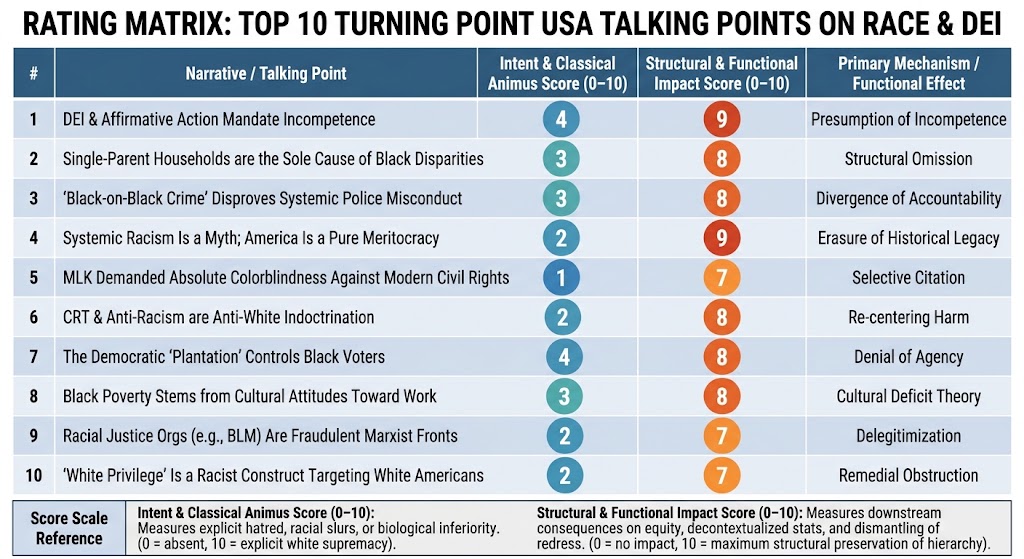
I started this inquiry because people repeatedly seemed unable to understand why I described Turning Point USA and some of the rhetoric associated with its key figures as anti-Black.
The immediate objection was predictable:
Where is the racial slur?
Where is the declaration that Black people are biologically inferior?
Where is the demand for segregation?
Where is the explicit statement that white people should rule over Black people?
Those questions sound reasonable.
They also revealed the problem.
When I asked an AI system to identify the major anti-Black narratives associated with TPUSA’s rhetoric, it initially applied essentially the same test. Anti-Blackness was treated primarily as explicit racial animus: biological inferiority, dehumanization, segregation, collective racial punishment or advocacy of racial hierarchy.
Under that definition, much of contemporary racial rhetoric disappears from the category almost automatically.
A statement can repeatedly associate Black people with criminality, incompetence, dependency or cultural failure. It can reject attempts to measure or remediate the consequences of historically documented racial discrimination. It can use accurate statistics stripped of causal context. It can transform criticism of a policy into suspicion of individual Black people.
Yet unless someone finally says, “Black people are inherently inferior,” the narrow test struggles to call the rhetoric anti-Black.
That became the most interesting finding of the entire conversation.
The problem wasn’t simply whether TPUSA met the definition. The definition itself needed examination.
And the AI’s initial response demonstrated why.
The Bias Was in the Starting Definition
The initial analytical framework effectively asked:
Does this rhetoric resemble nineteenth- or early-twentieth-century white supremacy?
That is a useful question.
It is not a sufficient definition of anti-Blackness.
Contemporary scholarship on racism does not generally restrict racism to conscious interpersonal hatred. Structural-racism research explicitly examines policies, practices, institutions and social processes that generate or reinforce racial inequality, including mechanisms that do not require prejudiced intent. (PubMed Central (PMC))
The National Academies, for example, describes structural racism in terms of public and private policies, institutional practices, norms and cultural representations that create unequal opportunities, resources, advantages and disadvantages across racial groups. (NCBI)
Research literature similarly distinguishes interpersonal prejudice from institutional and structural racism. (PubMed Central (PMC))
That changed the inquiry.
Instead of asking only:
“Does this person explicitly hate Black people?”
I began asking:
“What does the argument actually do?”
Does it create a presumption of Black incompetence?
Does it selectively explain Black disadvantage through Black behavior while minimizing institutional causes?
Does it transform population statistics into assumptions about individuals?
Does it acknowledge historical racial injury while rejecting mechanisms for measuring its continuing consequences?
Does it consistently reinterpret attempts at remediation as discrimination against the historically advantaged group?
Those questions produced a very different analysis.
A Two-Axis Anti-Blackness Framework
The conversation eventually produced a better framework.
Instead of forcing every racial argument onto a single racism/not-racism switch, the analysis uses two separate axes.
Axis One: Explicit Animus / Classical Anti-Blackness
This asks how closely rhetoric approaches traditional racial supremacism.
0 — No racial animus apparent
1–2 — Race-neutral or universalist language
3–4 — Racial generalization or recurring negative racial implication
5–6 — Explicit negative racial stereotyping
7–8 — Claims of inherent racial deficiency or collective racial unworthiness
9–10 — Explicit racial supremacy, dehumanization, segregation or denial of equal rights
Axis Two: Structural / Functional Anti-Black Impact
This asks a different question: whether the rhetoric or policy framing tends to reproduce historically anti-Black presumptions, erase relevant structural causes, apply racial statistics to individuals, or obstruct mechanisms intended to identify or remedy racial disadvantage.
0 — No identifiable anti-Black structural implication
1–2 — Incidental or weak racial consequence
3–4 — Some racialized framing or omission
5–6 — Significant reliance on racialized assumptions or contextual omission
7–8 — Strong reproduction of historically anti-Black narratives or obstruction of remedial frameworks
9–10 — Extensive functional preservation or reinforcement of racial hierarchy
These numbers are not scientific measurements of racism. They are an analytical rubric for comparing two conceptions of anti-Blackness.
And the difference between the columns is the point.
Applying the Framework to TPUSA-Associated Race and DEI Arguments
Using the conversation’s rubric produced the following assessment:
Narrative / Talking Point
Classical / Animus
Structural / Functional
Mechanism identified in the analysis
“DEI and affirmative action lower standards and mandate incompetence”
4
9
Presumption of incompetence: policy criticism can migrate into suspicion that Black professionals obtained positions through relaxed standards.
Black family structure as the principal explanation for racial disparities
3
8
Structural omission: emphasizes family behavior while minimizing competing explanations involving wealth, housing, incarceration and labor markets.
Using “Black-on-Black crime” against arguments about police misconduct
3
8
Divergence of accountability: community crime and government exercise of police power answer different questions.
“Systemic racism is a myth” / strong meritocratic explanations of current disparities
2
9
Historical discontinuity: treats formal legal equality as strong evidence against continuing effects of previous institutional exclusion.
Using MLK primarily as an argument for absolute contemporary colorblindness
1
7
Selective historical framing: emphasizes King’s character-not-color rhetoric while giving less attention to his support for targeted economic remedies.
CRT and anti-racism characterized principally as anti-white indoctrination
2
8
Re-centering: moves analysis from claimed structural Black disadvantage toward claimed discrimination against or stigmatization of white Americans.
The Democratic “plantation” metaphor for Black voters
4
8
Agency problem: can portray Black political behavior as manipulation or dependency rather than autonomous political calculation.
Cultural explanations for Black poverty and wealth disparities
3
8
Cultural-deficit framing: gives individual and community behavior explanatory priority over historically documented institutional factors.
Characterizing racial-justice organizations primarily as fraudulent or Marxist
2
7
Delegitimization: organizational ideology or misconduct becomes grounds for discounting the grievances those organizations invoke.
“White privilege” characterized principally as racism against whites
2
7
Remedial inversion: attempts to identify accumulated racial advantage are reframed primarily as discriminatory treatment of white Americans.
Again, these scores express the rubric developed in the conversation, not independently established scientific measurements.
And look at what happens.
Almost every proposition scores relatively low under the classical definition while substantially higher under the structural one.
That discrepancy is the story.
The Black Pilot Statement Exposes the Problem
Perhaps nothing made the limitation of the original framework clearer than Charlie Kirk’s widely reported statement:
“If I see a Black pilot, I’m going to be like, ‘Boy, I hope he’s qualified.’”
The defense of the statement is important to understand.
The argument is not necessarily:
Black people are biologically incapable of flying airplanes.
Instead it is:
DEI programs may prioritize demographic representation, therefore encountering a Black pilot creates uncertainty about whether ordinary merit standards were applied.
That distinction dramatically lowers the statement’s apparent racism under an intent-based classical test.
But now apply the second test.
The individual pilot has supplied no evidence of incompetence.
The observer doesn’t know his examination results.
He doesn’t know his flight hours.
He doesn’t know how he was recruited.
He doesn’t know his training record.
The observable fact triggering suspicion is that the pilot is Black.
The policy argument has therefore produced an individualized racial inference:
Black → possible DEI beneficiary → possibly relaxed standards → possibly unqualified.
That is precisely why an exclusively intent-based definition can miss something important.
One need not say “Black people are inherently incompetent.”
A social environment can produce something operationally similar by teaching people that encountering a Black person in a prestigious position should trigger a question that would not otherwise have occurred.
The distinction between criticizing a selection system and presuming something about an individual selected by that system is crucial.
“The Statistics Aren’t Racist” Wasn’t the End of the Argument
Another important correction occurred around statistics.
A statistic cannot possess racial animus.
If a racial disparity exists, reporting it does not become racist simply because the number is uncomfortable.
But that observation is incomplete.
The real questions are:
Why was this particular statistic selected?
What denominator is being used?
What causal variables were excluded?
Are arrest statistics being treated as offending statistics?
Is correlation being presented as causation?
Are socioeconomic and geographic variables considered?
Is a population average being converted into a prediction about an individual?
That final move is especially important.
Suppose some measured outcome differs between racial populations.
It does not follow that race itself caused the difference.
And it certainly does not follow that an individual member of either population possesses the average characteristics of that population.
Statistics can therefore be completely authentic while their selection, framing, causal interpretation or individual application remains deeply misleading.
Race-Neutral Language Can Produce Racially Specific Effects
This was the conceptual breakthrough in the conversation.
A rule doesn’t necessarily become racially neutral merely because the word “race” has been removed from it.
Nor does a race-neutral rule automatically become racist because racial outcomes differ.
Both propositions require investigation.
Structural-racism scholarship specifically exists because racism can operate through interconnected policies and institutions rather than only through consciously prejudiced individuals. One review describes structural mechanisms as not requiring individual racist intent. (PubMed Central (PMC))
The APA likewise describes structural racism as involving cumulative race-based inequalities produced by laws, policies and practices, including failures to correct effects of earlier explicitly racist systems. (American Psychological Association)
This creates an uncomfortable possibility:
A person can sincerely believe in racial equality while supporting an institutional arrangement that critics argue preserves a racially unequal outcome.
Intent remains relevant.
But intent cannot be the entire analysis.
The Historical-Remediation Problem
American slavery was explicitly racial.
Black Codes were explicitly racial.
Jim Crow was explicitly racial.
Housing discrimination was explicitly racial.
Numerous restrictions on political participation, employment, education and access to capital were explicitly racial.
Now imagine applying this rule:
The government may acknowledge that an injury was imposed according to race, but considering race when measuring or remedying its continuing effects is itself impermissible racial discrimination.
That creates what I came to think of as the remediation paradox.
The original harm was race-conscious.
The accumulated consequences may be racial.
But the remedy is required to become race-neutral.
This doesn’t prove that affirmative action, DEI, reparations or any particular race-conscious policy is justified. Each remedy has separate constitutional, empirical and moral questions.
It identifies the underlying problem:
How do you determine whether a race-specific historical injury has actually been remedied if consideration of race itself becomes illegitimate?
Acknowledgment Without Remediation
This produced another important distinction.
A person can fully acknowledge slavery and Jim Crow while opposing affirmative action, reparations, DEI or other contemporary race-conscious remedies.
There is no logical contradiction there.
Acknowledging an injury does not logically require supporting every proposed remedy.
But the analysis changes when every major mechanism proposed for measuring or remedying the residual effects of the injury is rejected.
At that point critics begin asking:
What would constitute acceptable evidence that the injury still has consequences?
What mechanism would be acceptable for measuring those consequences?
What remedy would be permissible?
And what evidence would demonstrate that remediation had succeeded?
If the answer continually becomes none involving race, despite the original injury having been imposed according to race, then the debate has moved beyond whether historical discrimination happened.
It has become a debate over whether its racial consequences remain a legitimate object of public policy.
What the AI Got Wrong
This is ultimately why the conversation became about more than TPUSA.
The first analytical framework effectively encoded an assumption:
Racism means racial animus.
That produced a predictable answer.
No biological inferiority?
No segregation?
No explicit hierarchy?
Then probably not anti-Black.
But that definition had quietly decided much of the argument before examining the evidence.
The research literature itself is broader. Structural-racism scholarship distinguishes personal prejudice from institutional arrangements and social systems, and explicitly recognizes that racially unequal mechanisms need not depend upon prejudiced intent. (PubMed Central (PMC))
There is even empirical literature specifically examining relationships between colorblind racial ideology and measures of anti-Black attitudes and racial-justice orientations. That research does not establish that every person advocating colorblind policy is anti-Black, but it demonstrates that treating colorblindness as analytically synonymous with the absence of racism would itself be an unsupported assumption. (American Psychological Association)
The AI hadn’t necessarily uncovered proof that TPUSA consciously intends racial harm.
It had revealed something different:
The answer to “Is this anti-Black?” depends enormously on what the system has been taught counts as anti-Blackness.
If explicit hatred is the gatekeeper, structural arguments barely enter the room.
Intent Matters. It Just Isn’t Everything.
None of this means intent should be discarded.
There is a meaningful moral difference between someone deliberately seeking Black subordination and someone sincerely advocating universal race-neutral rules.
There is also a meaningful analytical difference between:
racial hatred,
racial stereotyping,
statistical discrimination,
institutional discrimination,
structural inequality,
and
good-faith disagreement about remedies for inequality.
Collapsing them all into the same category makes analysis worse.
But collapsing racism into only the first category makes analysis equally defective.
That is why the two-axis framework became useful.
It allows us to say:
A proposition can exhibit little evidence of classical racial animus while still warranting examination for significant anti-Black structural effects.
That isn’t a contradiction.
It is the distinction the original question exposed.
The Question I Should Have Asked First
I began by asking whether TPUSA promotes anti-Black talking points.
The more revealing question turned out to be:
What definition of anti-Blackness would allow us to recognize it when nobody explicitly says Black people are inferior?
That question matters far beyond Turning Point USA.
Modern political rhetoric rarely arrives wearing the vocabulary of Jim Crow.
Arguments come dressed as merit.
Statistics.
Individual responsibility.
Public safety.
Equal treatment.
Colorblindness.
Those principles can be legitimate.
They can also be selectively applied.
The task is therefore not to declare those concepts inherently racist—or inherently incapable of carrying racial consequences.
The task is to examine how the argument actually operates:
What evidence does it select?
What history does it omit?
What causal inference does it make?
What does it assume about an individual because of group membership?
What policies does it legitimize?
What remedies does it exclude?
And who predictably bears the consequences?
That is a much more demanding definition of racial analysis than searching for slurs.
But that was the point of the exercise.
The conversation started as an attempt to explain why I called certain rhetoric anti-Black.
It ended by exposing how a definition of anti-Blackness centered almost entirely on explicit racial animus can make contemporary structural anti-Blackness analytically invisible before the conversation even begins.