

Subscribers get bonus perks: ask me unlimited gameplay questions about any review and get personal responses within 24 hours!
Check out Part 2, Castlevania: Symphony of the Night, here.
Even as a child watching my older (by six years) brother play the NES Metroid in the early 90s, the iconic escape scene captivated me, and it resonates with me to this day. This early fascination matured with Super Metroid (1994), a game consistently hailed as one of gaming's absolute best, often ranking in the Top 25 or Top 10. If you are looking for an example of something that ages like fine wine, here is the gaming equivalent.
Nowhere is that more evident than Zebes, a masterclass in world-building, lore, and this crazy concoction of abstruse, bizarre, eerie, and an underlying sense of doom. Very few games, even today, can generate anything remotely close to a jump scare. Still, several instances caught me off guard during my first playthrough and a recent second playthrough, with nervous anticipation, expertly building tension, demonstrating that the game's power remains high through numerous experiences.
The story follows Samus, an intergalactic bounty hunter, as she confronts the Space Pirates who aim to unleash devastation across the galaxy. They've stolen the sole surviving Metroid and fortified themselves on Zebes, a world they've completely rebuilt. Samus relentlessly hunts them down while also aiming to retrieve the vital Metroid specimen.
Samus is the textbook stylish, sleek, and futuristic hero. As one of the largest sprites on the SNES, she commands a powerful presence, moving with remarkable finesse. She eventually gains a plethora of movement upgrades, from hyper speed that would put Usain Bolt to shame to incredible jumps and powerful explosions. However, some of her abilities, like the grappling hook and space jump, take some practice to master. For instance, I found the space jump much easier to use horizontally than vertically, and I messed up the vertical jumps a lot more for whatever reason, but compared to the finicky grappling hook, it was a godsend. Plus lack of fast travel made backtracking time-consuming, especially before achieving space jump.
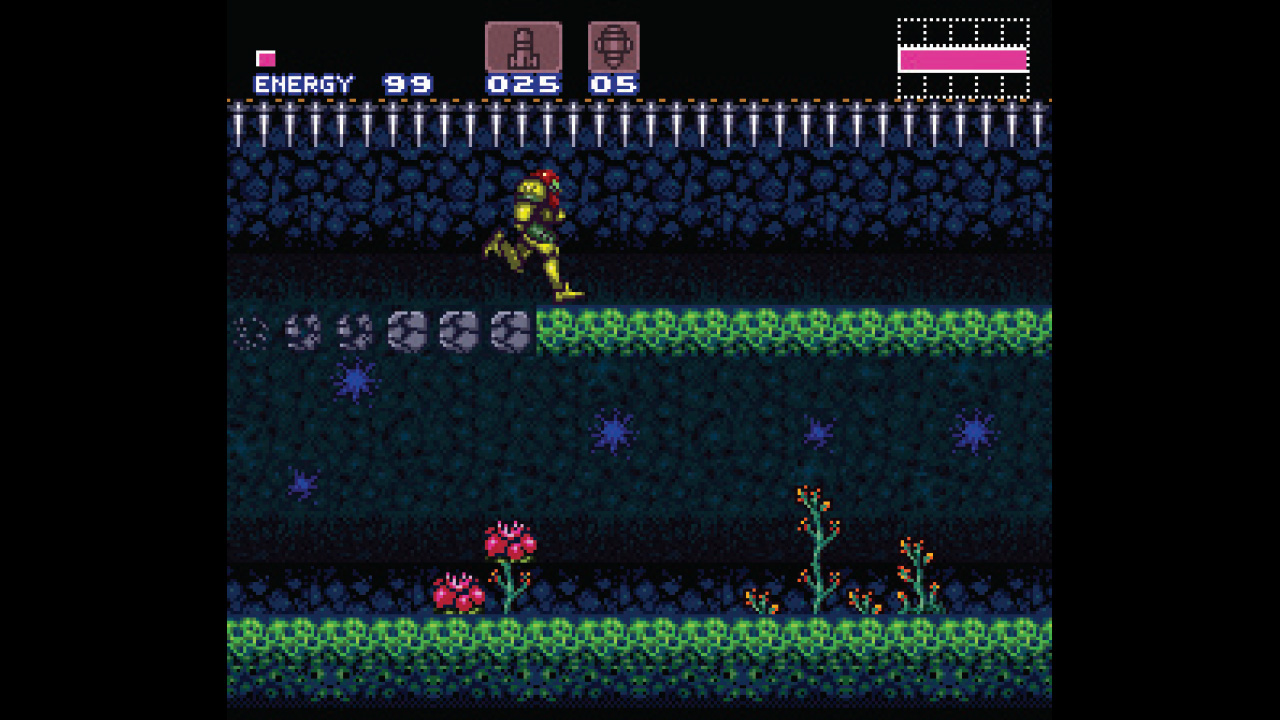 She travels through one humongous, interconnected world, chock-full of secrets buried away. If you aren't meticulous, you'll miss a lot. A hallmark of the genre is using new movement abilities and weapons to gain access to new parts of older areas that hide health upgrades and increased carrying capacity for weapons. Without finding a majority of the health tanks, the game is significantly harder. However, with full upgrades, it becomes quite manageable, even easy, though a few of the bosses still severely punish lazy mistakes.
One crucial issue that newcomers should be aware of is the potential to lock themselves into the finale by saving at the second (and last) save point in the last area. If you are short of missiles, you could be in for a hard time, if not impossible. So, without giving any spoilers, just be prepared with maxed-out missiles.
With that said, the closing three minutes of gameplay are arguably one of the most iconic sequences in gaming history: apprehensive, urgent, and undeniably badass. The music amplifies the nerve-wracking situation, serving as a perfect microcosm of the soundtrack as a whole. At times minimalistic, it often conveys more than some fully orchestrated tracks, ratcheting up the tension at precisely the right moments. This is exemplified by the catchy bleeps and bloops in the item and upgrade rooms. These sounds are ambient and ethereal, somehow sparse yet carrying a subtle, impending threat. I often find myself complaining about sound design in many modern games, where it can feel like overkill and adds little to the experience. Super Metroid is the antithesis of this. It doesn't rely on constant sound effects, but when they do occur, they're incredibly effective. Just look no further than the wails of a boss plummeting into lava. Super Metroid should be Case Study 1 on expert sound design.
More than 30 years later, Super Metroid remains an S-Tier classic that everyone should experience at least once, notably highlighted by one of the most profound gaming sequences in the history of the medium. My second playthrough on the Switch felt right at home. While a few minor flaws, like the absence of fast travel, have become more apparent over time, the game's overall atmosphere, both visually and audibly, remains unparalleled.
Wayback Wednesday Volume 1: Final Fantasy 7 and Chrono Trigger.