On July 23, I wrote about Grimm's Hollow, an interesting short RPG that just so happens to be free on Steam. Weird and Unfortunate Things Are Happening is also free and, with nearly 10x the content, might seem more appealing. But is it better? Before getting into that, I’ll note that both games are worthwhile.
In a sea of RPG Maker games, which are just a step below Kemco games, Weird and Unfortunate Things Are Happening is probably one of the better ones, along with Grimms Hollow, and it’s free to boot, so that’s a bonus. But as the adage goes, time is money, so is this game worth your time?
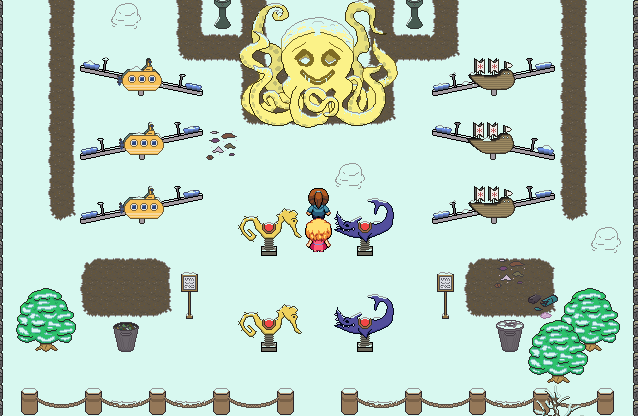 Granted, the pixel art is standard, especially the sprites of the four heroes, but the twisted world of Daybreak soon reveals its surreal, nightmarish reality. The city is trapped in some hellscape with evil beasts around every corner, and Alice must navigate through it and find her niece Dottie. Along the way to the local school, she crosses paths with the secretary of the corrupt Mayor, Miriam, Dottie’s school teacher, who is commendable for the lengths he’d go to protect his students, and finally, much later in the game, Dottie. The gap between meeting each new character, especially the last two, was a little longer than I would have liked, but it gives each their time to shine, even with their own intro.
The quartet makes their way through the ravaged city, which only gets odder as they progress, coming across the occasional survivor. The closest comparison I can make is to Earthbound on the SNES, with everything done to scale. For a fan-made amateur RPG, the world is surprisingly large, with secrets scattered throughout.
Also like Earthbound is the battle presentation, with portraits of the characters at the bottom of the screen and grotesque enemies, sometimes totally half a dozen, or in rare cases more. There are a sizable number of attacks, and paying attention to enemy weaknesses is essential to keeping sane, as otherwise, battles drag. Even with optimal attacks every round, they can feel slower than the average turn-based RPG. Otherwise, the challenge is average.
Probably the hardest part of the game was outside of fights, navigating around certain areas. Some of the largest have basic maps that can be referenced at one or two major points in the dungeon or outdoor area, but otherwise, they are few and far between. Considering the high number of twists, turns, side paths, and multiple doors available, a map, even if rudimentary, would have been beneficial to reference at all times. Some of the labyrinth-like areas also require a good memory, as finding a key or opening a new path often means remembering where you passed an inaccessible door or pathway several rooms earlier. Other than these exploration-style puzzles, the other type hides numbers around a large area that are required to open vaults later on. If you tend to get lost in real life or in games, you will get lost here on occasion. Especially when a small circle surrounds your character with pitch-black all around it.
Getting lost is always made worse by random encounters. While this game doesn’t have those, it has something close, with a meter that quickly fills up. Collecting little dots can decrease it slightly, but it surges forward so quickly you will still get into a ton of fights. In a select number of rooms, enemies appear on screen, which is honestly the most preferred way for battles to show up, as it gives the player agency regarding when to fight. Otherwise, if your desire is to run, it worked about 50% of the time, and the times it didn’t, it always worked the second time. Good, there’s nothing worse than a game that continuously refuses to let you go!
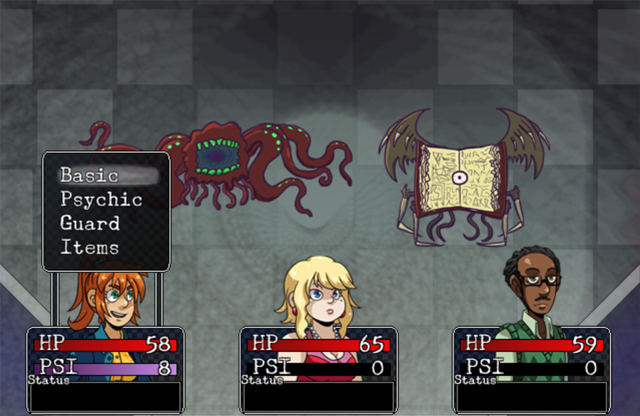 The variety of enemies is surprising for a game of its length, with some solid design, and the bosses are even more hideous and sometimes very large. The best part about bosses is the party always receives a premonition just before the most serious bouts.
Scattered around are red pools that instantly heal the party, which help with progressing through each area, at least in the first half of the game. However, later on, these tend to be one-use or even require payment on occasion. So the game slowly guides players towards resource management rather than depending on the pools, so items, naturally, become more important.
There is a respectable level of customization; each character has a small skill tree they can spend Obels on, and the biggest choice is deciding on focusing on skills or stats early on. If you reach the hidden ending and grind a little at the end, you can max out everyone. Money is slightly scarcer and is mostly used to upgrade weapons and armor, and on occasion accessories, but generally things found in dungeons and outside suffice. Again, there is some choice in how to outfit everyone, especially with the two accessory slots.
The last dungeon before the first ending is probably the worst portion, slightly obtuse, with sometimes poor visibility, and packed with enemy encounters. Making matters worse is that the music can sometimes be very jarring. Experimental and noise rock, or free jazz, can be intriguing, but in this case, the more conventional tracks were the strongest in the game. The more adventurous they tried to get, the more ear-splitting it was. One of the standout tracks was one (of the many) battle themes.
If you’re keen to just see the first ending, this should take around 15 hours, give or take, but to get the secret ending, an additional 5 or so hours should be tacked on. Oddly enough, while my opinion on the game was quickly dwindling in the closing hours leading to the first ending, it was somewhat restored during the journey through the secret dungeon.
As one minor side note, the game crashed when I tried to take a screenshot, so I never tried again. Otherwise, the performance was fine.
Weird and Unfortunate Things Are Happening is good for a week away from the more demanding games in the RPG genre and, for a free game, is one of the better Indie titles you can find on Steam. If you’re down for giving it a try, it’s a decent way to spend some time.