
Note: This review is based on the PC (Steam) version, which has had numerous reported technical issues not found in the original PS3 release.
I’ve always been a console gamer, and I don’t know much, if anything, about gaming rigs. But when I picked up my most recent laptop, the first I’ve purchased since 2018, I originally had work-related uses in mind. A tech-savvy friend, always curious about new tech purchases in our group, pointed out that, for the price I paid, it was actually a halfway-decent gaming laptop. Nothing mind-blowing, but respectable. That comment lingered with me for a few days, and I slowly became intrigued. While browsing DekuDeals one day, I stumbled across Final Fantasy XIII; each game in the trilogy was on sale for about six euros on Steam. I’d never gamed on PC before, so while the deal caught my interest, I initially kept browsing Switch and PS4 titles. One night, well past 1 am, in a sleep-deprived, Black Friday, spur-of-the-moment decision, I purchased the trio of games. So, after finishing the first, how do I feel about my purchase?
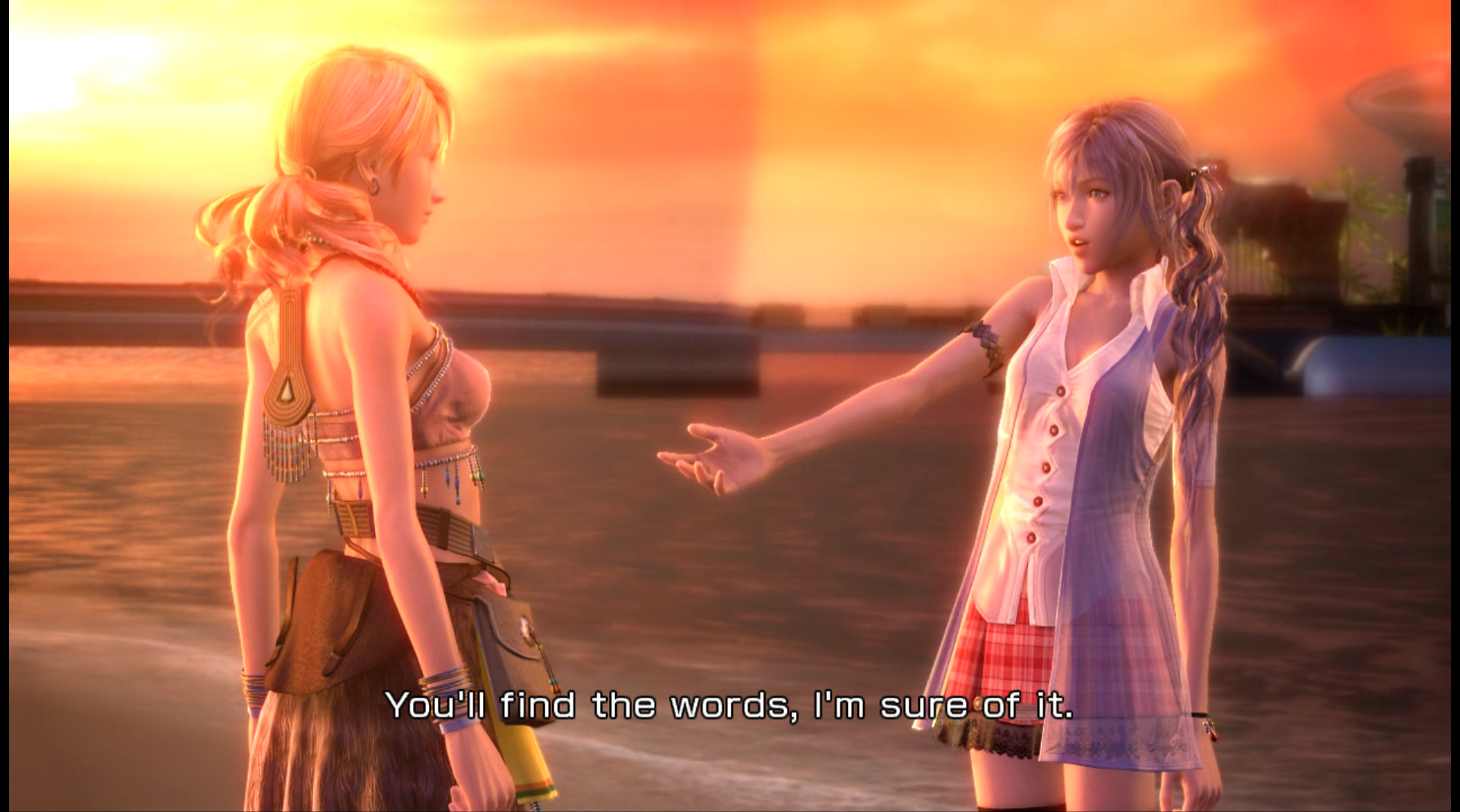 Final Fantasy XIII has an interesting premise marred by some issues I’ll touch on shortly. It is set between two worlds: Gran Pulse and Cocoon, a massive artificial sphere floating above it. Cocoon is ruled by the Sanctum, a theocratic government that serves powerful mechanical beings known as fal’Cie, who sustain the world and dictate how everything is run. Humans chosen by the fal’Cie become l’Cie, branded servants given a cryptic task called a Focus, a special, unique task they must complete. Success brings crystallization and eternal life, while failure turns them into monsters. The focus reminded me of the summoner’s duty and pilgrimage in FFX. One of my main issues is that the game often gets too caught up in its own jargon. Is it really reasonable to expect new players to effectively differentiate between similarly named but opposing concepts like fal’Cie and l’Cie?
The story follows six playable characters: Lightning, a former soldier searching for her sister; Snow, a rebellious leader and Serah’s fiancé; Vanille, an exile from Pulse with a hidden past; Sazh, a civilian pilot driven by concern for his son; Hope, a grieving boy struggling with loss; and Fang, a hardened l’Cie with ties to the Sanctum. Through these characters, the game touches on intriguing themes such as fate versus free will, oppression and authoritarianism, and the ease with which people can be dehumanized. At the same time, it also emphasizes rebellion, personal choice, and the possibility of a better future. While it’s easy to get swept up in the game’s striking cinematics, there is a genuine attempt here to tell a meaningful story and convey some solid messages, which I appreciated.
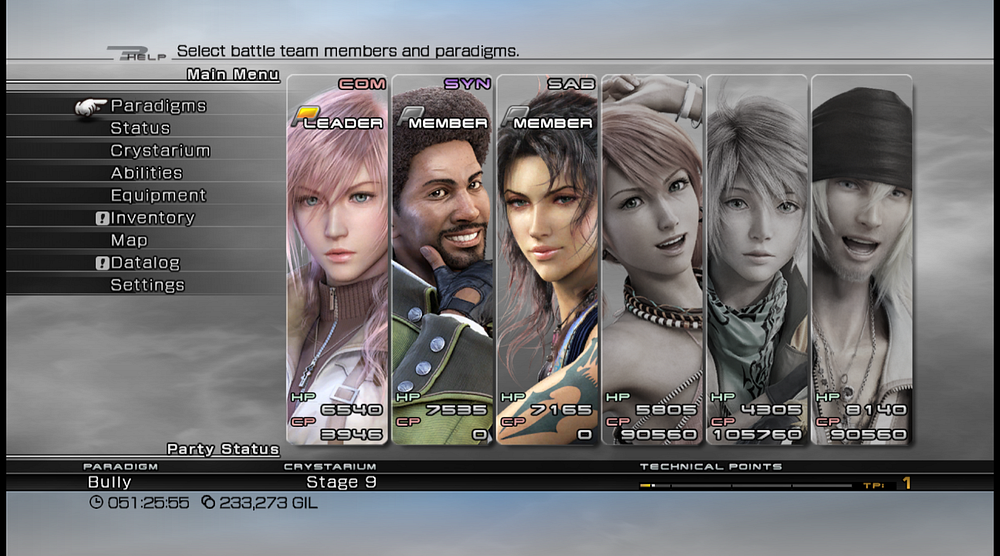 But let’s not overlook that Final Fantasy 13 is indeed a beautiful game, right down to modern-looking UI that still holds up in 2025. Along with the Mass Effect trilogy, I really think these games were ahead of their time graphically and look better than some post-2020 games. I was consistently blown away at what I was seeing until the very end. To the point where it seemed very obvious that a huge focus in the development of this game was on the aesthetics and audio-visuals, to the apparent detriment of other aspects.
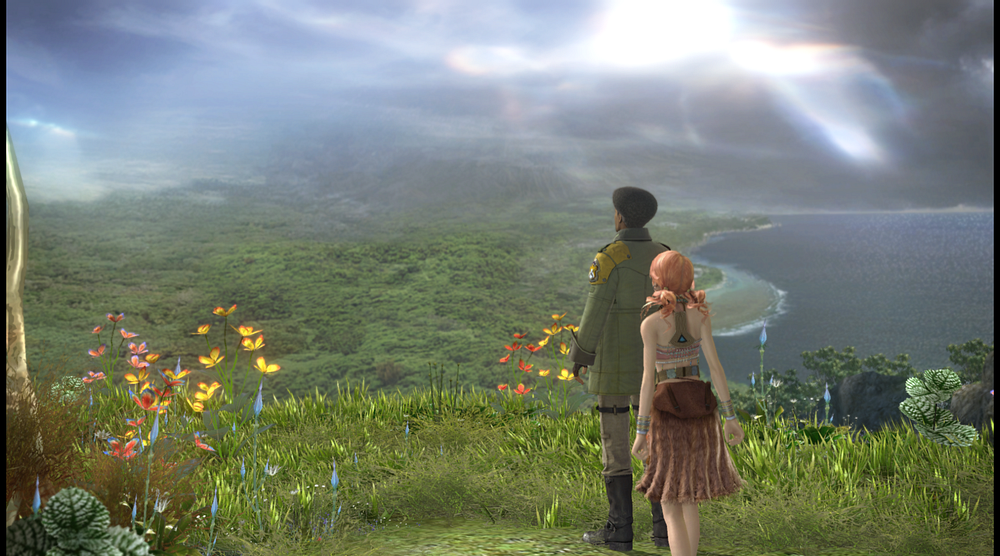 I’m not sure if sacrifices necessarily needed to be made in other areas, but in 13, they were. The big elephant in the room for any first comer is that it is highly likely that, like me, you’ve heard this is incredibly linear. This is true until Chapter 11. I always used to assume that criticism on this point was overdone and embellished, but it truly is one long corridor. There is little to no room for exploration; you go from point A to point B until about 20 to 25 hours into the game.
However, this doesn’t have to be a big deal by itself, as there is, potentially, narrative reasoning for this type of design. The problem with Final Fantasy XIII isn’t that it’s linear; it’s that nearly everything else in the game mirrors that same lack of player agency.
This extends to character customization via the Crystarium. Despite being less versatile than the license board, it still somehow felt more confusing. It took me longer to get a feel for it and find strategies to use it, partly because it is drip-fed to you for a long time. Again, you don’t gain full control until about Chapter 11. Final Fantasy 10 was likely almost as restrictive, technically speaking, but the designers did an excellent job presenting it in a way that made it feel like there was more freedom. Even though there is more of a risk of becoming a jack of all trades in 10. I’d even argue that, as far back as Final Fantasy 5, there was more freedom in building your heroes.
Yes, when the crystarium opens up, you can theoretically build your sextet any way you see fit. Again, technically, but the game strongly incentivizes assigning specific roles to each of the six. This is done by offering the best upgrades, such as ATB and accessory bonuses, as well as the character’s strongest moves, in their default role, the only role characters had access to for the first half of the game. The designers figured that, by Chapter 11, 12 at the latest, you’ll likely move deeper into a second sub-role, and again, looking at the path for each character, it was fairly obvious what the most favored secondary roles were. Although you can invest Crystogen Points (CP) into the remaining four roles, doing so comes at a real cost. Spreading CP too thin results in characters who are flexible on paper, but lack the mastery the game increasingly demands. And trust me, by the end of Chapter 12, and all of Chapter 13, you really do need to be a master in your first role, at least as a first-time player. Veterans could get away with being more experimental.
So, if this game is so one-dimensional exploration-wise for at least half the time you are likely to spend with it, what is the point? The game opens up by Chapter 11 (of 13) when you enter Gran Pulse. It is here where you are likely to get some whiplash as you’re presented with the exact opposite game design of the first 10 chapters, an open world. It can feel overwhelming as we’re trained for 20–25 hours to follow hallways and suddenly asked to self-direct navigation, hunts, and crystarium builds.
There are tons of hunts, similar to 12, in which you track down specific monsters and get rewards, sometimes very worthwhile and, at the very least, CP, which is always well-needed and welcome. I did the first 30; most were easy, but 2 or 3 were surprisingly tough. By Chapter 11, it is hoped that you are comfortable with the paradigm system, and the hunts are a low-risk way to test it. They are scattered around the open Gran Pulse, and though there is fast travel, it isn’t immediately open, so prepare to do a lot of running around and wandering, not just to start the hunt, but to find the specific monster(s) you need to slay. Even as more fast travel points open up, it still isn’t always effective for getting around efficiently. I’d claim 12 was more intuitive in that sense.
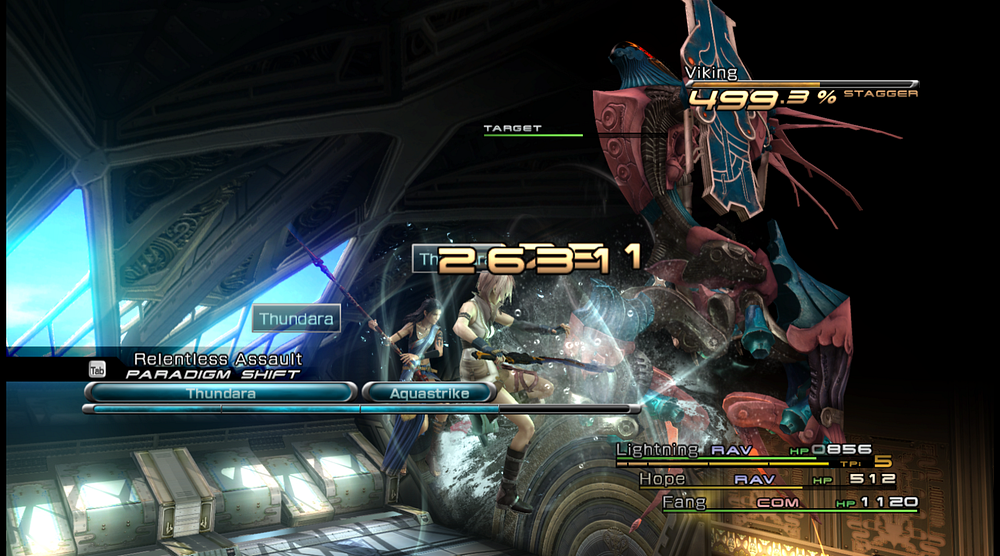 The other major critique I’ve heard a lot is that battles are “Push X” to win. While there is some validity to that, and auto-battle works for weaker random enemies, understanding the finer details of the paradigm system is key to winning the toughest boss battles. Simply pushing auto won’t always get the most out of each character’s turns. After all, when have we ever been able to trust AI to make the wisest choices? In the heat of challenging fights, having a firm grasp on the paradigm system is paramount to success.
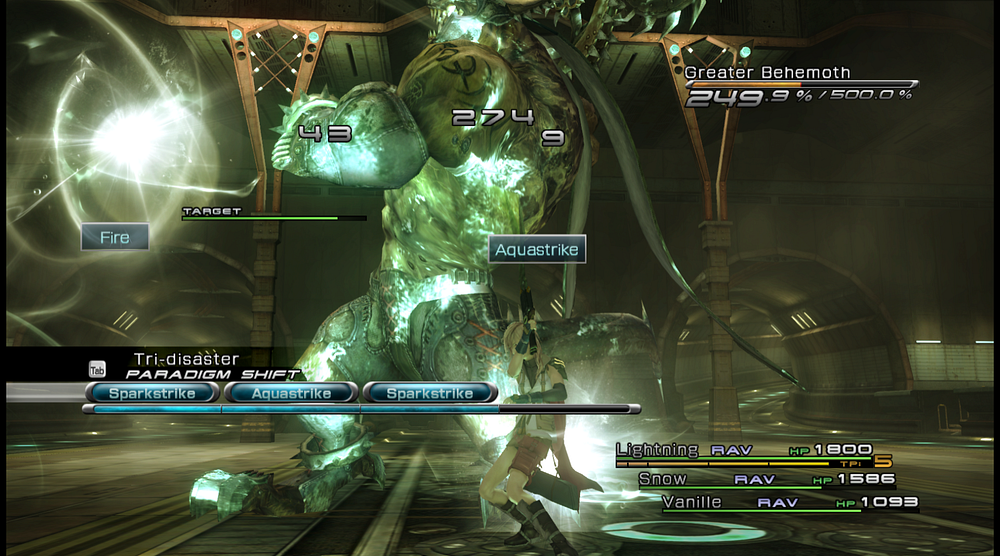 So, what is this paradigm system? It allows players to form up to six combinations, or paradigms, for their three active party members. Each combination has a name and tactical focus. Want to go all out in attacking? That paradigm is known as Ceberus (three commandos), excellent for weaker enemies or damaging staggered bosses. Tri-diaster (three ravagers) is perfect for staggering even the toughest foes, and Salvation (three medics) provides rapid, massive healing when in a pinch. Most importantly, having a good combination of roles: I enjoyed the Saboteur, Synergist, Sentinel trio to buff and debuff while the Sentinel drew enemy attention.
So what do these six roles do? The Medic heals, the Saboteur debuffs enemies, the Synergist buffs allies, the Sentinel draws enemy attention so others can attack safely or heal, the Ravager fills the chain gauge to stagger foes, and the Commando deals the most serious damage. In the most challenging fights, you’ll probably switch paradigms dozens of times, sometimes within seconds of each other. You could throw six paradigms together and push X to win. But this is where the variety shows its head; there are 56 possible Triple paradigm combinations, so experiment and see if there is an unheralded paradigm you prefer, and have a blast experimenting!
Final Fantasy 13 also boasts a robust but obtuse crafting system. There are tons of possibilities, but the game doesn’t do a good job at all of explaining much of anything. Plus, again, it doesn’t really come into its own until the later chapters, partially because money is at a premium for so long. But also, because characters are in and out of your party constantly. I didn’t mind, to an extent, as it forced your hand to not only become familiar with all six but also comfortable.
Still, I held off on crafting until the closing chapters, even though materials became available, via enemy drops and chests, much earlier. Materials are what are used to strengthen weapons and accessories. Organic components increase the multiplier, up to x3 experience, which is quintessential for efficient crafting. Once you have the x3 experience boosting, many electronic components or high-tech items will help your weapons level up quickly. What the game does a poor job of is telling you that once a weapon reaches maximum level (expressed with a star), as long as you have a catalyst, a weapon can be enhanced to a superior weapon.
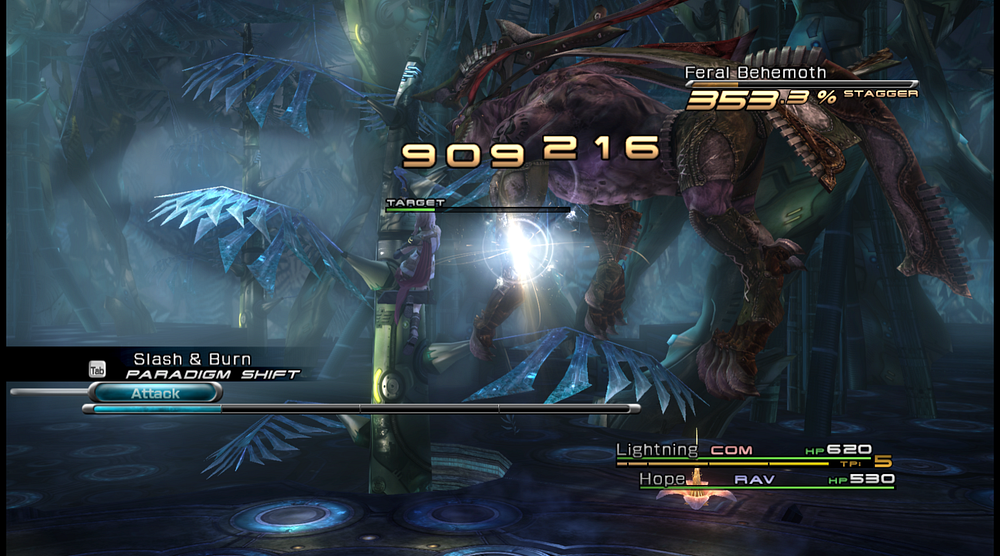 Difficulty-wise, I found the game to be fairly easy, though it was odd to face behemoths so early on compared to any other title in the series; at least they weren’t too hard to take out. There was a drastic spike in the last chapter, 13, that threw me for a loop. I played the entire game on normal, but had to set the last boss on easy. It is a long, arduous, three-part marathon, and by this point, I was just ready to move on. To be fair, I did not know I could enhance my starred weapons to the next tier, which certainly left me weaker than I should have been. Other bosses serve as barriers that demand you know a detail about the paradigm system, and once or twice, I looked up a solution online, like using Sentinel versus one of them to win. Also, be aware that if your lead character dies in battle, even if the other two are at full health, it is an instant game over, which was a vexing design choice.
It should also be stated that Final Fantasy 13 has a phenomenal soundtrack headlined by the effortlessly beautiful “My Hands” by Leona Lewis. It is memorable without being overbearing and timely when it appears during key moments. The boss battle theme is bombastic in the best sense, impressively grand and sweeping, matching the stakes of the fight.
Despite my criticisms, Final Fantasy XIII will always hold a special place for me, much like Ni no Kuni or Tales of Zestiria. Each of these was the first game I played on a new platform: Steam, Switch, and PS4, respectively. That said, some readers may be wondering how Final Fantasy XIII performs on a modern, budget gaming laptop. With the specs listed below, it ran almost perfectly after a minor adjustment. In full-screen mode, the game crashed once at startup and experienced a few instances of severe slowdown. After about five hours, I switched to Windowed full-screen mode, and it ran flawlessly for the remaining 45 hours. I don’t know much about PC gaming; it’s an Intel Core i5–13450HX, 13th Gen, 2.40 GHz Processor, 16 GB Ram, and NVIDIA GeForce RTX 3050 graphics card with 6 GB GDDR6. Nothing special, as far as I can tell, but it got the job done, and I didn’t need to download any of the patches that are sometimes mentioned online.
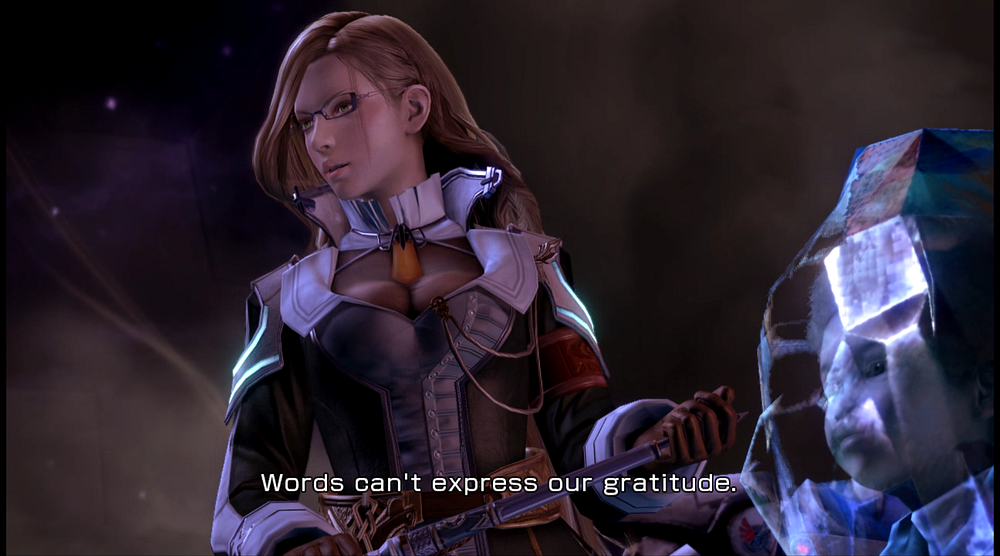 In the end, I enjoyed my time with this game and, just based on part 1 of the trilogy, happy with my purchase. The shortcomings were evident, but it wasn’t enough to hamper my overall experience. If you are new to this trilogy, temper expectations; expect a lot of cutscenes and enjoy the ride.
Check out my reviews of other Final Fantasy titles: