
Note: This review is based on the PC (Steam) version, which has had numerous reported technical issues not found in the original PS3 release.
I’m going to address the elephant in the room immediately because this elephant is angry, and it doesn’t need to be, since the door leading outside to vast areas to roam, food to chomp on, and water to splash in is right there. Square is the penultimate developer in RPGs, producing state-of-the-art graphics that age like fine wine, always innovating with gameplay that pushes boundaries (even if it’s a miss sometimes). We fans tend to be forgiving. So it’s baffling, and quite frankly disappointing, that the PC Steam version would be so fundamentally flawed and crash constantly, often immediately after the tutorial battle.
Fans have pleaded for fixes for years, and the company has ignored them, never releasing a patch, despite clearly having the resources to do so. That is shameful and unforgivable. I almost gave up on the game myself until a fan-made patch saved it. Don’t get me wrong: I’m grateful to the community, but the ability to play a game shouldn’t fall on the players, point, blank, period. That failure is Square’s, and it tarnishes their reputation, leaving me hesitant about future releases despite my love for so many of their games.
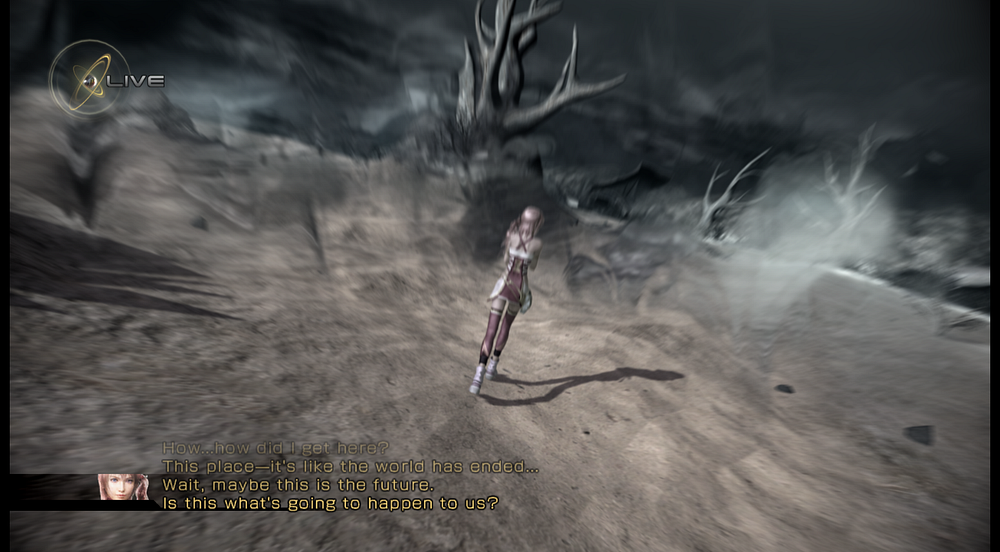
Thankfully, once I installed the fan-made patch, the game ran fine by my standards, for the most part. I’ll admit I’m not a PC gamer, so I don’t have a working knowledge of the in-depth lingo, nor the expectations. I’m what you would call a casual. But for casual gamers looking to dive into the trilogy and more specifically the second game, once the patch is installed, its performance is close to fine. Still, there were a few times my game would freeze at the worst possible time, in the midst of saving, stuck on the screen with the little yellow circle in the top left. Thankfully, I save often and in multiple slots, so I never lost any progress, but it was still unnerving in the moment. Otherwise, my game never froze, and I had, at least by my standards, almost no slowdown to speak of. I’ll list my specs at the end of the review.
Shifting gears to a more humorous note, the game’s narrative instantly reminded me of an old Simpsons episode. In Treehouse of Horrors VI (1994), Homer tries to fix his broken toaster and accidentally turns it into a time machine. Upon arriving in the past, he recalls his father’s warning that even the smallest changes can trigger a rippling butterfly effect of unimaginable proportions. Homer repeatedly returns to try to fix the resulting time paradoxes and restore the world he knows. In many ways, that last sentence sums up Final Fantasy XIII-2 perfectly.
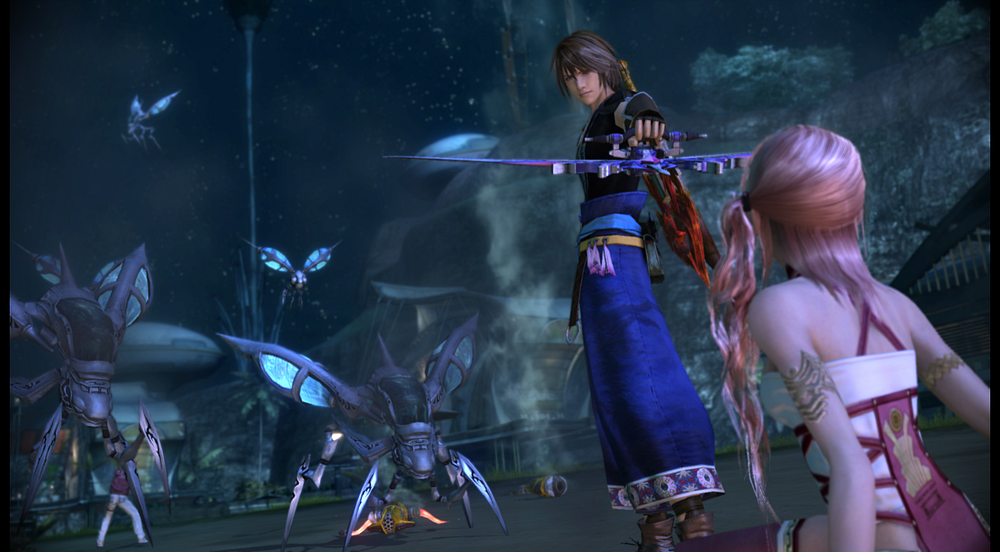 The plot is fascinating, dealing with time warps and alternate dimensions. I’ll admit I easily get distracted and thus lost in the abstruse nuances of time-traveling stories, but I found some of the fundamental overarching themes engaging and captivating, even relevant. Ideas of free will versus fate, destiny, perseverance, responsibility, and the consequences of choices. The basic premise is that Lightning is lost and her sister, Serah, wants to help find her, with the aid of Noel, a warrior from the future.
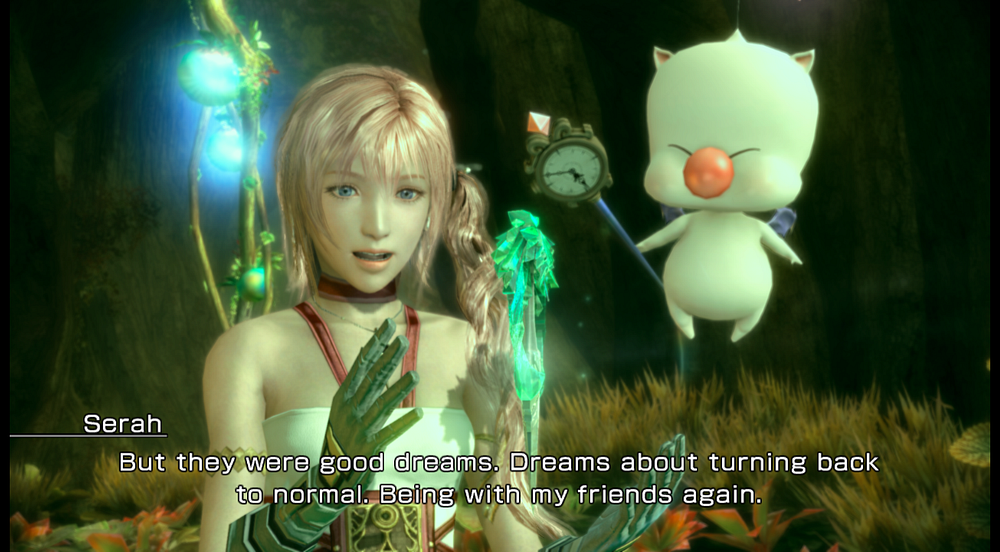 But an unease started to creep in for me that was hard to put into words: It was difficult to care about a world that Serah wanted to reshape to fit her own ideal vision, as if her goals were very subtly at odds with both Noel and the player who had already invested so much time in learning and understanding that world. It struck me as unintentional, even, but it was noticeable. Serah’s motivation is clearly personal, while Noel was more generally trying to prevent paradoxes and protect the future. From a philosophical perspective, Serah usually acted from hope and emotion, while Noel increasingly felt burdened by consequences and restraint, a contrast that becomes clearer as the game progresses.
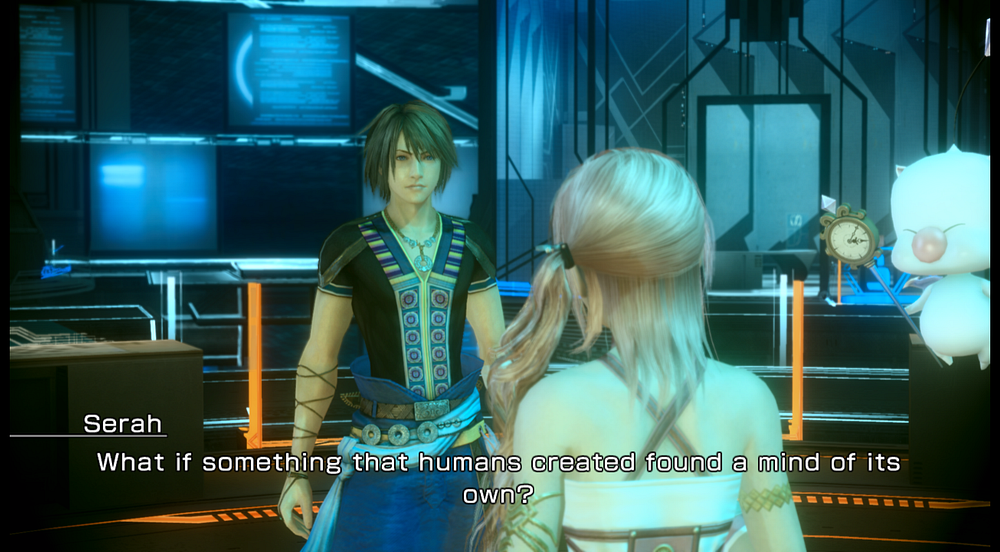
I was surprised by the level of narrative depth by gaming standards, even if it was sometimes clumsily executed. I’ll note that when the story is firing on all cylinders, it delivers some incredible scenes. One of the most goosebump-inducing scenes I’ve ever experienced in a game occurs towards the end. It’s surreal and subtly eerie, leaving me with a quiet, lingering unease. Plus, I could identify with 13-2’s main antagonist as he was operating in a morally gray area, and his icy, intimidating presence was intriguing. If nothing more, play the game for him.
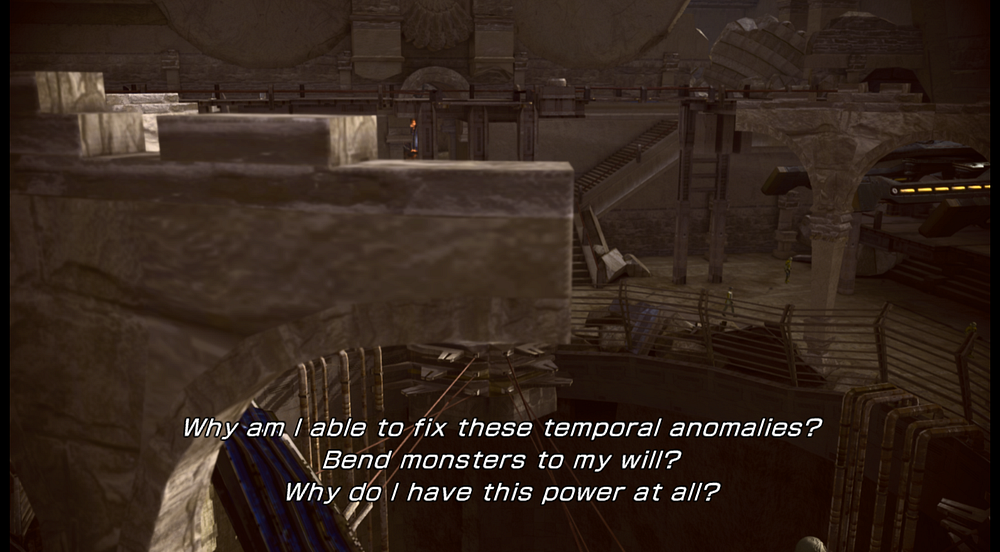 Additionally, the game can be very obtuse and cryptic regarding how to proceed, and I had to consult a walkthrough several times. Unlike 13, which was streamlined to the extreme for the first 10 chapters of its 13 chapters, there is far more freedom and open areas, almost a complete 180 from the previous game. This is no longer a hallway simulator that some critics called it. Once you enter the Historia Crux, more or less an enlarged, fancier version of Chrono Trigger’s End of Time, there are plenty of possible options regarding how to proceed. In fact, if I didn’t know any better, this could have been the next logical step in the Chrono series after Cross.
What I took issue with was how well hidden some of the artefacts were. These aren’t random items, but are necessary to proceed and open up new time periods and dimensions, and I don’t know how players could be expected to find them on a blind playthrough of the game. I used a walkthrough to track down several of the wild artefacts. Otherwise, I probably would have pulled my hair out and been bald by the endgame, nearly 35 hours later, trying to find them all.
The paradigm and crystarium systems from Part 1 return, but they were more flexible and, thus, manageable in the second part for two reasons. One, you have two main characters for the duration of the game, so you can focus all of your energy on building them up. As opposed to part 1, where, at least personally, I felt I was spreading my attention thin between the six characters. Here, I got to know the ins and outs of my two mains. Two, the crystarium system has been made more intuitive. It also takes less time to open, allowing for more flexibility and quicker.
The six roles from Part 1 still exist: Medic, Saboteur, Synergist, Sentinel, Ravager, and Commando. The Medic heals, the Saboteur debuffs enemies, the Synergist buffs allies, the Sentinel draws enemy attention so others can attack safely or heal, the Ravager fills the chain gauge to stagger foes, and the Commando deals the most serious damage. There are no branching paths; each of the six roles can go up to level 99, so your choices are between picking what role to level up, rather than what branch to take within each role, like in part 1. Even with limited grinding, I was able to master (level 99) two roles per character, and each character had two other roles over 60, with a 5th role in the high 30s. So, while it might seem daunting at first, CP, used to level up roles, will continue to pile up as you progress. Once a certain number of levels are gained, there are also bonuses you can pick from, anything from making a specific role more effective to being able to equip more accessories to adding an extra slot to the ATB, the last of which should be a priority by the way.
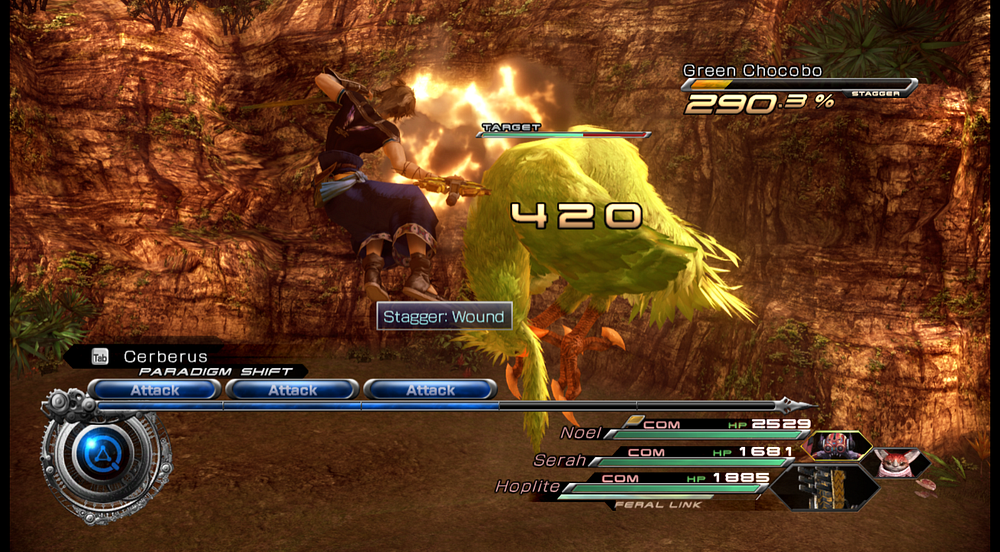 Plus, many different side quests offer rewards, such as CP. Usually, the CP was disappointing, but there is plenty of extra information that can be obtained from completing them. Also, finding special items can lead to CP rewards and other valuable benefits. Some of the late-game optional battles are very hard, but well worth it. Plus, some quizzes ask ridiculously tough questions about the lore of the game and other details. Admittedly, I looked up the answers online, as you have to get 10/10 for the reward. Though sometimes the question is extremely stupid, like “left or right” or “black or red,” where the “correct” answer is random. Truly vexing if one of those pops up in the later stages of a quiz. Mog, yes, the famous one from 6, or 7, among other titles, also serves as a valuable, though exasperating, companion who can be thrown to get distant items or uncover objects and items stuck in other dimensions.
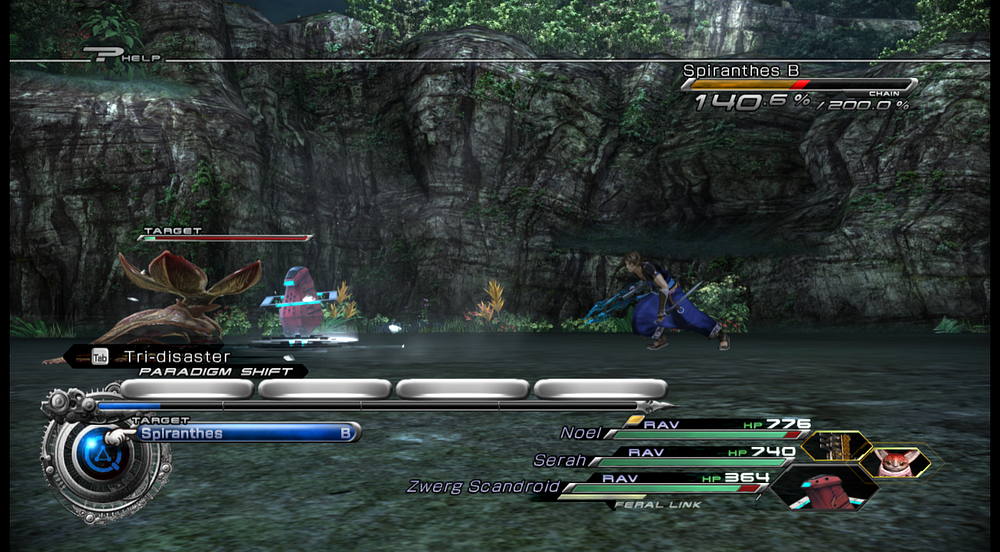 Battles play out much like in Part 1, with a few small tweaks. When an enemy is nearby, a circle appears around your character, giving you the chance to strike first and gain a pre-emptive advantage. It feels like a hybrid between classic random encounters and visible enemies on screen. But my goodness, are these encounters absurdly frequent, truly incessant, like a swarm of hungry mosquitoes.
Second, during major battles, there are quick-time events, usually to finish the fight, that require specific, timely button presses. They reminded me a bit of the Yakuza games. My only issue was that the on-screen buttons were for PC, and I couldn’t find a way to display PlayStation controller prompts instead. Thankfully, I found a workaround: I took a picture of the buttons and paused the game to refer to it, matching them to my PS controller.
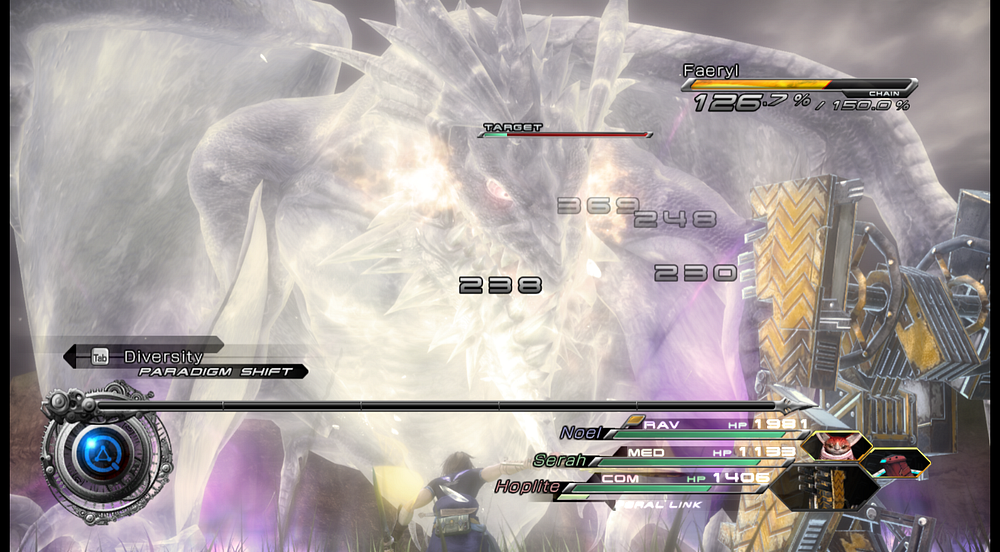 The paradigm system is back, first and foremost. This system allows players to form up to six combinations, or paradigms, for their three active party members. Each combination has a name and tactical focus. Tri-diaster (three ravagers) is perfect for staggering even the toughest foes, and once the stagger gauge is filled, enemies take more damage. Want to go all out in attacking? That paradigm is known as Ceberus (three commandos), excellent for eliminating weaker enemies or damaging staggered bosses. Salvation (three medics) provides rapid, massive healing when needed.
Having a good combination of roles is important. I enjoyed the Saboteur, Synergist, Sentinel trio to buff and debuff while the Sentinel drew enemy attention. But here, moreso than in 1, I largely stuck with three ravagers, followed by three commandos to dispose of enemies quickly. My hand was not forced as much to diversify my paradigms compared with the first game. I hardly used Saboteur and Synergist until the late game.
The first major tweak is that a monster fills the third slot in your battle party. Once captured in battle, they are aligned with one of the six roles. I solely focused on Commando, Ravager, and Medic roles and, honestly, didn’t even focus on monsters from the other three roles. They also have their own crystarium and, especially late game, they can be made into very formidable allies. To the point where my Commando did a decent chunk of damage to the last boss, and my medic saved my butt several times in that same battle. These creatures are strengthened using materials found throughout the world and dropped items from enemies. My suggestion is to hoard materials as long as possible and only use them once you start to see that your monsters aren’t pulling their own weight. In fact, I would even recommend researching the best mid-game and late-game monsters, as it can be overwhelming to go about on your own. These companions also have feral links, a gauge that, once filled, allows for powerful moves such as a special attack or ample healing. More or less, the sky is the limit for what you decide to do with them!
Compared to Part 1 of the trilogy, I found the opening of 13–2 harder, but by midgame and endgame, it was much easier. The last boss gauntlet, however, was outrageous. It consists of five battles with lengthy cutscenes in between, culminating in the final boss, who requires you to defeat two underlings before you can do any damage, and this several times throughout the fight. There is no option to save. I freaked out when I lost my first attempt, but thankfully, you can start from the fifth battle rather than replaying the first four, though you also have the option to reload a save from before the gauntlet (No thanks!). If the underlings were revived at set thresholds, like 75%, 50%, and 25% of the boss’s health, it would be more bearable, but instead, they were relentless. In this battle, and in general throughout the game, aggression is key.
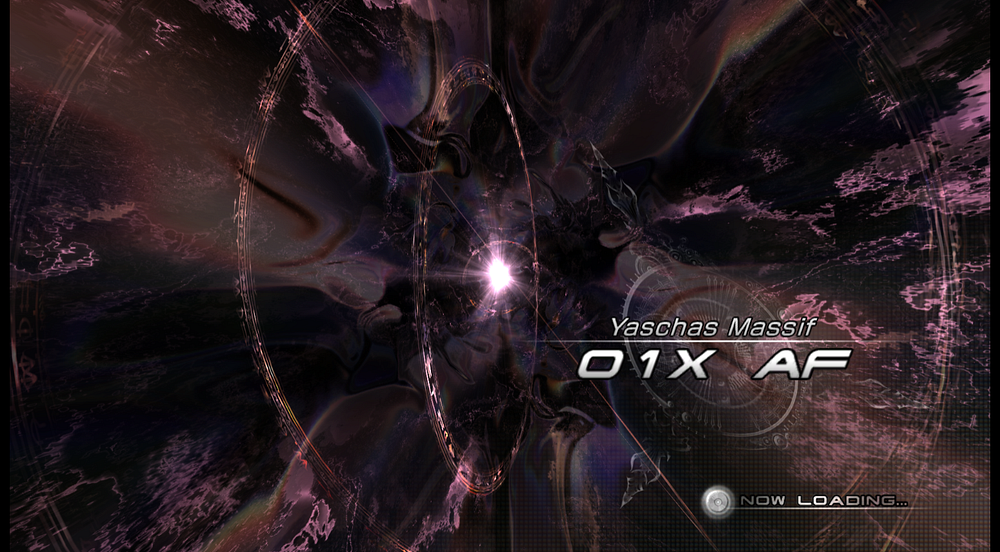 Even though this was released nearly two years later, it looked slightly less polished than part 1. Still, it’s a beautiful game, though I preferred the UI and menus in the previous game; it still looked slick. The cutscenes, however, were still breathtaking, and I was consistently impressed at what I was seeing until the very end. There are significantly more diverse and varied locations compared to part 1, and monster variety improved as well. Square is known as a pioneer in the gaming industry, especially regarding graphics, and its games often age very well. This game is no different. My favorite, and perhaps most underrated, aesthetic aspect of the game was the transition screen from the Historia Crux to a chosen location, truly trippy and visually striking. It reminded me of the classic Windows Media Player visualizations from the early 2000s.
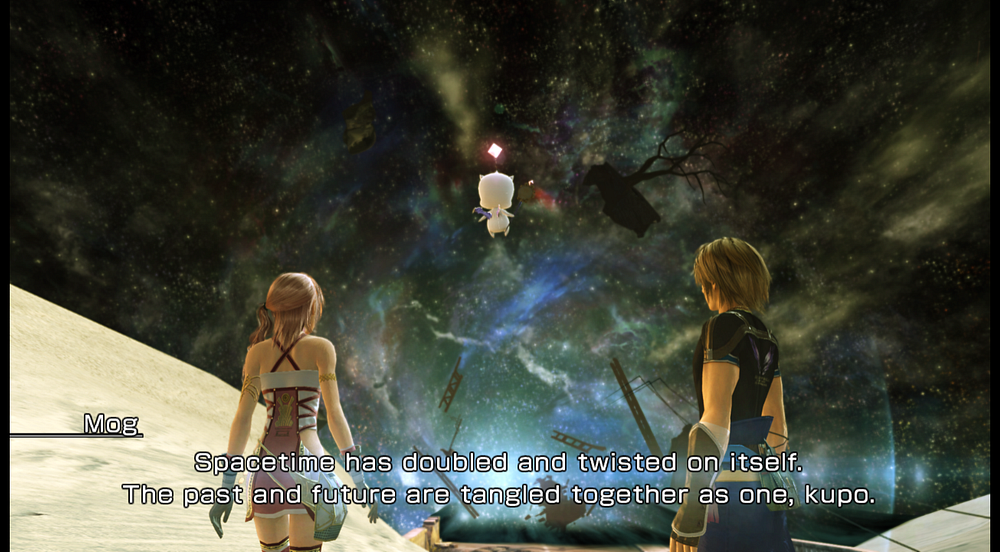 The soundtrack was top-notch, with memorable tracks spanning a wide range of moods, from poignant to mysterious, with the threatening boss theme standing out as the best. The voice acting was excellent as well. However, and it pains me to say this, as much as I love Mog, one of the only mascot-type characters I actually like, he was incredibly annoying in this game. Especially when you had to throw him repeatedly, and the constant “Kupo” at the end of every sentence felt just plain hamfisted. My other gripe: while I enjoy heavy metal to some extent, Crazy Chocobo was a terrible song.
 I ran this on a modest, modern budget gaming laptop in windowed full-screen mode, and after the patch, other than 2 freezes on the save screen, it ran flawlessly. I don’t know much about PC gaming, but it’s an Intel Core i5–13450HX, 13th Gen, 2.40 GHz Processor, 16 GB Ram, and a NVIDIA GeForce RTX 3050 graphics card with 6 GB GDDR6. In layman’s terms, from what I understand, the fan-made patch increases the amount of Ram the game can access from 2 GB to 4 GB, and is mandatory to run the game.
 This is an incredibly difficult game to review because, technically, it is not “playable” on Steam, so I’ve assigned it a score just below that. Without the fan-made patch, which never should have been necessary, the PC version is a mess. That’s what makes this so frustrating: aside from its technical state and slightly weaker visuals compared to part 1, Final Fantasy 13–2 is an improvement in nearly every other way. Even now, in December 2025, that elephant is still angry because the fix seems easy, but the official solution is nowhere to be found. As much as I enjoyed my time with the patched version, I cannot recommend it unless you’re willing to deal with the unnecessary hassle of installing a fan fix. And let’s be honest, even thirty seconds of effort to make a commercial release functional is thirty seconds too many. It’s a real shame, because beneath the banged-up hood is a respectable and arguably great game.
Check out my reviews of other Final Fantasy titles: