
Subscribers get bonus perks: ask me unlimited gameplay questions about any review and get personal responses within 24 hours!
Dragon Quest and Final Fantasy. It is safe to say that many RPG fans would view these two series as the two quintessential role-playing series for console gaming. Where Final Fantasy is constantly evolving and taking risks, sometimes leading to games that are quite polemic in the gaming community, Dragon Quest, more often than not, is one of the most consistent series. I played Dragon Quest 8 for the first time in the Autumn of 2021 and couldn’t wait to finally sink my teeth into Dragon Quest 11. Originally developed and released by Square Enix in 2017, I was eager to see if 11 would take the plunge towards massive innovation, or if the series would be content to continue down a fairly predictable path while stopping to painstakingly take care of everything on that path.
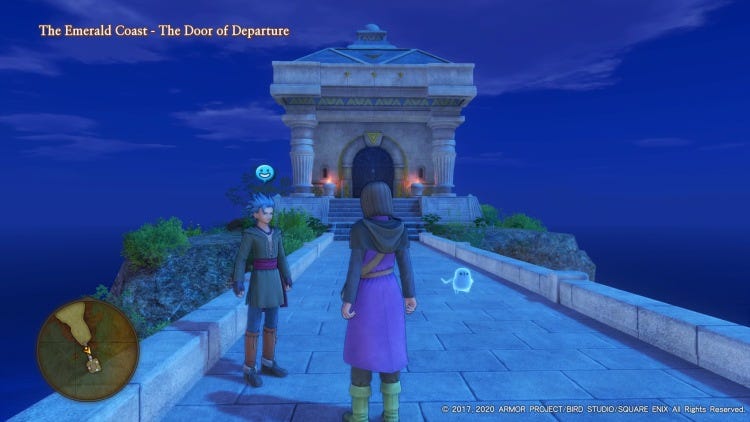 For those familiar with Dragon Quest, there are certain aspects of the game that will help you instantly feel at home. The orchestrated music sounds so familiar, but fresh at the same time. Tracks in Dragon Quest games are, generally, interchangeable. While this might not work for, say, Kemco’s mobile series, music in a Dragon Quest game is like mom’s cooking: comforting, delicious, and safe. There are the playful tunes of the early towns, the enigmatic songs of far-flung dungeons, and hyper-competitive enemy and boss battle anthems, ready to inject some tension into the air. Furthermore, many of the sound effects from older games are reused, to perfection, in this installment. It adds a certain charm while showing respect to the 10 games that came before. It was interesting to pick out all the sounds I had heard in previous games. Although seemingly small, it is yet another way to help gamers feel snug while becoming immersed in the world.
The world is indeed very inviting, ready to be explored, but I was disappointed as it felt like it was not as large as 8. Just the same, exploration felt way more manageable in 11. With 8, there was this constant, unrelenting hunch that I was missing something, even if I tried to comb the area as thoroughly as possible. Here, it is not like everything is laid out in front of you, but they get to the point.
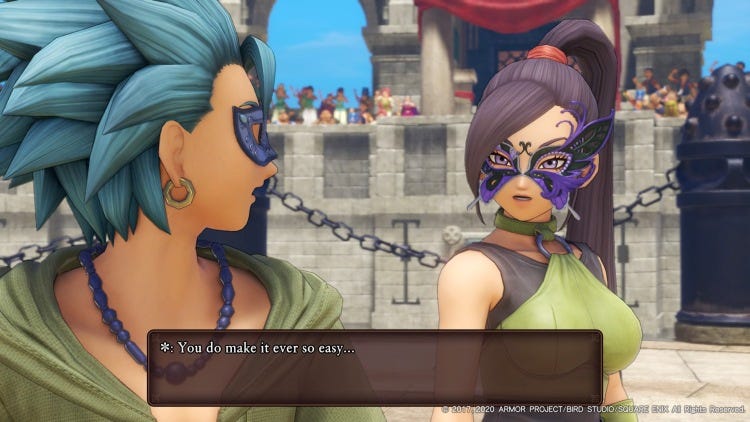
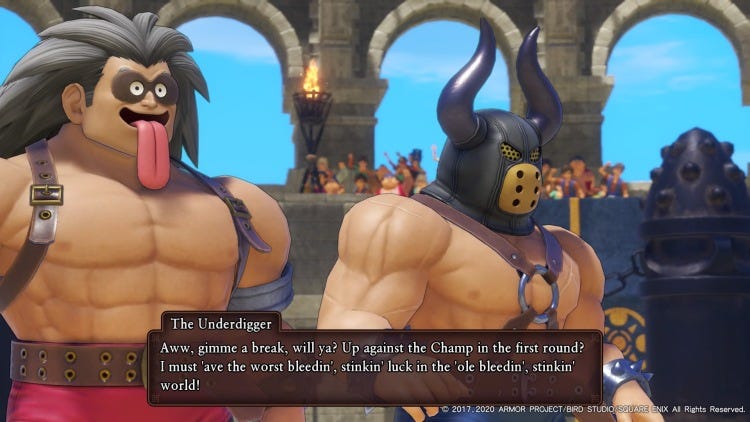 It was a pity to see Level 5 missing from development on this game, but the characters and monster models were still spot on, in the same spirit as 8, but looking even better. If you haven’t sensed a theme yet, yes, many of the monsters in this game have been seen in numerous Dragon Quest games of the past, the slimes being the most notable. There is a certain goofiness that is seen in many of the monsters, such as the one big doofus you fight in an arena tournament with his tongue hanging out. The series has always had an off-kilter sense of humor, sometimes subtle, other times understated, but never jumping up and down yelling, “Look at me, I made a funny.” It is just there, and it fits in with the world somehow.
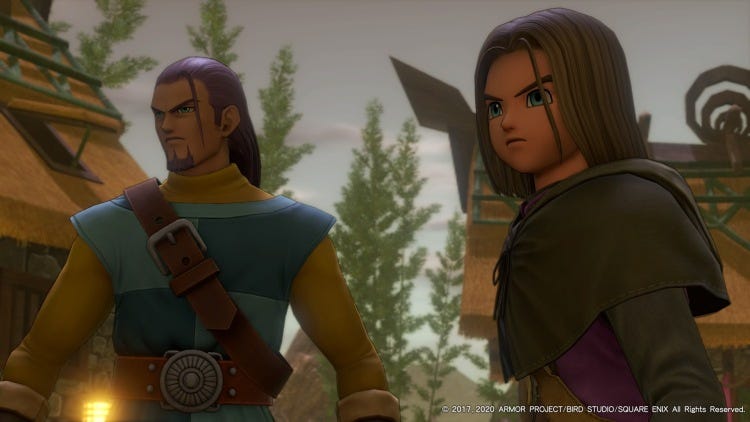 One tradition I could do without, though it is not a huge deal, is the silent main protagonist, a staple for Dragon Quest games. It isn’t even that he is mute, but he has limited facial expressions, too. When talking about more successful silent main characters, I always harken back to Crono from Chrono Trigger. Yes, he never said anything, but he had a huge range of facial expressions and body movements that were, at times, downright hilarious. Here, there is little reason to care about the lead.
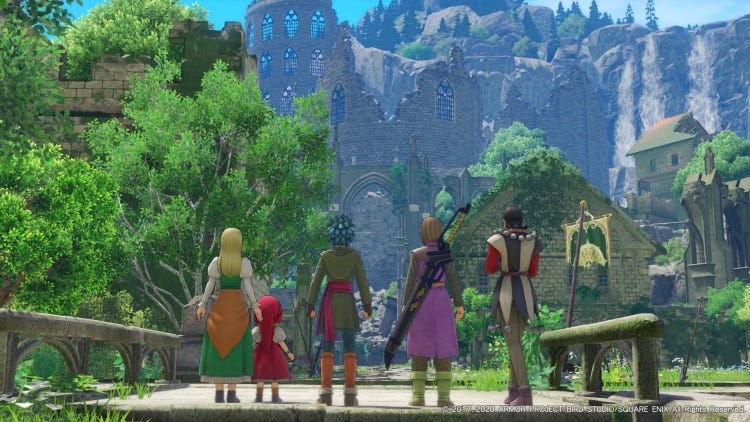 Otherwise, the cast of characters is pretty likable. There is the flamboyant Slyvando, who is steadfast in his affections toward those he cares about. The thief turned main right-hand man (to the lead) in Erik, the sensuous Jade, mostly chilled out, somewhat naive Serena, and her quicker-witted twin Veronica, and old man Rab, who, thankfully, isn’t a perv like some of the older characters in other recent RPGs. He is a pretty respectful, honorable old man with some nice story secrets to uncover while progressing through the plot. I was slightly annoyed that Hendrik seemed to take a back seat (and isn’t even on the cover despite playing a pretty big role in the story.
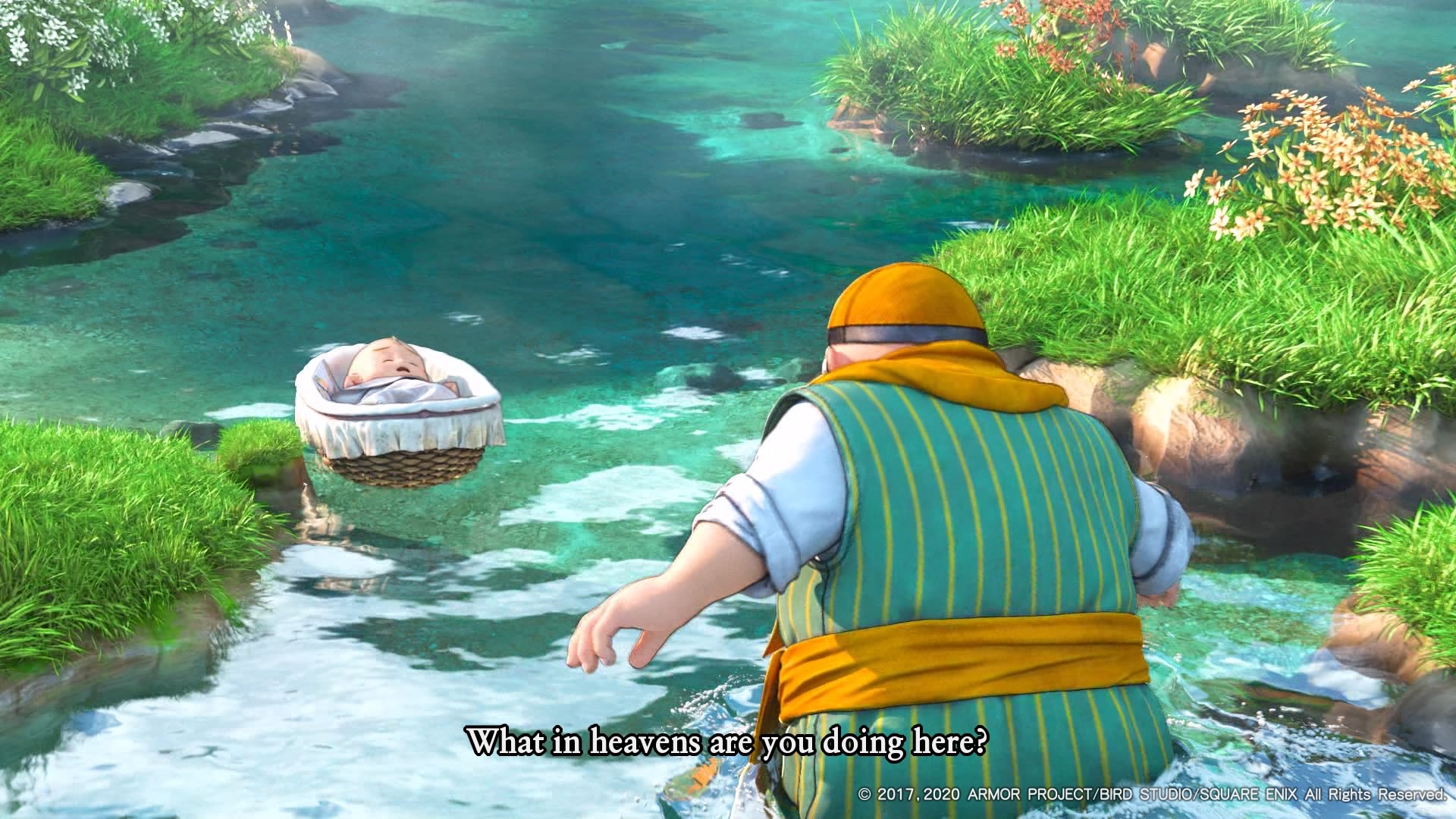 The story is decent, though I do admit to stopping after Act 2. I liked the game enough to eventually continue with Act 3, but my backlog is still lengthy. Plus, I admit to being more of a fan of having the large majority of a game’s content within the confines of the main game while making the optional stuff not key to the main plot. Just the same, I look forward to revisiting the 3rd optional Act. The story centers around the Kingdom of Dundrasil, which is under attack as the game starts. The main character is seen as a baby, placed in the water to float downstream, hopefully to safety.
 While Final Fantasy 6 was one of my favorite games, I admit to being less than thrilled at the portion of the game, at the start of the second half, where you had to run around the world collecting characters. Yes, it added to the background of each character, but I would have preferred to learn about them via character and party interactions and in different ways. A large portion of the second half of this game tasks you with tracking down the other party members. There were some intriguing story elements, but otherwise, gameplay-wise, it felt like unneeded padding and what turned me away from the post-game content. Going to mostly all the same areas in Act 2 started to feel old, and the prospect of repeating that for the extra content was slightly off-putting, especially after the first two acts took nearly 60 hours.
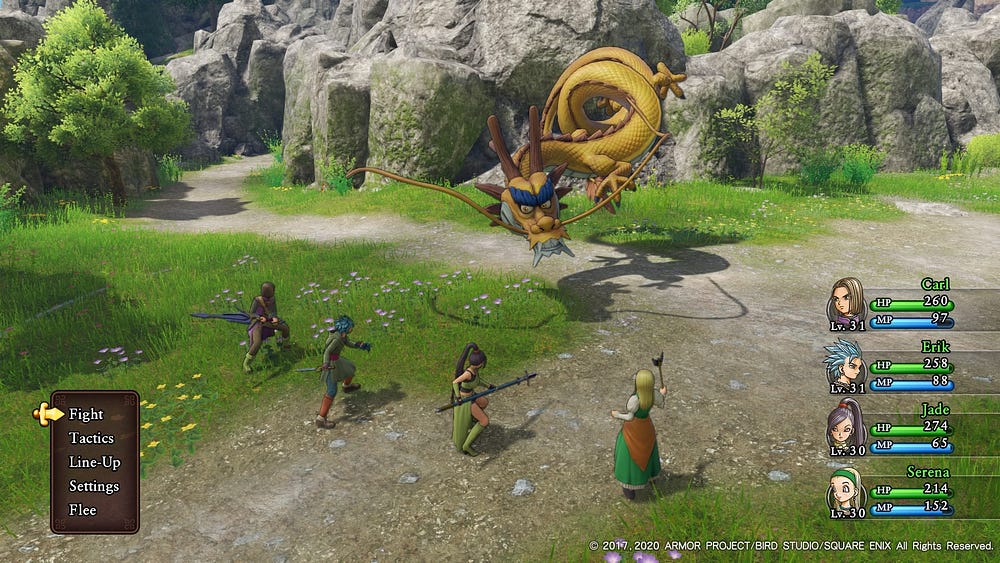 Still, the game is entertaining. Enemies can be seen on screen and easily avoided. Of course, because they were so easy to avoid, I couldn’t help but want to fight. Had there been random encounters, I am sure I would have felt differently. Once in battles, it is pretty standard JRPG fare. Like 8, but even faster-paced. I enjoyed the tension system in 8. It was something you could control, and there was a high-risk, high-reward system. In its place is the more random pep-up. You don’t quite know when it will occur, but it allows for increased stats, attacks, and some super-powerful special attacks.
Outside of battle, levels occur as usual, and similar to 8, you can assign points to different weapons and abilities. It works like a typical ability grid system, but I did not like that it was not always certain what could be uncovered if you decided to go down a specific path. I played this game largely blind (95+%), and it went without issue. I finished it with no problem at level 50, but it might be wise to check out a walkthrough to map out point usage ahead of time. I did that for 8, and I am glad I did. For 11, I went the random route, and while still content, I did find some of the uncertainty off-putting.
Many of the holdovers from old-school Dragon Quest games that remained in 8 have, thankfully, finally been left in the past where they belong. No longer do you need to see a priest to learn how much more experience is required for a level up, for example. I never died before gaining the revive spell, zing, so I am unsure if you still need to drag coffins to a priest to revive a character, but the game was not as hard as previous entries in the series. Auto-save also removes much of the stress of the limited number of saves found in older DQ games. Sadly, running from battles still has a low success rate; the few times I tried. I once used zing (“50%” success rate) 8 times in a row to no avail. It failed 8 times. 8.
One of the most addictive aspects of Dragon Quest 11 is crafting. Collecting the recipes isn’t so great; they are little books on shelves scattered throughout the world. But once you have the recipes, this is where the fun starts. I couldn’t get enough of it. You have a limited amount of points, and different strikes cost different points. You have to hammer different parts of the armor, weapon, or accessory to fill a meter while trying not to pass the “sweet spot” (indicated by a small green section on the larger meter). Some stuff is harder to forge, but getting to the exact perfect spot on each meter (every single item has at least 2 meters, some as many as 8) yields great bonuses in stats.
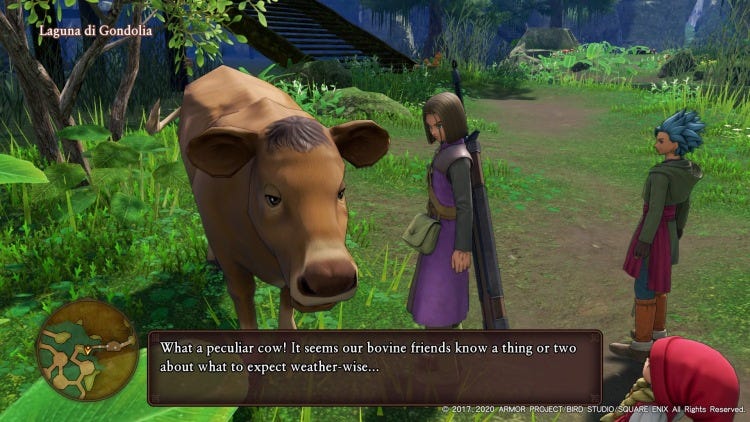
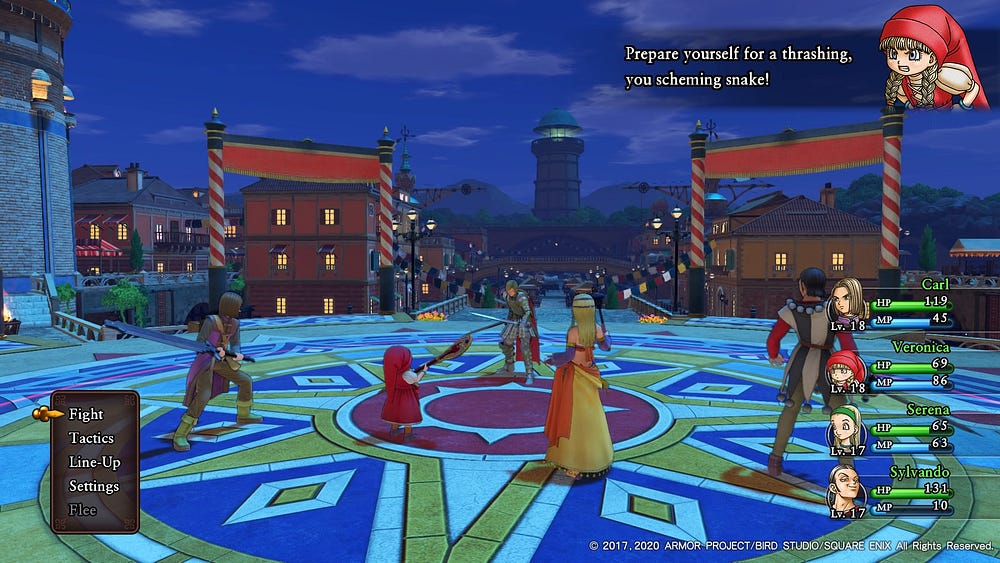 Dragon Quest 11 is a finely tuned game with a few minor flaws. Just the same, it is a long game with a ton of content. Even if you don’t do Act 3, there are a plethora of side quests in the first two acts. I completed 22 and found at least a dozen more. Doing everything could easily run 100 hours. Plus, finding all the little quirks scattered throughout, like cows that can help to predict the weather.
 Overall, this is the perfect example of a classic series successfully being modernized without forgetting its roots or forgetting what made it great in the first place. This is an excellent game for avid Dragon Quest fans and newcomers to the genre alike. Plus, it fills me with tons of hope for Dragon Quest 12 as I do not doubt in my mind it will be a lovely experience with top-notch music and world-building, just like 11.
You can buy Dragon Quest 11 for the PS4 or Switch.
This post contains affiliate links. I may earn a small commission at no extra cost to you.