

Subscribers get bonus perks: ask me unlimited gameplay questions about any review and get personal responses within 24 hours!
Be sure to check out my review of the first Axiom Verge.
It’s no surprise that Super Metroid’s timeless design has inspired countless games, but few capture its essence as brilliantly as Axiom Verge 1. Building on that foundation, a sequel emerged, to varying degrees of success, but with a few notable shortcomings.
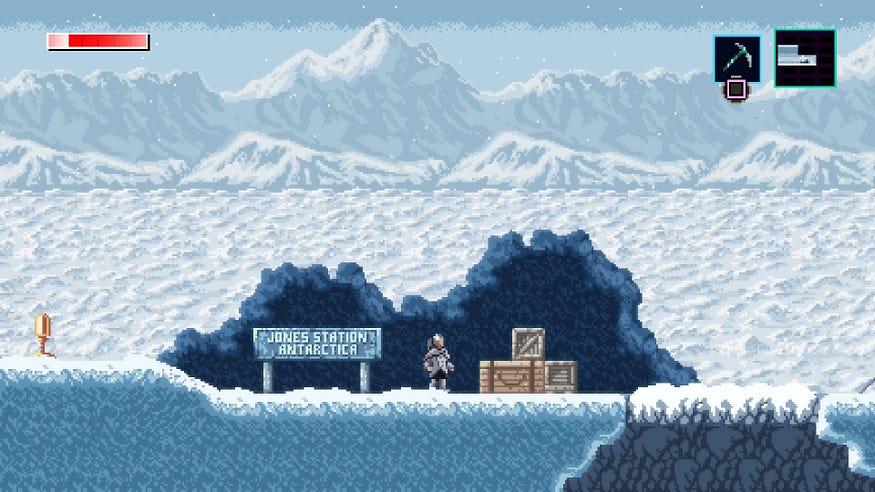 The story stars Indra Chaudhari, a billionaire, drawn to Antarctica by a mysterious message offering a chance to reunite with her lost daughter. She explores Jones Station and is teleported via a cargo lift to a reality she does not recognize. She drowns in rising water but finds herself reconstructed. From there, everything only becomes more puzzling as she navigates these ancient ruins with decaying technology.
Axiom Verge 1 is probably the best Super Metroid-inspired indie Metroidvania I’ve ever played. The maps were complex without being confusing, for the most part. Numerous power-ups consistently opened up new areas, though there were a few cryptic instances. While there wasn’t a standard warp system, there was a central hub called Indi. Axiom Verge 2 improves on this, though it takes a while to truly shine. About halfway through the game, you gain access to the warp ability that is more powerful than most games of the genre, as you can effectively warp from anywhere on the map to one of many well-placed save points. However, the map system, perhaps due to the color palettes used, didn’t feel as useful as it could have been. Just the same, by Metroidvania standards, this is a fairly linear game, but it isn’t always apparent where exits might be, looking at the map. Platforming isn’t difficult at all, and any current obstacle can be overcome with future movement upgrades.
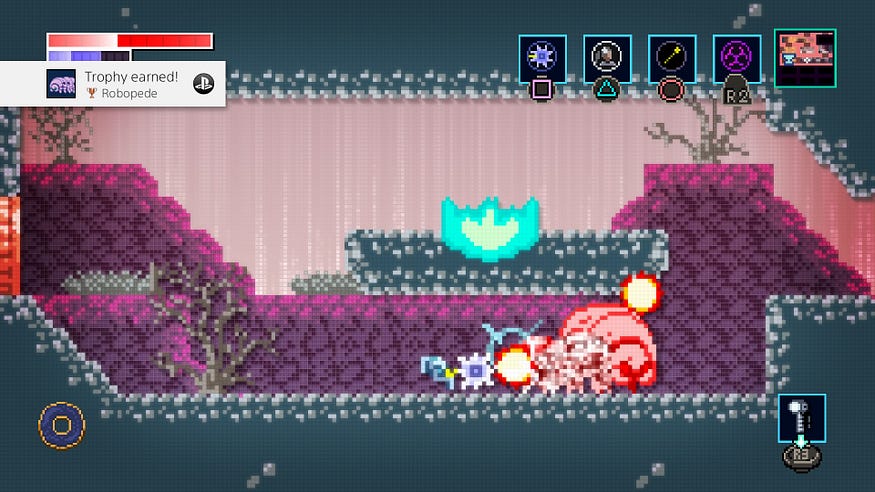 Axiom Verge 2 introduces a significant formula change by giving your drone a parallel world to explore called The Breach. While dual-world mechanics aren’t new, their execution here felt poor. The lack of a clear physical connection between locations in The Breach and Kiengir often led to unintentionally ending up in undesirable areas, necessitating unnecessary backtracking.
Combat takes a step back in AV2. Where AV1 offers a variety of guns, AV2 opts for a pickaxe as your primary weapon, a strange shift that feels like a change for the sake of it. A limited-range boomerang appears later, but it hardly fills the gap. After the versatility of attacks in the first game, the lack of options here is disappointing. There are a few dozen enemy types, with some late-game foes feeling more like nuisances than proper threats. Still, they can usually be avoided with stealth, although some also present environmental hazards. A basic, structured upgrade grid allows for limited customization using small, medium, and large Apocalypse Flasks worth 1, 2, or 3 points. The drone can be upgraded, too, allowing smoother progression through the Breach, such as the grappling hook to reach higher platforms. Upon death, which is likely to happen at least a few dozen times, you respawn at the last used save point, which is never too far away.
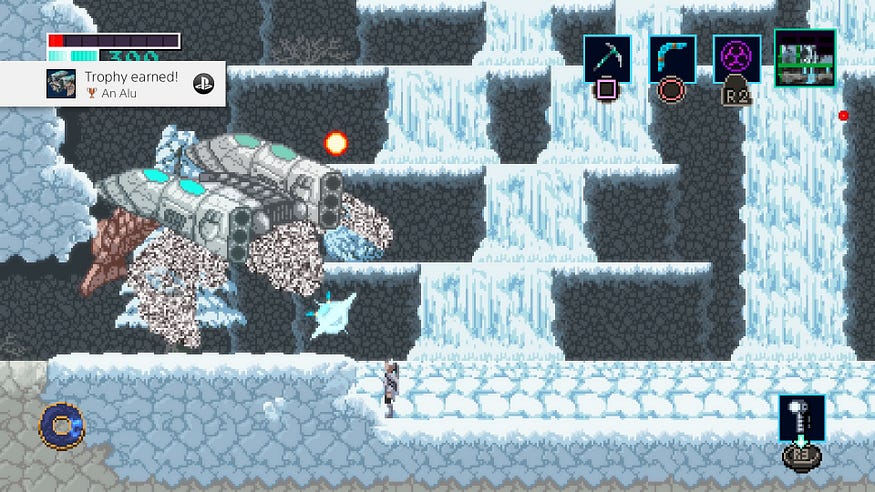 But the changes don’t stop there. In an interesting twist rarely seen in gaming, every boss, save the last one, can be skipped. While some or even many gamers may appreciate the challenge, I found the bosses to be underwhelming in design and scale compared to AV1, although the rewards they offer are decent.
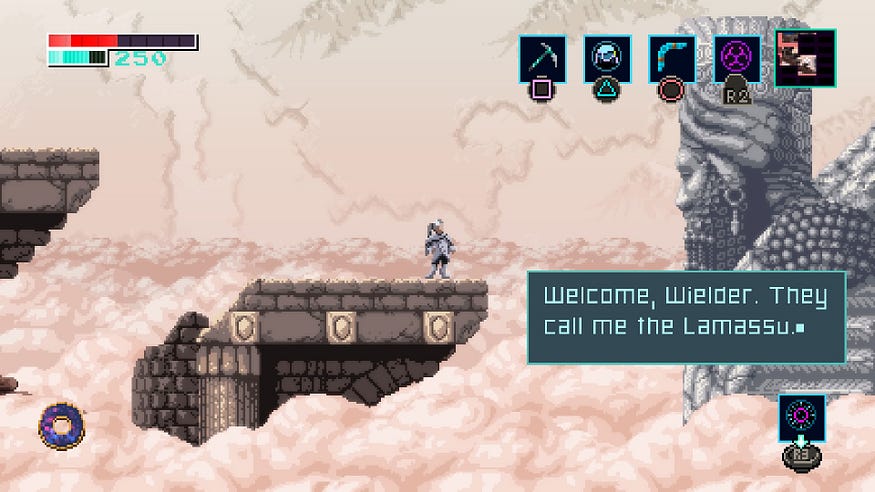 Like its predecessor, AV2 adopts a late NES/early SNES visual style, but where AV1 felt effortlessly stylish and inviting, AV2’s retro aesthetic feels more forced. The environments are more varied this time, ranging from the stark polar deserts of Antarctica (not tundra) to a smattering of sleek research facilities and the occasional scrubby, tundra-like terrain. However, despite the broader palette, the sense of mystery that made the first game so compelling is largely absent, as AV1 conveyed lore through its environments and subtle visual cues, but not in this case.
The music also falls short of the first game. While the original boasted an esoteric yet catchy vibe, like jungle rhythms from another planet (despite its wordless vocals), the sequel was hampered by subpar vocalizations that became grating with repeated listens. Plus, the tracks felt more listless in the sequel, less enigmatic. Sound effects enhance the experience and are out of this world in a mechanical sense.
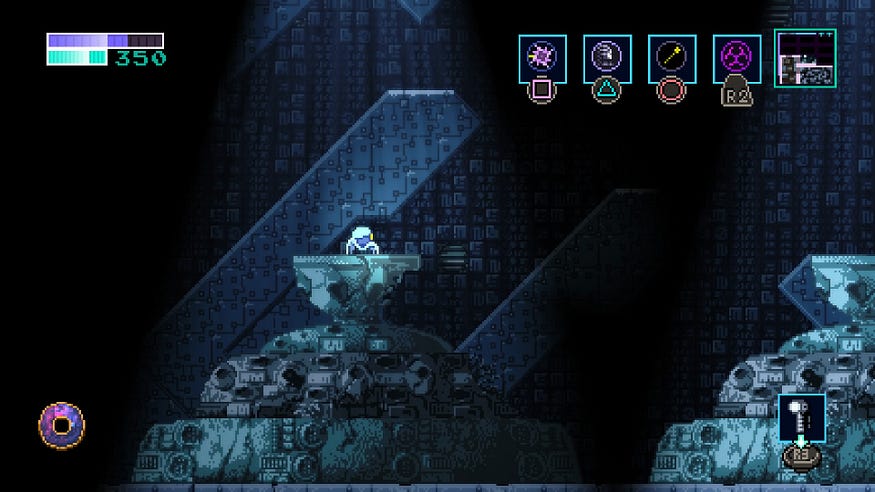 If you’re a fan of Axiom Verge 1, approach its sequel with tempered expectations and be prepared for some notable changes. It’s crucial not to skip the first game, as Axiom Verge 2 isn’t an ideal entry point for newcomers to the genre or the series. While not all of the new elements are detrimental, they often deviate from the successful formula of the original. Be aware that the experience is also significantly shorter; for instance, my playthrough of the first game clocked in at 17 hours, while Axiom Verge 2 took just 11.
You can buy Axiom Verge 1 and 2 here for the Switch, or just the second game, here. 1 and 2 are also on the PS4.
This post contains affiliate links. I may earn a small commission at no extra cost to you.