

Sexton SP guns of the 8th Field Regiment, RCA, firing 21-gun salute to celebrate VE Day, Groningen, Netherlands, 8 May 1945.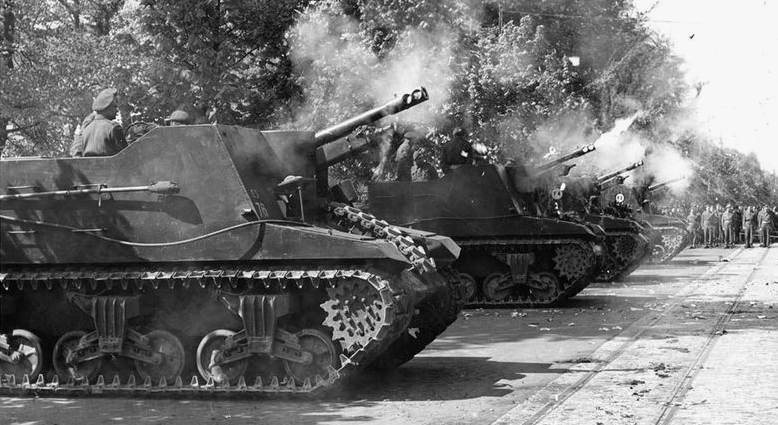
The Sexton is a Canadian-designed self-propelled gun based on Canadian-built derivatives of an American tank chassis. Canada was setup to produce the M3 Lee and Grizzly tank chassis to complement US medium tank production. When Sherman production in the US expanded and supply was no longer a problem, it was decided in 1943 to switch the Canadian production lines to produce the Sexton SP gun. The Sexton was used to provide indirect supporting fire, keeping back from the front line and used forward observers to direct overwhelming fire onto a target.
The design bureau of the Montreal Locomotive Works was given the task to use the M3 Lee chassis and mount on a custom platform the 25 pdr (87.6 mm /3.45 in), with storage and some armor protection. It was completed on 23 June 1942 and tested by the Canadian army, which ordered 125 vehicles in three batches. The prototype was shipped to Great Britain for evaluation at the beginning of 1943, and was approved in March 1943 for mass production, under the name of Sexton (another episcopal reference).
The gun had a +40° to -9° elevation and a 25° left 15° right traverse. Storage for the 105 rounds (mostly HE) was found at the rear in large vertical lockers, and laid down under the double floor bay. The crew was protected by a maximum of 32 mm (1.26 in) of armor to the front, but it was an open top superstructure and the lower sides and rear plates barely protected against shell fragments and bullets. The Sexton was designed to operate from the behind the front line, like any support artillery, using forward observers to direct fire on a target.
The chassis was similar to the Ram, with a three bogies wheeltrain, front idlers and rear drive sprockets, propelled by a Continental R-975 9 cylinder radial gasoline giving 400 hp. Auxiliary armament was provided by two removable 0.303 (7.7 mm) Bren light machine guns, supplied by fifty 30-round magazines. By 1944, the Mk.II appeared, specifically for the British army, built on the Grizzly chassis. Changes were visible on the drivetrain, bogies, storage and accommodation details, like the boxes added to the rear deck to carry batteries, with an auxiliary charging generator.
The first series, based on the Ram, was called Sexton Mk.I, and only used by Canadian Forces, whereas the standardized Sexton Mk.II was based on the Grizzly (a local version of the M4A1 Sherman). About 2,026 vehicles were ordered, and were produced from early 1944 until early 1945 (S-233626 to S-235061), for a grand total of 2,150 at the Montreal Locomotive Works. Variants included also the Sexton GPO (Gun Position Officer), without a gun, the space being allocated to an extra No. 19 Wireless radio and map tables. These command vehicles were used to control and coordinate battery fire.
The vehicle entered service in September 1943. Canadian Sextons were first used in combat in Italy by the British Eighth Army, and later took part in the invasion of France, the whole Battle of Normandy, and the following campaign in north-western Europe (Belgium, Netherlands and Western Germany). For the anecdote, during the D-day landings some Sextons were ordered to fire from their landing craft when approaching the beaches.