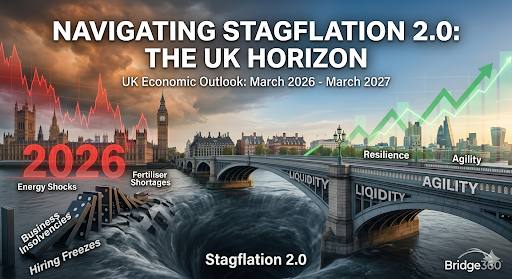

As we move through March 2026, the optimism that defined the start of the year has met a harsh geopolitical reality. For business owners, property investors, and households across the UK, the next 12 months will be defined by a "double-shock" of energy volatility and rising operational costs. 🇬🇧
Here is our comprehensive breakdown of the financial outlook for the year ahead.
1. Interest Rates: The "Higher for Longer" Reality 🏦
The Bank of England Base Rate currently sits at 3.75%. While many anticipated further cuts this spring, the escalating conflict in the Middle East has forced a defensive stance.
The Outlook: Expect a "hawkish hold" at 3.75% for the foreseeable future.
The Risk: If energy-led inflation spills into the wider service sector, we could see rates climb toward 4.25% or 4.5% by the end of the year to protect the Pound.
2. The Energy & Fertilizer Crisis ⚡🍞
The disruption in the Strait of Hormuz is the primary driver of current market volatility. This isn't just a "petrol pump" issue; it is a structural threat to the UK supply chain.
Household Bills: Analysts forecast a 20% jump in the Ofgem energy price cap this July, potentially pushing average annual bills toward £1,973.
The Food Chain: Fertilizer production—heavily dependent on natural gas—is seeing price hikes of 14%. This "hidden cost" is expected to trigger an 8–12% increase in supermarket staples like bread and dairy by Q4 2026.
3. Business Resilience & The Jobs Market 🏗️
The "squeezed middle" of the UK economy—our SMEs—is facing a significant endurance test.
Insolvencies: Business closures are projected to rise, with roughly 1 in every 175 companies expected to face restructuring or insolvency as cash reserves from the post-pandemic era finally run dry.
Employment: Unemployment is forecast to peak at 5.3% by early 2027. We are seeing a shift from active layoffs to "subdued hiring," where firms opt not to replace departing staff to offset rising National Insurance and energy costs.
4. Property & Mortgage Markets 🏠
The housing market remains a tale of two halves. While demand for quality housing persists, the "fear factor" in the swap markets has already begun to push mortgage rates upward.
Mortgage Pricing: Average 2-year fixed rates have already crept from 4.83% toward 5.4% in response to global instability.
House Prices: We anticipate modest growth of 2% to 3% nationally, though regional variances remain sharp, with the North and Scotland currently showing more resilience than the South East.
The Analyst's Bottom Line
The UK is entering a period of Stagflation 2.0—a cycle of low growth paired with high input costs. For businesses and investors, the next 12 months are about liquidity and agility. Those who can manage debt effectively and hedge against energy spikes will be best positioned to capitalize when the market eventually stabilizes in late 2027.
Bridge360 is here to help you navigate these shifting sands with expert bridging finance solutions tailored to the current economic climate. 🤝
Find out more and connect with us here: https://linktr.ee/bridge360uk
Your property may be repossessed if you do not keep up repayments on your mortgage.
#Bridge360 #UKEconomy #FinancialOutlook #InterestRates #PropertyMarket #BusinessAdvice #EconomicForecast2026 #BristolBusiness #BridgingLoans #FinanceNews
Would you like me to create a version of this specifically for a client newsletter or a LinkedIn article