

Hello & Welcome, Friends!
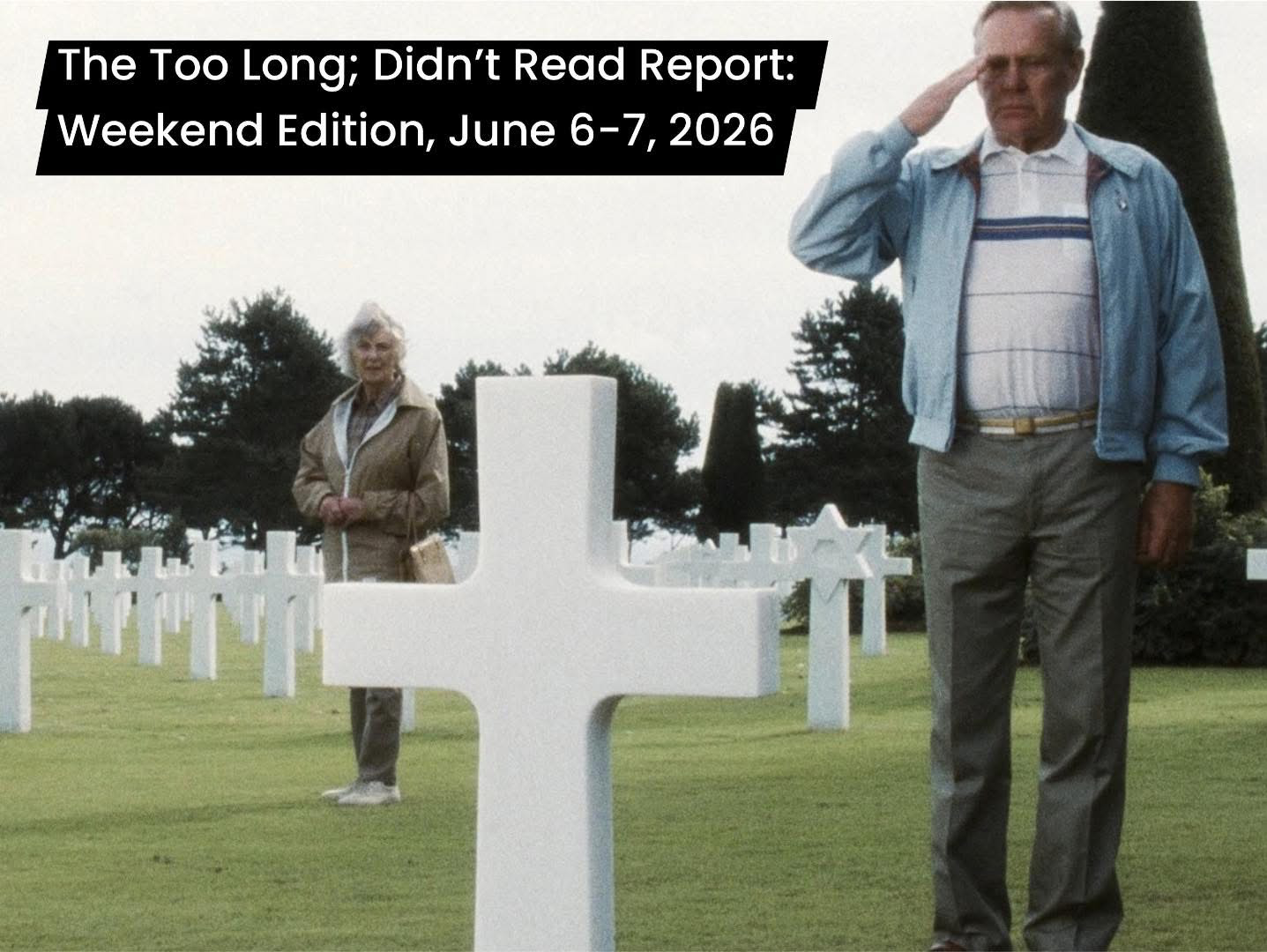
The film opens not with the guns but with an old man at a grave. Steven Spielberg gives us an aged veteran at Colleville-sur-Mer, falling to his knees before a white cross while his family catches up to him. The camera holds on his face while he searches for something. Then the beach comes, and we understand what a man who survived June 6, 1944 carries in his body for the rest of his life. Decades later, the same man stands at the same cemetery and asks the woman beside him the only question that has ever mattered to him: tell me I have led a good life. Tell me I am a good man. The beach and the grave bracket everything. What the film is actually about is the time between them, and what a person does with a life purchased for them at a cost they did not pay.
This weekend marked the eighty-second anniversary of that beach. The Channel was gray, as it almost always is. The crosses at Colleville-sur-Mer still stand in their precise rows, nine thousand three hundred and eighty-seven of them, white marble, still facing west toward home. The men buried under them were mostly young, and afraid, and most of them had never seen the ocean before the crossing. They crossed it anyway. What follows is a record of what was done in the country they did not come home to, on the weekend the world paused to remember what ordinary people are capable of when the moment is larger than they thought they were.
Spielberg understood something about how history’s worst failures accumulate. They do not arrive announced. They arrive in administrative language, in directives distributed through internal channels, in the quiet cancellation of paper trails. For years, Immigration and Customs Enforcement maintained a practice of publishing what are known as detainee death reports: documents that recorded the names, circumstances, and causes of death for individuals who died in federal immigration custody. The reports were incomplete by most advocates’ assessments. But they existed. They were a paper trail. Acting ICE Director David Venturella signed a directive this week ordering the agency to cease all public reporting on detainee deaths. No press conference. No policy rationale. A leaked memo, never meant for public eyes. Under the new order, when a person in federal immigration custody dies, the American public will not be told. The government will continue to detain people. Some of those people will die. And the record of their names will not be kept.
The beach in Spielberg’s film is chaos, but it is human chaos. Men making decisions in real time, under impossible conditions, with the full weight of moral consequence on every trigger pull and every hesitation. What makes the sequence so unbearable is not the scale of the violence. It is the presence, in every frame, of a human being who is choosing. The White House released a National Security Presidential Memorandum on Artificial Intelligence this week, and Defense Secretary Pete Hegseth confirmed that the administration is actively pushing back against companies like Anthropic, which had requested contractual language explicitly prohibiting their technology from being deployed in fully autonomous weapons systems. Fully autonomous weapons identify, select, and engage targets without a human being in the decision loop. A machine assesses a threat. A machine decides to fire. A machine fires. No soldier. No officer. No authorization. The administration’s position is that American weapons contractors should not be constrained by the ethical preferences of the companies whose technology they intend to weaponize. The human being is being removed from the loop. That removal is the policy.
The film’s central mission is built on a proposition the army makes at enormous cost: that individual lives matter enough to mobilize the full weight of the institution. The United States Senate voted 52 to 47, after a marathon overnight session, to hand the Trump administration seventy billion dollars to fund the largest domestic enforcement apparatus in American history. Seven votes separated passage from rejection. Seven Democratic senators crossed the aisle. The bill also ended a partial government shutdown that had dragged since February, which the administration framed as a victory for the American people. What it did not frame it as was what it actually was: a manufactured hostage situation resolved only when Congress agreed to write the check. Buried within the package: 1.8 billion dollars designated to compensate foreign governments for accepting deportees, including, in some cases, people being sent to nations they have never set foot in. That fund has been used as a diplomatic bargaining chip for months. Congress just replenished it.
In the film there are men who follow orders and men who ask what the orders are for. Spielberg does not moralize. He lets the distinction accumulate in small moments over the course of the story, and trusts the audience to understand what it means when someone with authority stops asking the question. President Trump has installed Bill Pulte as acting Director of National Intelligence with an explicit directive to purge the American intelligence apparatus. Trump offered the rationale himself: because Pulte holds an “acting” title, the president boasted, he operates unconstrained by the legal and bureaucratic limits that would otherwise apply. The White House did not attempt to obscure this logic. It presented it as a feature. Pulte, a housing finance director with no background in national security or intelligence operations, now nominally commands seventeen agencies responsible for the most sensitive information the American government collects. He is not there to assess threats. He is there to clear the field of anyone who might assess them honestly.
Not everything failed this weekend. On Friday morning, a 135-page opinion landed in a Rhode Island federal courthouse, and it read less like a legal ruling than an indictment. Chief U.S. District Judge John J. McConnell Jr. struck down the Trump administration’s blanket immigration processing freeze for nationals from 39 countries, naming what it was in unsparing language: USCIS had claimed authority it did not legally possess, manufactured justifications it could not lawfully sustain, and wrapped a policy born of anti-immigrant animus in the language of national security to disguise its true nature. Thousands of people who had played by every rule, who were living lawfully in this country and found their paperwork simply stopped, no decisions, no timelines, no appeals, now have a ruling that names what happened to them. The names in the opinion face west, toward home. That matters.
On June 5th, a Department of Justice attorney stood before a panel of federal appeals judges and said the thing out loud. Judge Patricia Millett, an Obama appointee, pressed with precision: this court, the Supreme Court, no court could stop the construction of the White House ballroom? The government’s attorney answered with a single word: yes. The project in question is a four hundred million dollar effort that began with the demolition of the White House East Wing without congressional approval. A George W. Bush-appointed district judge had already halted it, finding that no statute comes close to granting the executive the authority it claimed. The administration appealed, and then stood before the court and said, in the plainest possible language, that it operates beyond reach. The court had not yet ruled when this report was written.
Three months separated the day Donald Trump Jr.‘s venture capital firm acquired a stake in a small North Carolina rare-earth startup from the day the Pentagon announced a $620 million loan to that same company. The company is Vulcan Elements, whose products are used in drones, satellites, and military systems. The loan, according to a ProPublica investigation, was the largest ever made by the Pentagon’s Office of Strategic Capital, worth approximately twice the company’s entire estimated valuation at the time Trump Jr.‘s firm, 1789 Capital, took its stake. The man who made it happen, per ProPublica, was Peter Navarro, White House senior counselor, and by any honest accounting a close friend and ally of Trump Jr., who visited Navarro in federal prison while Navarro was serving time for defying a congressional subpoena related to January 6th. After the loan was announced, the company’s estimated valuation grew tenfold. Three months. A paper trail.
On the morning of June 6th, an Assistant United States Attorney walked into the Los Angeles County Ballot Processing Center and asked to watch the count. He had been dispatched by a Justice Department responding to baseless claims from President Trump that the slow pace of California’s primary count was evidence of Democratic cheating. No evidence of cheating has been produced. What does exist is a democratic process proceeding exactly as the law intends, with mail-in ballots legally accepted through June 9th and county workers methodically processing hundreds of thousands of them. First Assistant U.S. Attorney Bill Essayli had announced on social media that his office and the FBI had launched multiple election fraud investigations across Southern California, offering no specifics, no documentation, and no legal predicate. He simply released the claim into the digital ecosystem as raw political theater. The presence of a federal attorney in the counting room was the theater’s second act: not an investigation but a signal. A government apparatus hostile to democratic norms now views California’s ballot-counting room as contested terrain.
Thomas Massie of Kentucky lost his primary to a Trump-backed challenger, walked to his concession podium, and grinned. “I got seven months left in Congress,” he told the crowd. The crowd erupted. Somewhere in Washington, a White House aide felt a cold draft move through the building. Being relieved of the need to face another election, it turns out, can liberate a man. Capitol Hill staff have taken to calling them the YOLO Caucus: Republicans defeated in primaries, retiring voluntarily, or simply unburdened by the prospect of future elections, who have begun behaving in ways the administration cannot control, predict, or punish. Massie spent months voting against Trump’s signature legislation and pushing aggressively for the release of the Epstein files. Sen. Thom Tillis of North Carolina announced his retirement hours after Trump threatened to primary him, declared he had lost his “filter,” and has since been blocking Trump’s Federal Reserve nominees until the Justice Department drops its investigation into Fed Chair Jerome Powell. Senate counterparts call them the Wounded Bear Caucus. It is worth remembering that a wounded bear is the most dangerous bear of all.
The old man at the grave turns to his wife and asks the question. He needs to hear it confirmed. He needs to know that the decades between the beach and this cemetery were worth the price that was paid for them by the men who did not come home. It is the most human moment in the film precisely because the enormous machinery of history reduces, in that instant, to a single person standing before a white cross asking whether he has done enough with what he was given.
This weekend, on the eighty-second anniversary of that beach, a government said no court holds power over it. It silenced the record of deaths in its custody. It handed a nine-figure loan to the president’s son’s investment portfolio. It sent a federal prosecutor to stand in a ballot-counting room as an act of intimidation. It installed an unqualified loyalist to purge the intelligence community, and stripped the ethical guardrails from autonomous weapons. And in a Rhode Island courthouse, a judge named what it was. And in Congress, a small group of politicians with nothing left to lose discovered they had nothing left to lose, and began to act accordingly. And in Los Angeles, voters kept voting, and workers kept counting, and the law that permits this held.
The men on the beach were not exceptional in any prior accounting of their lives. They were young, and afraid, and the morning was cold, and the water was gray, and nothing in their training had prepared them for the sound of it against the hull. They crossed it anyway. The ones who came home carried a question for the rest of their lives. It is still a reasonable question. The asking of it is not a small thing.
I am a grassroots independent news organization with no ads and no corporate backing. Your support is the only thing keeping my voice alive. If you believe accountability journalism still matters, please consider supporting the work: https://linktr.ee/Brentnmolnar