
Are we the consequence of our environment or of our decisions?
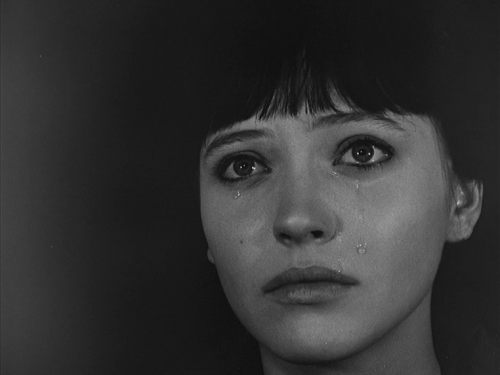
In "Vivre Sa vie" (1962), Jean-Luc Godard constructs a fragmented portrait divided into twelve acts, following the life of Nana, a young woman who decides to leave her husband and child to pursue her dream of becoming an actress. However, a chain of decisions and circumstances ultimately leads her into prostitution.
One of the moments that made me ask this question occurs when Nana (Ana Karina) meets Yvette, an old friend who also works as a prostitute. She confesses that she does it out of necessity, after her husband abandoned her and their child to pursue his career as an actor. In the middle of the conversation she says: “It’s sad, but I’m not responsible.” Nana, on the other hand, claims the opposite: one is responsible for everything one does.
Nana believes in individual responsibility, but how responsible are we really?
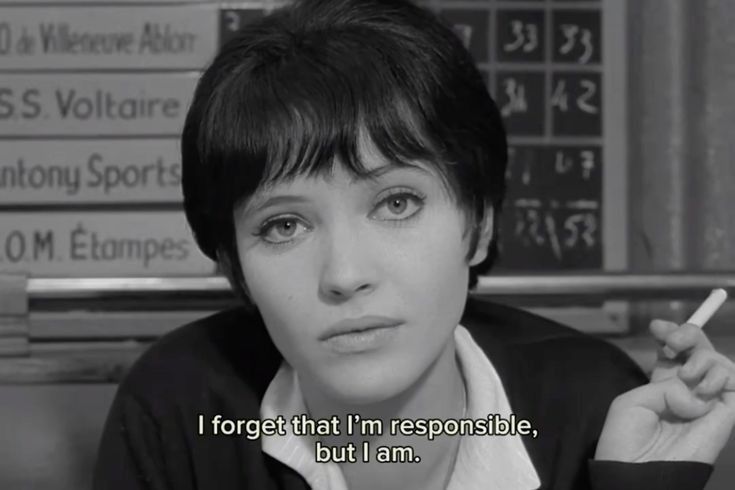
The philosopher Jean-Paul Sartre argued that human beings are “condemned to be free.” Every decision belongs to us, and with it come its consequences. From this perspective, the individual is fully responsible for their actions.
Something similar was suggested by the Spanish philosopher José Ortega y Gasset when he stated: “I am myself and my circumstances.” Our lives would therefore be the result of the decisions we make within a set of given circumstances.
Under this logic, Nana’s fate would appear to be the result of her own choices.
Working in a record store and without enough money to pay the rent, Nana begins to depend on friends for a place to spend the night. Later she accepts the proposal of a photographer who convinces her to pose nude with the promise of boosting her acting career.
When she once again finds herself on the street, she wanders aimlessly until she encounters a man who takes her to a hotel and gives her money, assuming she is a prostitute, forcing her to kiss him on the mouth. That moment opens the door to a world of exploitation.
Nana repeats to herself that she is in control. However, Raoul soon appears, her pimp, who organizes the clients and dictates every step of the business. From that point on, Nana loses the ability to refuse clients or choose when to work, even losing the freedom to take days off to go to the cinema.
If we strictly follow Sartrean logic, all of this would be a consequence of her decisions.
But then an inevitable question arises: did Nana really have control?
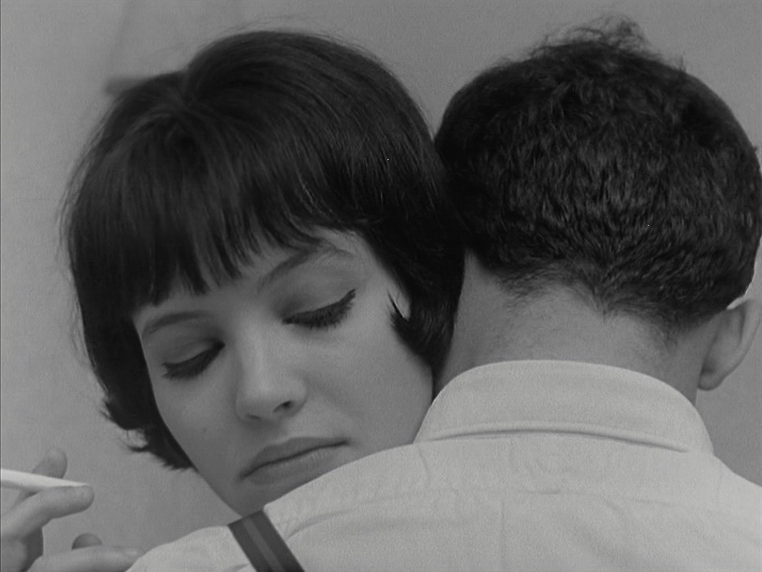
For me, the problem is that Nana is not making decisions from a neutral position.
She is a homeless woman in 1960s Paris, without connections in the film industry and in a society where men seem to move with greater freedom.
The sociologist Pierre Bourdieu explained this inequality by arguing that “not everyone starts with the same symbolic resources.” The opportunities available to each person depend on their social position, their education, and their environment.
From another perspective, behaviorist theory suggests that human behavior is deeply conditioned by external forces or unconscious factors.
Meanwhile, Viktor Frankl defended the idea that “everything can be taken from a person except one thing: the last of the human freedoms—to choose one’s attitude in any given set of circumstances.”
But that inner freedom does not eliminate the weight of material reality. In extreme situations, circumstances can drastically reduce our choices.
The philosopher Simone de Beauvoir, a contemporary and intellectual companion of Sartre, questioned precisely the idea of absolute freedom. For her, freedom is always situated: it is exercised within social, economic, and cultural structures that can deeply limit it.
From this perspective, Nana’s story stops being simply the consequence of her individual decisions and begins to reveal something broader: a system of inequalities that shapes her possibilities.
This becomes even clearer when we remember the story of Yvette’s husband. Both abandon their families, but the results are radically different. He ends up making a film in the United States; she ends up trapped in prostitution.
In several scenes, Godard emphasizes this dehumanization in an almost documentary way. In one of them, excerpts from the book Où en est la prostitution by Marcel Sacotte (which unfortunately I could not find online) are read while Nana is sold from one man to another.
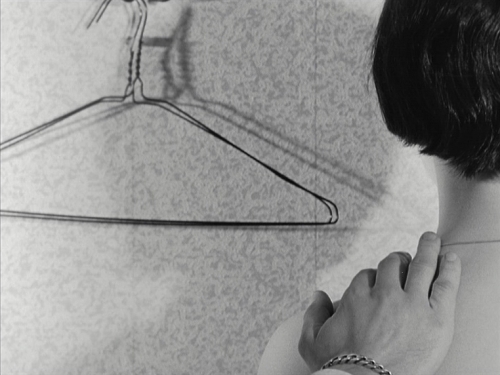
In one scene, the camera shows her from behind, almost motionless, and beside her there is a metal hook that resembles those used to hang merchandise. The image turns Nana into an object within a system of exchange.
Even from a neuroscientific perspective, the philosopher and neurologist Antonio Damasio has argued that pure reason is not enough to make good decisions: emotion plays a fundamental role in human judgment. When decisions are made under pressure, fear, or desperation, their rationality becomes fragile.
Throughout the film, Nana tries to exercise her autonomy: she leaves her husband, tries to become an actress, and refuses to depend on her ex-husband. But every decision takes place within an environment that increasingly limits her options.
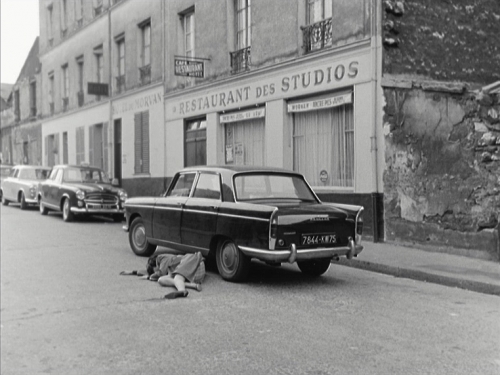
In the end, Raoul tries to sell her to another pimp. The deal goes wrong, and Nana dies in the middle of the exchange, left in the street with no one concerned about her lifeless body. Her death is abrupt, almost indifferent. There is no heroic ending, no redemption.
For me, as Simone de Beauvoir explains, human freedom is not absolute; it is crossed by social structures and by the circumstances each person inherits.
Nana tries to live her life, but the world in which she does so ultimately decides a large part of her destiny.