Once upon a time, when I was a student, I was set a difficult task. It was a module on the teaching course I had to complete in order to obtain my teaching diploma. The course itself was not difficult, but to get a good mark for one of its modules, I had to write a paper on the main and operational objectives.
The subject was not overly complex, but it was primarily presented in theoretical terms, which made it rather time-consuming and thought-provoking. It was the kind of text where you read a sentence, ponder it, and realise you have to read it again to grasp the main idea. Don’t get me wrong; I don’t dislike theory. It’s essential for learning, and you won’t progress if you don’t master it. However, an excess of theory can kill interest in a subject, and I wasn’t really interested in this particular course in the first place. The main objectives were explained in such a way that I did not understand them at all. But, in order to complete the course, I needed to pass this module, so I went to a specialist library for teachers and found some relevant books. Eventually, after spending a lot of time and effort, I managed to write the semester paper.
Now it was time for the teacher to debrief us. I was waiting in the corridor with a fellow student. The teacher seemed busy, but eventually told us to come in. My acquaintance was first in the queue, so she went in. The door was thin, and I could hear snippets of conversation. At first, she was talking, then I heard the teacher ask, What are the main and operational objectives? My fellow student apparently got lost. She struggled to find the right words and refer to the subject convincingly. My heart was beating faster because I did not think I would do any better at explaining the theoretical subject of my paper. I couldn’t say for certain that I understood what I was writing about. My fellow student was still stuttering, and the teacher was clearly getting impatient. My heart was beating even faster, and my fingers began to tremble. ‘Calm down,’ I told myself. ‘Calm down. If you don’t calm down, you certainly won’t pass this exam.’ But I could not ignore the fact that my understanding of the subject was probably no better than that of my fellow student.
Eventually, the teacher lost her patience and told my acquaintance to leave. ‘Come back when you’ve found out what the main and operational objectives are!’ she exclaimed as the student left the room. You can imagine how fast my heart was beating and how much my fingers were trembling. I took a deep breath and went in. The seemingly irritated teacher glanced at me and told me to sit down. I did. My adrenaline kicked in, putting me in a state of heightened alertness. I was still afraid, but I at the same time also calm, motivated and focused. ‘So perhaps you could tell me what the main and operational objectives are?’ she asked. Not knowing what to say, I responded exactly as my mind dictated: ‘The main objectives are the most important goals in our hierarchy, while the operational objectives are the technical ways to achieve them.’ She looked at me with relief. ‘Finally, someone understands,’ she sighed, and my heart started beating faster again, this time with joy. Following this encouraging start, I felt more confident and was able to answer all the other questions relating to the theoretical considerations covered in this module. I passed the exam and completed the entire course, going on to work as a teacher for a good couple of years at every level of education with people aged 6 to 60.
However, it is not the reason why I am writing about that particular episode of my life. It is because I learnt that even the most difficult and theoretical topics can provide us with practical knowledge, no matter how detached they are from reality.
The scheme appears straightforward at first glance.
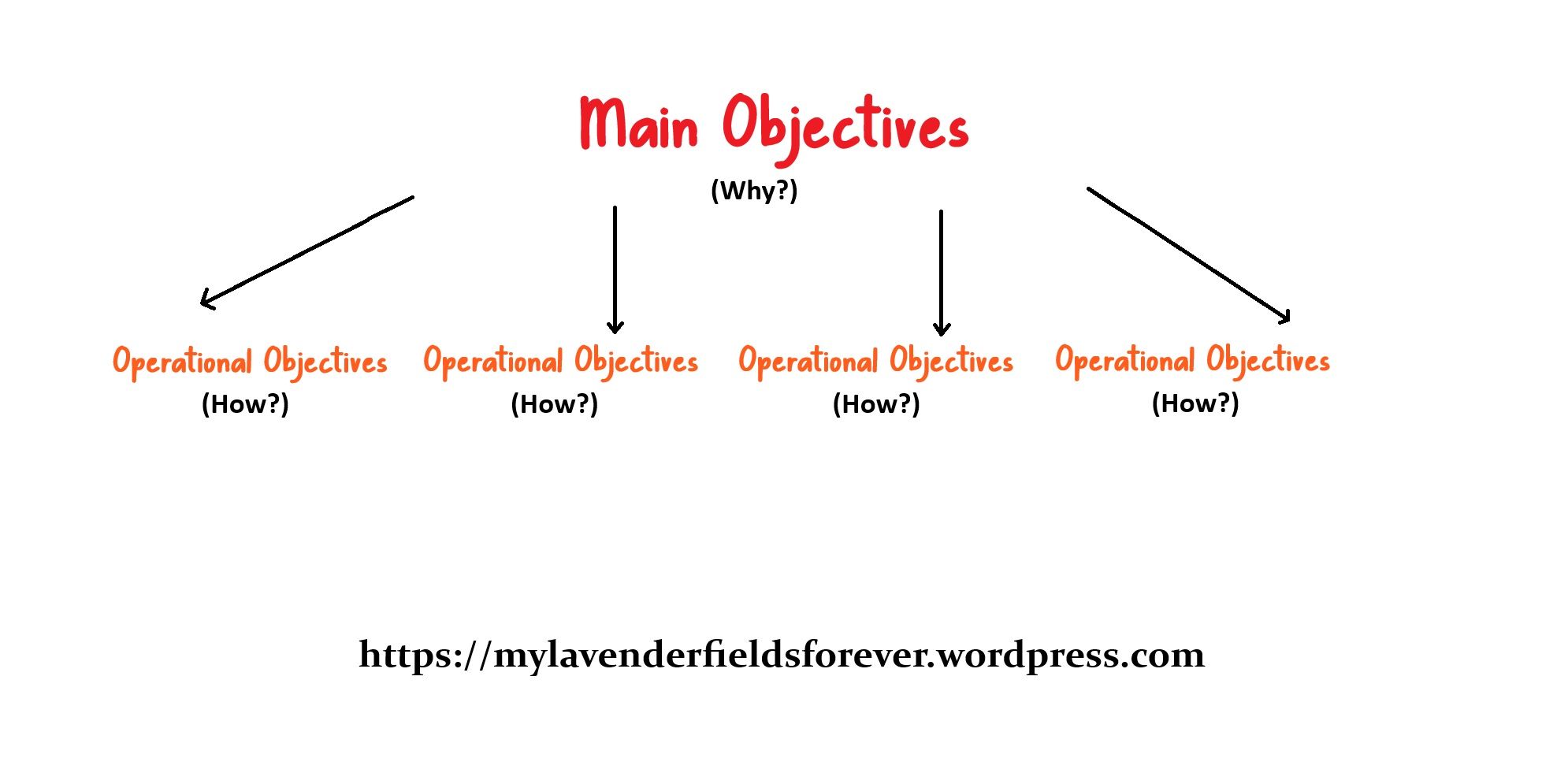
But in everyday life, isn’t it the case that the clear division between these objectives becomes blurred? Can we always recognise the difference between the main objective and the operational one? Don’t we confuse them? Have you ever had the feeling that you’re spending too much time, energy or money on operational objectives instead of main ones? Or perhaps you worry too much about something that is only an operational objective? Have you perhaps become fixated on operational objectives and forgotten the main ones?
In fact, if we delve deeper, we may attribute two short questions, ‘why?’ and ‘how?’ to these objectives. ‘Why?’ corresponds to the main objective, determining whether the subject itself is good or not. ‘How’ is the equivalent of the operational ones, and it only poses the question in what manner to do it. I won’t say anything original here, but I have the impression that, with the development of technology, the pendulum of mass consciousness is swinging from ‘Why?’ to ‘How?’. We stopped asking about the deeper meaning. Somehow, we lost our discernment and insight. We no longer care about complexity. We are unable to set long-term objectives and wait patiently until they are completed. Instead, we settle for quicker but less meaningful operational objectives.
But this did not happen overnight. It is the result of a slow but steady process of pushing humanists and the humanities out of the mainstream and replacing them with engineers and the exact sciences. Humanists take a bird’s-eye view and delve into the nature of things, asking questions such as “why should this be done?” and “should this be done at all?”. An engineer looks for practical solutions and asks, “how should this be done?”. Don’t get me wrong; both approaches are valuable and necessary depending on the situation. I myself am a humanist with a scientific mind. But without “why?” and its philosophical and ethical nature, “how?” can be used for evil purposes that hurt people. The modern world is so hopeless because it pushes aside the question “why?” and reduces the humanities to social justice. This approach leads nowhere, and I am not the only person to have noticed this correlation. Let me quote April DeConick, a professor of biblical studies at Rice University in Texas, who wrote about it on her blog as early as 2014.
Working in the trenches of humanities in face of the rise in the last decades of the internet and the overwhelming belief that knowledge is about information and data and number crunching, that everything about being human can be reduced to scientific investigation, I have been very concerned about where we are going as a people.
It is as if utilitarianism and efficiency and speed are all the driving forces behind anything we now consider most valuable. Everything is short and sweet and public. If it doesn’t make us richer, faster, or easier, we don’t want it. We don’t think it is worth pursuing. We are becoming thin and instant like our devices. We are remaking ourselves in the images of our devices. We are scattering our attention. Like our devices, we do two or three things at once. We watch TV and check our email, giving neither full attention, while ignoring the other people in the room. Screens intersect and offset us from others as we type away behind them.
As a student, I might have been annoyed and overwhelmed by all the theory, but I now appreciate those tough moments. If I had not persevered with all those boring books, I would never have discovered the joy of successfully completing a hard and complicated task. I would never have known whether I was capable of doing it. My self-esteem would not have grown with each success, achieved through hard work and effort.
Given my rebellious nature, I am the last person on Earth who would set boundaries or reinforce existing systems. I am naturally suspicious of organised structures, but I have learnt that they are necessary for defining yourself. If you encounter a wall on your path, you have a couple of options. You can try to jump over it. You can try to break it. You can try to walk along it to eventually bypass it. You can try to dig under it. Whatever you do, you become more creative and engaged. This wall helps you to define yourself. No matter what method you use, you will eventually overcome this obstacle and continue on your way, feeling happy and confident that if you encounter another obstacle, you already know how to deal with it.
Never forget to focus on ‘why?’ even if the contemporary world wants you to think there is only ‘how?’
Technology vs Humanities: The Shift from Why to How © 2026 by Blanka Solun is licensed under CC BY-ND 4.0
Disclaimer: I do not consent to this text being used to train AI.