

# The Longest Morning
## Twenty-five years after September 11, We remember the families—always.
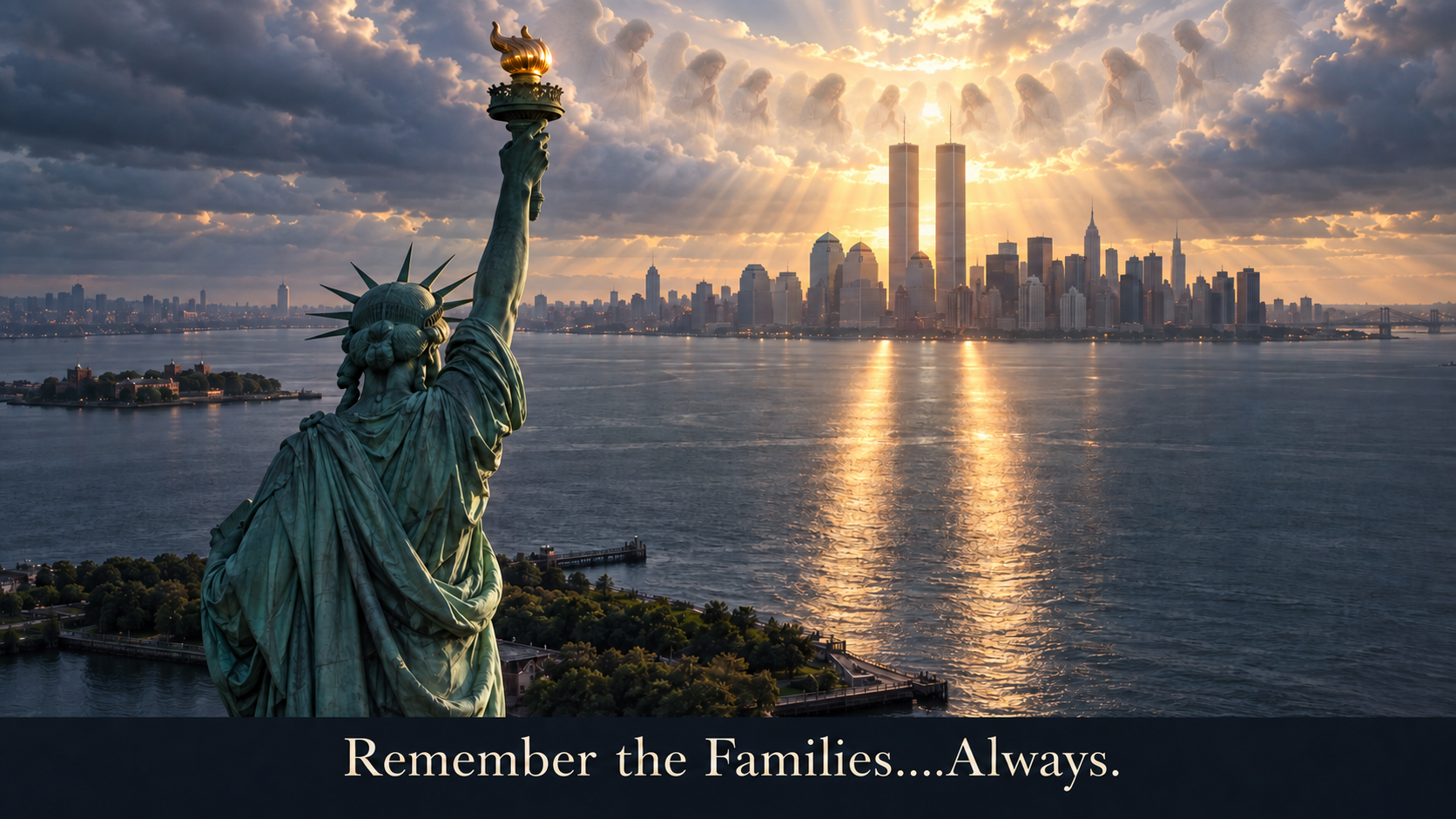
![The Statue of Liberty faces the intact Twin Towers across New York Harbor. Two paths of golden light cross the water while faint angels bow in prayer within the clouds. The image reads: Remember the Families....Always.
Before the sky became history, it was an ordinary Tuesday.
Coffee cooled on kitchen counters. Children hurried toward school. Someone straightened a tie in an elevator mirror. Someone else promised to call after landing. There were lunches packed, errands postponed, birthdays approaching, bills waiting to be paid.
Most lives do not announce their final ordinary moment.
That is part of what makes September 11, 2001, so difficult to hold: the ordinary was taken without warning and then preserved forever.
For me, it began as a normal busy morning, already crowded with meetings and phone calls. Then someone turned on the television in a conference room where it was usually dark. The sound was muted. The room was full—and completely silent.
The country remembers images. I remember that room.
Without saying much, the twenty of us entered the same reality: national horror, shared vulnerability, and a sudden unity rooted in concern for the people we loved.
One coworker had a next-door neighbor who worked at Cantor Fitzgerald. The thought came at once: someone might need to be home when that neighbor’s child returned from school. We did not yet know that he would never come home.
Cell phones were beginning to fail. Flights across the country were being grounded.
Then the room moved. We began arranging ways home for every traveling consultant and employee. Some found what rental cars remained. In other cases, people handed over the keys to their own vehicles without knowing when they would get them back.
Before we understood the scale of the horror, every instinct in that room had turned toward family.
Between those arrangements, I made a series of quick calls to family and friends. We had little certainty to offer one another. We called to hear familiar voices, to compare what we knew, and to secure the personal lifelines that suddenly mattered most.
Families remember voices.
They remember the cadence of a laugh, the sound of a key in a door, the private joke no one else understood. They remember what was said at breakfast and what should have been said. They remember a shirt left hanging, a book with the page still marked, a number on a caller-ID screen, an answering-machine tape preserved because erasing the message felt like losing the person a second time.
For most of us, public memory begins with the skyline, the Pentagon, four flights, a field near Shanksville, and a morning that divided time into before and after. Family memory begins elsewhere. It begins at the table. In the empty side of a bed. In the audience at a graduation. In the instinct to reach for the phone years after there is no one left to answer.
That is why, twenty-five years later, the first duty of remembrance is simple:
Remember the families.
### A date, or a number cannot carry a life
Nearly three thousand people were killed that day. The scale matters. So does the danger of scale.
A number can tell us how immense the loss was. It cannot tell us who was lost.
It cannot hold a father’s advice, a daughter’s stubborn courage, a sister’s terrible singing, a husband’s Saturday ritual, a wife’s handwriting, a friend’s loyalty, or the way one person made a room feel safer merely by walking into it. Statistics belong to history. Particulars belong to love.
Each name spoken at the memorial opens into a world. Each name is connected to parents, children, spouses, partners, siblings, friends, coworkers, neighbors, teammates, congregations, firehouses, precincts, companies, towns, and countries.
The victims came from many nations and many faiths. They worked in offices and kitchens, on aircraft and in public service. Some were beginning their careers. Some were nearing retirement. Some were traveling. Some were rescuing strangers. None arrived that morning intending to become a symbol.
They were people with somewhere to be that evening.
When the names are read aloud, the ceremony resists the flattening force of history. One person at a time returns to the center. The statistic recedes. The photograph of destruction recedes. What remains is a name, carried and lifted by a human voice.
And after every name, whether the silence lasts one second or twenty-five years, there is a family listening.
### The years after the cameras left
The attack happened in a morning. Its consequences entered every year that followed.
Families endured notifications, funerals, searches, identifications, courtrooms, investigations, anniversaries, rebuilding arguments, and questions with no satisfying answers. Many had to grieve in public while managing life in private. They raised children, cared for aging parents, returned to work, opened mail, filled out forms, answered questions, and found a way through holidays that arrived on schedule even when grief had stopped the clock.
Some children grew up knowing a parent through stories told by others. Some have now lived longer than the mother or father they lost. Spouses crossed birthdays and anniversaries that once had two names attached to them. Brothers and sisters became keepers of childhood memories. Parents carried the cruel inversion of surviving a child.
Purpose emerged from grief: families built foundations, endowed scholarships, pursued laws, created memorials, preserved testimony, helped strangers, and welcomed other grieving families into circles no one would ever choose to join. There were also quieter acts no camera recorded: getting out of bed, making dinner, attending a school play, laughing without apology, putting one foot in front of the other.
We often use the word closure because it promises a threshold we can cross and leave behind. Grief rarely agrees. It changes shape. It recedes, returns, hides inside music, and waits in familiar places. A birthday can summon it. So can a scent, a subway stop, a clear blue sky, or an ordinary Tuesday morning.
The nation marks September 11 once a year. Families have carried it every day.
### Remember the whole horizon
The Twin Towers remain one dominant image of September 11, but the horizon of loss is wider.
It reaches from Lower Manhattan to the Pentagon and to the field near Shanksville. It includes the passengers and crews aboard all four flights. It includes firefighters, police officers, emergency medical personnel, military and civilian workers, office staff, restaurant workers, technicians, travelers, and visitors. It includes those who escaped but carried the morning in body and mind, the responders and recovery workers who later became ill, and the families who entered new chapters of fear and caregiving long after the ruins disappeared from television. Its consequences reached lives across the country—and, for many, continue to unfold.
No single family can speak for every other family. Some have lived their grief in public; others have guarded it fiercely. Some found strength in faith. Some found it in service, friendship, work, art, or silence. Some wanted the world to know every detail. Some wanted one day without being asked.
Remembering well means allowing those differences to stand. It means resisting the temptation to turn the families into scenery for somebody else’s argument. Their loss is not a prop. Their loved ones are not raw material for spectacle.
The people killed that morning belonged to the whole human family. A remembrance worthy of them cannot become permission to hate an innocent neighbor. The attack revealed deliberate cruelty. The response also revealed courage, sacrifice, duty, tenderness—and strangers refusing to abandon one another. We honor that courage when we refuse to make another innocent person pay for someone else’s crime.
### Why the Towers still stand within us
In the nation’s memory, the Twin Towers remain intact.
That is not an attempt to rewrite the morning. It is memory exercising its right to return a beloved shape to the skyline—the city as countless families last knew it, before the world changed.
The Statue of Liberty faces the Towers as a witness. Her torch does not erase the night. It keeps watch inside it.
The angels do not celebrate. They bow. They surround the skyline in prayer because prayer is one of the oldest human responses to the point where language fails. For some, angels are an article of faith. For others, they are a visual language for guardianship, mercy, reunion, and the hope that no soul was alone. We need not share one theology to understand the longing: that those who were lost are held, and that those who remained are not forgotten.
The heavenly light is not there to make tragedy beautiful. Tragedy needs no decoration. The light belongs to love—the force that outlived the smoke, the headlines, the arguments, and the passing years.
In the image that opens this remembrance, two paths of light cross the harbor. They do not lead away from the families. They lead home.
### What “Always” asks of us
Memory must be practiced and renewed.
Read the names. Learn one life beyond the final morning. Listen to family testimony without rushing it toward a lesson. Share your story of that day and beyond. Preserve the voices of survivors and witnesses. Care for responders, recovery workers, survivors, and their families as health consequences continue. Teach children the facts without turning death into entertainment.
Tell them how quickly an ordinary day can change. Tell them that human beings caused terrible harm. Tell them, too, that other human beings climbed stairs toward danger, carried strangers, opened doors, gave blood, offered shelter, searched through dust, rebuilt classrooms, raised children, and kept promises to the dead.
Do not teach only how the buildings fell. Teach who stood up.
And remember beyond the anniversary.
Remember when the television music stops. Remember when the speeches end and the flags rise again. Remember on September 12, when public attention moves on but an empty chair remains empty. Remember at weddings, graduations, births, retirements, and family photographs with a space no camera can fill.
Twenty-five years is a generation. Babies became adults. Young adults entered middle age. Parents became grandparents. The passage of time has not reduced the value of a single life or shortened the distance between love and absence. It has shown how far families have had to carry both.
### The longest morning
The Towers were once visible for miles. The void they left is visible and felt whenever we choose to look.
Look past the famous photographs. Look past the footage we already know by heart. Look toward the kitchens, living rooms, firehouses, offices, houses of worship, and quiet gravesides where September 11 continued after the cameras departed.
Memory takes humble forms: a photograph touched at the edge, a recipe prepared on the right day, a story told to a grandchild, a voicemail played once more, a name spoken clearly.
This is how love argues with erasure.
This is how a nation keeps faith with itself and with families who paid a price beyond measure.
This is how we carry light forward from the longest morning: one name spoken, one story preserved, one family held close.
We Remember the Families....Always.