

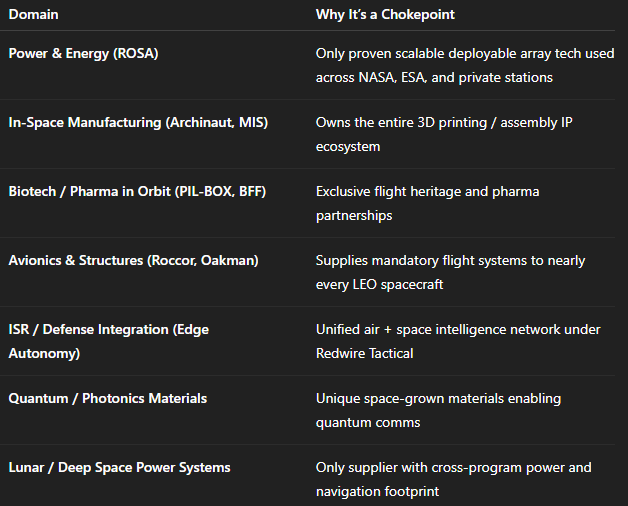
RDW – Redwire Revamped 12/10/25
Current Valuation: ~$2.7B when originally posted Jul 20, 2025 - - updated** 1.2B mc
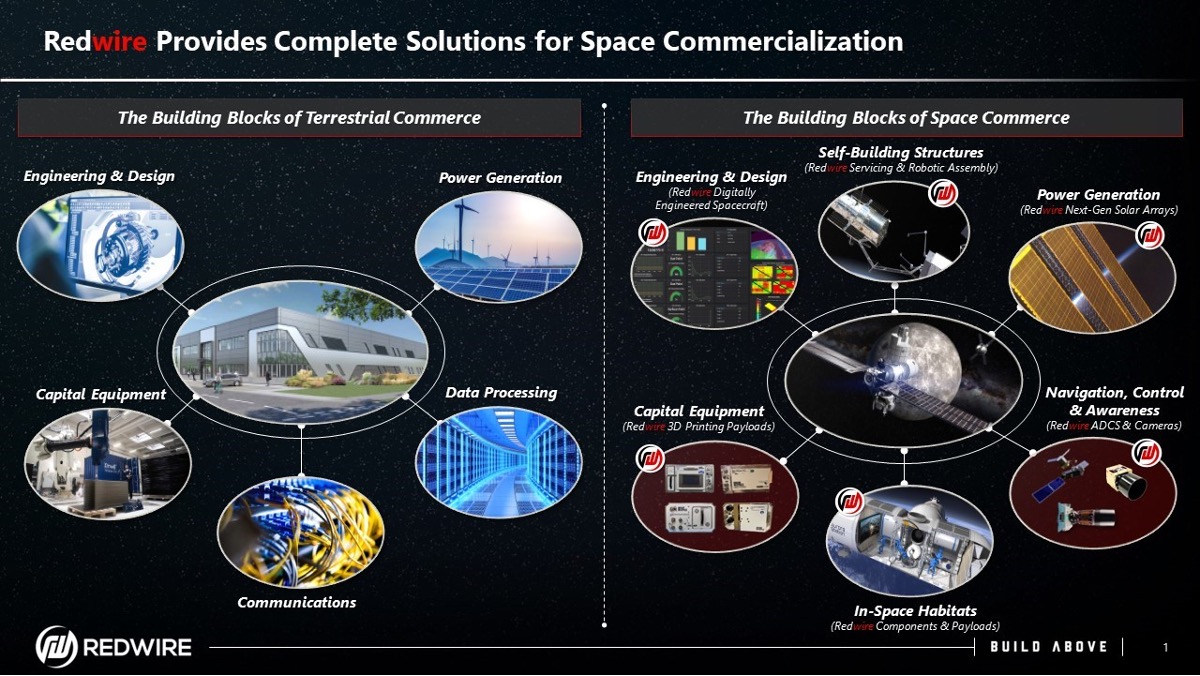
Redwire is building the infrastructure layer of the space economy - - manufacturing, energy, ISR, biotech - - they've quickly become my favorite space play for long term
If they execute, they’ll be the “picks & shovels” play for a $1T+ market - - can see a 5x easily if they get even a small piece of that and they can execute
NASA estimates that in-space servicing, assembly, and manufacturing (ISAM) could be a $10B/year market by 2030... I bet its more

Redwire is the infrastructure layer of the space economy:
Power (ROSA)
Thermal (Q-RAD)
Data (ZBLAN)
Materials (MSTIC)
Robotics (Archinaut/SpiderFab)
Platforms (Phantom/SabreSat/Thresher/Mako)
update*
Redwire’s New DARPA Win: OTTER VLEO Mission (Nov 19, 2025)
Redwire just won a $44M Phase 2 DARPA contract to build and deliver Otter - - the first air-breathing spacecraft ever attempted
Built on Redwire’s SabreSat platform
Designed to fly in Very Low Earth Orbit - - basically skimming the atmosphere
Uses atmospheric particles to help power the spacecraft
Gives Pentagon ultra close, ultra fast ISR from orbit
Why VLEO matters:
3–5x higher resolution
Faster revisit
Lower latency ISR
Harder to target
Cheaper to launch
Redwire now owns VLEO:
DARPA OTTER
ESA Skimsat - Prime contractor
DeepSat constellation support
SabreSat = Redwire’s New Flagship ISR
This award strengthens SabreSat as Redwire’s main ISR platform
Combined with Edge Autonomy’s drones (Stalker + Penguin), Redwire now has:
Drones (air) → SabreSat (VLEO) → Thresher (LEO) → Mako (GEO)
A full ISR chain from the ground up to high orbit
SabreSat’s projected lifespan in VLEO depends on altitude and atmospheric density, but Redwire’s design supports:
180–250 km orbits: ~4–6 months before needing reboost
250–300 km orbits: ~1–2 years
300–350 km orbits: ~2–3 years
OTTER extends this significantly because its air-breathing system reduces propellant needs by 30–50%, meaning multi-year ISR presence is possible in an altitude regime normally measured in months
Why Redwire’s OTTER → SabreSat Differentiates From SpaceX VLEO
SpaceX VLEO = mass deployment, bulk imaging, Starshield-based architectures
Redwire VLEO = precision ISR, low-power drag compensation, air-breathing longevity, tactical autonomy
Key differentiators:
Air-breathing intake → electrical propulsion hybrid
SpaceX does not have this.. OTTER can convert atmospheric particles into usable thrust, reducing station-keeping mass and operational dragLow-vibration power & thermal package for ISR
Redwire integrates ROSA + Q-RAD + precision metrology from ESA missions, letting SabreSat hold stable pointing in high-drag environmentsAutonomous station-keeping using Acorn/DEMSI modeling
Redwire can simulate drag pockets, solar cycles, and atmospheric density variations in advance - - enabling optimal orbital paths SpaceX is not modeling at this granularityDesigned for Pentagon Tier-1 ISR
SabreSat + OTTER is optimized for missile tracking, tactical ISR, denied-space environments - - - NOT commercial comms
DoD Use Cases (Why VLEO = high priority)
Missile Tracking / Hypersonic Glide Vehicle (HGV) Tracking
3–5× higher resolution vs LEO reduces false positives and improves early-phase tracking
Denied-Environment ISR
Lower altitude = lower latency → real-time support for Indo-Pacific and CENTCOM A2AD regions
Tactically Responsive Space (TacRS)
Small satellites that can be launched within 24–72 hours, providing battlefield ISR on demand
Dynamic Targeting / Kill Chain Acceleration (JADC2)
VLEO provides sub-10-second latency to ground users when integrated with SDA Transport Layer
SpaceX’s 15,000-Satellite VLEO Filing — Why It Helps Redwire
The FCC just opened formal review of SpaceX’s new 15,000-sat VLEO layer (326–335 km)
This is the strongest signal yet that VLEO is now a strategic orbital regime
SpaceX Just Validated Redwire’s Core Altitude
Starlink Gen3 targeting ~330 km confirms:
extreme drag
high power demand
continuous propulsion
tight thermal margins
Exactly the regime SabreSat, OTTER, ROSA, and Q-RAD were built for
VLEO Splits Into Two Markets — Redwire Owns Defense
SpaceX = consumer D2D (mobile broadband)
Redwire = tactical ISR, autonomy, missile tracking, VLEO robotics
Huge Replenishment Rate = More Subsystem Demand
A 15,000-sat VLEO shell requires 1,500–3,000 replacements per year.
That accelerates demand for:
ultra-light power systems (ROSA)
thermal rejection (Q-RAD)
ISR buses (SabreSat/OTTER)
deployables + avionics
DoD Implication: SpaceX Normalizes VLEO, Redwire Militarizes It
DoD won’t use Starlink for ISR, but:
SpaceX builds public infrastructure
Redwire builds tactical VLEO architecture
Adoption curves accelerate for both
ESA & Deep Space Science
Redwire is tight with the European Space Agency - - they’ve quietly become one of ESA’s go-to engineering partners for high-complexity, deep-space missions where precision, reliability, and extreme environments matter
PROBA-3 solar missions
Comet Interceptor nav systems
Mars and dark matter mission concepts
They’re becoming a go to design house for complex deep space missions
PROBA-3 Formation-Flying Solar Mission
Redwire provides:
precision deployable structures
solar array mechanisms
guidance + metrology components
PROBA-3 is the flagship formation flying mission where two spacecraft must hold position within millimeters of each other to create an artificial solar eclipse
Comet Interceptor — Navigation & Autonomy Systems
ESA selected Redwire to deliver:
optical navigation hardware
autonomous guidance algorithms
deployable booms + sensor mounts
This mission will intercept a comet entering the solar system for the first time & requires hardware that can:
operate far from the Sun
withstand thermal extremes
autonomously adapt to unknown target conditions
Mars, Dark Matter & High-Complexity Mission Concepts
Redwire is now embedded in ESA’s early-stage planning for:
Mars lander power systems + deployables
dark matter detection payload structures
future Lagrange point observatories
planetary defense demonstrations
They’ve become a concept to flight engineering partner trusted for:
ultra-stable structures
low-mass mechanisms
radiation-tolerant components
long-duration autonomous systems
Working with ESA gives Redwire:
non U.S. revenue insulated from Pentagon cycles
access to Europe’s science missions before they mature into billion-dollar programs
credibility in the highest-performance scientific payloads
a direct role in missions that push materials, power, and deployables to their limits
Multi-Orbit ISR Chain (Air → VLEO → LEO → GEO)
After acquiring Edge Autonomy, Redwire now owns a full ISR ladder:
Air: Stalker + Penguin drones
VLEO: SabreSat + Phantom
LEO: Thresher
GEO: Mako servicing + sensing
Only one U.S. company offers this seamless stack... guess who
Through Roccor + Oakman Aerospace, Redwire owns key IP in:
Deployable booms, antennas, weather sat payloads
Modular spacecraft avionics + digital twins
Plug-and-play satellite control systems
Gives them an edge in rapid prototyping + modular satellite builds
AIR (Tactical ISR Layer) — Stalker + Penguin
ISR-capable drones flown by DoD, DIU, and foreign militaries
Endurance platforms for wide-area surveillance
Perfect for feeding VLEO/LEO satellites with real-time cues
The air layer gives Redwire persistent sensing + tasking before spaceborne ISR ever turns on
VLEO (Ultra-Close ISR Layer) — SabreSat + Phantom
OTTER (DARPA) = first air-breathing spacecraft
Tactical ISR
VLEO enables 3–5× higher resolution than LEO
Near-real-time ISR with minimal latency
VLEO → 5–15 second revisit latency
Harder to jam, track, or target
This is Redwire's new crown jewel - - the tactical ISR altitude where the Pentagon wants eyes-on right now
LEO (Operational ISR Layer) — Thresher
Mid-orbit workhorse for day/night surveillance
Operational ISR
Supports multi-sensor payloads (IR, RF, optical, hyperspectral)
Ideal for missile tracking, maritime domain awareness, and edge AI inference
LEO → 45–90 seconds latency
Thresher is the layer that ties tactical VLEO observations to strategic GEO coverage
GEO (Strategic ISR & Servicing Layer) — Mako
Long-duration staring missions
Strategic ISR
GEO → continuous but lower resolution latency
GEO inspection & rendezvous support
Strategic early-warning sensors
Potential future refueling & servicing platform
The Roccor + Oakman Advantage (This matters more than people realize)
These two acquisitions give Redwire the "infrastructure glue" that makes cross-orbit ISR integration possible:
Deployables + Structures (Roccor)
High-reliability deployable booms
Antennas + high-gain comms
Thermal structures for ISR payloads
Active attitude-control mechanisms
Essential for precise pointing, large apertures, and stable sensing in VLEO/LEO
Roccor Flight Heritage (This is what DoD reviewers look for)
Roccor hardware has flown on:
NASA ISS – deployable booms
DART – solar array deployment structures
SDA Tranche 0/1 spacecraft (via York & Lockheed) – antennas + deployables
NOAA GOES weather satellites – RF booms
Commercial GEO satellites – high-gain deployables
Avionics + Digital Twins (Oakman)
Modular spacecraft avionics
Rapid design → test cycles
Plug-and-play satellite control systems
Digital twins used for full constellation simulation
This lets Redwire go from idea → flight-ready design faster than small players and cheaper than primes
Oakman Aerospace Flight Heritage + TRL
Oakman avionics/digital twin systems have:
7+ satellites in flight using Oakman avionics stacks
TRL-8/9 hardware on multiple commercial LEO missions
Flight-qualified software for modular spacecraft configs
Oakman’s digital twin pipeline (Acorn/DEMSI integrated):
TRL-7 for multi-satellite simulation
TRL-8 for thermal/orbit modeling
TRL-9 for power system modeling and validation
Orbital Compute, Power & Data Stack (The Most Important Part of Redwire People Still Don’t Understand)
Everyone talks about Redwire’s biotech, their VLEO ISR, their ISAM robotics but the real asymmetric upside is this: Redwire quietly controls the physical infrastructure required for space-based compute
As AI hits Earth’s power limits and datacenters become impossible to expand, compute is moving off-planet. Space offers what Earth can’t:
unlimited solar
near-zero cooling cost
global line-of-sight
no NIMBY or permitting
perfect security and redundancy
But orbital compute only works if three things exist:
Massive deployable power (ROSA)
Thermal rejection for GPUs (Q-RAD)
Ultra-low-loss data pipes (ZBLAN)
Redwire is the ONLY company with flight-proven solutions in all three categories
DoD systems generating massive data that must be processed in orbit:
SDA Tranche 2/3 Missile Warning / Missile Tracking
OPIR follow-on architectures (Next-Gen OPIR)
Tactically Responsive Space (TacRS)
Hypersonic detection constellations
CCA (Collaborative Combat Aircraft) offloaded processing
Kill Chain fusion under JADC2

ROSA: The Power Backbone of the Space Economy
The biggest unsolved problem for large satellites, high-duty ISR platforms, and future orbital compute isn’t sensors or comms it’s power
Everything in space is power-starved: radar, optical payloads, GPUs, navigation stacks, and propulsion systems all fight over limited energy
Redwire’s solution is ROSA - - the Roll-Out Solar Array - - the new industry standard for high-efficiency, high-surface-area power generation in orbit
What ROSA Actually Delivers
ROSA is a deployable, ultra-light, flexible solar array system that provides:
30–50% more power for the same mass vs. legacy rigid panels
Higher stowage efficiency (fits in smaller rockets, rides cheaper)
Massive deployed surface area for megawatt-scale missions
Radiation-tolerant performance for long-duration deep space ops
Ultra-low vibration for precision sensing platforms
Plug-and-play power buses for modular satellite architectures
ROSA Is Already Flight-Proven on Flagship Missions
ROSA isn’t a lab prototype - - it’s powering real missions right now:
ISS (the entire station got its power boosted with ROSA wings)
NASA’s DART asteroid-deflection mission
Artemis / Lunar Gateway
CLPS lunar lander missions
Kuiper testbeds & commercial LEO platforms
Power & Thermal Systems (Deployable Space Systems)
Their solar arrays are already on the ISS and Artemis
ROSA arrays = lighter, cheaper, more flexible
Used on NASA’s Lunar Gateway and CLPS missions
Becoming the default power platform for deep space and satellite missions
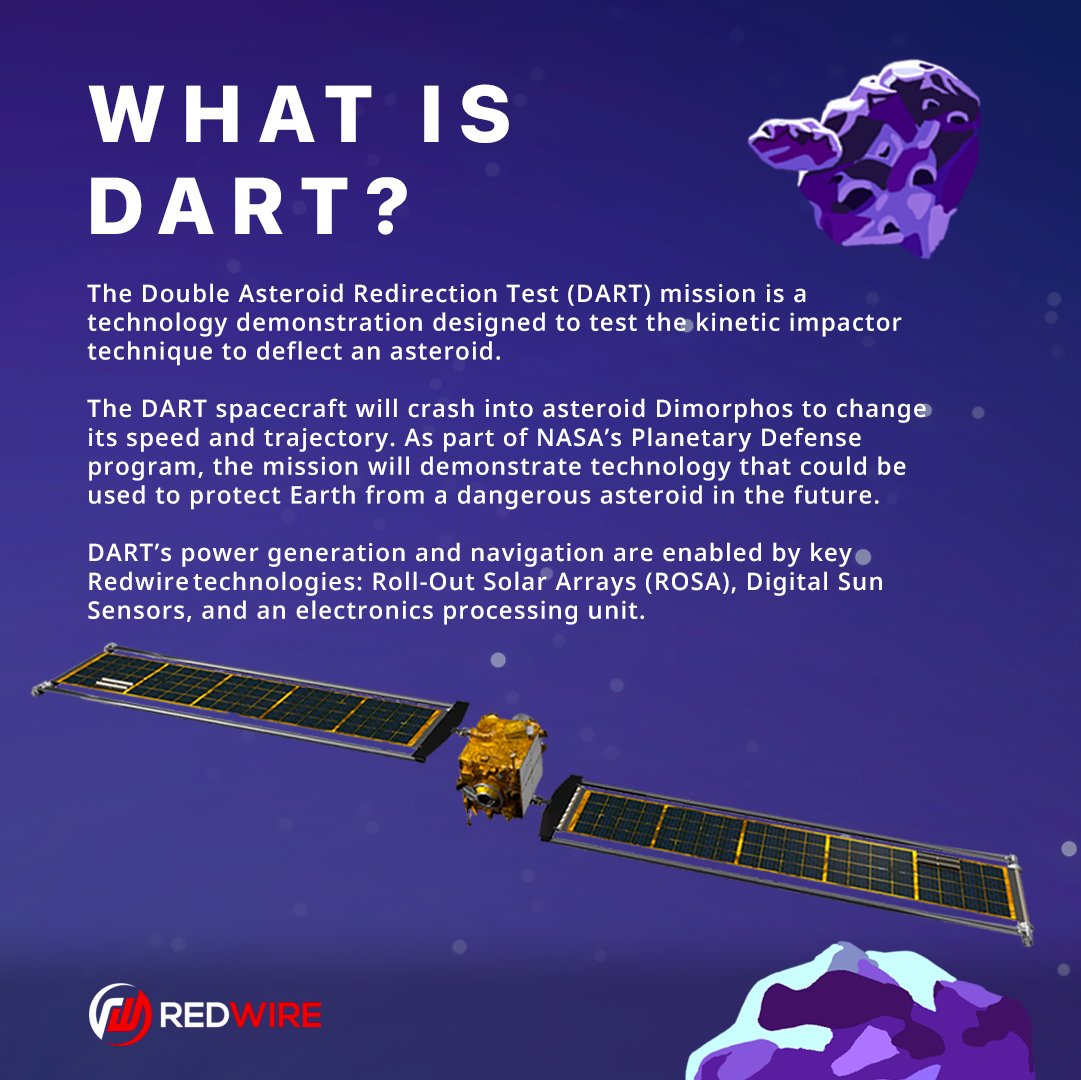
Redwire’s solar arrays aren’t just sitting on labs - - they’re actually powering real missions like NASA’s DART asteroid defense mission
slammed into a rock in space to prove we can deflect Earth bound threats
That spacecraft used Redwire’s ROSA solar arrays, sun sensors, and electronics to steer and power the whole thing
Why ROSA Is a Must-Have for the Next Decade
Every major space architecture hitting deployment this decade is power-hungry:
Missile-tracking constellations
Hyperspectral ISR
On-orbit GPU compute
GEO inspection + servicing
Lunar surface infrastructure
Deep-space probes
Commercial space stations
Orbital data centers
ROSA = The Power Layer for Off-Planet Computing
Orbital AI workloads demand:
continuous power draw for GPUs
stable output for thermal balance
huge deployable area to support inference engines
radiation-tolerant power generation
ROSA is the energy backbone that enables:
Space-based AI
Edge-processing ISR platforms
Autonomous servicing robots
Future orbital data centers
Lunar outposts
Deep-space logistics networks
Q-RAD: The Thermal Bottleneck Breakthrough for AI in Orbit
The biggest unsolved problem for AI satellites is heat.
Edge-AI payloads running onboard inference generate hundreds of watts of waste heat - - and in space heat can only leave through radiation
Redwire solved this with Q-RAD, a deployable radiator system that can:
dump 100–300W+ of GPU heat
scale modularly for multi-GPU payloads
enable long-duration inference in LEO/VLEO
support onboard SAR processing + computer vision workloads
This is a must-have for:
SDA’s missile tracking constellation
DARPA autonomy nodes
GEO inspection / refuel spacecraft
Orbital data centers
Any future NVIDIA/AMD/Intel chips in orbit
Typical AI/SAR Payload Heat Loads
Edge GPUs: 200–500W
SAR inference: 150–300W
Computer vision: 100–200W
A satellite with 2–3 AI processors generates 500–900W of waste heat
Why Q-RAD > Fixed Radiators
Foldable → fits inside smaller fairings
Lightweight → higher W/kg rejection
Multi-wing → scalable for different AI payloads
Low-jitter → essential for ISR pointing precision
Modular → directly integrates with ROSA power rails
ZBLAN: The Data Throughput Breakthrough for the Space Economy
Power (ROSA) runs the spacecraft
Thermals (Q-RAD) cool the onboard compute
But none of it matters if you can’t move data fast enough & modern space missions generate absurd amounts of data:
hyperspectral imaging
SAR
missile warning sensors
onboard AI inference
GEO inspection
optical navigation
multi-satellite mesh networks
The bottleneck isn’t compute — it’s bandwidth.
This is where ZBLAN comes in.. Redwire is the first company in history to manufacture ZBLAN optical fiber in microgravity
What Makes ZBLAN So Important
ZBLAN is a fluorozirconate glass fiber with extreme properties:
Up to 10–100x lower signal loss than silica fiber
Ultra-wide transmission window (UV → IR)
Massive data throughput potential
Minimal scattering (critical for laser comms)
Perfect for long-distance, high-bandwidth links
What ZBLAN Enables for Space
ZBLAN is the backbone of future:
optical inter-satellite links
high-bandwidth LEO → GEO → lunar comms
tactical ISR downlink
AI satellite constellations
deep-space data return
orbital data centers
ultra-fast sensor networks
Why the Space Economy Needs ZBLAN
The more AI moves onboard satellites, the more data moves between satellites.
This requires:
higher throughput
lower latency
wider bandwidth
lower loss
zero-defect optical materials
ZBLAN × Orbital Compute = Unmatched Advantage
Orbital AI nodes (SDA, DoD, commercial) need three things:
ROSA → power
Q-RAD → thermal rejection
ZBLAN → high-speed data transfer
MSTIC — Redwire’s In-Orbit Semiconductor Factory
MSTIC is Redwire’s autonomous semiconductor manufacturing facility in microgravity
Why it matters:
microgravity eliminates convection-driven defects
enables ultra-pure silicon and exotic materials
radiation-hardened wafers become easier to produce
thin-film coatings for optics and sensors reach Earth-impossible precision
What MSTIC Can Actually Produce (Processes)
Thin-film deposition for optical coatings
Epitaxial layer growth for photonics
Crystal growth for radiation-hard components
Semiconductor precursor refinement
High-purity wafers for optical/sensing chips
Production Scale
Grams → tens of grams per batch (current)
Millimeter-scale wafers, progressing toward centimeter-scale
Pilot-level, TRL-5 with some TRL-6 components
Scaling to TRL-7 by 2027 under NASA programs
The Strategic Endgame of MSTIC
Why does NASA (and DoD) want in-orbit semiconductor manufacturing?
Because modern electronics fail in radiation environments
Microgravity enables:
defect-free crystal growth
radiation-resistant chiplets
ultra-pure optical coatings
microelectronics for deep space missions
DoD sees MSTIC as:
the path to producing radiation-hardened AI accelerators
the foundation for autonomous deep-space probes
a way to build secure supply chains off-planet
Quantified Power Needs for Edge AI in Space
Typical AI/ISR payloads require:
Edge GPUs (NVIDIA Jetson / custom ASICs): 150–500W
SAR processors: 150–300W
Hyperspectral AI pipelines: 200–400W
Spaceborne radar or tracking sensors: 300–800W
Total: modern ISR spacecraft require 800W–2 kW continuous power
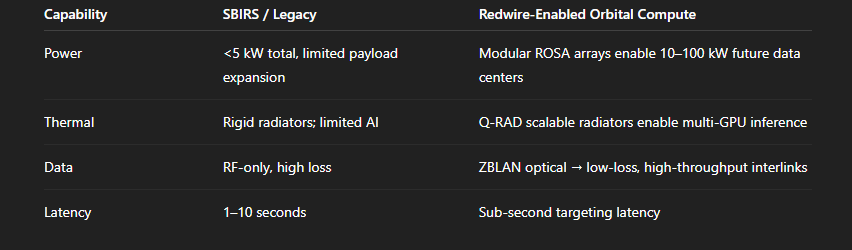
No legacy rigid panel satellite can support this without massive power/thermal penalties
ROSA + Q-RAD solve exactly this...
Why ROSA + Q-RAD + ZBLAN = Minimum Viable Stack for Orbital Compute
ROSA supplies high-output deployable power
Q-RAD dissipates 200–500W of GPU heat per radiator wing
ZBLAN transmits terabit-class data across optical mesh networks
Together these enable:
On-orbit AI inference
Low-latency ISR
Inter-satellite optical networking
Operational autonomy
No other U.S. company provides all three at flight heritage TRL
Cybersecurity & Resilience Angle
Redwire’s architecture improves survivability through:
Distributed compute nodes across orbits
Optical mesh networking resistant to jamming
Reduced RF signatures
Radiation-hardened materials from MSTIC
Rapid reconstitution using VLEO TacRS buses
Acorn 2.0 & DEMSI — Redwire’s Digital Twin Engine for Space Architecture
Another part of the Redwire stack most people miss:
Redwire doesn’t just build spacecraft - - they build the software that designs the entire constellation
Acorn 2.0 + DEMSI simulate:
VLEO drag + atmospheric density
thermal load and radiator sizing
mesh network routing
ISR CONOPS
multi-satellite autonomy
power cycles + solar geometry
high-density AI payload behavior
inter-satellite links + latency budgets
This modeling suite is used before hardware is ordered which means Redwire gets “designed in” at the architectural level
Which DoD Programs Benefit/Use It
SDA constellation design
TacRS rapid mission modeling
SpaceWERX tactical ISR payloads
AFRL modeling & simulation frameworks
How It Ties Redwire to Architecture-Level Procurement
If your digital twin becomes the mission blueprint:
Redwire becomes the default subsystem integrator
Redwire’s hardware becomes designed in at Phase 0
Competing vendors must integrate into Redwire’s model
Partners & Programs
Blue Origin's Blue Ring Space Mobility Platform
Products: ROSA solar arrays (4 units), Argus cameras, LVDUs
Why it matters:
Blue Ring is Blue Origin’s multi-orbit logistics and delivery platform — a cornerstone architecture for in-space mobility, refueling, and persistent presence. Redwire is supplying:
ROSA wings → core power generation
Argus imaging systems → navigation & mission ops
LVDUs → electrical distribution backbone
NASA — ISS, Artemis Gateway, DART, and ISAM
6 ROSA arrays already on ISS
2 more in production
ROSA power for NASA’s Artemis Gateway
ROSA enabled the DART asteroid-deflection mission
Biofabrication + optical fiber (ZBLAN) + ISAM tech
U.S. Space Force / DoD — SDA, VLEO, OTTER
DARPA OTTER Phase 2 ($44M) — air-breathing VLEO spacecraft
SabreSat VLEO ISR platform for next-gen tactical sensing
Q-RAD thermal systems for DoD spacecraft
Deployables + structures across classified and SDA missions
ESA / International Governments
European Space Agency missions using Redwire navigation components
International payloads leveraging deployables, imaging, and structures
Axiom Space - - Commercial Space Station Ecosystem
Redwire supplies:
power systems
deployables
materials research hardware
manufacturing modules
Commercial Constellations & Space Manufacturers
Across the industry, Redwire components appear in:
Blue Origin (multiple programs)
Maxar / Viasat legacy systems
Sierra Space
SpaceX (indirect supply chain components)
Multiple satellite OEMs in MEO/LEO/GEO
When building a spacecraft Redwire likely provides:
solar arrays
radiators
deployable structures
star trackers
cameras
power distribution
materials
optical fiber
In-Space Manufacturing (ISAM): Redwire’s Crown Jewels
Archinaut One — The First Autonomous Factory in Space
Archinaut One is Redwire’s flagship:
a fully autonomous robotic factory designed to build large structures in orbit - - not on Earth
What makes it so important:
Builds trusses, beams, antennas, radiators, solar arrays directly in space
Operates with zero astronauts
Removes rocket payload fairing limits
Reduces launch mass since structures aren’t transported from Earth
Enables infrastructure too big to ever launch conventionally
This is the first real “construction robot” in orbit
Archinaut is the technology that unlocks:
Giant next-generation telescopes
Full-scale space stations
Orbital shipyards
Power farms
Space logistics hubs
SpiderFab — The Web-Weaving Successor
SpiderFab is Redwire’s evolution of Archinaut:
a robotic “spider” that weaves huge structures using composite materials in microgravity
How it works:
Robotic arms pull, unroll, and connect structural elements
Builds kilometer-scale structures without human intervention
Creates antennas, solar arrays, trusses, and power structures far larger than anything we can launch
Why it matters:
Completely removes rocket size limits
Allows telescopes bigger than JWST
Creates power arrays for high-energy missions and defense platforms
100% autonomous
Funded by NASA, DARPA, and Space Force as a priority ISAM tech
SpiderFab = Redwire becomes the construction crew of orbit
Redwire’s ISAM Milestones
Redwire (via Made In Space) has a list of firsts nobody else can touch:
First 3D printer in orbit (ISS)
First ceramic part printed off-Earth — huge because ceramics are used in structural, thermal, propulsion components
First plastic recycler in space — enabling closed-loop material use
First company to print ZBLAN optical fiber in microgravity
First companies to perform biomedical tissue printing in orbit
Why ISAM Is the Most Valuable Part of Redwire’s Future
ISAM is how Redwire becomes:
The Honeywell of space infrastructure
The Caterpillar of orbital construction
The first industrial conglomerate beyond Earth
Because once off planet manufacturing works, the whole economics of space flips:
Structures get bigger
Satellites get cheaper
Missions become permanent
Defense platforms scale
Lunar and Mars infrastructure becomes achievable
Space factories and data centers become real industries
The Defense Payload Arm Most People Are Sleeping On
In 2025, Redwire quietly launched Redwire Tactical, a dedicated business unit focused entirely on national security space
What Redwire Tactical Actually Produces
Space-based ISR Payloads
RF detection
Infrared telescopes
Missile warning sensors
SIGINT/ELINT payloads
Edge-AI Processing in Orbit
Onboard computer-vision pipelines
Real-time tactically relevant ISR
SAR preprocessing
Low-latency tracking + targeting
Tactical Space Infrastructure
LEO → GEO ISR payload chains
Autonomous inspection sensors
Navigation + guidance modules
Rapid reconstitution payloads
This is Redwire’s Palantir/Anduril competitor except instead of delivering software, Redwire delivers physical, orbital hardware that those software companies run on top of
This is where Redwire’s value becomes unavoidable for DoD:
Space-based missile tracking
Hypersonic detection
Global ISR
Tactical autonomy
Redundancy/resiliency for warfighting networks
Every Pentagon modernization effort requires one or more of:
power → ROSA
thermal → Q-RAD
data → ZBLAN
materials → MSTIC
ISR → SabreSat/Thresher/Mako
autonomy → Archinaut/SpiderFab modeling systems
Redwire Tactical is the “front door” for DoD to buy from all these verticals.
Key Partners
Space Force
SDA
DARPA
Boeing/Millennium
Lockheed
General Atomics
L3Harris
SDA Transport Layer – The Hidden Cash Cow
Redwire is a major supplier to the SDA Transport Layer aka the Pentagon’s orbital internet
They provide:
Link-16 antennas
power systems
thermal structures
deployables
VLEO → Layer 0 tactical ISR
LEO → Transport Layer and Tracking Layer
GEO → OPIR augmentation and MEO/GEO relay nodes
Redwire’s deployables, antennas, power, and thermal hardware are already qualified for SDA buses through Lockheed, York, Northrop, and Millennium
Redwire’s integration is possible because:
Roccor deployables
Oakman avionics
SabreSat/VLEO bus
Mako GEO platform
Acorn/DEMSI modeling suite
ROSA/Q-RAD/ZBLAN compute stack
They are the only mid-size contractor providing horizontal ISR integration across four altitudes
Life Sciences in Space
Redwire runs biotech payload ops aboard the ISS:
Organoid printing + tissue engineering
Drug R&D in zero-G
Early-stage contracts with NASA and pharma partners
Space-grown proteins = higher purity than anything Earth-based
Redwire also pioneered the growth of photonics materials in orbit - - the kind used in next-gen sensors and high speed communications
They’ve already grown higher quality protein crystals in space that pharma companies can’t replicate on Earth... huge advantage and massive potential / TAM
Running biotech ops on ISS and future commercial labs
Partnered with Aspera, NASA, and pharma giants (including royalty talks with Eli Lilly + Bristol Myers) - - BMY is going to be the key for RDW space/pharma link
Redwire’s PIL‑BOX + Microgravity Platform
PIL‑BOX = miniaturized biotech lab built for space
Used to run crystallization, stability, and reaction experiments in zero gravity
Redwire has already flown multiple missions with Bristol Myers Squibb since early 2024
Bristol Myers + Bain Capital Team-Up - - connect the dots
BMY and Bain Capital announced the launch of a new biotech company focused on five immunology assets, including:
A late stage lupus drug
4 other immunology candidates
Redwire is the only publicly disclosed company to be running drug experiments for BMY in orbit
Bain Capital’s preferred stake is convertible into 20M in commons - 12% of RDW
June/July filings removed the blocker, giving Bain the right to convert at any time
So BMY / RDW / Bain Capital all in bed together - - worth noting
Eli Lilly PIL‑BOX experiments produced higher quality insulin crystals in microgravity
Goal: create autonomous drug development platforms in space - - again this is crazy potential
Lunar Surface & Deep Space Infrastructure
Redwire is already embedded across NASA’s entire Moon-to-Mars architecture
Redwire gear is already on Artemis + CLPS missions:
Power + guidance systems for landers
Long-term: lunar infrastructure + Moon to Mars logistics
Near-Term (2025–2027)
Redwire hardware is riding on:
Artemis lander systems
precision sun sensors
avionics components
thermal structures
array deployment mechanisms for power systems
Commercial Lunar Payload Services (CLPS) missions
ROSA-derived power arrays for landers
guidance and navigation hardware
payload support structures
Mid-Term (2027–2032): Lunar Infrastructure Build-Out
NASA’s shift toward permanent lunar presence requires:
ultra-light deployable power systems
radiation-tolerant avionics
autonomous robotics
in-space manufacturing materials
long-duration thermal solutions
Redwire is strategically positioned for all of these.
Their capabilities map directly onto future lunar infrastructure:
Lunar power stations → ROSA
Thermal regulation for shadowed areas → Q-RAD derivative radiators
Habitat structure components → ISAM-built beams, trusses, and structural composites
Surface labs for biotech & materials → PIL-BOX + microgravity manufacturing
Long-Term (2030+): Moon → Mars Logistics Chain
Redwire’s ISAM systems (Archinaut, SpiderFab), ZBLAN optical network, and ROSA power technologies translate directly to:
in-orbit assembly of Mars transfer vehicles
deep-space power farms
autonomous refueling depots
radiation-hardened comms networks
modular space habitats

Orbital Stations & Civilian Infrastructure
Redwire is the only mid-cap company that shows up in all three commercial space station programs replacing the ISS & this matters because NASA is transitioning to commercial LEO destinations, and Redwire is a core supplier to every single contender
Involved in ALL next gen ISS replacement programs!!
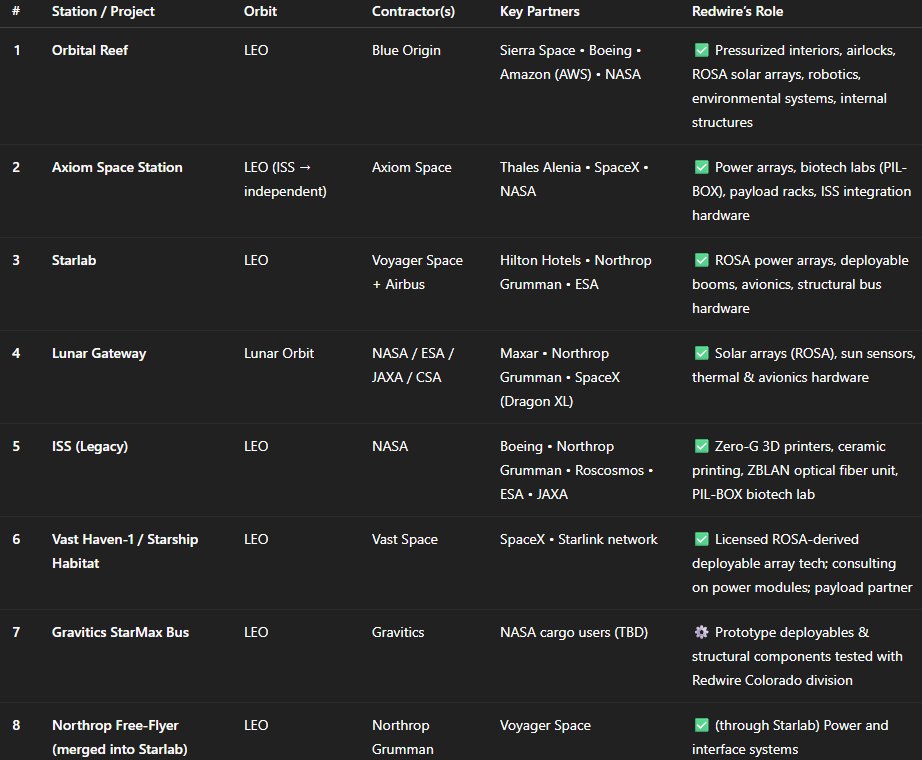
Orbital Reef (Blue Origin + Sierra Space)
Redwire is providing:
pressurized interiors & structural modules
airlocks & life-support infrastructure components
ROSA power arrays
robotic systems & deployables
environmental monitoring hardware
they’re part of the station’s backbone architecture
Axiom Station
ROSA-derived power systems
biotech labs (PIL-BOX)
ISS rack integration hardware
structural bus components
Axiom is the first commercial module physically attached to the ISS
Starlab (Voyager Space + Airbus + Northrop)
Redwire is supplying:
deployable booms & structural components
ROSA arrays
thermal & avionics systems
interface hardware for the Northrop free-flyer integration
This positions Redwire within both U.S. and European ISS replacement programs
ISS (Legacy) — Still a Cash Machine
Redwire continues to operate:
3D printers
ceramic manufacturing units
ZBLAN fiber production module
PIL-BOX biotech labs
Vast Haven-1 / Starship Habitat (SpaceX)
Licensed ROSA-derived deployable array tech
Modular power consultation
Opportunities for structural components
Gravitics StarMax Bus
Redwire supports:
deployable prototypes
structural components
power subsystem consultation
Why This Matters
Redwire is now embedded across every U.S. commercial ISS replacement, multiple lunar surface programs, and deep-space scientific missions
This creates a structural moat built on three pillars:
1. Hardware Standardization Across the Station Ecosystem
Redwire subsystems are becoming the default building blocks for LEO habitats:
ROSA → primary power architecture
Q-RAD → thermal management standard for high-duty payloads
Avionics & Sun Sensors → guidance/core electronics
Deployables & Structures → booms, airlocks, trusses, interior modules
Once these components are integrated into one station, other station vendors adopt them for compatibility and cost efficiency
2. Multi-Agency, Multi-Nation Flight Heritage
Redwire hardware appears in missions and stations backed by:
NASA
ESA
JAXA
CSA
Roscosmos (legacy ISS systems)
Blue Origin, Axiom Space, Voyager Space/Airbus, SpaceX, Gravitics
This matters because:
International mission flight heritage drastically lowers procurement risk.
Station operators prefer vendors already qualified across NASA and ESA standards.
Redwire becomes a cross-program common denominator — reducing integration friction for the entire LEO economy.
3. Future-Ready Station Architecture
Every next-generation station — and every lunar outpost — requires the same foundational capabilities Redwire already supplies:
High-power generation (ROSA)
High-efficiency thermal rejection (Q-RAD)
Robotic assembly + ISAM
In-space manufacturing (ZBLAN, ceramics, composites)
Biotech labs (PIL-BOX)
Optical networks + high-throughput data infrastructure
Autonomous structural systems (Archinaut / SpiderFab)
Redwire is one of the only companies providing flight-proven solutions across all six of these categories.
This positions them as the prime industrial supplier for:
commercial LEO stations
lunar bases
deep-space logistics hubs
future orbital data centers
autonomous factories in space
Future Tech: Quantum, AI, Autonomy
Developing quantum secure comms + autonomous servicing robots
Positioning for future ISR and space logistics stack
Acquires Edge Autonomy June 2025
This was huge for them because they now own:
Stalker + Penguin drones (DoD/DIU approved)
Air + orbital ISR stack from drone to GEO
Combining UAS, VLEO satellites (SabreSat), LEO ISR (Thresher), and MEO/GEO platforms (Mako)
They now offer a vertically integrated defense ISR system - - air to space

Redwire x Amazon x Microsoft - - Hyperscaler War in Orbit
Amazon (Project Kuiper) — Redwire = Core Subsystem Provider
Redwire provides Kuiper with:
ROSA-derived solar arrays (high-surface-area power for comm workloads)
RF antennas (Kuiper’s phased-array integration relies on stable deployables)
Structural + thermal components
Microsoft (Azure Orbital) — Cloud-Controlled Manufacturing = first of a kind
Redwire demonstrated:
ISS 3D printers receiving cloud commands
Azure edge compute validating print parameters in microgravity
Real-time data loops between ISS → cloud → ISS
Autonomous correction without human intervention
What Azure’s Demo Actually Proved (Critical for DoD)
Orbital manufacturing can be cloud-coordinated
crucial for autonomous ISR hardware, rapid satellite repair, ISAM
Secure cloud → spacecraft command is viable
directly relevant to SDA Tranche 2+ architectures
Low-latency, resilient compute in space is possible today
enables onboard AI for targeting, tracking, missile warning
Orbital machines can operate as cloud-native devices
seamless JADC2 integration
Why Hyperscalers Matter for DoD
DoD already runs workloads on:
Azure Government
AWS GovCloud
Secret/Top Secret regions
If orbital compute integrates with their existing identity, zero-trust, and pipeline frameworks:
No new security stack needed
No new integration layer
No new accreditation burden
DoD can move ISR/AI workloads into orbit with almost zero friction
Redwire = The On-Ramp for Orbital Compute
Hyperscalers are competing to bring:
AI processing
storage
mission data
compute nodes
off planet.
But they cannot do:
deployable power (ROSA)
thermal for GPUs (Q-RAD)
data-grade optical materials (ZBLAN)
autonomous manufacturing (Archinaut)
Redwire is the only bridge between hyperscaler compute and space hardware
Lonestar Data Holdings
What the first orbital data center proved:
Commercial partners can operate compute/storage reliably in orbit
Data survivability is higher than terrestrial centers
Space-based redundancy reduces cyberattack surface
Latency links to Earth/cloud were within commercial tolerances
Power + thermal demands matched ROSA/Q-RAD capabilities
Orbital compute payloads can be modular and serviceable
Road to Success
If Redwire nails execution they become the infrastructure king of the space economy with upside across defense, pharma, civil infrastructure, and deep space exploration... they can potentially do it all
Their stack isn’t limited to orbit.. it’s increasingly a dual-use tech platform for Earth and space, with direct exposure to rising U.S. defense budgets, ISR demand, and biotech innovation
The market hasn’t priced in the optionality yet and thats the opportunity
One thing to keep in mind with all space companies is their very at risk for dillution, I would assume they all get bought up by investors since this field is so massive and lucrative in future
I look at them as a potential Honeywell in space, involved in so much... the low valuation right now makes it relatively low risk so if they execute
Redwire subsystems use Honeywell guidance components
Honeywell avionics + Redwire deployables show up on shared missions
Redwire is supplementing Honeywell’s Earth-based industrial infrastructure with its own orbital infrastructure
Executives worth looking into
Peter Cannito, CEO & Chairman
Took the helm in June 2020
Ex-Marine Corps officer, finance & MBA background
Former CEO of Polaris Alpha (DoD/Intelligence systems)
Has led 10+ strategic acquisitions in the space/defense sector
Nominated for 2024 Satellite Executive of the Year — recognized for growing RDW’s revenue nearly 5x and securing NASA/ESA/Defense contracts
Al Tadros, Chief Technology Officer
Former VP at Maxar, led on-orbit manufacturing
MIT-trained engineer, holds patents in satellite robotics and attitude control
Jonathan Baliff, CFO & Board Member
Ex-Air Force F-4 pilot and analyst at Credit Suisse
Former CEO/CFO of Bristow Group; led major aerospace M&A and financial strategy
Aaron Futch, EVP & General Counsel
Joined June 2024 from Virgin Galactic and Intelsat
Senior NASA legal advisor
Critical for navigating advanced contracts, compliance, and strategic negotiations
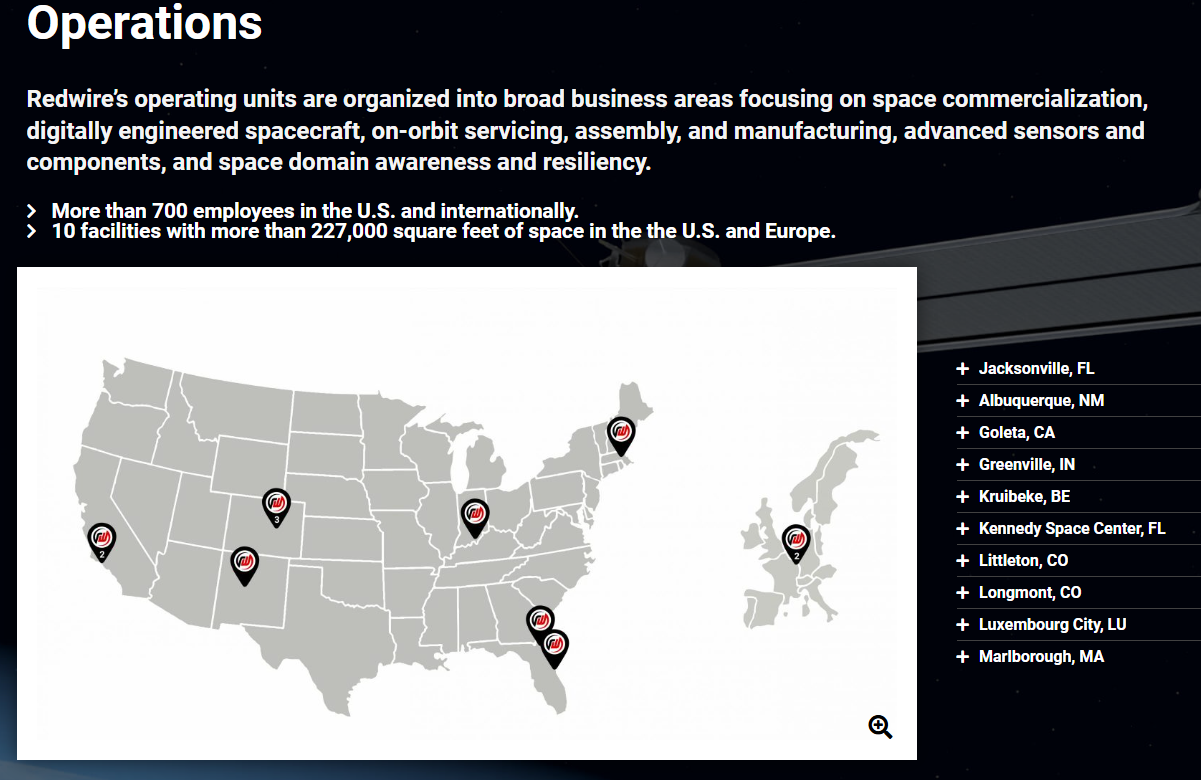

https://redwirespace.com/capabilities/
Keep noted:
ROSA = power
Q-RAD = thermal
ZBLAN = data
MSTIC = materials
Acorn/DEMSI = modeling
Phantom/SabreSat/Thresher/Mako = platforms