

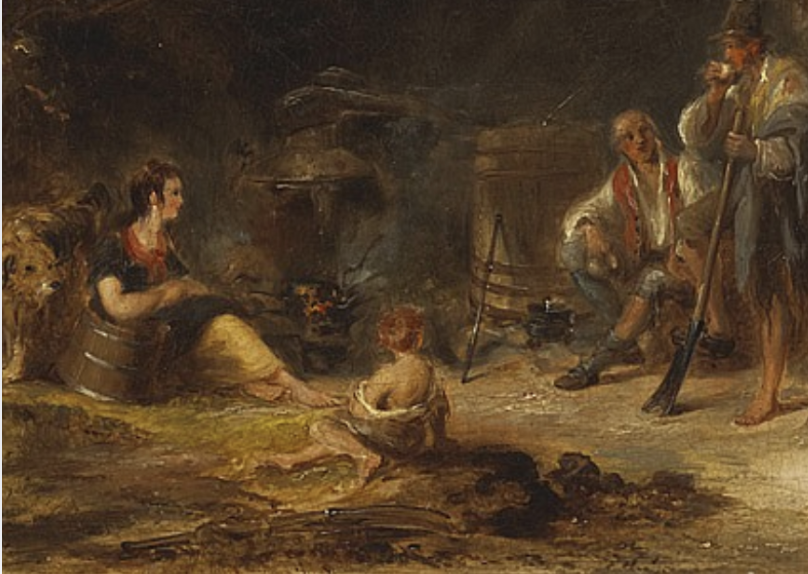
 July was known as the "Hungry Month" or "Hungry July" in Irish tradition. It was a lean six week period between Midsummer and the first potato harvest at Lughnasa, when food stores such as oats and last year's potatoes ran dangerously low.
Other names for Hungry July, or Iúil an Ghorta, included:
Cabbage July because if people had cabbage they ended up eating a lot of it.
Yellow Month or Buímhís, a reference to both the colour of the fields and the faces of the poor during this difficult month.
Staggering July or The Dead Month, Mí Mharbh, other names that reflected just how hard the month could be, with hot weather and empty cupboards.
It was also considered bad luck to get married in July, as it was believed you and your family would always be hungry.
There was, however, a way to use up the last of the potatoes, even if they were beginning to turn, by making boxty. From the Schools Collection, recorded in Coogue Middle, Co. Mayo:
When the months of June and July came the oatmeal and potatoes were nearly gone and the people used to make a food called boxty. First of all about twelve or thirteen potatoes were washed clean. These twelve potatoes would do for three or four cakes. Then the potatoes were scraped into a big dish or basin. The potatoes were scraped with a piece of tin with holes bored through it.
The rough side was used for scraping. This piece of tin was fastened to a piece of wood. When it was scraped it was squeezed. Sometimes boiled potatoes were put through with the raw potatoes. Then they were mixed with a little salt and a little flour and made into the shape of a cake. This cake was put in a pan or sometimes left on the tongs. There is not as much boxty made nowadays as was made long ago.
July was also known as Thirsty July by the people of Inishowen in County Donegal.
The month also provided a unique opportunity to make poitín. As it was illegal at the time, it was usually distilled on islands or in remote places where it was less likely to be discovered, despite the huge plumes of smoke created during the process.
The timing of July as the distilling month had nothing to do with folklore or feast days. In the early 1870s, a local man named Dolty MacGarvey explained why:
"We always dry the malt in the beginning of July, when all the police are taken off to Derry to put down the riots there; so we can do it safely then. God is good, sir; God is good."
Considering how lean this period could be (the names Mí Mharbh and Iúil an Ghorta don't leave much to the imagination) it makes sense that Lughnasa became one of the wilder feasts and celebrations of the Irish calendar.
In some parts of Ireland, the official end to this lean period was not Lughnasa itself on 1st August, but the last Sunday in July, known as Bilberry Sunday. It was marked with a meal of the first potatoes of the season, some meat and a barmbrack made with bilberries.
These berries were also known as blaeberries, heatherberries, fraughans or frachóg. They were important in ancient Ireland and were used in everything from cooking, healing and even as a purple dye. Until relatively recent times there was a thriving cottage industry built around them. Young people would spend their summer picking bilberries, which were collected by merchants and shipped to towns and cities across Britain, where they were hugely popular.
But bilberry picking was not just about earning a few pennies. It was also a social occasion, especially for young people. Groups would spend long summer days foraging together, and the outings often came with a cheeky bit of flirting. In some places, young women baked bilberry cakes and presented them to the lad they fancied.