

Public order theatre isn’t prevention, and you can’t police your way out of extremism.
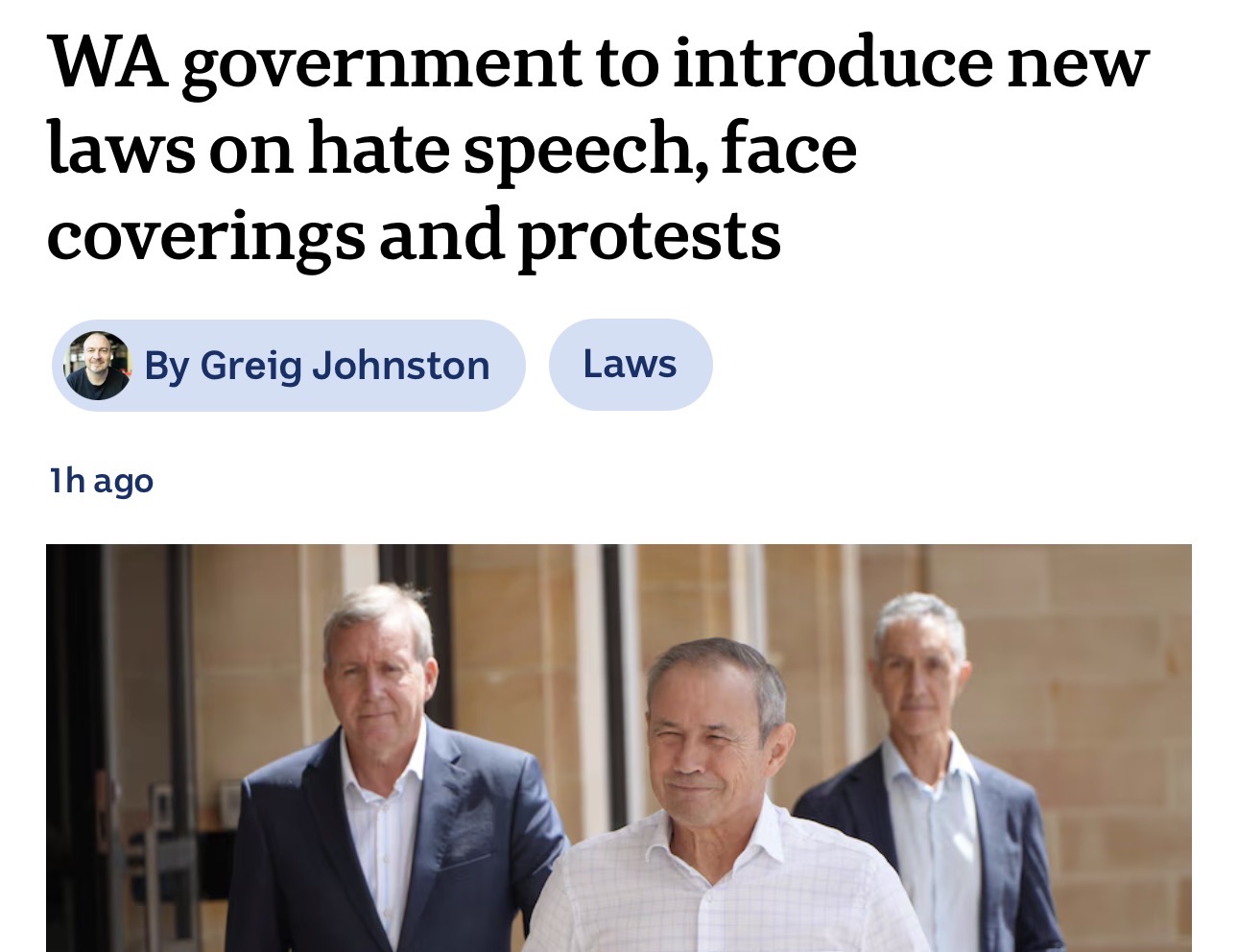
In the wake of the attempted bombing at the Invasion Day rally in Perth, the WA government has announced new laws allowing police to refuse protest permits if an event is deemed likely to “promote hate” on the basis of race, religion, gender, sexuality or other protected characteristics. The stated aim is “social cohesion” and public safety. The political instinct is familiar: a shocking act of violence occurs, and the legislative response centres on protest regulation.
No reasonable person disputes that governments have a duty to prevent violence and intimidation. The question is whether expanding powers over protest is actually a meaningful way to prevent extremist violence, or whether it simply creates the appearance of action while leaving the structural drivers of radicalisation largely untouched.
Research into violent extremism consistently shows that it does not emerge from a single cause. Radicalisation is shaped by a combination of social conditions, grievances, identity dynamics, and enabling environments, particularly online ecosystems that reward polarisation and conspiratorial thinking.
Policies that focus narrowly on controlling public demonstrations target the visible expression of conflict rather than the underlying conditions that make extremist ideologies appealing or actionable.
There is a political logic to this. Protest regulation is tangible, fast and legible to the public. Structural prevention is slow, expensive and less photogenic. But if the goal is to reduce the likelihood of future extremist violence, the evidence points upstream.
Extremism grows in instability, not in public squares.
International research on preventing violent extremism emphasises that structural inequalities, social exclusion and political alienation create environments where extremist narratives can take hold.
That does not mean poverty alone “causes” terrorism. It means instability, humiliation and lack of belonging can be exploited by movements offering identity, purpose and grievance.
Housing policy, for example, rarely appears in national security debates, but it should. Stable housing is one of the strongest predictors of social stability and community connection. Chronic precarity, by contrast, erodes trust in institutions and increases susceptibility to narratives that frame society as hostile or illegitimate. If you wanted to design a society that is harder to radicalise, you would start with secure housing and functioning social safety nets. Not because they are morally virtuous, but because they reduce the conditions extremist groups recruit from.
Education plays a similarly foundational role. There is growing international recognition that education systems are part of the prevention architecture for violent extremism. Schools that prioritise critical thinking, civic literacy and media literacy help individuals recognise manipulation and resist propaganda. (World Bank)
Extremist movements, particularly far-right networks, rely heavily on online radicalisation pipelines built on disinformation, grievance and identity politics. An education system that equips people to navigate those environments is not a soft social policy. It is a resilience strategy.
The digital pipeline matters more than the protest permit.
Contemporary extremist movements operate through digital ecosystems where algorithms amplify outrage and polarisation. Radicalisation often occurs in online communities long before any public demonstration or act of violence. Research on pathways to extremism highlights the role of recruitment networks, ideological indoctrination and social reinforcement in these spaces.
If the concern is preventing violence, regulation and accountability in digital environments are likely to be more consequential than restricting public assembly. Transparency requirements for platforms, stronger enforcement against coordinated hate networks and investment in community-based intervention programs address the environments where radicalisation actually develops.
By contrast, laws that allow authorities to deny protest permits based on predicted “hate” risk shifting significant discretionary power to police over who can assemble in public. Critics of the WA proposal have already raised concerns about oversight and the potential for authorities to decide which groups are allowed to protest.
Even if implemented in good faith (are they ever?), such powers sit uneasily within democratic norms and can fuel the very narratives of state overreach that extremist groups use to recruit.
Security policy that is mostly optics
None of this is an argument against responding to violence or intimidation. Targeted measures against explicit incitement, threats or coordinated harassment can be justified. But there is a difference between addressing specific harms and expanding broad discretionary powers over protest.
The deeper problem is that prevention policy is often replaced by visibility policy. Governments respond to shocking incidents with legislation that signals control rather than legislation that reduces long-term risk. Stronger protest laws are highly visible. Housing reform, education investment and digital regulation are not. One produces headlines. The other produces resilience.
It wouldn’t be a badyogi blog post without a more cynical reading…
Protest crackdowns rarely affect extremists alone. They affect environmental activists, unionists, Indigenous organisers and anyone else who uses public assembly to challenge power. It is politically convenient to fold all of that into a single “public order” framework. It is less convenient to address inequality, social fragmentation and online radicalisation.
What could prevention actually look like?
If the aim is to reduce extremist violence rather than simply respond to it, the policy priorities look different:
secure and affordable housing as a foundation for social stability
properly funded public education with strong civic and media literacy
anti-poverty and inclusion policies that reduce structural grievances
regulation and transparency in digital ecosystems that facilitate radicalisation
community-based intervention and de-radicalisation programs with oversight
strong, targeted anti-hate laws that address incitement without broadly restricting assembly
These are not as politically satisfying as announcing tougher protest controls. They do not produce immediate headlines about “cracking down.” But they are more aligned with what the research says about how radicalisation occurs and how it can be prevented.
TLDR; My Hot Take
Much like you cannot downward-dog/love and light your way out of fascism, you also cannot legislate it out of existence by making protest permits harder to obtain. Extremism is not a scheduling issue. It is a social ecosystem issue.
If governments want fewer radicalised individuals willing to throw explosives into crowds, the answer is not just more authority over who gets to gather in a public square. It is building a society where fewer people are drawn to violent ideologies in the first place.
That work is slower, less dramatic and far less instagrammable than announcing new protest restrictions. It also happens to be the work that actually reduces the risk of extremist violence.
Don’t take my word for it ✨I’m just a girl ✨ but here is some further reading that can back up some of my RaDiCaL LeFt claims:
United Nations Development Programme (2016). Preventing Violent Extremism Through Inclusive Development and the Promotion of Tolerance and Respect for Diversity.
United Nations (2015). Plan of Action to Prevent Violent Extremism.
World Bank (2017). The Role of Education in the Prevention of Violent Extremism.
UNESCO. Media and Information Literacy: Reinforcing Human Rights and Countering Radicalisation.
Australian Institute of Criminology (2023). Understanding and Preventing Internet-Facilitated Radicalisation.*
National Institute of Justice (US). Radicalization and Violent Extremism: Research Briefs.
Institute for Strategic Dialogue. Research on far-right online ecosystems and digital radicalisation.
Australian Housing and Urban Research Institute. Research on housing insecurity, social exclusion and community stability.
ABC News (2026). WA government to introduce new protest and hate-speech laws following Perth attack.