

 Dear Readers,
There is something deeply paradoxical about the modern world. Everywhere we turn, from mental health campaigns and corporate wellness seminars to casual conversations with well-meaning friends, the advice offered to anyone struggling is remarkably consistent. When someone is weighed down by depression, isolation, fear, or the quiet exhaustion of daily life, we tell them to speak up. We say, “Talk to someone,” “Reach out,” and “Don’t carry this alone.” We treat reaching out as the definitive first step toward healing, an act of quiet courage that promises relief.
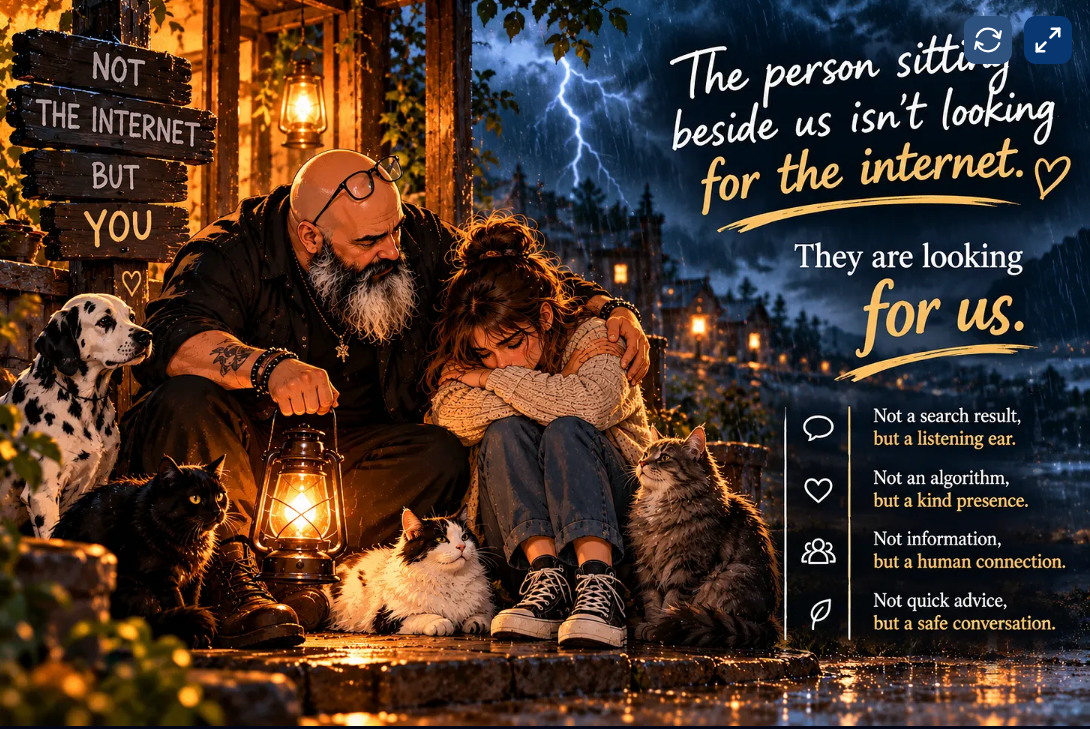
Eventually, having mustered whatever fragile resolve they have left, that person takes our advice. They approach someone they trust, a spouse, a parent, a close colleague, or a friend across a kitchen table, and ask a deceptively simple question: “Can I talk to you?” In that vulnerable moment, their ask is rarely complicated. They are not looking for a clinical diagnosis, an intellectual debate, an unsolicited critique, or a five-step blueprint to reorganise their life. What they want, more than anything, is the reassuring warmth of another human being willing to sit beside them, shoulder the silence, and simply listen.
Yet despite our endless encouragement to speak up, our instincts upon hearing someone’s vulnerability have become warped by the digital era. Somewhere along the way, we developed a peculiar and troubling habit: we have learned to place more faith in the internet than in the living, breathing human being sitting right in front of us. We will unquestioningly believe a thirty-second video posted by an algorithm. We accept viral tweets, polished infographics, quotes overlaid on scenic landscapes with millions of views, and charismatic strangers speaking authoritatively into smartphone cameras. We treat algorithmic content as objective gospel, yet the moment a person of flesh and blood reveals their interior world to us, our immediate reflex is scepticism.
Instead of opening our arms, we cross them. We scrutinise their lived reality with analytical suspicion, asking, “Are you sure it’s really that bad?” or “Don’t you think you’re just overthinking things?” Worse still, we instinctively reach for the nearest device and ask, “Have you looked up what the internet says about this?” This last reaction is perhaps the most disorienting of all. It betrays a fundamental misunderstanding of why someone reached out in the first place. The person speaking to us did not come seeking an information retrieval system; they came seeking a witness to their reality. They do not need data; they need to know they have been heard.
This divide exposes a critical distinction that our hyper-connected culture regularly overlooks: the internet offers answers, but people offer presence. The digital realm is an undeniable wonder of human ingenuity, granting us access to encyclopedic knowledge, global support communities, specialised research, and professional guidance that would have been entirely inaccessible a generation ago. Yet access to information is fundamentally distinct from human connection. A search query can return millions of definitions of loneliness, but it cannot breathe alongside you when the silence in your home feels heavy and suffocating. A sleek medical video can map the neurobiology of clinical depression, but it cannot perceive the sudden tremor in your voice. An article can catalogue ten textbook coping mechanisms for grief, but it cannot see the unshed tears brimming behind your eyes, nor can it rest a gentle hand on your shoulder to whisper, “You do not have to carry this alone.”
Why, then, do we find it so difficult to simply listen to the person standing before us? The uncomfortable truth is that believing someone comes with an emotional and practical price tag. Believing another person demands responsibility. If I genuinely believe you when you confess that you are falling apart, I can no longer remain passive. I may have to stop what I am doing, set aside my own urgent agenda, put away my distractions, ask thoughtful questions, and willingly inhabit your discomfort. Believing you forces me to stay present inside a space that feels messy and unresolved.
In contrast, the internet allows us to care strictly from a distance. It offers the illusion of empathy without demanding any personal sacrifice. It is painless to scroll past an online essay about someone else’s anguish, double-tap a supportive sentiment, or consume emotional narratives through a screen, precisely because a screen cannot ask anything of us. Human beings, however, cannot be curated or kept at arm’s length so easily. Real people carry flawed histories, unpredictable reactions, and inconvenient truths. They present contradictions that cannot be tidied up with an aesthetic font or resolved before the next swipe. Because raw human vulnerability is demanding, we retreat into the safety of abstract “information,” treating cold facts as far more palatable than the messiness of someone’s lived experience.
And now, there is another layer to this conversation. Increasingly, when people are lonely, confused, heartbroken, or simply overwhelmed, they turn not only to search engines but to artificial intelligence. They open ChatGPT and begin typing what they cannot bring themselves to say aloud to another person. Sometimes, that can be genuinely helpful. An AI can help someone organise their thoughts, find information, explore possibilities, or even find the words for feelings they have struggled to articulate. For someone who feels completely alone, having somewhere to begin can matter.
But we should not confuse a place to begin with a human relationship.
There is something fundamentally different about telling a machine what you are feeling and telling another human being who can look into your eyes and say, “I hear you.” AI can respond to our words, but human beings can respond to our presence. A person can notice the long pause before we answer, the change in our voice, the tears we are trying to hide, or the silence that says more than our words. A machine can help us understand what we are experiencing; a human being can sit beside us while we experience it.
Perhaps the real danger is not that people talk to AI. Perhaps the danger is that we begin choosing AI because human beings have become too difficult to talk to.
If someone has reached the point where they are telling a chatbot what they cannot tell their own family or friends, perhaps we should not immediately ask why they are using AI. Perhaps we should ask ourselves why they did not feel safe enough to come to us.
Technology can be a bridge. It should never become the only place where someone feels heard.
A significant barrier to this kind of listening is our conflation of belief with total agreement. When someone opens up about their emotional turmoil, believing them does not require endorsing every conclusion, cognitive distortion, or catastrophic assumption they have arrived at. There is a profound difference between validating a person’s pain and endorsing their worldview as entirely factual. You can maintain a thoughtful perspective while still honouring their emotional reality by adopting an attitude that says: “I may not fully comprehend how you arrived at this conclusion, but I believe without hesitation that this is what you are experiencing.” That single acknowledgement carries immense restorative weight. Often, people are not asking you to rubber-stamp their interpretation of reality; they are asking you to recognise that their suffering is legitimate. Conceding that “you are hurting” is an act of deep compassion, entirely separate from debating who is technically right.
Unfortunately, modern society has made us remarkably proficient at broadcasting and remarkably deficient at listening. We inhabit a culture overflowing with constant noise: instant messages, social commentary, voice memos, podcasts, and ceaseless notifications competing for our finite attention spans. Genuine listening, patient, unhurried, and receptive, has become an endangered art. In almost every interaction, our reflex is to interrupt, diagnose, offer quick-fix advice, or pivot the conversation back to our own experiences.
Yet the most generous gift one human being can offer another is the restraint to abandon that reflex. Real presence means refusing to construct a rebuttal while someone else is speaking. It means resisting the temptation to compare their private sorrow to your own past hardships. It means leaving your phone face down rather than searching for a quick psychological label, and refusing to transform someone’s tender vulnerability into a debate. Sometimes, people do not require an architect to rebuild their life on the spot; they simply need a companion who refuses to walk away while they gather the pieces.
Ultimately, this is not an indictment of technology, nor does it require us to treat the modern web as an adversary. Digital resources, psychiatric medicine, therapeutic care, and institutional support systems are essential lifelines that have saved countless lives. But our mistake lies in treating digital efficiency as a surrogate for genuine human intimacy. Technology can provide invaluable data, but it cannot provide the restorative sanctuary of human presence.
The next time someone reaches out, perhaps the question we should ask ourselves is not, “What does the search engine say about what they have?” Instead, we should pause and ask, “What is this human being trying to tell me right now?” Behind every tentative knock on a door, every strained late-night phone call, and every hesitant “Can I talk to you?”, there is a person who has wrestled with self-doubt and finally found the bravery to speak. When that threshold is crossed, our job is not to deliver an immediate solution. Our job is to put down the screen, look them in the eyes, and remain entirely present.
“The person sitting beside us isn’t looking for the internet; they are looking for us.”
Jacob Mascarenhas
Author • Podcaster • Storyteller