

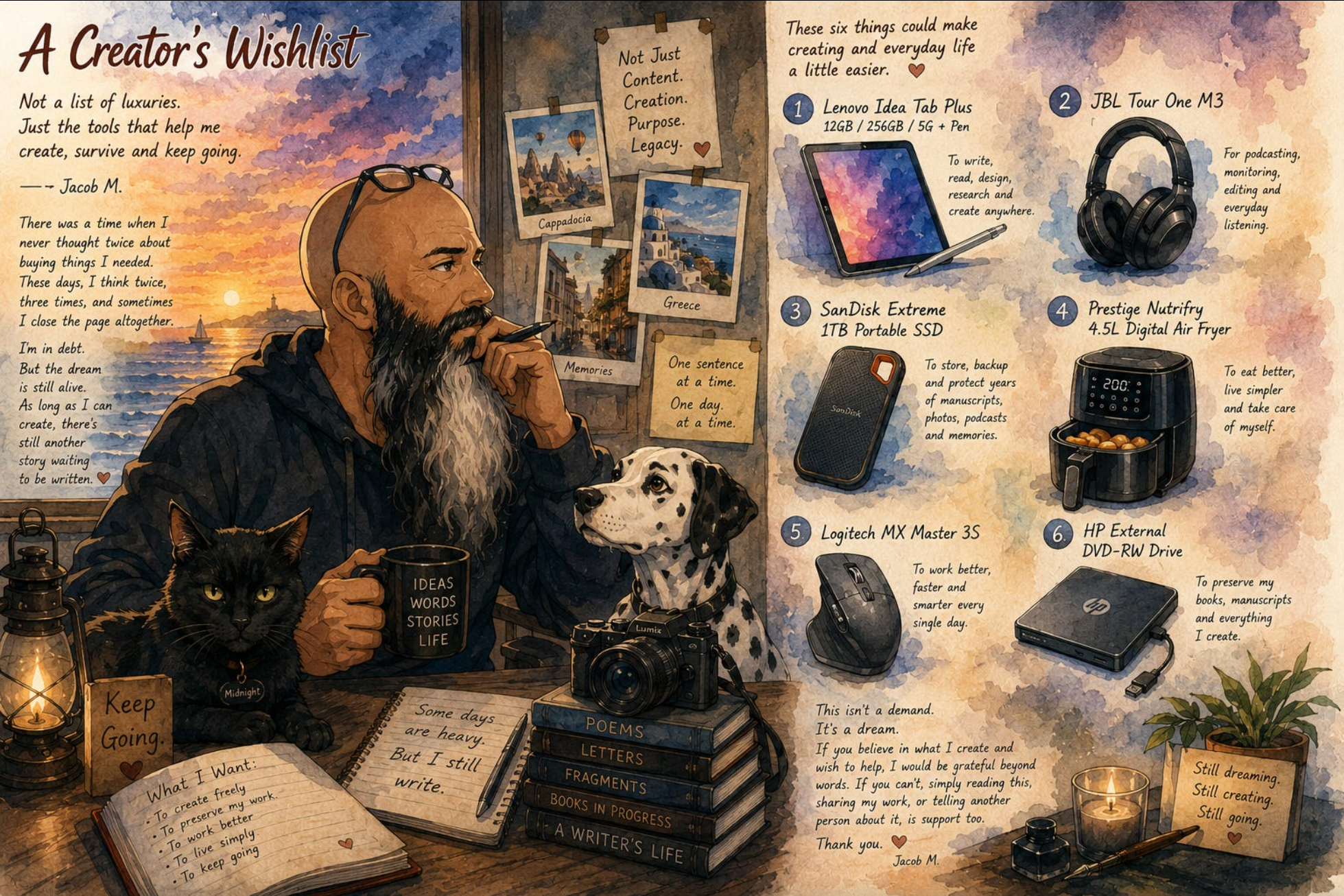
 The Creator’s Wishlist:
The Things That Could Make Creating a Little Easier
There was a time when I never thought twice about buying something I needed. These days, I think twice, three times, and sometimes I simply close the page.
By Jacob Mascarenhas / Awriterstip
Dear Readers,
Having dreams and desires does not make us greedy. Wanting something that could make our lives, our work, or our circumstances a little better does not make us ungrateful for what we already have. I believe everyone is entitled to dream, to imagine something better, to hope for things that may one day become possible, and to believe that some of those wishes might eventually come true. There is nothing wrong with wanting; what matters is understanding the difference between wanting something and believing you are owed it.
Every independent creator has a wishlist. It may not always exist as a shared link on Amazon. Often, it lives only in our heads, a screenshot tucked into a phone gallery, a bookmarked product page, or a browser tab left open for weeks simply because we are waiting for the day we can finally say, “Okay, I can afford this now.”
For a writer, podcaster, photographer, designer, or musician working without backing, a wishlist isn’t about luxury or consumer excess. Most of the time, it is simply about wanting the basic tools that make work manageable. And lately, I have been thinking about mine.
Not because I expect anyone to buy these things for me, and certainly not because I believe anyone owes me a single rupee. I am thinking about it because there is a quieter, less glamorous story behind an independent creator’s wishlist that rarely gets discussed: the reality of creating when you don’t have an agency behind you, an IT department, an advance, or an annual budget for equipment upgrades. You have your ideas, your notebooks, whatever hardware is still functioning, and the quiet resolve to turn your time into something meaningful.
I think every creator has imagined a better setup at some point, a proper desk, a chair that doesn’t hurt your back by mid-afternoon, a responsive computer, a dependable microphone, or simply enough reliable storage for the manuscripts and recordings that accumulate over years of work. It doesn’t need to look like the pristine studio setups popularised online; it just needs to be a functional place to create.
I have never needed a perfect studio to write.
Give me a laptop, a notebook, or even a little space on the floor, and I will probably find a way to work. Writers are good at improvising. We learn to create with what we have, because the story doesn't always wait for the perfect chair, the perfect desk, or the perfect room.
I have spent years writing books, essays, articles, and newsletters, while expanding into podcasting, digital publishing, and photography. Like anyone else, there are tools I would love to use. But there is a substantial difference between recognising what could improve your work and actually being able to afford it.
Years ago, if a particular piece of equipment solved a genuine problem, I would research it, compare options, and purchase it. Today, the arithmetic has changed entirely. Every potential expense goes through a gauntlet of questions: Can I afford this? Can I wait? Is there a workaround? Can I simply make do without it?
The uncomfortable truth is that mounting debt shifts your perspective on necessity. When money is tight, even practical tools begin to feel like an indulgence. That is why my wishlist doesn’t feel like a shopping catalogue anymore; it feels like a ledger of small possibilities, practical changes that could reduce friction in my daily work. Out of everything I could possibly wish for, I stripped the list down to six specific items.
Lenovo Idea Tab Plus (12GB / 256GB / 5G + Pen)
This is the primary item on my list, not out of a desire for another screen, but because of how directly it would alter my daily routine. A capable tablet functions as a portable extension of a writer’s desk. It would allow me to research, annotate manuscripts, review proofs, edit visual assets, and write away from a fixed workstation.
The specific configuration matters for longevity. Choosing 12GB of RAM is about ensuring the device remains responsive over several years of heavy use without slowing down under large documents or multitasking. The 5G connectivity provides the independence to research and write anywhere without relying on public Wi-Fi, and the stylus transforms it from a consumption device into an active workspace for drafting and annotating. If I had to prioritise a single tool to carry the weight of my daily routine, this would be it.
JBL Tour One M3
This addition is tied directly to my audio production and podcasting. When recording and mastering audio, consumer-grade speakers or faulty earbuds hide the flaws in a mix. You need accurate acoustic monitoring to hear room reflections, low-frequency hums, balance issues, and harsh vocal sibilance before an episode reaches an audience.
I previously owned a pair of Sony headphones, but when financial pressures escalated, I had to sell them to raise quick cash, even while still paying off their monthly instalments. That experience was a sobering reminder of how precarious independent work can be: sometimes you can possess the right tool and still not be in a position to keep it. The JBL headphones represent a return to reliable, accurate monitoring so I can produce audio with clarity and focus.
SanDisk Extreme 1TB Portable SSD
Storage is never an exciting item to look at, but it is easily one of the most critical on this list. Over the years, I have built an archive of completed manuscripts, draft books, high-resolution photographs, podcast masters, design templates, and reference materials.
When files sit inside a computer directory, it is easy to view them as mere data. But to a writer, a manuscript represents six months of unbroken labour; a folder of photographs holds irreplaceable documentation; a mastered audio file contains hours of editing and thought. Currently, I do not have a dedicated external SSD to create a secure, redundant backup of these archives. Hard drives degrade, operating systems crash, and digital work can disappear overnight. A durable solid-state drive is not a luxury accessory; it is an insurance policy for years of creative output.
Prestige Nutrifry 4.5L Digital Air Fryer
An appliance might seem out of place alongside digital hardware, but a creator still needs to eat. Writing, audio editing, research, and self-publishing demand long, solitary hours, and after a full day of mental exertion, finding the energy to cook elaborate meals is often difficult.
I initially looked at larger, more expensive multi-cookers before realising that a straightforward, reasonably priced digital air fryer solves the real problem: preparing healthy meals quickly with minimal effort and cleanup. That realisation applies to the entire philosophy of this list. It isn’t about chasing top-tier luxury models; it is about finding practical tools that eliminate unnecessary friction from daily life so more energy can go toward the work that matters.
Logitech MX Master 3S
This choice comes from long familiarity. I have relied on Logitech peripherals through various stages of my writing and digital work, and while I am currently using a basic HP mouse that gets the job done, the ergonomic and functional differences are real.
When you spend eight to ten hours a day navigating timelines, jumping between research documents, editing image layouts, and writing, input precision matters. The smooth horizontal scroll wheel, tactile response, and wrist support prevent the repetitive strain that comes with long production sessions. I deliberately prioritised the 3S over its newer, more expensive iterations because it delivers all the functional utility I need without unnecessary cost. If a tool reliably solves the problem, that is more than enough.
HP External USB DVD-RW Drive
An external optical drive might appear outdated in an era dominated by cloud servers and flash memory, but my reason for including it is simple: permanent, physical preservation.
Cloud platforms change their terms, subscriptions lapse, and digital accounts can be compromised. There is a lasting security in having offline, physical archival copies of finished books and long-term projects burned onto physical discs and stored safely on a shelf. It serves as tangible proof of the work: a permanent record that says, this was written, this was completed, and this existed. Writers tend to be protective of their archives, and having physical backups offers peace of mind that purely cloud-based systems cannot match.
I considered adding an HP Smart Tank printer as well, particularly for proofreading physical drafts and scanning documents, but I chose to set it aside. Learning to distinguish between what is merely useful and what is immediately necessary is a vital discipline when resources are limited.
None of this is written as an appeal, a demand, or an expectation for handouts. I would feel deeply uncomfortable framing it that way. This is simply an honest account of where I currently stand as an independent creator, and an inventory of the practical tools that would make this road a little easier to navigate. If a reader ever chooses to assist with one of these items, my gratitude would be immense. But if this essay simply serves as a window into the unglamorous mechanics of independent creative work, that is equally worthwhile.
When you look at a creator’s wishlist, you aren’t looking at a catalogue of objects. You are looking at a blueprint of intentions. The tablet represents mobility; the headphones represent audio precision; the hard drive represents preservation; the mouse represents daily focus; the air fryer represents simple self-care; and the optical drive represents permanence.
Support for independent creators takes many forms. It doesn’t have to mean purchasing hardware. Reading someone’s work, sharing an essay with a friend, listening to a podcast episode, leaving a thoughtful comment, or recommending a book to someone else often provides the exact momentum needed to keep going.
Every independent creator builds slowly, improvising, repairing what breaks, making do with what is available, and keeping their ideas moving forward. I have created with less, and I know I can continue creating with less. These six items are simply the tools I hope to bring into my workspace when the time is right, not because I cannot create without them, but because they would make the journey a little easier. Until then, the work continues; the drafts will keep being written, and the stories will keep being told.
Writers and creators deserve support, not because of what we own, what we wish for, or what we might someday be able to afford, but because of the value of what we create. Behind every article, book, photograph, podcast, painting, song, or story is time, thought, imagination, effort, and a part of the creator themselves. So, please support creators for their work. Read what they write. Listen to what they create. Share their work. Recommend them. Give them a chance to be heard. Our creative work is valuable, and sometimes the greatest support you can give a writer or creator is simply to recognise that their words, their ideas, and their voice matter.
Jacob Mascarenhas
Author • Podcaster • Storyteller