

 Dear Readers,
There is a particular kind of exhaustion that does not come from physical work. It comes from constantly giving pieces of yourself to other people and slowly realising that they have begun to regard those pieces as something they are entitled to. Your time becomes available whenever they need it, your knowledge becomes something they expect for free, your contacts become their contacts, your ideas become their plans, and your kindness becomes an obligation. Eventually, when you hesitate or say no, you are made to feel as though you are the one who has done something wrong.
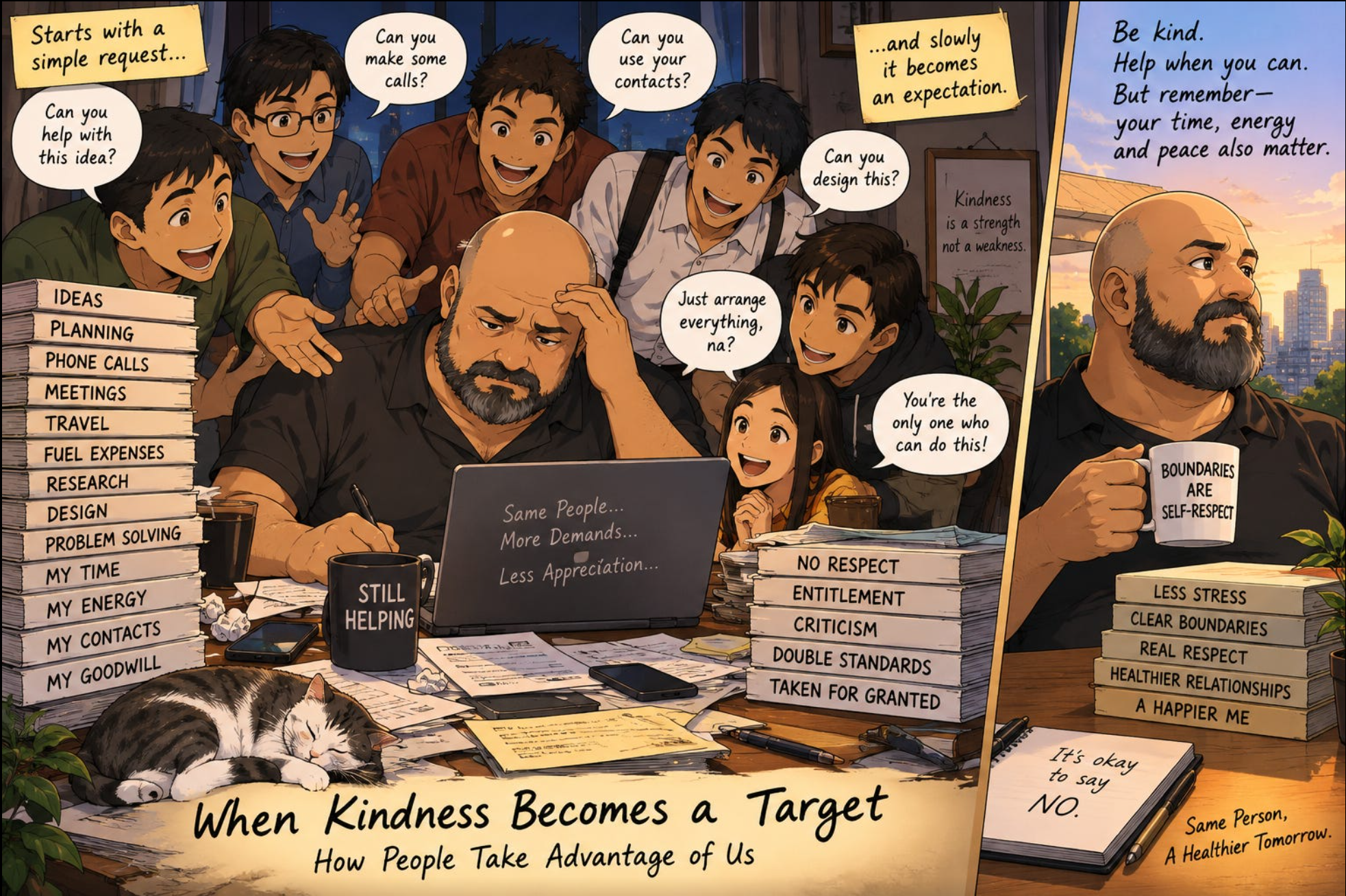
This is how people take advantage of us. It does not always happen dramatically, nor through some obvious act of betrayal. Sometimes it happens quietly, gradually, and almost invisibly. It begins with a simple request where you help someone because you can. Then another request comes, and you help again. Before long, the favour has become an expectation, and the expectation has become a demand. Somewhere along the way, the person stops seeing your help as generosity and starts seeing it as their right.
I have experienced this in ways that have made me question why I continue to give so much of myself to people who do not always seem to value it. Consider something as simple as working on a project for someone. An idea is discussed, and because you have experience, knowledge, contacts, and the ability to put things together, you begin helping. You do the groundwork, make the phone calls, speak to people, travel around, spend money on fuel, research possibilities, design things, and solve problems. You use relationships and influence that took years to build, sitting and breaking your head over details that the other person may never even have considered.
And then, somehow, all of that work disappears. The person sees only the finished idea. They do not see the hours behind it, the fuel burned travelling from one place to another, the conversations, the planning, the thinking, the mistakes, the corrections, or the mental energy involved. They simply see someone who knows how to make things happen. So they ask for more: to speak to that person, arrange that detail, design that piece, share that contact, or explain how to do it. Eventually, you realise that you are no longer helping with a project; you are practically running it for somebody else.
The strangest part is that generosity can create its own trap. When you are capable of doing something, people naturally come to you. At first, it feels good to be useful because you enjoy solving problems, helping people, and seeing an idea become reality. But there is a profound difference between being appreciated for your ability and being exploited because of it. A capable person can easily become a victim of his own competence. People begin thinking that he will handle it, and because you have handled it before, they expect you to handle it again.
This is where resentment begins. It does not necessarily take root because we do not want to help, but because we begin to feel invisible. We start asking ourselves whether anybody actually appreciates what we are doing. We wonder why our contribution is never acknowledged, and why people expect more and more while giving less and less in return. Sometimes what hurts most is not the absence of money, but the absence of respect. Respect does not mean someone has to praise us constantly, nor does it mean every favour requires a reward. Genuine generosity does not work like a transaction, and if I help someone because I want to help them, I should not necessarily expect payment.
Yet there is a fundamental difference between generosity and being treated as though our time has no value. My time has value even when I give it freely. My knowledge has value even when I choose to share it. My experience has value even when I do not charge for it, and my effort has value even when I volunteer it. Perhaps most importantly, my kindness does not mean that I have surrendered my right to say no. That distinction is something many of us learn far too late.
We sometimes think that setting boundaries makes us selfish. We worry that refusing a request will make us look rude, arrogant, unhelpful, or uncaring. So we say yes, and then we say yes again and again. Eventually, we are exhausted, frustrated, and angry, yet the other person may have no idea why. Why would they? We taught them that everything was available, that our time could be interrupted, that our expertise could be requested whenever they wanted it, and that we would solve the problems they did not want to solve themselves. We did not necessarily mean to teach them that; we may simply have been trying to be kind. But human beings can become accustomed to generosity very quickly.
There are also smaller forms of disrespect that accumulate over time. Someone comes into your home and speaks to you as though you are somehow beneath them, expects you to make an effort that they themselves are unwilling to make, questions you about your money or your spending, or assumes that because you have helped before, you should continue helping indefinitely. Individually, each incident might seem insignificant, but disrespect rarely arrives as one enormous event. More often, it arrives as a collection of small moments: a dismissive comment, an unreasonable expectation, a favour never acknowledged, a demand disguised as a request, a presumption that your time belongs to someone else, a lack of gratitude, and a refusal to recognise the effort you have made.
Eventually, the small things become a large thing, and then comes the moment when you stop. You stop not because you suddenly became cruel or stopped caring, but because you became tired. There is something liberating about realising that we do not have to prove our worth to people who refuse to recognise it. Our appearance does not determine our value, our body does not determine our intelligence, and our circumstances do not determine our dignity. We can be imperfect, overweight, bald, old, young, wealthy, poor, successful, struggling, confident, or insecure, and still deserve basic human respect. Nobody earns the right to humiliate another person simply because they think they are somehow superior.
Nobody should have to become aggressive in order to establish a boundary, either. Sometimes the most powerful response is silence. Someone makes an accusation, you provide the evidence that proves them wrong, they realise their mistake and apologise, and you do not need to spend another twenty minutes arguing, insulting them, or explaining your entire life. You have shown the truth, and that is enough. Learning to control our response is part of learning to protect ourselves. Anger is often a signal that something important has been violated, but anger does not have to become destruction. We can acknowledge that we are furious without allowing fury to make our decisions for us.
There is a difference between saying that you are angry because someone disrespected you, and spending the next hour destroying yourself emotionally over what someone else did. The first recognises the boundary; the second gives the other person control over your peace. Perhaps that is another way people take advantage of us: they take our peace because we allow their behaviour to occupy our minds long after they have left. We replay conversations, think about what we should have said, imagine what we should have done, and become angry all over again. We carry somebody else’s behaviour into our evening, our sleep, our next morning, and sometimes into our relationships with people who had nothing to do with the original problem.
At some point, we have to put the burden down. That does not mean pretending nothing happened; it means learning from what happened. Perhaps the lesson is that not everybody deserves unlimited access to us. Not everybody who asks deserves an answer. Not every opportunity deserves our involvement, not every project deserves our time, not every person deserves our contacts, and not every relationship deserves unlimited patience. Not every request deserves a yes. We can still be generous, help people, share our knowledge, and open doors for others, but generosity should remain a choice rather than an obligation. Helping someone should never require us to destroy ourselves.
There is also nothing wrong with saying, “I can help you with this part, but the rest is your responsibility.” That simple sentence can change everything. It creates a boundary without creating hostility, and it reminds the other person that assistance is not ownership. It says that you are willing to walk beside them, but you are not going to carry them. Helping someone does not mean doing everything for them. We need to allow people to carry their own responsibilities; otherwise, our help can actually prevent them from becoming capable. If we constantly solve every problem, eventually they stop learning how to solve problems, and we become exhausted.
There is another painful truth: sometimes people will only respect a boundary after they discover that you are actually willing to enforce it. Talking about boundaries is easy; living by them is harder. The moment we say no, someone may become disappointed, accuse us of changing, or claim that we are no longer the person we used to be. Maybe that is true. Maybe we have changed because we finally realised that being available to everyone was costing us too much. Growing older teaches us that energy, time, money, health, and emotional strength are finite. We cannot spend everything we possess and then wonder why we have nothing left for ourselves. Protecting our remaining energy is not selfishness; it is responsibility.
The goal is not to become suspicious of everyone, nor is it to stop helping or become cold. The goal is to become discerning. Give because you want to give, not because you are afraid to refuse. Help because you believe in something, not because you fear being disliked. Share your knowledge with people who respect it, and give your time to people who understand that time is precious. When someone repeatedly demonstrates that they value what you provide more than they value you, pay attention, because that is critical information.
We often ask why people take advantage of us, but perhaps the more useful question is what we have allowed to become normal. Sometimes the answer is uncomfortable. We allowed the favour to become an expectation, the expectation to become an obligation, and the obligation to become resentment. We kept repeating the cycle because we were afraid that saying no would cost us the relationship. But a relationship that survives only because one person continually sacrifices himself is not a healthy relationship. We should not have to purchase someone’s company with our exhaustion, earn respect by constantly being useful, or prove that we deserve dignity.
Above all, we should never confuse being needed with being valued. Being needed can feel wonderful and make us feel important, but being valued means someone sees the human being behind the usefulness. They appreciate the effort, recognise the sacrifice, respect the boundaries, and do not treat generosity as an endless resource. That is the kind of relationship worth protecting.
So perhaps the answer to how we let people take advantage of us is not simply that we are too kind. Sometimes we are afraid, sometimes we want to be accepted, sometimes we avoid confrontation, sometimes we are proud that we can solve problems, and sometimes we keep hoping people will change. Often, we simply do not realise what is happening until we are exhausted. But once we recognise the pattern, we have a choice. We can continue handing people unlimited access to our time, energy, money, knowledge, and peace, or we can begin drawing a clear line.
A clear line simply says: I will help you, but I will not carry you. I will respect you, but I will not accept disrespect in return. I will give when I choose to give, but you are not entitled to what I have. I can be kind without abandoning myself. That is perhaps the greatest lesson of all. We do not have to become less kind; we simply have to stop allowing kindness to become permission. When people begin treating our generosity as an obligation, it is no longer generosity they are receiving; they are taking. And sometimes, the most courageous thing we can finally say is not an angry argument, but simply: “No. This time, I choose myself.”
Jacob Mascarenhas
Author • Podcaster • Storyteller