
Recently, what I expect from the PCs I keep close at hand has begun to change.
The catalyst was Claude Code’s remote control feature. With it, I could check on a task and add instructions while away from my PC. Being able to leave in the middle of a task and continue managing it from my phone made a bigger difference than I expected. It felt genuinely liberating. It reminded me of the freedom I felt when I first put on a jacket while wearing Bluetooth earbuds, without a cable getting in the way.
However, because Codex is the main tool I use for everyday development, I couldn’t say that things had improved all that much. Running Codex across multiple projects while building and testing Rust code in parallel still requires a reasonably powerful primary PC. If I also want to work while away from home, that naturally makes me want a fairly powerful laptop.
In practice, carrying a powerful laptop was genuinely valuable. The computer-use skill was another breakthrough because it allowed agents to operate a desktop browser directly. As long as my local machine was powerful enough, I could delegate not only coding but also tasks that required looking at and interacting with the screen. Until last month, that was the optimal setup.
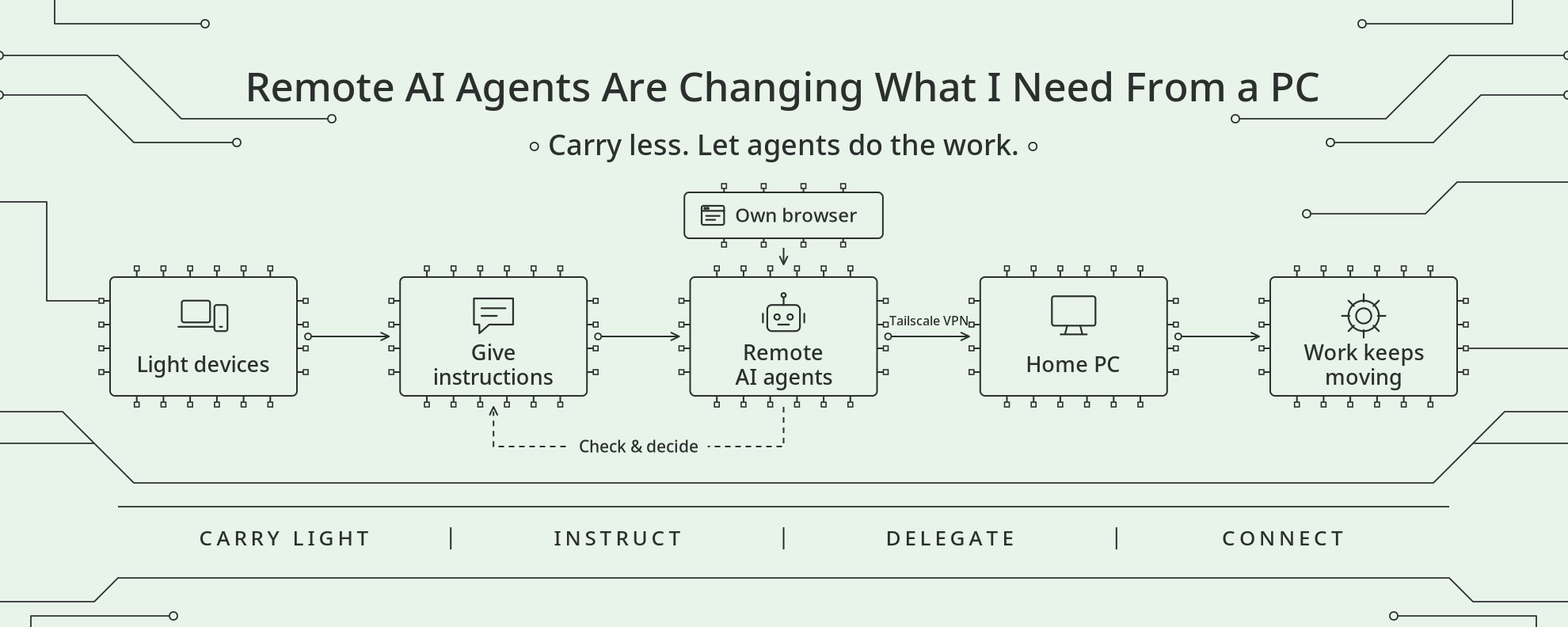
But the situation has changed rapidly in recent weeks. Remote AI agents capable of handling serious work have arrived one after another, including Codex’s remote features, ChatGPT’s dot, and Grok Bot. Even heavy tasks such as writing, building, and testing Rust code can now be handed off to the agents’ own environments instead of running on my local machine.
What feels especially significant is that Codex and Grok Bot can work through their own dedicated browsers. They can do more than write code: they can research sites that only work in a browser, operate web services, and even verify the results of a deployment—all remotely.
That also changes the role of the PC I carry with me. Instead of bringing a high-performance development environment everywhere, it is becoming more important to direct multiple agents, keep track of their work, and make decisions when needed.
These days, I do most of my work on my phone. Writing a long article for X like this one is difficult in the mobile app, so I still use a PC for that, but the need to build code or run tests locally has dropped dramatically. Buying a used iPad recently was an extension of the same idea. I also logged back into an older Chromebook for the first time in a while and completely refreshed its apps. Both are simply devices for accessing agents through apps or a browser and moving work forward. If something can be done on a phone, I use the phone. If I need a larger screen, I use the iPad. If I need a keyboard, I open the Chromebook. More and more often, that is enough.
Meanwhile, I bought my recent high-performance Mac mini specifically to leave at home from the beginning. I also keep my other laptops running continuously, configured not to sleep when the lid is closed. When an OS update occasionally requires a restart, I restart them when the timing is right. That is all.
Tailscale also plays a major role. My PCs at home and the devices I use while away are all on the same VPN. This lets me access the computing resources and development environments at home through Codex or SSH from wherever I am. I can also use it for simple file transfers.
With this combination, development environments that I once needed to carry with me can now be delegated entirely to agents or simply left at home. I will still need to run code on local PCs and connect physical devices, and access to ample computing resources remains just as valuable. But the need to carry those resources around with me is fading rapidly. Until very recently, I was convinced that my next laptop should be more powerful and have a larger screen. Now that almost feels hard to believe.
Technologies that enable similar things have existed for years, including SSH, remote desktops, and cloud development environments. Even so, they ultimately required me to connect to a remote environment from the PC in front of me and operate it myself. The development environment was somewhere else, but the basic structure remained unchanged: I was still the operator. And when a task required direct browser interaction, a desktop environment was absolutely necessary.
Now, the agents on the other side of the apps can take over the actual operation itself. The time I have to remain glued to a device and the time during which work is making progress have become dramatically decoupled.
At this point, it feels as though we have broken through some kind of ceiling.
I am still experimenting, but I suspect this shift will change not only how I use PCs, but also which devices I buy and what I choose to spend money on. For now, I want to see just how far I can go with this setup.
――
Originally published on X (October 13, 2026)
https://x.com/asopitech_iot/article/2109987868248834105