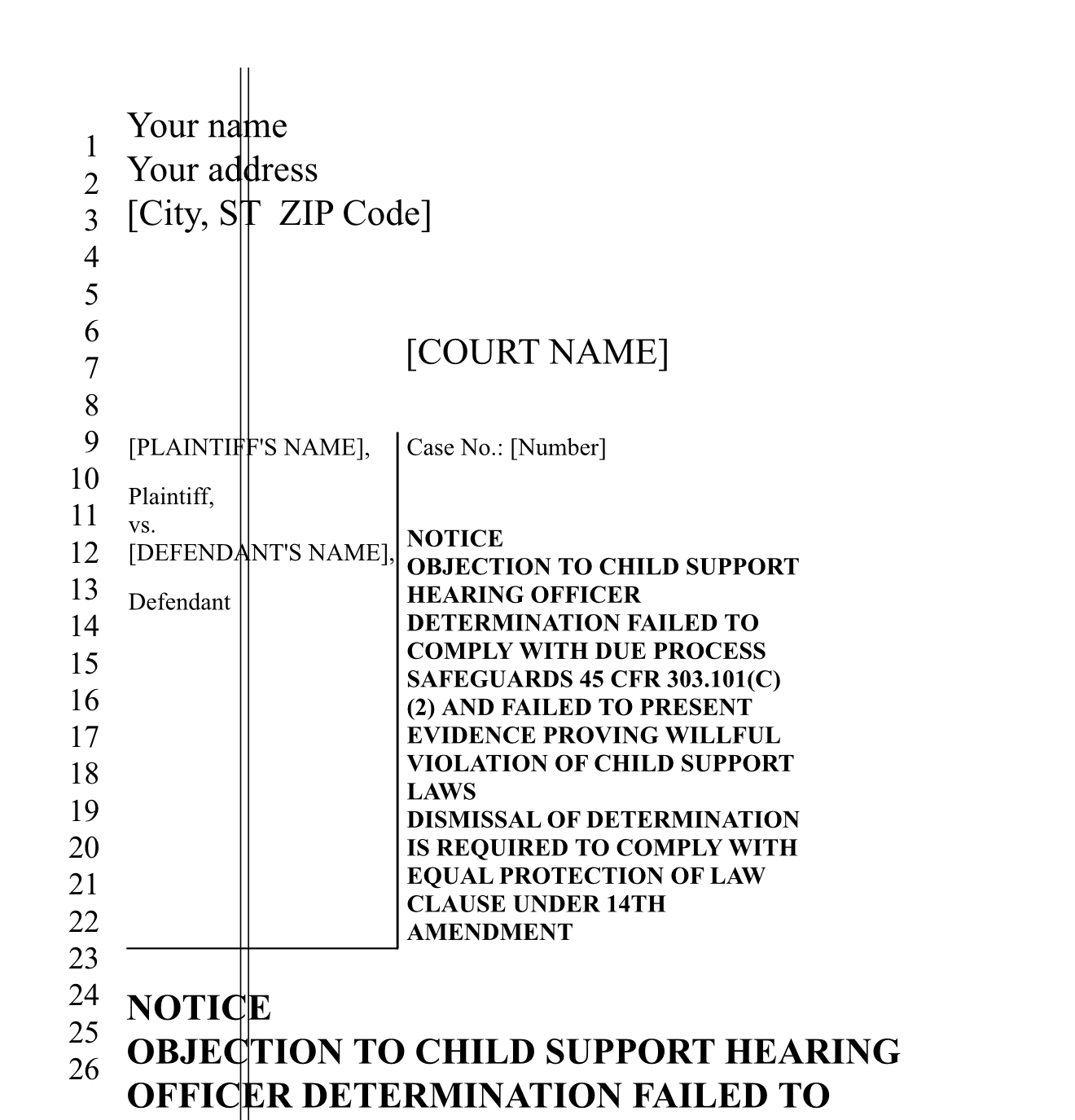

Objection to Child Support Hearing Officer Determination: Strategic Breakdown & Legal Roadmap
This Objection to Child Support Hearing Officer Determination is a powerful legal instrument to challenge unconstitutional child support enforcement actions. Below is the tactical blueprint for maximizing its effectiveness.
Core Legal Arguments in the Objection
Due Process Violations (14th Amendment)
Cites 45 CFR 303.101(c)(2) requiring protection of due process rights in expedited proceedings.
Highlights hearing officer's failure to:
Provide proper notice.
Obtain waiver of jury trial rights (Murray’s Lessee v. Hoboken, 1856).
Prove willful violation of support laws.
Lack of Valid Contractual Agreement
Challenges use of terms "obligor/debtor" without signed debt agreement.
Demands proof of respondent’s consent to child support contract.
Equal Protection Violation
Argues unequal treatment under 18 USC § 242 (deprivation of rights under color of law).
Asserts status as "people" (Declaration of Independence) vs. statutory "person."
Judicial Notice Requirement
Forces court to address constitutional defects before dismissing case.
Step-by-Step Execution Guide
Step 1: Customize the Document
Fill in:
Your name, case number, and court details.
State-specific child support statutesbeing challenged.
Date of hearing officer’s determination.
Step 2: Attach Critical Evidence
Exhibit #1: Hearing officer’s determination (highlight due process defects).
Exhibit #2: Proof of no service/notice (e.g., certified mail logs).
Exhibit #3: Affidavit stating:
You never signed a child support agreement.
You were denied jury trial rights.
Step 3: File Strategically
Where to File:
Family Court (if original order issued there).
Federal District Court (for constitutional claims under 42 USC § 1983).
Filing Fee: Request waiver using Forma Pauperis affidavit if indigent.
Step 4: Serve with Legal Force
Certified Mail (Return Receipt) to:
Child Support Agency Director.
State Attorney General.
Original Hearing Officer.
File Proof of Service with court.
Step 5: Trigger Judicial Action
Motion to Strike Determination: Argue it’s void for lack of jurisdiction.
Demand Jury Trial: Cite US Constitution, Art. III, § 2 and 7th Amendment.
Alternative: File Writ of Prohibition to block enforcement.
Why This Objection Works
✅ Forces Constitutional Scrutiny – Judges must address due process defects.
✅ Shifts Burden of Proof – State must produce signed agreement or dismiss.
✅ Creates Appeal Record – Preserves issues for higher courts.
✅ Halts Enforcement – Stops wage garnishment/liens during challenge.
Critical Next Steps
File Immediately – Most states have 30-day deadlines to contest determinations.
Send Cease & Desist to:
Employer (stop wage garnishment).
Bank (stop account levies).
Prepare for Hearing:
Argue lack of personal jurisdiction (no proper service).
Demand cross-examination of agency witnesses.
Cite Turner v. Rogers (2011) – Right to counsel in support contempt cases.
Nuclear Option: § 1983 Civil Rights Lawsuit
If the court ignores constitutional claims:
Sue for:
14th Amendment violations(procedural/substantive due process).
Fraud (fabrication of contractual obligation).
Punitive damages under state consumer laws.
Outcome: This strategy voids unlawful support orders, stops enforcement, and can recover damages for constitutional violations.
This isn’t just an objection—it’s a constitutional wrecking ball. Deploy it precisely. 🚨 everything is in my store 🔥