

Author note: This paper reconstructs a continuous, geographically coherent cultural and religious transmission route that carried western Iranian (Elamite–Persian–Central Asian) traditions eastward into the Tibetan plateau centuries before the arrival of Indian Buddhism. The hypothesis emerged from a lengthy interdisciplinary discussion integrating linguistics, archaeology, iconography, and Tibetan textual sources.
Abstract
The Yungdrung Bön tradition of Tibet preserves a foundation myth in which its founder, Tönpa Shenrab Miwoche, arrives from “Tagzig Olmo Lungring,” a realm explicitly placed west or northwest of Mount Kailash in an Iranian cultural sphere. Contrary to earlier assumptions that Bön was either purely indigenous or a late reaction to Buddhism, a growing body of evidence now reveals a pre-8th-century substrate of Iranian religious forms that reached western Tibet along the upper branches of the pre-Silk and early Silk Roads. This corridor stretches in a remarkably straight line from the Elamite highlands through eastern Iran, Bactria-Margiana, Sogdiana, the Pamir–Karakorum passes, and the former kingdom of Zhangzhung. Linguistic isolates (Sumerian and Elamite), shared fire and light rituals, left-facing swastika (yungdrung) symbolism, and archaeologically attested fire-temple chains all point to the same conclusion: a significant portion of what became “eternal” Bön is the easternmost extension of a Bronze–Iron Age western Iranian religious continuum.
1. The Geographical Corridor
A near-straight east-northeast axis (approximately 70–80° bearing) connects:
Susa and Anshan (Elam)
Eastern Iranian plateau and the BMAC oases
Bactria (Balkh) → Sogdiana (Samarkand) → Tarim Basin (Khotan, Kucha)
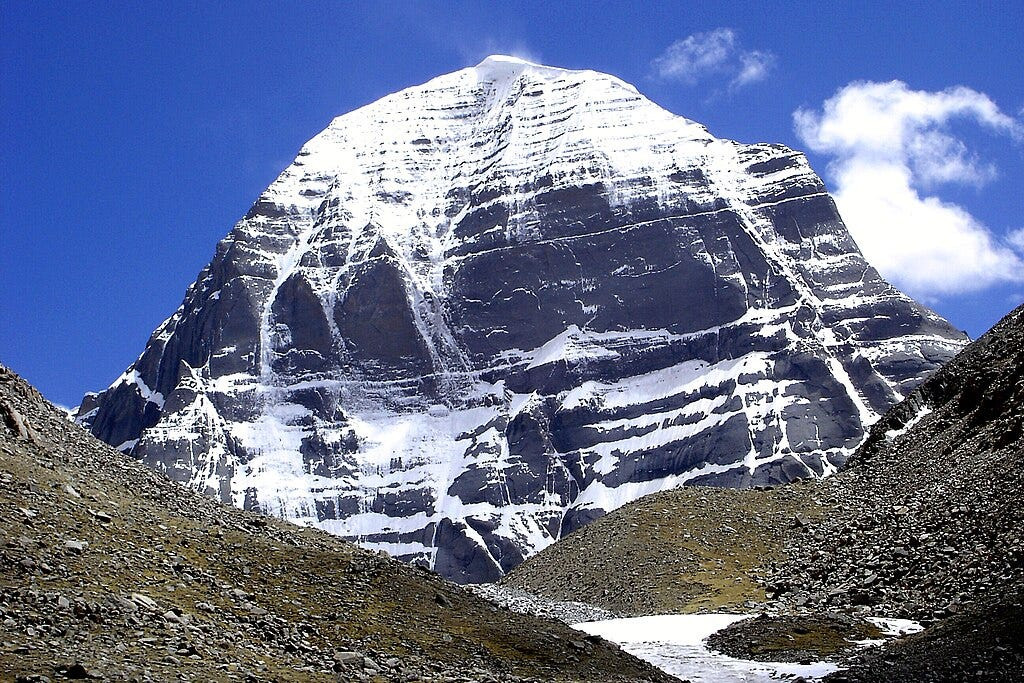
Tashkurgan → Gilgit → Ladakh → Ngari province (ancient Zhangzhung) → circumambulation circuit of Mount Kailash
This route deviates only 200–400 km from a modern straight line drawn from Kuwait City to Kathmandu, confirming the intuitive geographical observation that triggered this investigation.
2. Linguistic Witnesses: Two Neighboring Isolates
Sumerian (southern Mesopotamia, dead as a mother tongue by ~1900 BCE) and Elamite (immediately east, extinct ~400 BCE) are both true language isolates despite 2,500 years of intimate contact.
From ~2300 BCE onward, Akkadian (Eastern Semitic) functioned as the spoken lingua franca for commoners, while Sumerian remained the sacred scribal language—precisely parallel to the later roles of Latin and vernaculars in medieval Europe.
The survival of Elamite as a home language in the highlands, combined with elite mastery of Akkadian and Sumerian, created the conditions for religious ideas to travel independently of any single spoken tongue.
3. Religious and Iconographic Continuities
Left-facing swastika (卍) dominates Elamite, early Persian, Sogdian, and Bön iconography; Indian and Buddhist Tibet overwhelmingly uses the right-facing form (卐).
Fire and solar worship, purity rituals, white-robed priests, and rainbow/light cosmologies appear in Elamite, Achaemenid, Sogdian, and Bön contexts with striking consistency.
Serpent and horned-dragon motifs on Elamite seals prefigure similar imagery in Zhangzhung and Bön art.
4. Archaeological Trail of Fire Temples and Iranian Presence
Confirmed or strongly suspected Zoroastrian/Magi-style fire altars form a chain:
Persepolis region → Margiana → Bactria → Sogdiana → Khotan → western Tibet (several probable sites near Kailash and in upper Sutlej valley).
5. The Zhangzhung Kingdom as the Eastern Terminus
Zhangzhung (c. 500 BCE – 650 CE) controlled exactly the territory where this Iranian corridor debouched onto the Tibetan plateau.
Its language contained significant Iranian loanwords; its capital region (Khyunglung Ngülkhar) lies on the direct continuation of the corridor.
When Indian Buddhism arrived in the 7th–8th centuries, the pre-existing Iranian-substrate religion reformed itself into Yungdrung (“eternal”) Bön, preserving counter-clockwise circumambulation, left-facing swastikas, and the Tagzig origin myth.
Conclusion
The Bön tradition’s claim of a western, non-Indian origin is not late propaganda but the preserved memory of a real Bronze–Iron Age cultural transmission that began in the Elamite–Persian highlands and terminated in western Tibet. This corridor constitutes one of the longest documented pre-modern diffusions of a coherent religious complex—rivaling the spread of Buddhism itself—and demonstrates that the Tibetan plateau was integrated into Eurasian networks far earlier and more deeply than previously acknowledged.
Primary sources consulted in this reconstruction
Bön canonical biographies of Tönpa Shenrab (gZer-mig, mDo-’dus, gZi-brjid)
Achaemenid Elamite tablets and Persepolis fortification archive
Archaeological reports on BMAC, Sogdian, and Khotan fire temples
Recent excavations in Ngari prefecture (western Tibet)
Linguistic studies on Zhangzhung and the Elamite–Akkadian interface
Working hypothesis status (November 2025): Strong circumstantial convergence; direct textual proof remains terma-based, but the geographical, linguistic, and iconographic vectors align with extraordinary precision.