

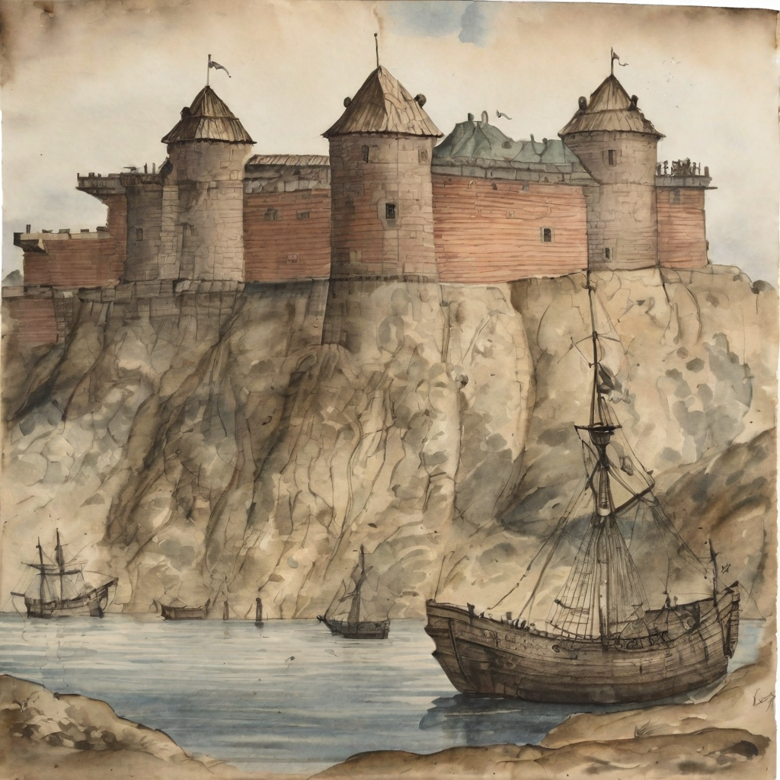
A star fortress, also known as a trace Italienne or bastion fort, is a type of fortification design that emerged in the late 15th century and became prominent during the 16th and 17th centuries. It represented a significant advancement in military engineering compared to earlier castle designs.
The star fortress was characterized by its distinctive shape, featuring a series of angular bastions connected by curtain walls. The bastions were typically five-sided or six-sided, projecting outward from the main walls to provide defensive positions for cannons and muskets. This design allowed for increased firepower coverage and improved defense against artillery attacks.
The star-shaped layout of the fortress provided several advantages. It allowed defenders to have overlapping fields of fire, enabling them to cover the entire perimeter and eliminate blind spots. The projecting bastions also made it difficult for attackers to approach the walls directly without being exposed to defensive fire from multiple angles.
Furthermore, the walls of star fortresses were often built with a slope known as a glacis, which made it harder for attackers to approach the walls and reduced the impact of artillery bombardment. Additionally, ditches and moats were commonly incorporated into the design to create further obstacles for attackers.

While not an exhaustive list, here are some notable star forts from different regions:
Europe
Fortifications of Vauban, France: Designed by the military engineer Sébastien Le Prestre de Vauban, these fortifications include numerous star-shaped forts and defensive systems. Some well-known examples are Fort Saint-Jean in Marseille and Fort Carré in Antibes.
Citadel of Antwerp, Belgium: The citadel in Antwerp features a star-shaped design and was built during the 16th and 17th centuries. It served as a military stronghold and played a significant role in various conflicts throughout history.
Fort Bourtange, Netherlands: Located in the province of Groningen, Fort Bourtange is a star-shaped fort that was constructed in the late 16th century. It has been restored and transformed into an open-air museum, showcasing its historical significance.
Asia
Galle Fort, Sri Lanka: Galle Fort, situated in the city of Galle, is a fortified complex built by the Portuguese in the 16th century and later expanded by the Dutch. It features a star-shaped design and is now a UNESCO World Heritage Site.
Fortaleza de Santa Cruz, Brazil: Located in Niterói, near Rio de Janeiro, Fortaleza de Santa Cruz is a star-shaped fort built by the Portuguese in the early 17th century. It served as a strategic defense post against potential invasions.
North America
Castillo de San Marcos, United States: Situated in St. Augustine, Florida, the Castillo de San Marcos is a star-shaped fort constructed by the Spanish in the late 17th century. It is the oldest masonry fort in the continental United States and is now a national monument.
Fort McHenry, United States: Located in Baltimore, Maryland, Fort McHenry is a star-shaped fort that played a significant role in the War of 1812. It famously withstood a British naval bombardment and inspired Francis Scott Key to write "The Star-Spangled Banner," the U.S. national anthem.
These are just a few examples of the many star forts that exist around the world. Each fort has its own historical significance and architectural features, contributing to the rich military heritage of various regions.