
Sung Tieu — Silent Resistance
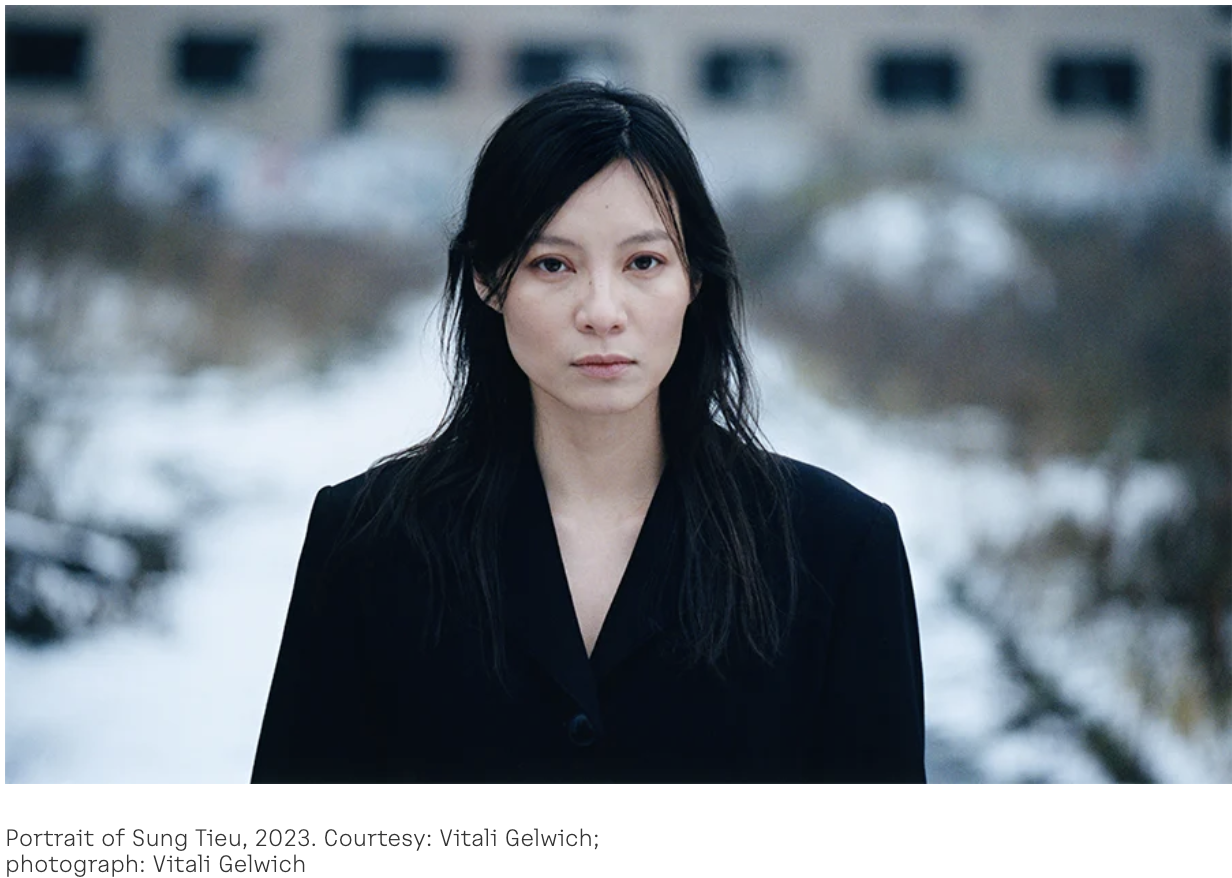
Sung Tieu is a German-Vietnamese artist, born in Hải Dương, Vietnam, in 1987 and based in Berlin. Her practice moves across installation, sound, text, video, sculpture and research. Rather than treating history as something fixed, Tieu examines how power enters everyday life: through architecture, documents, labour systems, migration policies, institutional language and the quiet pressure of bureaucracy.
Her work is often precise, restrained and unsettling. It does not announce resistance through spectacle. Instead, it exposes the structures that shape who is allowed to belong, who is documented, who is displaced, and who remains invisible inside official histories.
Tieu’s biography is inseparable from this research, but her work never collapses into autobiography. She arrived in Germany from Vietnam as a child in the early 1990s. Her family history is connected to the Vietnamese contract workers who came to the former GDR, a history that remained marginal within dominant narratives of German reunification. At KW Institute for Contemporary Art in Berlin, her research-driven practice was described as examining the tension between individual lived experience and larger mechanisms of systemic regulation, with particular attention to Germany’s divided history.
This makes Tieu especially important now. She is not simply revisiting the past; she is showing how the past continues to live inside buildings, legal categories, public memory and inherited forms of exclusion. Her work asks what happens to people whose histories were useful to a nation, but never fully welcomed into its image of itself.
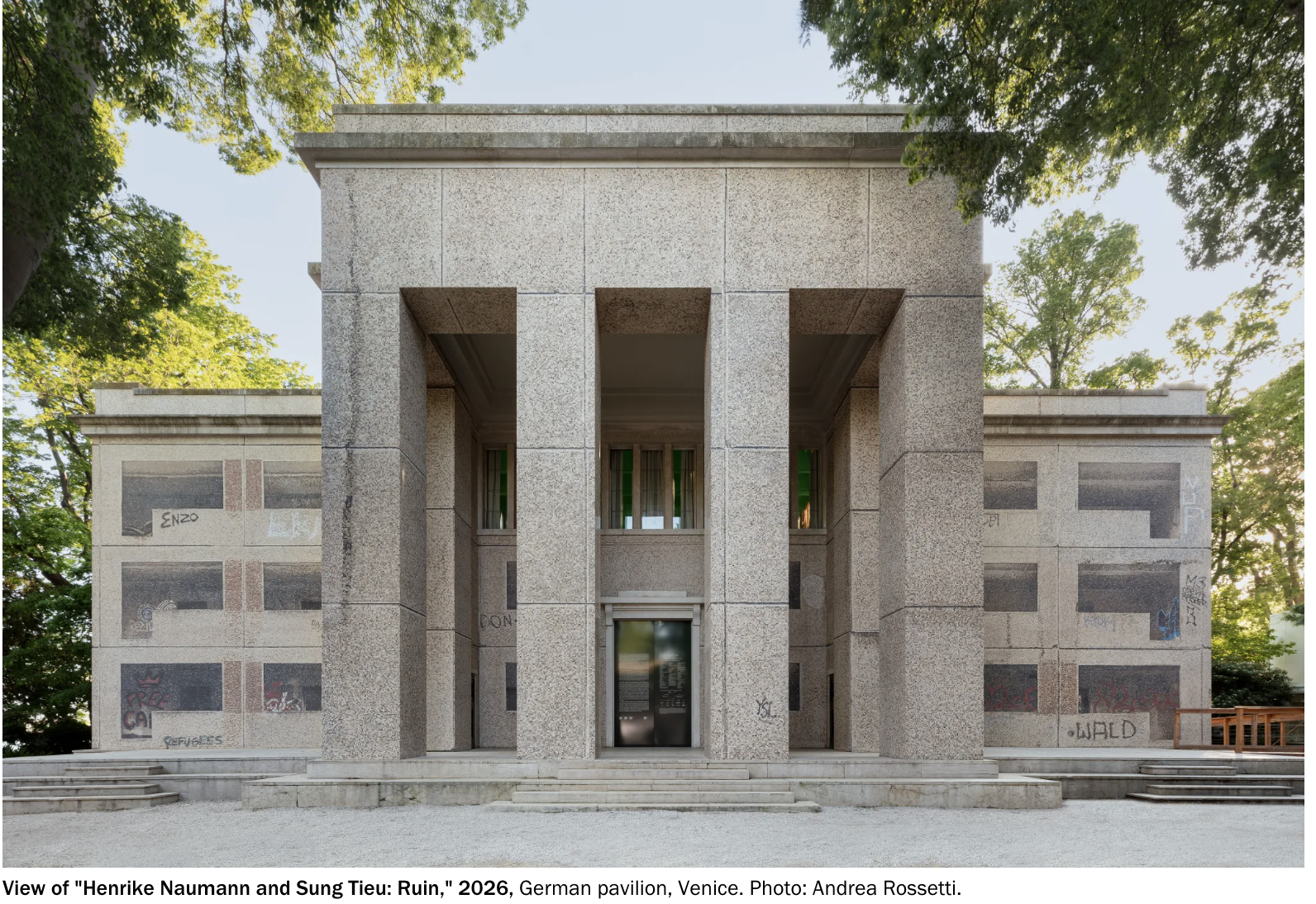
In 2026, Sung Tieu represents Germany at the 61st International Art Exhibition of La Biennale di Venezia, together with the late artist Henrike Naumann, in the German Pavilion exhibition RUIN, curated by Kathleen Reinhardt. The German Pavilion confirms that the exhibition brings together the work of Naumann and Tieu under the title RUIN. The project was commissioned by ifa, the Institut für Auslandsbeziehungen, which announced the artists for the German Pavilion in 2025.
For the Biennale, Tieu’s contribution is rooted in the history of Gehrenseestraße, a former housing complex in East Berlin where Vietnamese contract workers and their families lived. According to reporting on the pavilion, Tieu transforms the German Pavilion through reference to this derelict housing estate, connecting personal memory to the broader legacy of migrant workers who were brought to East Germany and later marginalised after reunification.
That gesture is powerful because it does not simply place a forgotten history inside the pavilion. It presses that history against the architecture of national representation itself. The German Pavilion, with all its historical weight, becomes confronted by the remains of another architecture: the housing block, the labour dormitory, the space of migrant survival. What was pushed to the margins becomes impossible to ignore.
This is why Sung Tieu connects so strongly to the value Silent Resistance.
Silent Resistance is not passive. It is the refusal to disappear. It is the persistence of lives, labour, memory and presence in systems that were not designed to honour them. Tieu’s work does not turn that resistance into a heroic slogan. She works through evidence, atmosphere, architecture and withheld emotion. The silence in her work is not emptiness; it is pressure.
Her practice teaches us that resistance does not always need to be loud to be radical. Sometimes it takes the form of documentation. Sometimes it is a building remembered against the will of public forgetting. Sometimes it is a name, a room, a contract, a body affected by labour, a bureaucratic trace that reveals the violence of a system.
In the context of the Venice Biennale, this becomes especially significant. National pavilions often perform cultural identity. Tieu complicates that performance from within. By bringing the history of Vietnamese contract workers into the German Pavilion, she asks who gets included in the story of a nation and who remains structurally outside it.
Her work is selected not because it offers a simple image of migration, but because it understands migration as architecture, administration, labour, memory and residue. It reveals how history survives in forms that look ordinary: housing blocks, files, institutional procedures, walls, corridors, waiting rooms.
Sung Tieu’s work matters because it gives form to what is often almost invisible. She shows that silence can contain testimony. A ruin can contain a social history. A bureaucratic system can contain violence. A marginalised presence can become a monument without becoming sentimental.
Silent Resistance, in relation to Sung Tieu, is the value of staying present when systems make disappearance convenient.
It teaches us to look again at what has been treated as background: the worker, the migrant, the daughter translating documents, the housing block at the edge of the city, the life lived inside administrative categories. Tieu’s work insists that these are not secondary histories. They are central to understanding the present.
In a time marked by migration, nationalism, institutional amnesia and renewed struggles over who belongs, Sung Tieu’s work is urgently contemporary. It does not offer comfort. It offers clarity.
It shows that what remains can still speak.
That what was marginalised can return as structure.
That silence, when held with precision, can become a form of power.
Sources
German Pavilion 2026, RUIN — Henrike Naumann and Sung Tieu, 61st Venice Biennale.
ifa — Institut für Auslandsbeziehungen, announcement of Henrike Naumann and Sung Tieu for the German Pavilion 2026.
KW Institute for Contemporary Art, Schering Stiftung Award for Artistic Research 2024: Sung Tieu.
The Guardian, interview/profile on Sung Tieu and the German Pavilion, 2026.