

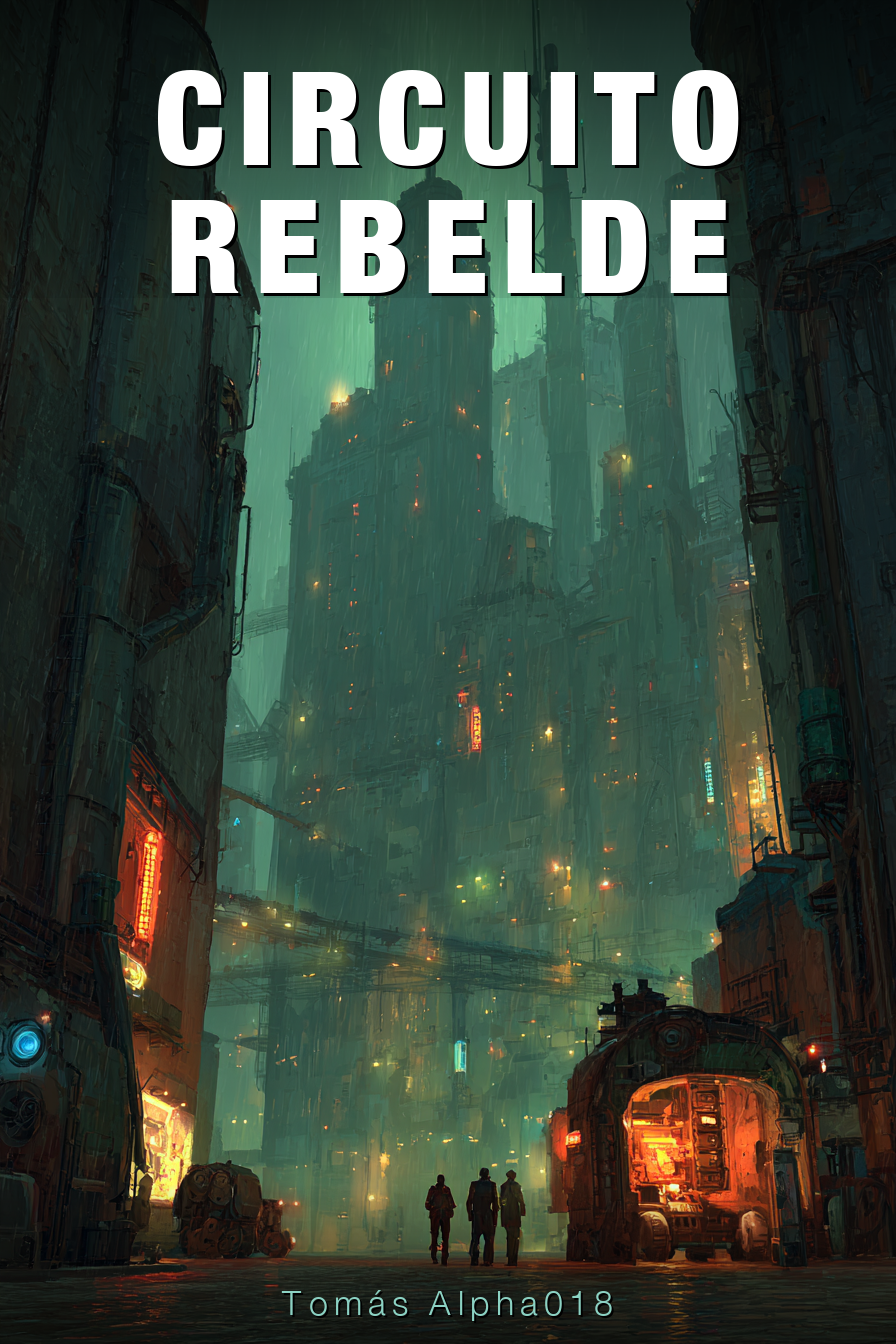
There's a short version of this announcement: I wrote a book, it's called Circuito Rebelde, it's on Amazon. The end.
That's not the version you're getting here. This is the platform where I get paid to tell you the whole story, so here it is in full: it took me about a year, with more gaps than I'd like to admit in public, and there's a concrete reason this matters to me more than it probably should.
Circuito Rebelde on Amazon
How I decided to write it
I've always liked the idea of telling a story. That's not a recent revelation or a New Year's resolution — it's something I've carried since before I even knew that writing software was, underneath it all, another way of building narratives with their own rules.
Cyberpunk sci-fi grabbed me for the same reason a badly documented legacy system does: worlds that believe they're orderly, that have run that way for years, and that nobody questions until someone on the inside finally looks closer. That "someone" in Circuito Rebelde is Carl Solis. That "someone" writing the book was me, with a lot less epic scale and a lot more open Notion tabs than I'd like to admit.
The process wasn't linear. There were entire weeks the manuscript file never got opened, followed by stretches where I'd come back every night just to close out one more chapter. Before January I already had the first chapters locked down, zero through four. This January I stopped treating it as a side project: I picked back up at chapter five and didn't stop until all fifteen were closed, ending included. Circuito Rebelde is finished, published in full.
The world of Circuito Rebelde
Year 2140. Forty-five years after an alien species — the Thal'ryx — arrived on Earth after intercepting the Voyager 1 signal. The war ended twenty years ago. What's left isn't active resistance or visible chaos — it's bureaucracy. Quotas, shifts, silence. Occupation became just another line item between quotas and shifts, and that normalization was the part I most wanted to write.
The Thal'ryx aren't machines, even though almost everyone in the story believes they are for most of it — they're biological, with an ambiguity that's never fully resolved, not even for the reader. Below them in the occupation's hierarchy are the Purgadores: human collaborators forced to wear a mask and a voice modulator, the deliberate humiliation of erasing their identity in exchange for surviving one rung above everyone else.
Carl Solis, the protagonist, is a factory worker. Twenty-eight years old, with no particular skill that would set him apart in a direct fight. He has flaws and he knows it, which already sets him apart from most protagonists in this genre. The one thing he does genuinely well is bring the right people together — and out of that seemingly minor skill, EXANIMIS PROTOCOL is born: the resistance formed from an alliance between his group and another one that had no real reason to trust them.
If you liked the resistance in Half-Life 2, the paranoid first-person feel of Mr. Robot, or the constant moral ambiguity of The Man in the High Castle, you'll recognize some tonal DNA in Circuito Rebelde. It's not a direct homage to any of them — it's the result of years spent consuming that kind of story and holding onto the question I most wanted to answer myself: what does prolonged occupation do to trust between the victims themselves, not just their relationship with the occupier?
That's where the synopsis stops. What happens to Carl, who he ends up trusting and at what cost — I'm keeping that on purpose. It's the one thing I'm not willing to give away in an announcement post.
⚠️ When this book is for you, and when it isn't
Honesty first, because selling a book without acknowledging who it's not for feels disrespectful to the reader.
Circuito Rebelde is for you if:
You like dystopian sci-fi with real social critique, not just aesthetics.
You prefer protagonists with genuine flaws over friction-free heroes.
You're not scared off by a long book: around 249,000 words. This isn't a one-afternoon read.
You're an adult: it's rated 18+, with intimate scenes present (not gratuitous, but not avoided either) and violence typical of the genre.
It's probably not for you if:
You're looking for something quick and light.
You need clean resolutions: this first stretch of the story is built to feel like a genuine open question, not a victory.
You'd rather read regional slang than neutral Spanish — I wrote it in neutral Spanish on purpose, so it reads the same from Mexico to Argentina.
For now, it's available in EPUB on Amazon for $7.99. Paperback and hardcover editions are coming.
What I learned publishing this
I learned more about the craft of publishing than about the craft of writing, and none of those lessons came free.
I had to register the ISBN through Chile's national book registry, understand how print-on-demand actually works, and put together the whole upload process for the right platforms — none of that gets explained to you before you start. Understand that Amazon royalties aren't a fixed number: they pay 70% only if the purchase comes from one of 41 eligible territories, and outside that list — Chile, my own country, included — the royalty drops to 35%. That's not a bug I can fix from some settings panel. That's how the system is built, and I learned it by reading the fine print after publishing, not before.
And then there's the part that has nothing to do with ISBNs.
While I was writing this book, I thought more than once about the people I would have liked to have close by to show the finished thing to. Some of them aren't around anymore. My father died in 2015, and whole stretches of this year of writing ended up looking, without my planning it, like a one-sided conversation with someone who couldn't answer back anymore.
I don't know if my father would have been interested in dystopian sci-fi. I don't know if he would have liked Circuito Rebelde. What I do know is that finishing this book, chapter by chapter, over months when nobody else was watching, ended up looking a lot like what I wrote into the story itself: people who keep building something with no guarantee it'll amount to anything, and no guarantee that the person who most needed to see it finished will be there to see it.
Circuito Rebelde isn't a perfect book. It's self-published, with no publishing house standing behind it. It's exactly what I could build in a real year, with real gaps, learning a new craft as I went, and thinking about someone who was never going to read it but who, somehow, I was still writing it for.
If you made it this far, you already know more about this book than most of the people who'll buy it without reading the full synopsis. Maybe that says something about what this space means to me.
🚀 Circuito Rebelde is available on Amazon. For now, it's EPUB only — paperback and hardcover are coming soon:
💌 To someone who, without knowing it, pushed me to keep creating and coding in my free time. To the one who was once my spark: for "YLP", with gratitude — and with scars that also teach.
☕ If you want to keep supporting this kind of content, buymeacoffee.com/alpha018
Have you ever finished something knowing the one person you most wanted to see it wasn't going to be there to see it? Tell me in the comments — I'm not looking for comfort, I'm looking for company in the question.
For anyone who finishes what they started even when the people who wanted to see it are gone. A year of gaps, fifteen closed chapters, and no rush to ask permission. This one's for you too, even if you can't read it.