

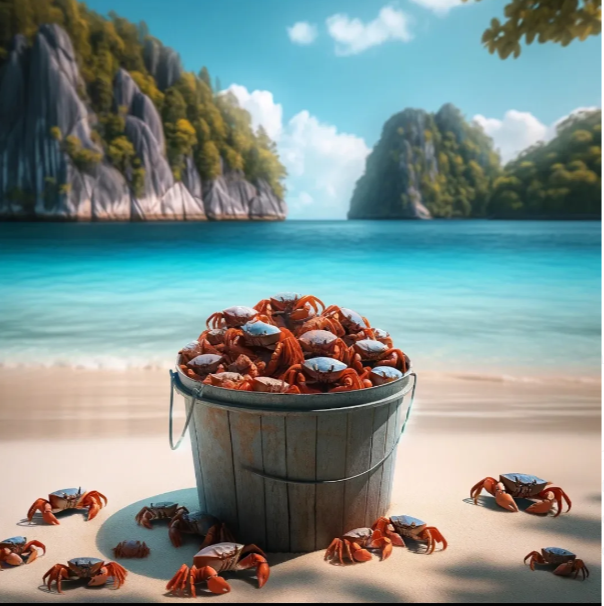
Imagine you’re walking along a picturesque beach, the kind where the sand is so fine it squeaks underfoot, and you stumble upon a bucket of crabs. Unlike the pristine setting around them, these crabs are in a frenzy, clambering over each other, each trying to escape, but inadvertently pulling down any crab that gets close to freedom. It's a powerful visual, isn't it? Yet, it’s important to remember that these crabs didn’t wander into the bucket on their own. They were placed there, likely by someone dreaming of a seafood dinner.
The term "crab mentality" refers to a way of thinking best described by the phrase "If I can't have it, neither can you." Originating from the behavior observed in a bucket of crabs, it metaphorically describes individuals within a group who, seeing any member getting ahead, will pull them back to prevent their progress. However, the irony lies in the setting of this behavior: crabs naturally do not live in buckets or cages but thrive in vast, open seas or under the shelter of rocks and coral. They were put in these confines by an external force, much like the societal or environmental constraints placed on individuals.
The Natural World vs. Human Constructs
In their natural habitat, crabs are solitary creatures. They spend their lives foraging, mating, and sometimes fighting for territory, but always with the freedom to roam the ocean floor. There's no natural scenario where crabs are trapped together, fighting to climb over each other for survival or freedom. The "crab mentality" phenomenon is thus not a natural behavior but a reaction to an unnatural, confined situation imposed on them.
This discrepancy highlights a critical aspect of the "crab mentality": it's more about the circumstances individuals find themselves in rather than an inherent trait. Just like crabs in a bucket, people often react negatively when placed in restrictive, competitive environments that pit them against each other. It reflects less on human nature and more on the structures and systems that foster such behavior.
Breaking Free from the Bucket
Recognizing that "crab mentality" is not a natural state but a reaction to certain conditions offers a hopeful perspective. If societal systems and structures are the buckets, then changing these can potentially reduce such negative behaviors. Promoting cooperation, celebrating collective success, and designing inclusive systems that offer equal opportunities for progress can help shift the focus from pulling down to lifting up.
Examples from the Animal Kingdom
Nature is replete with examples of cooperation and mutual aid. Take, for instance, the symbiotic relationship between clownfish and anemones. The clownfish protects the anemone from its predators and cleans it, while the anemone provides a safe home and food for the clownfish. This mutualistic relationship shows how cooperation, rather than competition, can lead to survival and prosperity.
The Real Lesson
The real lesson from the crab mentality metaphor should not be the negative behavior it describes but the understanding that environments heavily influence behavior. By fostering environments that prioritize collective well-being and support, we can mitigate the emergence of such detrimental mindsets.
Conclusion
The story of crabs in a bucket is a powerful metaphor for human behavior, but it's essential to remember that the crabs didn’t climb into the bucket themselves. They were placed there, much like the societal and environmental constraints that sometimes bring out the worst in human nature. By acknowledging this, we can work towards creating conditions that bring out the best in us instead, encouraging cooperation over competition, and support over sabotage. As we move forward, let’s not forget that we have the power to change the environments we create — to ensure that no one feels like a crab trapped in a bucket.