

 Introduction
For the last twenty or so years, I have been fascinated by Dante Alighieri and his masterpiece The Divine Comedy. I do not fully understand why his work has resonated with me in such a way but that is why I am writing this, both as much for my understanding as it is for yours. I know that every time I reach for my well-thumbed copy of The Divine Comedy, I am instantly transported back to the moment I discovered it. I am by no means a scholar, I have a bachelor’s degree in biomedical sciences and some education in theology but hardly the credentials that you’d expect from a person writing this, however, I truly believe that what I have learned over the last 2 decades of discovery may offer some interesting insight into the topic of Dante and who knows may even be an interesting read for someone other than myself.
As I have already stated, this is not a scholarly article, there will be opinion, conjecture and even a little, dare I say it, personality in this piece. The aim is to introduce a new generation to the wonders of the Divine Comedy and in an ever changing political, theological world highlight that the themes introduced in this masterpiece are just as relevant today as they were when it was first written.
So, with further ado. Let us dive in and get started on our own descent into The Divine Comedy and meet the man behind it all.
A Brief Biography of Dante Alighieri
Dante Alighieri was born in Florence in May 1265. His Father Alighiero was a wealthy merchant and lesser nobleman and his mother Bella passed away when Dante was still a young child. Alighiero remarried but it is reported that he died soon after in 1283. Dante, like most young men from a wealthy background, was educated in grammar, language and philosophy, the political landscape heavily influencing the young Dante life as his family was often caught between warring factions that shaped the political and social landscapes of Florence during his early life.
Dante, during his education found himself gravitating heavily towards classical literature, poetry, and theology. His love and respect for classical authors such as Ovid, Cicero and Virgil would profoundly influence what is commonly considered to be Alighieri’s opus, ‘The Divine Comedy.’ As a boy Dante experienced the political and cultural life of Florence, often engaging with poets and political figures and free thinkers. It is also around this time (1274) at the age of about 9 years old he would meet one of the most influential people of his life, Beatrice Portinari. Though they never really interacted directly, her profound influence left an indelible mark on Dante's very soul and she, knowingly or not, became his lifetime muse. Another of Dante's works said to be heavily inspired by Beatrice was ‘Vita Nuova’ a poem in which Dante explores the very nature of love, virtue and spirituality, quite common themes in his work.
Dante’s life was not a straightforward one, plagued with conspiracies, political skullduggery, loss all of these would come to feature heavily in his later prose as he explored morality and leadership. He was later in his life exiled and sentenced to execution in absentia should he ever return. He was forced to seek patronage and shelter in various cities such as bologna, Verona and finally Ravenna. Where in his exile he began to compose his literary opus The Divine Comedy.
The opening cantos of the divine comedy are used to illustrate Dante's thoughts and emotions about his exile from Florence and serve as a wider allegory for the human soul as it journeys through sin, redemption, and salvation. Dante never saw his beloved Florence again. He died in Ravenna in 1321 shortly after completing The Divine Comedy, whilst it is unclear how Dante died some historians have speculated, that probable cause of death was due to him having contracted Malaria.
Dante: The Father of Hell!?
Is Dante Alighieri the modern father of hell? This seems like it is a bold statement/question, right? Well, for all intents and purposes in my humble opinion it is a relatively accurate one, although other scholars will be quick to jump in refuting that statement. Let me take this moment to explain what I mean by Dante, being the modern father of hell.
Now, I am not saying that Dante literally invented hell. That would go against my faith, and all reason. No mortal can achieve such a feat. However, what Dante Alighieri did succeed in doing is creating a vision of the inferno that has widely influenced society, literature and philosophy to such an extent that his descriptions of the Inferno are still widely used to this day, when we think about the afterlife.
From famous Botticelli drawings in the mid 1480’s through to Gustave Dore’s 1860’s etchings and even today as I sit here writing this in 2026, we still reference the great work when imagining the afterlife. That is 700 or so years. During that time his work has captivated the imaginations of countless millions, angered more than a handful, inspired countless more. To label him as anything less than the father of modern hell in my opinion would be frankly, a disservice to his legacy.
I would like to begin our journey through his work; in much the same way the great man himself did by setting the scene where my fascination with the divine comedy began.
What a captivating beautifully illustrated way of describing an existential midlife crisis. Dante here is setting the scene for his epic journey of spiritual, physical and moral redemption. At the midway of life, one would assume that you are at the peak of physical,
cognitive and moral function, what seems to make this more terrifying is the fact that instead of being in a place of enlightenment, beauty and wisdom, Dante finds himself in a dark mysterious forest, one that is overgrown and rough to traverse and filled with the needling turns of regret from past sins. A sobering thought, indeed.
When I first discovered The Divine Comedy, I was by no means at the midway of life. In 2009, I was a 20-year-old young man at a turning point.
“IN THE MIDWAY OF THIS OUR MORTAL LIFE,
I FOUND ME IN A GLOOMY WOOD, ASTRAY
GONE FROM THE PATH DIRECT: AND E’EN
TO TELL IT WERE NO EASY TASK, HOW
SAVAGE AND WILD THAT FOREST, HOW
ROBUST AND ROUGH ITS GROWTH, WHICH
TO REMEMBER, ONLY MY DISMAY RENEWS
IN BITTERNESS NOT FAR FROM DEATH."
Dante Alighieri, (1265-1321) 'The Divine Comedy', Inferno.
I picked up the book and read that very paragraph and was instantly hooked. Something, spoke to me about this book, the author and his character’s (Himself) situation. I had to read on. Now I by no means am likening myself to Dante and his life’s experiences, we come from two different times yet through the subject matter I found a connection to an adventure fraught with mystery, intrigue, warning and longing. It is often consider by many that Dante, began his work unlike his classical influences with the introduction to the dying lands and hell as a direct reference to the woes and fall of humanity as illustrated in Christian doctrine and those of Italian city states in particular fitting in with his personal exile and alleged and probably false transgressions he faced in his waking life. No, Dante’s life was not an easy one but born from adversity rose an epic journey worthy of the classical Roman and Greek poets.
The Inferno
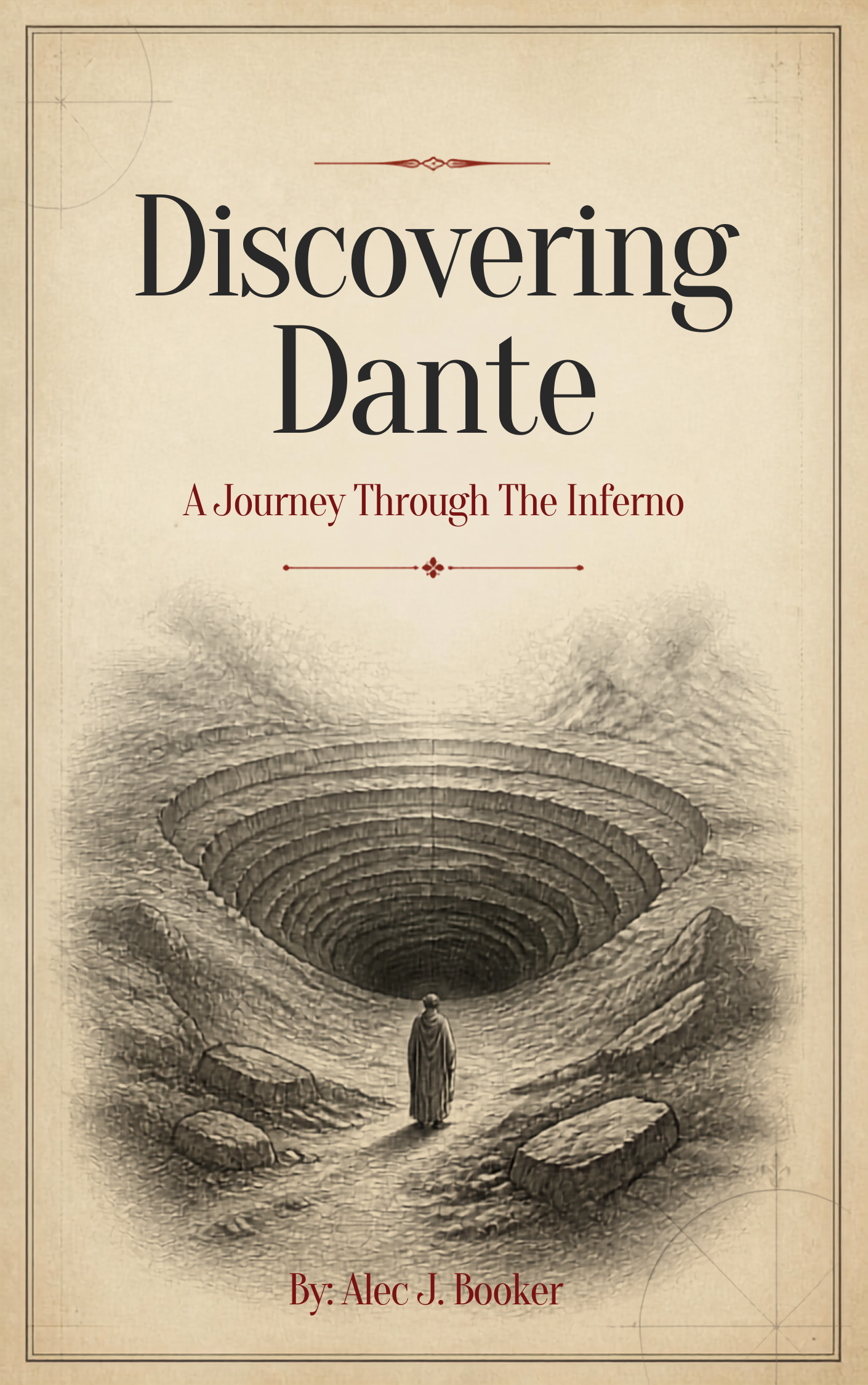
Now we get into the part that undoubtedly all of you have been waiting for. The Inferno and Dante and Virgil’s travels through this accursed place. Dante described Hell as 9 concentric descending circles, each circle dedicated to a particular sin and its punishment, the more sinister of which located in the lower levels with the king of the inferno, Lucifer being at its very centre with the worst of the worst. Here is the first point I found particularly interesting. Contemporary sources of theological writings and poetry describe Hell as a fiery pit of despair and an eternal separation of sinners from the presence of God. Dante however, added structure and vivid literary detail that at the time must have raised a few eyebrows and even caused quite a stir. I must admit, when I read the Inferno for the first time, I couldn’t help but wonder where he had gotten his information about the place from, it was so vivid, so real it was like he had undertaken the journey through the inferno for real.
So, with that being said, I thought we would undertake the same journey together and spend a little time traversing the inferno and highlighting points, people and thoughts of interest.
I think that this is a great place to pause for now. I hope that this introduction has whet your appetites for what is to come next. Next week we shall be diving into the first circles of the Inferno and beginning our descent into the underworld.
So all that remains for me to say today is thank you for reading and I look forward to sharing the next instalment with you next week.
In an effort to keep all my work on this platform free for all, I rely heavily on the kindness of my readers. If you like what you read and want to help me continue this endeavour then please consider donating a cup of coffee or whatever you can. As always your kindness is greatly appreciated.
Thank you & Happy reading.