

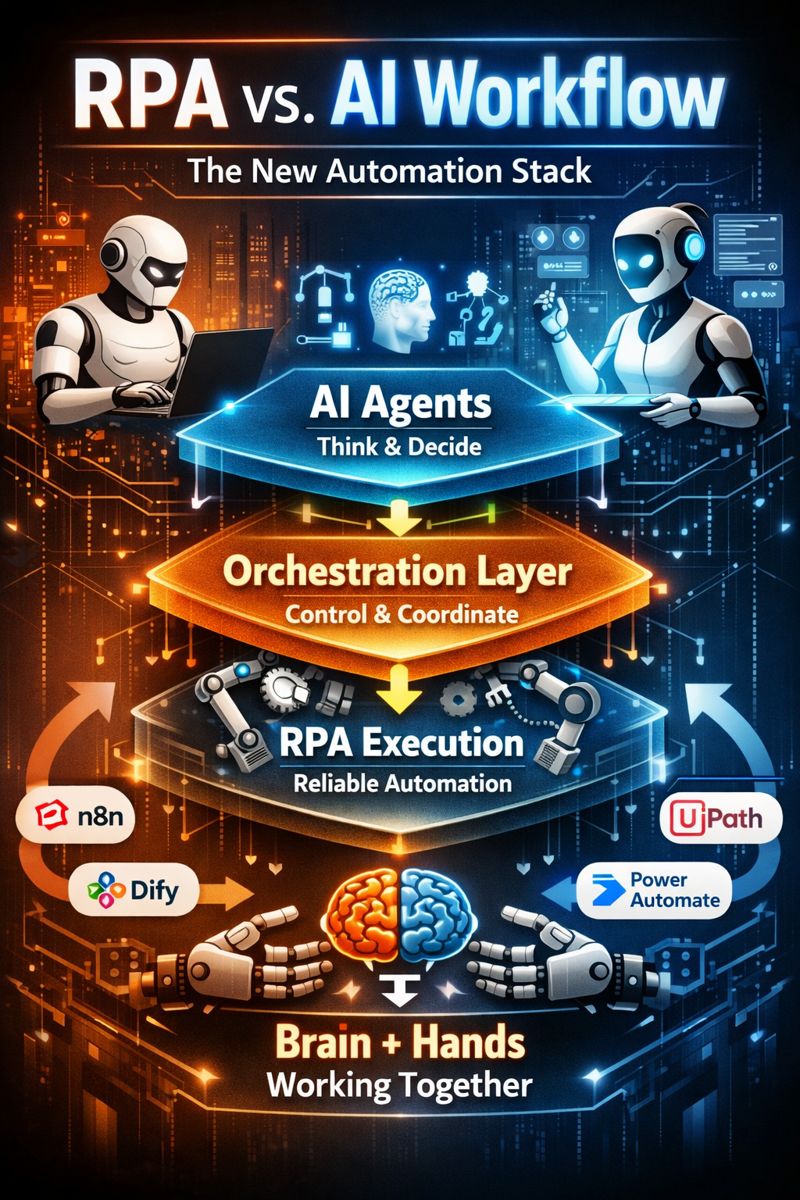
RPA Won’t Be Replaced (Yet), But It Will Be Re-layered and Redefined
Agent AI is changing automation fast. But the most important shift isn’t “RPA vs. agents.” It’s how the stack gets re-layered so enterprises can capture flexibility without losing control, auditability, and reliability.
This post answers three practical questions I hear most often:
1. What’s the trend for RPA platforms like UiPath and Power Automate in the age of Agent AI—and how do we adopt it?
2. If agents can make dynamic decisions, will rule-based RPA become unnecessary?
3. Will RPA be replaced by AI workflow tools like n8n or Dify?
The one-line conclusion
Agents will become the “thinking front desk and orchestrator,” while RPA becomes the reliable, auditable execution layer (hands & feet).
Enterprises don’t just need an AI that can reason—they need automation that finishes work, is traceable, and is risk-controlled.
1) Platform trends: “Agents as products” + orchestration as a control plane
The biggest shift from major vendors is clear: they’re not treating agents as a side feature. They’re productizing agents and upgrading orchestration into a true control plane—where agents, robots, tools, and humans can be coordinated, governed, and measured.
UiPath: Productizing Agentic Automation
UiPath is positioning Agent Builder, Maestro, Healing Agent, and Autopilot under a unified orchestration layer—bringing agents + robots + humans into one coordinated, governed pipeline.
The direction is:
* Agents handle interpretation and decision-making
* Robots execute repeatable steps
* Orchestration governs the end-to-end flow (handoffs, exceptions, approvals, logs)
Microsoft: Bringing agents into Copilot Studio / Power Platform
Microsoft is embedding agents into Copilot Studio and the broader Power Platform. Copilot Studio expands agent capabilities through connectors and agent flows, and adds computer use so agents can operate UI directly (click/type/navigate) when APIs are missing.
This matters because many enterprises still live in a mixed reality:
* Some systems have modern APIs
* Some have partial connectors
* Many still require UI-driven work on web or desktop apps
“Computer use” becomes a bridge—*but it also raises governance requirements*.
2) Will agents replace RPA? My view: not in the near term
Agents are great at flexibility—but enterprise automation is often constrained by repeatability, accountability, and cost. That’s where rule-based workflows and RPA remain essential.
Why RPA remains hard to replace
Determinism & verifiability
Finance, invoicing, access changes, and compliance reporting often require the same output every time. Agents can reason dynamically, but reproducibility and regression testing are harder.
Auditability & accountability
Enterprises must answer:
* Who did what?
* When?
* Based on which rule or approval?
* What system was impacted?
RPA/workflows naturally produce structured logs and evidence trails. Agents can achieve this too—but only with added governance layers.
Cost & throughput
For high-volume, stable-format tasks (e.g., batch reconciliations, routine data movement), deterministic workflows are often cheaper, faster, and more reliable than agentic reasoning loops.
Execution stability
With shifting UIs, legacy systems, and inconsistent APIs, you still need robust mechanisms for scheduling, retries, concurrency, recovery, and monitoring—classic strengths of mature RPA platforms.
The practical split
👉 Agents excel at: exception handling, intelligent routing, and unstructured understanding (emails/contracts/screenshots → decisions)
👉 RPA excels at: testable, repeatable, auditable “mainline” execution
3) RPA vs. n8n / Dify: not replacement—the best “brain + hands” combo
AI workflow tools like n8n and Dify are powerful for orchestrating AI + APIs + tools. RPA platforms are powerful for enterprise-grade execution and governance. In practice, the best architecture combines them.
The clearest division of labor
AI workflow (n8n / Dify / Copilot Studio, etc.) = the brain
* Understand intent
* Retrieve knowledge
* Plan steps
* Route exceptions
* Call tools and services
RPA = the hands & feet
* Log into legacy systems
* Execute web/desktop UI automation
* Run batch operations
* Preserve audit evidence
* Handle retries and recovery
The most likely future: layered, not either/or
Agent Layer (decision/planning) → RPA Layer (controlled execution)
This layered model also maps neatly to risk:
* Higher risk, higher compliance → stronger controls in execution
* Higher ambiguity, unstructured inputs → stronger agent involvement upfront
A rollout approach that works: start “high-exception, low-risk”
If I were rolling out Agent × RPA in an enterprise, I’d do it in this order:
1. Start with workflows that have many exceptions and unstructured inputs
Let the agent handle understanding and routing (classification, summarization, decision suggestions).
2. Hand off deterministic execution to RPA/workflows
Once “what to do” is clear, use RPA for stable execution + audit trails.
3. Enforce human-in-the-loop for high-risk actions
For payments, permissions, contract sending, or external communications: require approval gates, logging, and governance.
Closing thought
The question isn’t whether agents will “kill RPA.” The real shift is that enterprise automation is becoming a layered system:
* Agents make sense of ambiguity and decide what to do
* RPA/workflows execute reliably and leave a trace
* Governance ensures accountability and risk control
That’s not replacement. That’s evolution—and it’s where real scale becomes possible.