The Coon Chicken Inn: The Racist Restaurant Chain That Thrived in the Pacific Northwest
The history of anti-Black racism in America is often associated with the Jim Crow South, but some of the country's most disturbing racial imagery also flourished thousands of miles away.
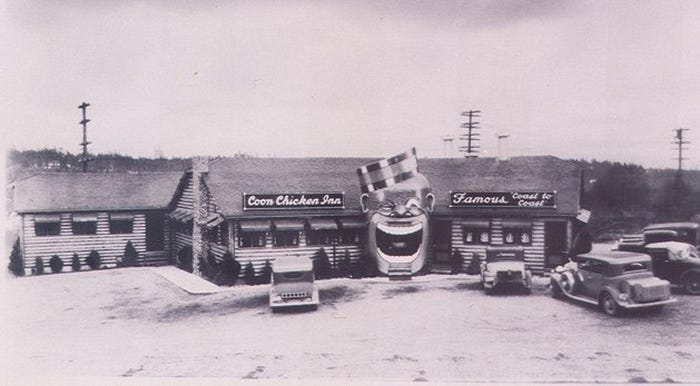
For nearly three decades, a restaurant chain called the Coon Chicken Inn operated in Utah, Washington and Oregon. Its identity was built around an exaggerated racist caricature of a Black man, complete with an enormous grinning face that served as the entrance to the restaurants.
Customers literally walked through its mouth to enter.
How the Restaurant Began
The first Coon Chicken Inn was opened by Maxon Lester Graham and his wife, Adelaide, in Salt Lake City, Utah, in 1925. The restaurant specialized in fried chicken, but its most recognizable feature was its racist branding.
Its logo depicted a Black man with exaggerated lips, wide eyes and an enormous grin, imagery rooted in the minstrel stereotypes that had been used to demean Black Americans for generations.
The caricature appeared everywhere, including menus, advertisements, signs, postcards, matchbooks and restaurant decorations. Most notoriously, a huge version of the face was constructed around the front entrance.
The concept proved successful enough for the owners to expand, opening additional locations in Seattle, Washington, and Portland, Oregon.
Racism Was Not Confined to the South
The success of the Coon Chicken Inn is an uncomfortable reminder that anti-Black racism was never exclusively Southern.
Black residents of the Pacific Northwest faced discrimination in housing, employment and public life. Oregon had an especially troubling history of racial exclusion, including nineteenth-century laws designed to restrict Black settlement in the state.
By the twentieth century, discriminatory housing practices also helped determine where Black families could live in cities across the region.
The restaurant therefore existed in a society where racist caricatures could be openly used for entertainment while actual Black residents faced barriers to equal participation in everyday life.
Why Was This Considered Acceptable?
Racist images of Black people were widespread in American culture during the nineteenth and early twentieth centuries.
Minstrel shows had popularized exaggerated portrayals of Black Americans as foolish, lazy, childish or permanently cheerful. Similar imagery eventually appeared in advertisements, cartoons, children's books, household products, toys and food packaging.
The Coon Chicken Inn turned those stereotypes into an entire business identity.
Its giant entrance also fit into the growing roadside culture of the 1920s. As automobile ownership increased, restaurants and other businesses used unusual architecture to attract motorists. The Coon Chicken Inn combined that trend with racist imagery to create something customers would immediately recognize and remember.
Black Americans Challenged These Stereotypes
It is important not to dismiss the restaurant's imagery simply as something that was considered acceptable because it was "a different time."
Black Americans were already challenging racist stereotypes while businesses such as the Coon Chicken Inn were using them.
Black newspapers, activists and civil rights organizations criticized degrading representations of Black people throughout the early twentieth century. Such images were understood as part of a wider culture that portrayed Black Americans as inferior while they were simultaneously fighting discrimination in voting, employment, housing and education.
The restaurant continued operating for decades, but the chain eventually disappeared by the late 1950s as American society entered a period of growing civil rights activism and changing attitudes toward openly racist commercial imagery.
What Remains Today
Original menus, postcards, signs and other objects connected to the Coon Chicken Inn still survive in museums, archives and private collections.
They preserve an uncomfortable piece of American history.
The significance of the Coon Chicken Inn is not simply that an offensive restaurant once existed. It is that the business operated openly and successfully for decades. Ordinary customers ate there, advertisements promoted it and its enormous racist caricature stood along public roads in major Western cities.
Its history challenges the idea that America's most blatant forms of anti-Black racism belonged only to the South.
The Coon Chicken Inn was a product of the American West and Pacific Northwest, and its popularity shows how deeply racist stereotypes had become embedded in everyday American culture.