
That bus was not luxury. For Sister Rosetta Tharpe, it was protection, shelter, dressing room, restaurant, and a moving declaration that a Black woman would not wait for Jim Crow to decide where she could rest.
She could stand onstage before roaring crowds, electrify a room with one hand on her guitar, and still be told after the curtain fell that the hotel had no room for her. She could headline the show, carry the crowd, sell the tickets, and still be sent around back for food because segregation cared nothing for genius.
That is the part of her story that must be held close. Sister Rosetta Tharpe was not only fighting to be heard as an artist, she was fighting to move through America with her dignity intact.
Born Rosetta Nubin in Cotton Plant, Arkansas, in 1915, she grew up inside the sound of the Black Pentecostal church, where music was not decoration but testimony. By childhood, she was already known for singing and playing guitar, traveling with her mother, Katie Bell Nubin, who was connected to the Church of God in Christ tradition.
But Rosetta did not stay inside the narrow place the world prepared for her. She took the church’s fire, the blues’ ache, the pulse of swing, and the sharp bite of electric guitar, then carried all of it into public view.
In 1938, at only 23, she made her first recordings for Decca, including “Rock Me” and “That’s All,” and those songs helped make her one of gospel’s first major recording stars. Smithsonian notes that those early records became instant hits and established her commercial breakthrough.
Still, success did not mean safety. A Black woman could become famous in America and still be reminded at every stop that fame did not cancel racism.
That is why the tour bus matters. National Women’s History Museum notes that even while performing alongside white artists, Tharpe was made to sleep on buses and eat outside restaurants, and she eventually bought her own tour bus to resist the exclusions and daily indignities of segregation.
Imagine the weight of that choice. Not a glamorous rock-star bus years before the idea became fashionable, but a practical shield against a country that wanted her talent onstage and her body outside the door.
Every mile carried a contradiction. Her name could be on the marquee, but the rules of Jim Crow still tried to place her beneath the people who came to profit from her sound.
And what a sound it was. She did not simply strum behind her voice, she attacked the guitar with confidence, rhythm, and holy force, making the instrument speak in a language that future rock musicians would later claim as their own.
The Rock and Roll Hall of Fame calls her “the first guitar heroine of rock & roll,” recognizing the command and originality she brought to the electric guitar before the genre had settled into its popular image.
That image, for too long, did not look like her. It became a young white man with a guitar, a sneer, and a stage full of permission.
But before that mythology hardened, Sister Rosetta Tharpe was already there. She was already bending notes, driving rhythm, and making sacred music move with the urgency of the street.
In 1944, she recorded “Strange Things Happening Every Day” with pianist Sammy Price. Britannica notes that it reached the top 10 on Billboard’s “race records” chart and that some music scholars have argued it can be viewed as the first rock-and-roll song.
That does not mean history belongs to one record alone. Black music has always been a river with many branches, fed by church songs, work songs, blues, jazz, rhythm and blues, and the genius of people who created under pressure.
But Rosetta’s place in that river is not small. She stood at a crossing point, where gospel left the sanctuary, picked up voltage, and helped shape the sound that would shake the world.
Her guitar did something America was not ready to admit a Black woman could do. It led.
At a time when guitar virtuosity was often framed as masculine, she stepped forward with authority and joy. Smithsonian describes how her performances disrupted both racial and gender stereotypes, proving her to be one of the most influential artists of the twentieth century even though she never became a household name in the way many of her musical descendants did.
That lack of recognition was not accidental. America has often celebrated Black creation only after separating it from Black creators.
Rosetta lived inside that painful pattern. The sound she helped build moved forward, gathered money, gathered praise, gathered white faces on magazine covers, while her name too often slipped into the margins.
Still, she refused to become small. She played churches, theaters, clubs, revival spaces, and concert halls, moving between worlds that did not always welcome one another.
Some church people criticized her for taking gospel into nightclubs and secular spaces. Some secular audiences did not fully understand the church foundation beneath her power.
She belonged everywhere and nowhere at once. That is often the burden carried by those who are ahead of their time.
Her partnership with Marie Knight added another layer to her story. The two recorded and toured together in the late 1940s, and Britannica notes their successful gospel recordings, while later sources and historians discuss Tharpe’s relationships with both men and women with care because much of that part of her life could not be openly documented in her own time.
That silence matters too. Black queer history has often been forced into whispers, not because it was absent, but because survival required caution.
Rosetta lived in a world where being a Black woman was already dangerous, being an independent musician was already judged, and loving outside public expectation could carry real consequences. So the record is careful, incomplete, and shaped by what people could safely say.
Yet even with all of those pressures, she kept moving. The bus kept rolling, the guitar kept ringing, and her voice kept lifting rooms into something close to freedom.
In 1951, she turned even her wedding into a public spectacle of music and community at Griffith Stadium in Washington, D.C. Washingtonian described the event as one of the best-remembered concerts of her career, with fans arriving dressed for church and bringing gifts as if they were family.
That moment shows her brilliance beyond the guitar. Rosetta understood performance, publicity, and the emotional bond between artist and audience.
She knew Black people did not simply come to hear songs. They came to be carried somewhere, if only for a few hours, beyond bills, grief, racism, and the daily demand to endure.
Her stage presence gave people release. Her music allowed the sacred and the everyday to stand together without apology.
By the 1960s, her fame in the United States had declined, but Europe received her with fresh attention. In 1964, she performed as part of the Blues and Gospel Caravan, including a filmed appearance in Manchester, England, during a rain-soaked outdoor performance that later became one of the most iconic pieces of footage associated with her name.
There she was, older but still commanding, holding that electric guitar in the rain like the weather itself had to wait its turn. Younger musicians watched and absorbed what America had failed to properly honor.
The tragedy is not that Sister Rosetta Tharpe disappeared. The tragedy is that so many people heard her through others without knowing they were hearing her at all.
Her influence moved through Chuck Berry’s guitar language, Little Richard’s fire, Elvis Presley’s early musical imagination, and the broader rise of rock and roll. Smithsonian lists Chuck Berry, Elvis Presley, Jerry Lee Lewis, and Little Richard among the major figures she inspired.
But influence without credit is another kind of theft. It does not always arrive with a locked door or a stolen paycheck, sometimes it arrives as silence.
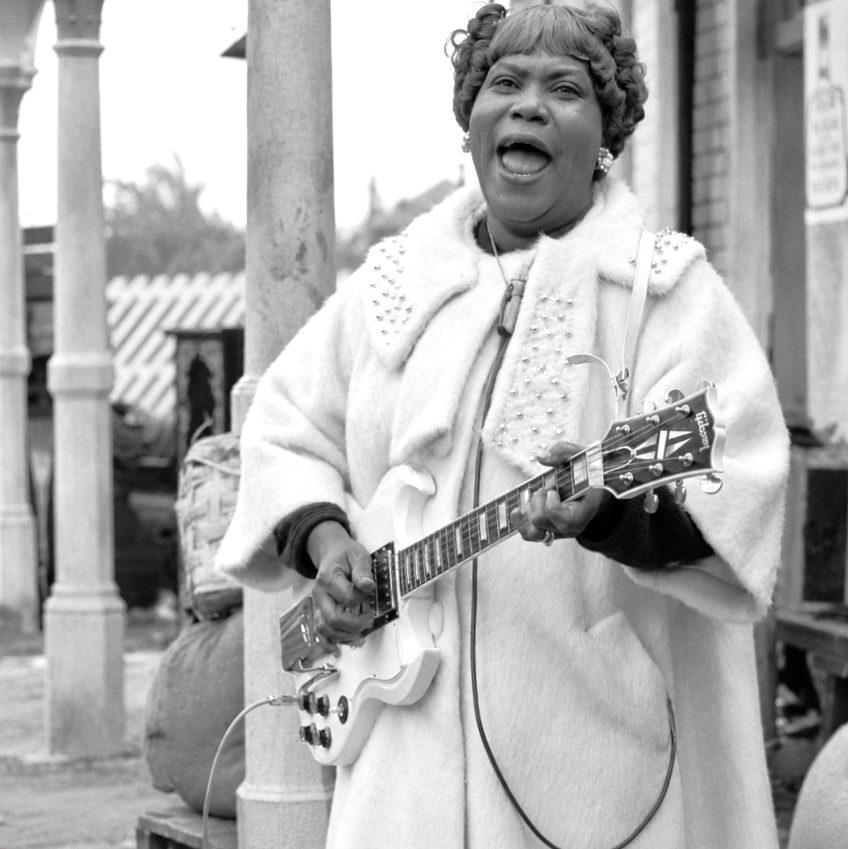
When Rosetta died in Philadelphia on October 9, 1973, she was 58 years old. Britannica records her death there after a career that continued despite declining health in her later years.
Then came one of the most painful details in her legacy. For decades, her grave in Philadelphia remained unmarked.
A 2008 report described how her remains had rested for 35 years in an unmarked grave at Northwood Cemetery, even though she was widely recognized by admirers as gospel’s first superstar and a lasting influence on American music.
There is something deeply unsettling about that image. A woman who helped give the world a new sound was left without even a proper marker for people to find her name.
But Black memory has a way of surviving neglect. What institutions fail to protect, communities, scholars, musicians, and listeners often begin to restore.
Her Rock and Roll Hall of Fame induction finally came in 2018, under the category of Musical Influence. It was deserved, but it was late.
Still, late honor does not erase early truth. Sister Rosetta Tharpe was not waiting to be validated by a hall, a plaque, or a ceremony.
She had already made her case every time she stepped from that bus, lifted that guitar, and gave people a sound bigger than the limits around her. She had already written herself into history, even when history tried to write around her.
Her story asks us to listen differently. Not just to the song, but to the road beneath it.
Listen for the bus engine in the background. Listen for the restaurants that would not seat her, the hotels that would not open, the church critics who judged her, the industry that borrowed from her, and the audiences who knew they were witnessing something rare.
Then listen again for the victory. Because she did not stop.
She made a way across highways that were not built for her comfort. She carried Black sacred sound into the modern age with a guitar in her hands and a kind of courage that did not need permission to be beautiful.
Sister Rosetta Tharpe’s life reminds us that Black history is not only made in courtrooms, marches, and famous speeches. It is also made in studios, sanctuaries, bus seats, train stations, stadiums, and in the private decision to keep going when the world refuses to make room.
The lesson is not only that rock and roll has Black roots. The lesson is that those roots had names, faces, burdens, and brilliance.
Her name was Sister Rosetta Tharpe. And every time her story is taught with the fullness it deserves, another buried piece of our history rises back into the light.