

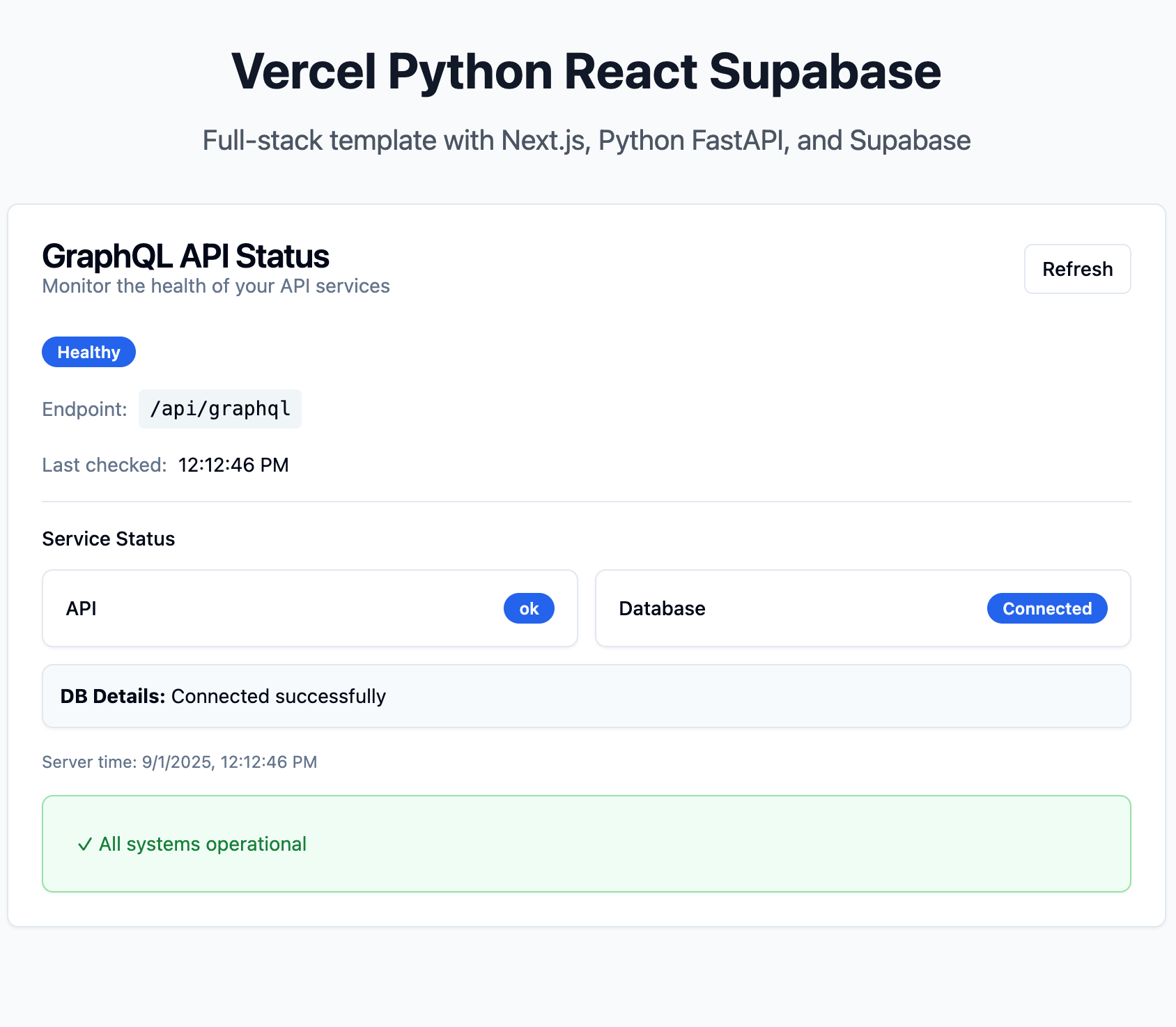
Modern web applications demand scalability, developer productivity, and strong type safety across the stack. Many developers experiment with combining modern frontends such as Next.js with Python backends and managed databases, but stitching them together into a coherent, production-ready system is often challenging.
This article introduces a full-stack template designed for production use. It combines a Next.js 14 frontend, a FastAPI backend with Strawberry GraphQL, and Supabase PostgreSQL, all deployed on Vercel. The architecture focuses on type safety, developer experience, and scalability while maintaining a straightforward monorepo structure.
GitHub repository: vercel-python-react-supabase
Live demo: vercel-python-react-supabase.vercel.app
Technical Architecture Overview
Project Structure
The project uses a monorepo managed with pnpm workspaces and Turbo. A Python environment is isolated in the project root with uv.
.
├── apps/
│   ├── web/         # Next.js frontend
│   └── api/         # FastAPI backend
├── turbo.json       # Turbo build orchestration
├── pnpm-workspace.yaml
├── vercel.json      # Vercel deployment config
├── setup.sh         # One-command setup script
└── .venv/ # Python virtual environment (uv managed)Frontend: Next.js 14 with the App Router, React 18, TypeScript, Apollo Client, TailwindCSS, Radix UI
Backend: FastAPI, Strawberry GraphQL, SQLAlchemy, Alembic, Python 3.11+
Database: Supabase PostgreSQL with Row Level Security and generated TypeScript types
Deployment: Vercel serverless with hybrid routing (Next.js and Python functions)
Tooling: pnpm, uv, Turbo, Jest, Testing Library, pytest, ESLint, Black, isort, flake8, pre-commit hooks, Husky
Monorepo Structure
Why a Monorepo
A monorepo offers several benefits for modern full-stack projects:
Unified build pipeline with Turbo caching and parallelization
Shared developer tooling for linting, formatting, and type-checking
Consistent workflows across frontend and backend
Easier CI/CD setup with a single source of truth
Turbo Orchestration
// turbo.json

{
	"tasks": {
    	"build": { "dependsOn": ["^build"] },
    	"dev": { "cache": false, "persistent": true }
	}
}
Turbo orchestrates builds across the apps/ directory. The build process is incremental, which improves both local iteration speed and CI/CD pipelines.
GraphQL API Implementation
The backend is built with FastAPI and Strawberry GraphQL, offering schema-first API development and type safety.
FastAPI with Strawberry
# apps/api/index.pyfrom fastapi import FastAPI

from strawberry.fastapi import GraphQLRouter
import strawberry

@strawberry.type
class Query:
    hello: str = "Hello from FastAPI + Strawberry!"

schema = strawberry.Schema(query=Query)
graphql_app = GraphQLRouter(schema)

app = FastAPI()
app.include_router(graphql_app, prefix="/api/graphql")
Database Integration
SQLAlchemy models represent the Supabase PostgreSQL schema
Alembic migrations manage schema evolution
Supabase provides connection pooling and built-in Row Level Security
Queries are secured by policies, ensuring multi-tenant and per-user data isolation
Frontend Architecture
The frontend is built on Next.js 14 with the App Router, enabling server components and optimized rendering patterns.
Apollo Client
The frontend communicates with the backend through Apollo Client.
// apps/web/lib/apollo.ts

import { ApolloClient, InMemoryCache } from "@apollo/client";

export const client = new ApolloClient({
  uri: "/api/graphql",
  cache: new InMemoryCache(),
});
Supabase Client
For cases where direct access to Supabase is required (for example authentication and real-time subscriptions), a Supabase client is initialized.
import { createClient } from "@supabase/supabase-js";

export const supabase = createClient(
  process.env.NEXT_PUBLIC_SUPABASE_URL!,
  process.env.NEXT_PUBLIC_SUPABASE_KEY!
);
Type Safety
Types are generated automatically from both the Supabase database schema and the GraphQL schema, providing end-to-end type safety.
Deployment Strategy
Vercel supports hybrid deployment where Next.js routes and Python serverless functions coexist in the same project.
Routing Configuration
// vercel.json

{
	"builds": [
   		{ "src": "apps/web/package.json", "use": "@vercel/next" },
   		{ "src": "apps/api/index.py",	"use": "@vercel/python" }
	],
	"routes": [
    	{ "src": "/api/graphql/(.*)", "dest": "apps/api/index.py" }
	]
}
Deployment Considerations
Python serverless functions can suffer from cold starts; keep dependencies lean and use connection pooling
Environment variables are managed securely in Vercel
Static assets benefit from Next.js static optimization and Incremental Static Regeneration
Developer Experience
This template emphasizes productivity and consistency.
One-command setup:
./setup.shinstalls dependencies, creates virtual environments, and runs migrationsHot reloading: Both frontend and backend support live reloads during development
Unified tooling: ESLint, Black, isort, flake8, pre-commit hooks, and Husky ensure code quality
Testing:
Frontend uses Jest and Testing Library
Backend uses pytest and pytest-asyncio
Production Readiness
Security, observability, and CI/CD are integrated into the architecture.
Security: CORS policies, Supabase RLS, and secure environment variables
Observability: Structured logging (loguru) and health endpoints
CI/CD: GitHub Actions workflows are compatible with Turbo caching for faster builds
Documentation: Architecture guides and setup instructions are stored in the
docs/directory
Performance and Scalability
Advantages:
Next.js ISR reduces server load
FastAPI serverless functions scale automatically on Vercel
Supabase connection pooling ensures efficient database access
Turbo build caching improves CI/CD performance
Considerations:
Cold starts on Python functions can increase latency
GraphQL queries can lead to N+1 problems without dataloaders
Connection management in serverless contexts must be carefully tuned
Roadmap of Features
High Priority:
Authentication with Supabase Auth (email/password, magic links, OAuth providers)
Protected routes using Next.js middleware
CRUD examples with RLS enforcement
Dashboard UI with profile and navigation
Medium Priority:
File upload via Supabase Storage
Real-time updates with subscriptions
End-to-end test coverage
Structured logging
Advanced Features:
Vector embeddings with PostgreSQL
Automated code quality enforcement with pre-commit hooks
Evaluation of Supabase migrations versus Alembic
Comparison with Alternatives
T3 Stack (Next.js, tRPC, Prisma, NextAuth): Strong end-to-end type safety in TypeScript but limited for Python developers
SvelteKit with FastAPI: Similar separation of frontend and backend but less adoption in enterprise settings
Full JavaScript with Node GraphQL: Avoids Python cold starts but misses out on Python’s scientific ecosystem
Traditional REST: Simpler to implement but lacks schema validation and flexibility offered by GraphQL
Conclusion and Call to Action
This template demonstrates how to build a modern full-stack application that is production-ready, type-safe, and developer-friendly. By combining Next.js 14, FastAPI with Strawberry GraphQL, and Supabase on Vercel, developers gain a solid foundation that can scale with project requirements.
Explore the GitHub repository: vercel-python-react-supabase
Try the live demo: vercel-python-react-supabase.vercel.app
Deploy with a single click using the Vercel button in the repository
Contribute by opening issues and pull requests
Extend the template with authentication, storage, and real-time features
This architecture is designed for teams that want both the flexibility of Python and the modern frontend capabilities of Next.js, without compromising on scalability or developer experience.