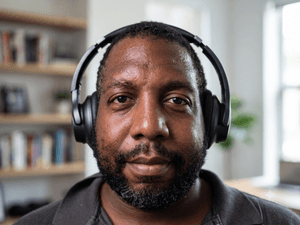


There’s a creator on Facebook named Julian Cross who makes short, blunt, profanity-laced videos about real life. Fair warning: if strong language isn't your thing, he might not be for you. But what makes him worth watching isn't the humor—it’s the honesty.
He recently posted a video comparing the old job market to the current one, and it hit differently. Not because it was funny, but because it was undeniably true. It forced me to reflect on one of the hardest stretches of my own life.
The Assumptions vs. The Reality
When I was homeless and unemployed, people in my circle—family, friends, people who knew me well—quietly (and sometimes not so quietly) assumed I wasn't trying hard enough. They assumed I was being lazy. The prevailing logic was that because I had a college degree, I should be able to walk into any building and secure employment.
The directive was always the same: "Just get any job." As if that wasn't precisely what I was killing myself trying to do.
Let me be clear about what job hunting actually looked like back then:
It wasn't casually submitting a couple of resumes a week; it was hundreds of applications sent through Indeed, LinkedIn, and every job board I could access.
It was pounding the pavement in Brandon and St. Pete, walking into every single business I passed to ask if they were hiring.
It was CC'ing family and friends on email confirmations—interview invites, application receipts, follow-ups—until some of them explicitly told me to stop sending them.
I was providing literal, undeniable proof of effort. Yet it still wasn't enough to change their perception of me.
It didn't stop at applications, either. I accepted every single job offer I received—no exceptions. Some fell through because transportation was an insurmountable barrier; when you're unhoused, traveling across town is a complex logistical challenge. Other employers ghosted after making the offer. But whenever anyone offered me work, I said yes immediately. I even accepted multiple overlapping offers at once, knowing I could only physically show up to one, because survival meant I couldn't afford to turn anything down.
What Survival Actually Looked Like
The lowest-paying job I took during that period was at a Circle K in Brandon, earning just over twelve dollars an hour. I worked forty hours a week, mostly overnight, entirely alone. I came close to being robbed twice.
When my shifts ended, I walked the streets of Brandon searching for a safe place to sleep. For a stretch, I slept in the laundry room of a nearby hotel—until management caught me on camera and banned me from the property permanently, refusing to even let me rent a room when I had cash. Whenever I scraped together enough money, which wasn't often, I stayed at a cheap motel down the road.
I worked at that gas station for over three months without missing a single day. There was no safety net—no paid sick leave, no PTO, no financial cushion whatsoever. Even while sick, sleeping outside, and eating inconsistently, I showed up for every shift. One night, I was so severely ill that I had an accident on the job. I went into the bathroom, cleaned myself up, threw away my clothes, changed into a spare outfit, and finished the remaining hours of my shift. Missing work simply was not an option.
A Broken System and the Performative Burden
The shelter system offered little real refuge. At Tampa Hope, we stayed in tents, baking in the summer heat. The shelter in Clearwater was even harsher: we slept outside under an open canopy, packed tightly beside strangers while rats ran around us in the dark. It was staffed by sheriff's deputies and operated like a detention facility.
To get housing assistance, you were required to stay on-site to meet with a caseworker—except the caseworker never visited our pod. Not once. Every morning for weeks, I put my name at the top of the sign-up list. I waited, checked at the front desk, and followed up continuously. Nothing. Yet if you left the property to hunt for jobs, you risked losing your bed. The system demanded you stay put, while everyone on the outside scolded you to go find work. It was a lose-lose trap.
What made the hardship infinitely heavier was the constant need to perform. When you're forced to rely on others for basic survival, you lose the luxury of raw honesty. You spend your energy constantly reassuring people, apologizing, over-explaining, and proving that you're "trying hard enough." You're the one sleeping outside, getting eaten by mosquitoes, and working night shifts alone—yet you're also expected to continually justify your existence and effort to the very people who claim to love you unconditionally.
The Absence of Safety Nets & Present Realities
What people fail to grasp is that homelessness and unemployment are not uniform experiences. Some people facing joblessness still have credit cards to lean on, an employed partner, parents with an open door, or assets to leverage. Having those resources doesn't mean their struggle isn't real, but it fundamentally alters the physics of their situation.
I had zero safety net: no credit, no assets, no family home to return to. Ironically, the complete absence of alternatives was weaponized against me—as though sleeping on the street was a conscious lifestyle choice rather than a total lack of options.
Today, my current employer is the most supportive I’ve ever had, and I deeply appreciate that. My immediate supervisor and management have supported me in ways no previous job ever did. I live with a documented chronic illness, and despite unpredictable health flare-ups that might have cost me my job elsewhere, they've stood by me.
Still, navigating workplace policy while managing chronic illness before qualifying for FMLA is uniquely stressful. I recently missed a couple of days due to an illness flare-up. While my medical accommodations protected my job status, my lack of one-year tenure meant I wasn't FMLA-eligible yet. That distinction meant I couldn't use my accrued vacation time to cover my lost wages. I was protected from termination, yet left financially exposed.
The Takeaway
I’m still bitter about how I was treated during those dark times, and I won't pretend otherwise. It’s not that I expected perfection from people, but because I showed up—literally and figuratively—every single day, and my effort was still minimized.
The takeaway is simple: never judge a person's struggle when you don't hold the full picture. Struggling does not equal laziness. Needing support does not make someone a burden. And the people carrying the heaviest loads shouldn't have to put on a performance just to earn basic empathy and belief.
How You Can Help / Bridging the Gap
This platform and my voice have always been built on raw truth—and the truth right now is that I need my community.
As I mentioned, I live with a documented chronic illness. Because I haven't quite reached the one-year tenure mark at my current job, I don't yet qualify for FMLA. Missing just a few days of work due to a recent flare-up meant those days were completely unpaid. As a result, my paycheck fell short, leaving me only able to cover half of my rent for this period and exposing me to upcoming late fees.
I survived the streets, and I am working relentlessly to ensure I never go back. If my words have ever resonated with you, helped you feel seen, or challenged your perspective, I am humbly asking for your support today.
If you are in a position to help—whether by buying me a coffee, contributing toward this rent shortfall, or simply sharing this essay—it would mean everything. Your support isn't just a donation; it is literal shelter and a bridge to the stability I am actively building.
Thank you for reading, for honoring the receipts, and for standing with me.
If this one stayed with you, you might also like:
💛 They're Dismantling the Safety Net. I'm Still Standing. Will You Stand With Me?