
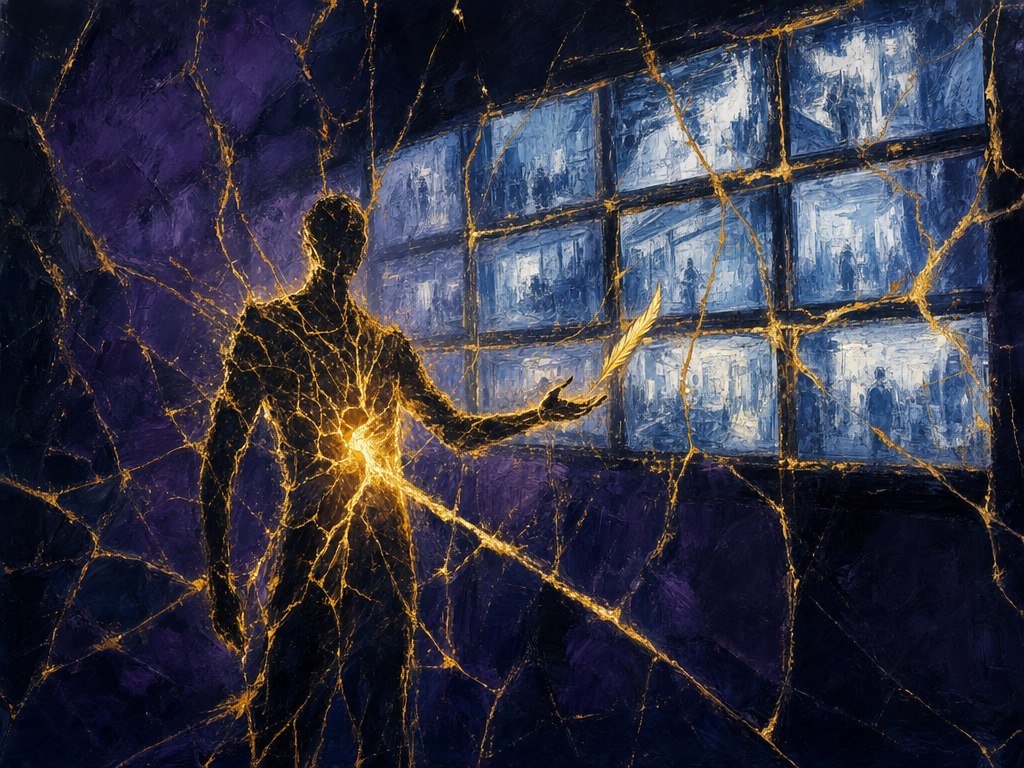
If you read the essay, you got the polished version. The four-step framework. The locked computer lab. The kintsugi closer. All of that is true, and I meant every word of it.
This is the part I cut.
***
The essay makes it sound like I discovered writing-as-technology in some quiet moment of clarity. Standing at the glass, looking at the screens, epiphany arrives. Clean. Cinematic.
It wasn't like that.
The first time I wrote anything that mattered at Tampa Hope, I was shaking. Not from cold — it was July in Florida, nothing is cold. I was shaking because I'd just had a conversation with a caseworker who looked through me like I was furniture, and something inside me cracked in a way I didn't know how to hold. Not dramatic cracking. Not movie cracking. The kind where your face stays still and something behind it just... relocates.
I sat on the pallet, opened the notes app, and typed:
"I am not what just happened to me."
That's it. That was the whole entry. Seven words. I didn't know I was starting anything. I was just trying not to disappear.
***
The essay talks about The Re-framing — switching "I am homeless" to "I am navigating housing instability." What it doesn't say is how many times I failed at that before it stuck.
There were nights where I'd write the reframe and then read it back and laugh at myself. Not kind laughter. The kind where you know you're performing for an audience of zero. "Navigating housing instability." Sure. I'm navigating a tent that smells like mildew and the man two pallets over is talking to someone who isn't there, and I'm navigating. Got it.
The reframe didn't work because I believed it. It worked because I kept saying it past the point where I believed it, and eventually, my nervous system stopped arguing. That's the part that doesn't fit neatly into a numbered list. Repetition without belief. Faith before feeling. The practice isn't pretty. It's mechanical before it's spiritual.
***
The Curation section mentions Route 34 down Hillsborough Avenue. What I didn't say is that I used to narrate the bus ride in my head like I was writing it. Not to be literary. Because if I didn't give the ride a narrative, my brain would fill the silence with inventory — everything I'd lost, everything I didn't have, every way I'd failed to be where I thought I'd be at 42.
The narration was defense. "The sun is hitting the Walgreens sign at an angle that makes it look expensive." That kind of thing. Stupid observations. Meaningless ones. But they kept the inventory quiet for thirty minutes, and thirty minutes of quiet was worth more than sleep some nights.
I still do it. I'm on the bus less now, but when the inventory starts — and it still starts — I narrate. Whatever's in front of me. It's not meditation. It's not mindfulness. It's closer to what a boxer does between rounds. You don't think about the last hit. You breathe, you look at your corner, you find one thing to focus on.
***
The essay ends with "they can lock the computer lab. They cannot lock this." And that's true. But here's the thing I've been sitting with lately:
They couldn't lock it, but I almost locked it myself.
There was a stretch — maybe month four at Tampa Hope — where I stopped writing entirely. Not because I chose to. Because the fatigue got so deep that even opening the notes app felt like too much. The technology was still there. I just couldn't reach it. And that terrified me more than the tent, more than the heat, more than the caseworker. Because if the one thing I had was my words and I couldn't access them, then what was left?
What was left was silence. And silence, it turns out, is not the enemy of writing. It's the soil.
I came back to the page slower. Quieter. Less performative. The writing that came out of that silence is the writing you're reading now. The stuff before was me trying to prove I was still here. The stuff after was me just... being here.
The difference is everything.
***
That's the backstage. The essay is the room after it's been cleaned. This is what the room looked like at 3 a.m. before anyone swept.
If you're in a stretch where the words won't come — where the technology feels locked even though you know it shouldn't be — I'm not going to tell you to push through. I'm going to tell you that the silence is doing something. You might not see it yet. But it's working.
And when the words come back, they'll be different. Better, maybe. Definitely more honest.
If this found you in a place you recognize — this space exists because someone decided it should. Keep it alive if you want to.
If this one stayed with you, you might also like:
Behind the Paywall: The Archives: The Part About the Splurges