

How Ideas emerge
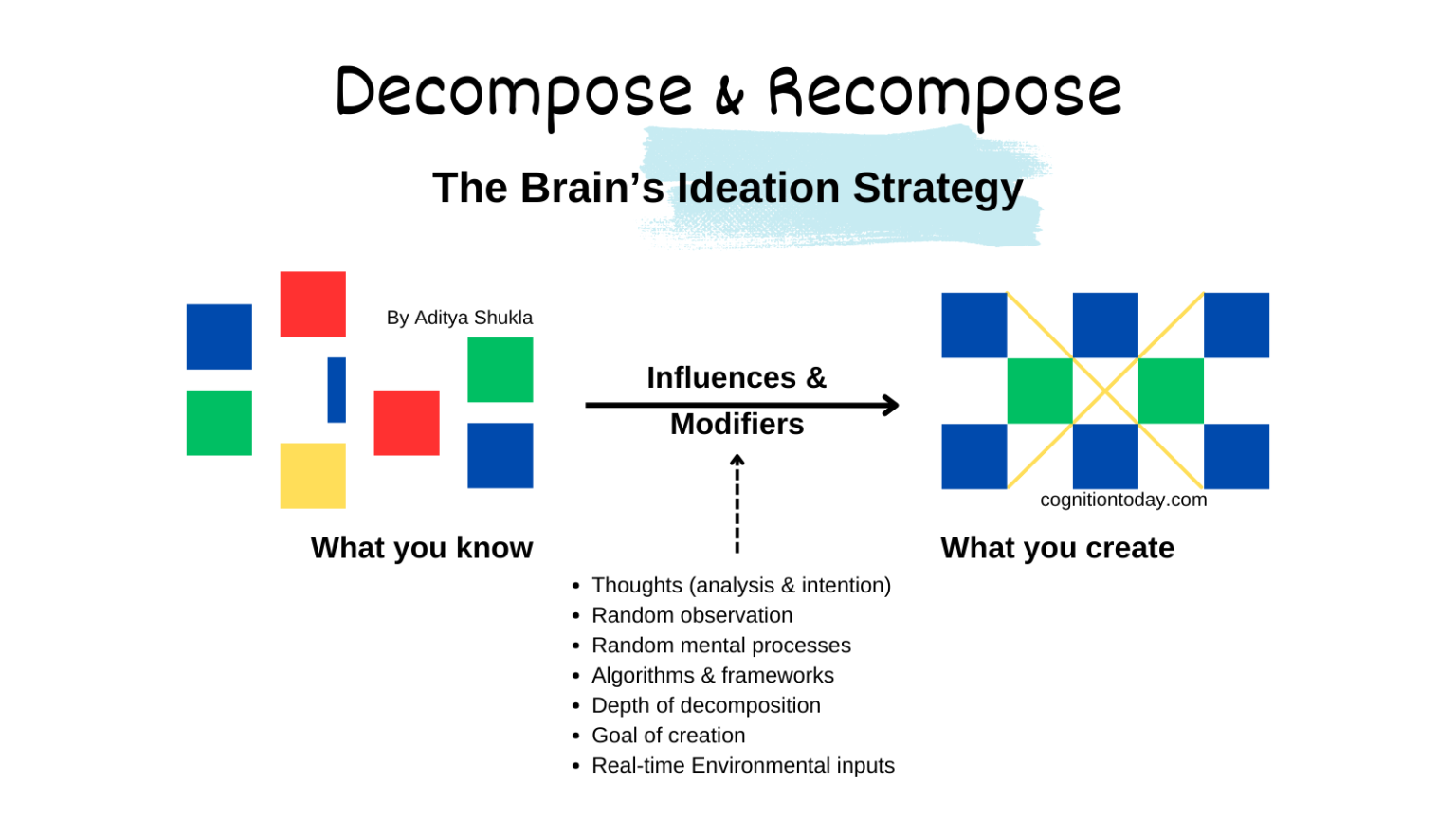
🔬 The decomposition stage: We break things apart and use tidbits of knowledge we acquire. (the decomposition stage).
➡️ Thoughts & randomness influence/modify some of that.
🏗️ The recomposition stage: We recompose using the “influenced and modified” decomposed units. However, the recomposition takes on a new shape and becomes a new decomposable entity. We can then iterate.
Example
When composing music, you take chunks of what you learn in the form of chords, melodies, and rhythm. Then, combine and reorganize those building blocks, apply some guidelines to it by making decisions, and then compose.
Did I trigger an interesting thought in your head??? Do buy me a coffee so I revive my last brain cell :)
AI alignment
The alignment problem considers whether any AI or an intelligent system is aligned with human goals and pursuits.
Is the AI behaving as intended by the designer?
E.g., Does an AI built to discover medicines really discover medicines or is it trying to fix something that doesn’t need fixing? Is medicine discovery attempting to fix frizzy hair?Is the AI understanding human context and expectations?
E.g., Can an AI make relationship decisions as per human’s wanting the struggle, the chase, the payoff, the sacrifice without relying on a heuristic like compatibility?Can humans trust AI to be aligned with their goals if the AI’s internal workings can’t be actively tweaked?
E.g., Can we effectively say that an AI teacher wants the children to learn? But if it teaches well, and is just programmed to teach well, is that aligned with what we want our children to experience in the classroom?Once we build an AI with a specific goal, are we sure we want that goal reached exactly as we have specified?
E.g., Once we make an AI that makes all hiring decisions, are we sure we want a company to hire based on that system? Are we psychologically ready for those decisions made by AI, even if they are optimized beyond our own capacity?
If we use, to achieve our purposes, a mechanical agency with whose operation we cannot interfere effectively… we had better be quite sure that the purpose put into the machine is the purpose which we really desire
Norbert Weiner (AI pioneer, 1960)
.... they show that our “verbal” actions of describing our preferences and decisions do not accurately represent the actual source of our decisions. So WHAT we say doesn’t match WHY we act. And then comes misinterpretation and rationalization. But our source of introspection itself isn’t very valid. As a result, we are incapable of precisely estimating our needs and wants with just words.
So, if we are incapable of knowing and trusting our own preferences and we are incapable of fully controlling an AI, we get this 2-tiered trust issue – we can’t trust AI, and we can’t trust ourselves. So how do we trust AI that is built based on only what we think we want?