
Does Britain deserve to have its population replaced? That is the question now being asked, often framed as a kind of historical payback.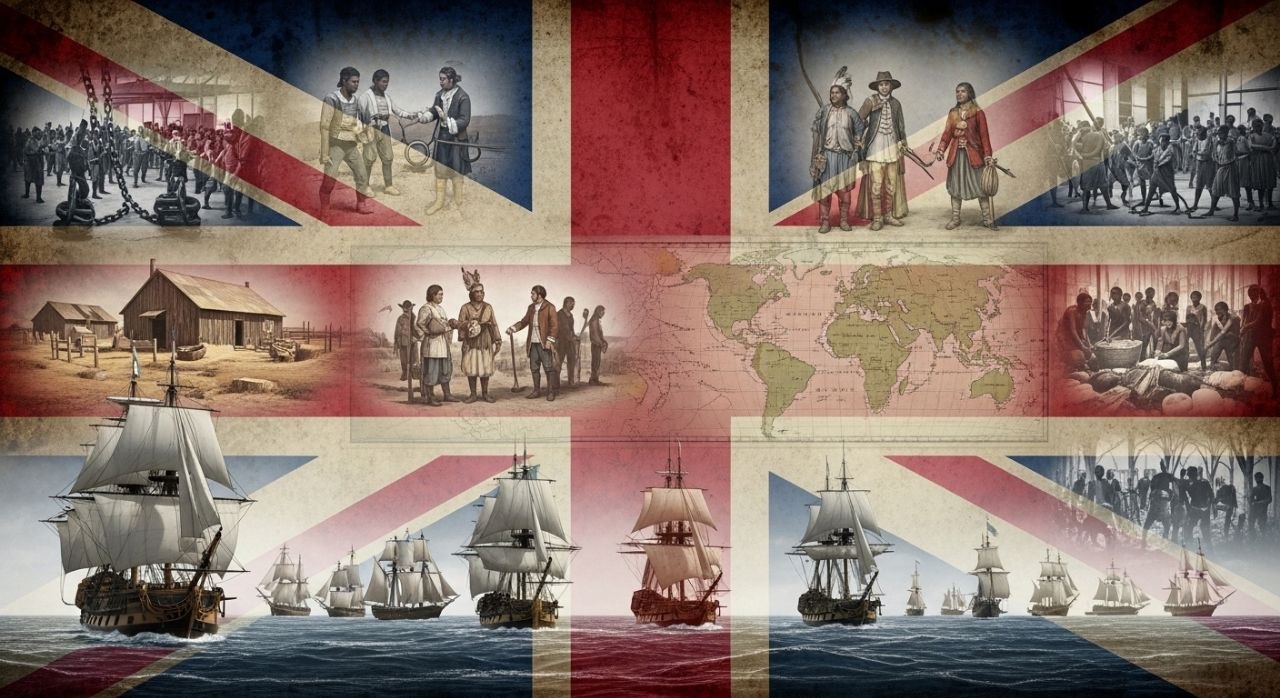 Britain is going through a demographic transformation unlike anything in its recorded history. Net migration remains high, and while headline figures suggest it is falling, much of that reduction reflects British nationals, particularly young people, leaving the country. The population of foreign-born residents continues to rise while the native British population, particularly white British, declines in both share and absolute numbers. Some demographic projections suggest white British people could make up around a third of the population within a generation.
So now the question is this: does Britain deserve this?
I have been making videos about mass migration for a while now. There is a whole playlist if you want the full picture. One of those videos made a straightforward observation: London is now less than a third white British, according to the 2021 Census. I do not mean a third white including all other European backgrounds. I mean a third white British. I made the video with a fairly clear sense of how people would respond.
What I had not fully anticipated was one particular kind of response. Not the abuse. That is easy enough to ignore. What stood out was a certain type of comment that kept appearing in different forms but always followed the same logic. Good. This is what Britain deserves. You colonised the world. You destroyed other people’s homes. Now it is happening to yours. Call it karma. Call it justice. Call it whatever you want. Do not expect sympathy.
That argument, the historical karma argument, carries real emotional weight. It does not come from nowhere. But it rests on a version of history that does not hold up. Even if the history were exactly as the argument requires, the conclusions drawn from it still would not follow. It is worth going through it properly.
The argument runs like this. Britain built an empire through conquest and force. It drew borders that divided existing communities and created artificial states. It extracted resources from the territories it controlled. In specific cases it caused famines, massacres, and widespread human suffering. The people living in Britain today are the inheritors of that wealth and that history, whether or not they chose to be. The people arriving today are, in many cases, the inheritors of the damage. The demographic transformation of Britain is therefore not an imposition. It is a reckoning.
The empire did involve conquest. It involved violence, and sometimes extreme violence. It imposed foreign rule on people who had no say in the matter. In specific territories at specific times it caused genuine and serious harm. None of that is invented. Serious historians across the political spectrum acknowledge it, from Niall Ferguson, who remains broadly sympathetic to the imperial project, to historians like John Darwin and Caroline Elkins, who are far more critical. The history itself is not in dispute.
What is worth challenging is the idea that this is the complete account of what the empire was. It is not. A moral argument built on a selective reading of history is not really a moral argument.
The karma argument tends to judge the empire against an alternative that never existed. The assumption is that without British rule, the territories it governed would have developed peacefully along their own lines, with stable societies and human flourishing that colonialism interrupted. The historical record does not support that.
Before British rule across much of sub-Saharan Africa, political realities often included slave-raiding states, persistent warfare between communities, and the exploitation of weaker groups by stronger ones. The Atlantic slave trade was not created by Europeans from scratch. It developed from existing African slave-trading networks that had operated for centuries. Historians such as John Thornton, in Africa and Africans in the Making of the Atlantic World, have documented how European demand expanded and intensified something already present. That does not excuse British involvement. It provides context, which the karma argument tends to remove.
A more honest comparison looks at what followed the empire rather than an imagined alternative. Nigeria’s civil war killed up to three million people, largely through famine used deliberately as a weapon. Uganda under Amin and Obote saw mass killings estimated in the hundreds of thousands. Zimbabwe’s Gukurahundi massacres, the Congo wars, Darfur, death tolls in the millions, all after the British left.
Sure some of these events involved Western interference. In Congo, the CIA and Belgium were involved in removing Lumumba and installing Mobutu. That is well documented. Mobutu then looted the country for decades, and the conflicts that followed involved African leaders and factions making their own catastrophic decisions. External influence shaped conditions. Internal leadership determined outcomes in many cases.
The karma argument presents colonialism as the root of suffering and independence as the solution. In many places suffering intensified after independence. Acknowledging that is not a defence of empire. It is a recognition that political agency did not disappear once colonial rule ended.
There is another point that is often overlooked. The same empire that participated in the slave trade later abolished it, and not only within its own territories. Britain enforced abolition globally through the Royal Navy, at considerable cost, for decades. Between 1808 and 1860, the West Africa Squadron intercepted over 1,500 slave ships and freed around 150,000 enslaved people. Britain spent a significant share of its national income over many years suppressing a trade it had once profited from.
At this point, it is often argued that Britain ended slavery for economic reasons, so it carries less moral weight. This standard is rarely applied elsewhere. The Allied powers had strategic and national interests when they defeated Nazi Germany. The liberation of concentration camps is not treated as morally diminished because of that. Actions can be morally significant even when motives are mixed. Dismissing them entirely suggests the evaluation itself is selective.
Now the economic argument behind the karma claim rests on the idea that Britain grew wealthy through colonial extraction at the direct expense of colonised populations. This case is often overstated.
Economic historians have found that the empire was of limited and sometimes negative economic value to Britain as a whole. Maintaining it required large public expenditure: military forces, naval patrols, administrative systems, and the suppression of uprisings. These costs were borne by taxpayers. Financial gains tended to concentrate among specific companies and elites rather than the population at large. Decolonisation was not only a moral shift. It also relieved a financial burden on a postwar state under strain.
The narrative of national enrichment obscures a more complicated reality. The benefits of empire were unevenly distributed, and many ordinary British people saw little of them. Workers in places like Sunderland, Bradford, and Stoke paid taxes and supplied manpower. They did not receive the kind of lasting economic advantage the karma argument assumes. Yet they are often the ones expected to accept its consequences.
Okey Chigbo, a Nigerian-Canadian writer and editor, addresses this in his work How Africans Underdeveloped Africa. He argues that attributing ongoing problems solely to colonial history has served political elites well. It provides a ready-made explanation for corruption, mismanagement, and internal conflict. The colonial legacy remains relevant, but decades after independence it becomes an incomplete explanation for continued failure in resource-rich countries.
There is a deeper issue with the karma argument that goes beyond historical interpretation. It concerns who is actually being held responsible.
The supposed reckoning does not fall on those who governed the empire. They are long gone. It does not primarily affect the elite families who benefited most. It affects ordinary people in towns and cities across Britain. Communities that have changed rapidly within a single generation. Workers facing increased competition. Families struggling with housing and public services. People whose concerns have often been dismissed when they try to express them.
The British working class did not direct imperial policy. In many ways, they lived under harsh conditions themselves. Historians such as E. P. Thompson documented the extent of industrial-era poverty and exploitation. The empire was largely shaped by political and economic elites. Holding the descendants of working people responsible for it shifts accountability away from those who exercised power.
The argument also relies on treating people as members of a group rather than as individuals. Empire categorised entire populations, it looked at Nigerians and saw subjects. The karma argument does something similar in reverse. It looks at the British working class and sees colonisers. It assigns responsibility based on identity rather than personal involvement. The individual disappears.
This is a conversation that benefits from honesty. Britain’s history, like that of any nation, is complex. Understanding it requires more than a simplified narrative of permanent guilt on one side and permanent victimhood on the other. The karma argument selects certain elements, ignores others, and presents the result as settled truth.
It is not settled. And the people expected to accept its conclusions deserve a more serious account than the one they are being given.