
A few years ago, some artists approached me and said they were planning to create a sculpture of Nangeli and were looking for facial references. They asked if they could use my photograph as a reference. I politely declined, although I was horrified by the request. I couldn't imagine looking at a sculpture of a woman's body carrying her severed breasts on a plantain leaf, bloodied and mutilated and finding my own face staring back at me. Why would I want to see myself attached to that image of suffering? For a moment, I wanted to tell them to put their own faces on that body. But I bit my tongue and the sentence I didn't say still tastes weird in my mouth.
There are few body parts that have had to endure as much political scrutiny as breasts. They have been worshipped, sexualised, regulated, exposed, covered, moralised over and occasionally turned into historical controversies. In Kerala, breasts have had a particularly complicated relationship with the state, caste, religion and respectability. At various points in history, what a woman could do with her breasts was not entirely her business.
At this point, Nangeli's breasts occupy a rather peculiar position in our social imagination. The popular tale goes that Nangeli was an Ezhava (currently OBC) woman who cut off her breasts in protest against the breast tax imposed on lower-caste women.
The breast tax, or mulakkaram, refers to a gender-specific tax historically associated with the caste-based taxation system of the erstwhile princely state of Travancore (present-day southern Kerala). It was reportedly imposed on women belonging to subordinated caste communities, while men paid a corresponding tax called talakkaram (head tax). However, there is a dispute about what the tax actually meant. The pop culture interpretation suggests that women from oppressed caste communities had to pay a tax to cover their breasts, some even go further that it was supposedly calculated according to breast size. But historians argues that breast tax was essentially a poll tax on women, with the name distinguishing it from the corresponding tax on men. It was not specifically a fee for permission to cover one's breasts.
According to the story of Nangeli which relies on the popular narrative, when the tax collector arrived to collect the levy, she presented her severed breasts on a plantain leaf. She subsequently died from her injuries and her husband is said to have taken his own life in grief. Until relatively recently, Nangeli was widely spoken about as a historical figure and her story was often narrated as an established historical event. However, the absence of corroborating contemporary archival evidence has led historians to question its historicity. Today, the story is more cautiously approached as folklore, oral history or popular memory. There are historians who dismiss it as fiction, while others are interested in the social and political circumstances that might have produced and sustained such a narrative.
I find this distinction interesting, particularly because we tend to assume that a story's significance is directly proportional to its historical verifiability. If an event cannot be established through archival records, ie, colonial records we are often tempted to treat the story as though it has nothing meaningful left to tell us. But luckily, I'm not a historian, but a poet and I don't think a story has to be true in every detail to matter. Nor do I think that acknowledging its uncertain historical status requires us to abandon the questions it raises.
After all, stories do not circulate in a historical vacuum. They are told, retold, modified and embellished within particular social and political contexts. They can carry collective anxieties, grievances, aspirations and memories that might not find their way into official historical records. This is especially worth considering when we are dealing with communities whose experiences have historically been underrepresented in the production and preservation of written archives. Perhaps, then, the more interesting question is not whether Nangeli existed exactly as the popular story describes her. It is also why Kerala needed a story like hers, why her breasts became the central image of that story and why generations continue to return to it when talking about caste, gender and bodily autonomy. That symbolic meaning deserves examination, even as we remain careful about the historical claims we make.
I sometimes think about this in relation to arguments about the existence of God. Atheists spend considerable time trying to establish that God doesn't exist. I don't believe in God either, but I've always found the question of God's existence less interesting than the material consequences of belief in God. Whether or not God exists as a supernatural being, violence in the name of God certainly exists. People have been killed, persecuted and denied rights in the name of this entity. God exists as a social and political force, as an idea that organises and legitimises institutions, authority and produces material consequences. Establishing that God doesn't exist isn't going to make those consequences disappear.
But what was the reality? In 19th century Kerala, clothing was rigidly controlled by the caste system, where uppered caste women were permitted to cover their chests, while oppressed caste women were forced to remain bare chested as a sign of submission. Uppered caste women (like Nairs and Brahmins) could cover their breasts, though Nair women were still barred from covering up in front of royalty, temple deities or uppered caste men as a token of respect.
In 2023, I was out running errands when a few friends dragged me along to a TM Krishna concert at the Thrippunithura temple auditorium. Naturally, I wasn't dressed "appropriate" for a temple. I was wearing a tight shirt, with gaping buttons, so I received disapproving looks from people around me and grandmothers whispered loudly enough for me to hear their comments.
The irony of it all is laughable. This was, after all, the very same temple where, roughly a century earlier, a Nair woman's blouse had been torn off in the presence of the king for daring to wear it inside the temple.
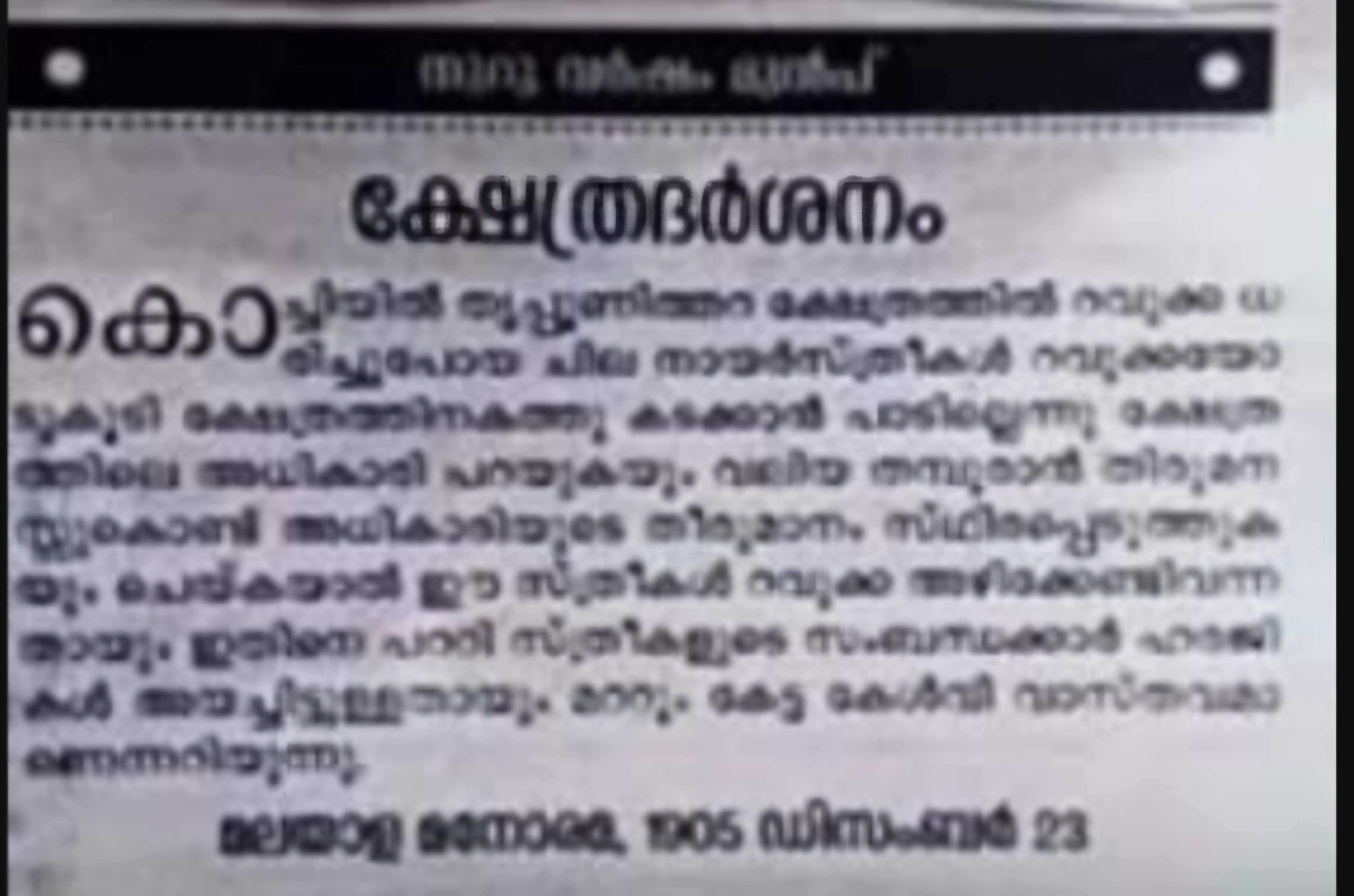
Like I said before, Nair women, classified as Shudras within the caste hierarchy of kerala were expected to remove their blouses as a mark of respect towards royalty and the deity before entering certain temples. Around 1905, one Nair woman entered the temple wearing a blouse while the king was present. When the king's attendants demanded that she remove it, she refused. So they proceeded to tear it off her body. Her relatives subsequently filed a petition before the king's court, but the ruling went against them saying women were not permitted to wear blouses inside the temple. Worshippers eventually abandoned their blouses, however reluctantly, rather than give up their religious practices.
Another interesting event worth mentioning is the Velur Maru Marakkal Samaram, a historic 1956 social reform protest at the Manimalarkavu Devi Temple in Thrissur, Kerala. Until then, Nair women were strictly forbidden from covering their upper bodies while participating in the temple's annual Kuthira Vela (horse festival) rituals. They were forced to march bare-chested in public while carrying ritual offerings (Thalappoli).
But in 1956, led by progressive leaders like Devaki Nambisan and Velathu Lekshmikutty and supported by communist leader A.S.N. Nambisan, a group of 23 brave women decided to break the rule. The women marched into the temple wearing red blouses and traditional attire. Despite threats from conservative groups, the protesters stood their ground, backed by local progressive youth and police protection. The protest successfully crushed the regressive custom. From that day forward, the forced bare-chested ritual was abolished permanently. Even in the 1950s, not even a hundred years ago, women were still fighting for the right to decide what they could wear and where they could wear it. This isn't much different from how women's bodies are policed even today.
Okay, what did oppressed caste women do?
The missionary and historian Samuel Mateer documented the restrictions in his 19th century account "The Land of Charity". He described how oppressed caste women, as well as men, had been prohibited from wearing clothing above the waist as a symbol of their "lower" status. One important event in the clothing history of Kerala is Channar revolt of the 19th century. For nearly three decades, with varying degrees of intensity, the revolt kept southern Travancore in turmoil.
Nadar women (currently OBC) who had converted to Christianity wore upper-body clothing, while those who remained unconverted did not. The customary attire of savarna women consisted of a roukka (jacket or blouse) and an additional upper cloth worn over it. Missionaries dressed women who converted to Christianity in a similar manner. Tensions arised when more people converted and began asserting their right to cover their upper bodies, challenging their landlords and caste system in general. These actions provoked savarna Hindus. They launched attacks against women who wore upper-body clothing. They said covering breasts would make it impossible to identify caste.
In 1822, when Nadar women wearing such clothing arrived at the Kalkulam market, some savarna men tore their jackets off. That same year, a group of Nadar women who were walking with their upper bodies covered at Padmanabhapuram, along with the men accompanying them, were brutally assaulted by several Nair men. These incidents triggered widespread retaliation and the disturbances spread to other parts of Travancore. The Diwan at the time, Venkitta Rao, favoured the savarna position, but missionary Reed challenged this position in court. The court ruled in favour of the Nadar women. But still Diwan Venkitta Rao issued an order prohibiting Nadar women from covering their upper bodies and the Nadar women who wore blouses were kept on getting attacked and violated. On January 1859, disturbances intensified in Kumarapuram and there, Nadar women were stripped naked and paraded through the streets. Later that year, Nadar women were permitted to wear blouses, provided they did not resemble those worn by savarna women. All Nadar women despite of religious status were also granted the right to wear the upper cloth. Eventually under pressure from the British authorities, the Maharaja of Travancore was eventually compelled to withdraw this discriminatory condition as well. With this, the Channar women's struggle for clothing rights finally achieved its ultimate victory.
But where did Nangeli appear in this history? It's because the image of a woman's severed breasts does not exist in isolation in Kerala's historical imagination. There are other accounts of women being subjected to breast mutilation as punishment for violating caste specific dress codes. For example, there is an incident, repeated in Kerala historical writing of a woman who had spent time in a European settlement and appeared before the Rani of Attingal wearing clothing that covered her breasts.
According to this account, the Rani ordered her breasts to be cut off for violating the dress convention. The incident is generally dated to 1682.
So why has the image of breast cutting become so central? I think there are three layers to this.
First, breasts became a site through which caste authority was exercised. Women's upper bodies were not governed by one universal rule and the clothing they could wear, the people before whom they had to uncover themselves and the type of garments they were permitted depended on caste status and ritual hierarchy.
Second, the violence was not about nudity or modesty. The breasts, covered or not, maintained visible caste distinctions. When Nadar women began wearing clothing associated with savarna women, they were challenging the social order. The 1859 proclamation itself demonstrates this. Third, the image of Nangeli and her self mutilation has become an extraordinarily powerful visual metaphor for a woman refusing to submit to the authority that claims ownership over her body.
There is a fascinating political and cultural history, especially in South India, behind the act of women cutting, removing, mutilating or deliberately altering parts of their bodies in protest. Like a corporeal resistance, the resistance performed through the body itself. The central proposition is when the state, religion, caste and patriarchy claims authority over a woman's body, she can turn that body into the site from which she challenges its authority. It can be a rejection of the conditions under which womanhood is permitted to exist.
Because society attaches so many meanings to breasts, the meanings of sexuality, femininity, motherhood, modesty, fertility, their removal or destruction in narratives can become a charged political gesture.
Consider Kannagi in the "Silappatikaram". When she confronts the king and exposes the injustice of the royal court, she tears out one of her breasts and hurls it towards Madurai, which is subsequently consumed by fire.
There is a symbolic connection here with contemporary acts of women cutting or shaving their hair in protest. Hair, much like breasts, carries cultural meanings associated with feminine beauty, respectability and social conformity. When women publicly cut their hair, they can be refusing to maintain what patriarchal society expects of them.
So I don't think we necessarily have to establish Nangeli as a verifiable historical figure for her story to retain its political and cultural significance. We can read her as an embodied protest myth through whom generations have articulated the violence of caste, the regulation of women's bodies and the possibility of refusing authority. Whether or not a woman in Cherthala actually cut off her breasts in protest against mulakaram, the story has acquired a life of its own because it speaks to a much larger historical reality that the female body has always been a site upon which caste, patriarchy, religion and the state have exercised power. To acknowledge the uncertainty surrounding her historical existence need not mean diminishing her significance. This is the purpose of stories. This is why we create stories, tell them, love to listen to them.
Coming back to why I declined to be a facial reference to Nangeli even though I wanted her to be remembered. Is it just that I didn't want to see my own face on her mutilated body? Perhaps I was unwilling to become a visual shorthand for a history of suffering. Perhaps I didn't want my face to be the thing that made the violence more intimate, more real to an audience. I don't know. I'll let that go unresolved for now.
NOTICE: I recently found out that Buy Me a Coffee doesn't support GPay and creators are encouraged to share their personal GPay IDs instead. So here's mine, in case you'd like to contribute but are too lazy to pull out your card and type in all that shi (like me).
Absolutely no pressure. ❤️

evealina7@oksbi