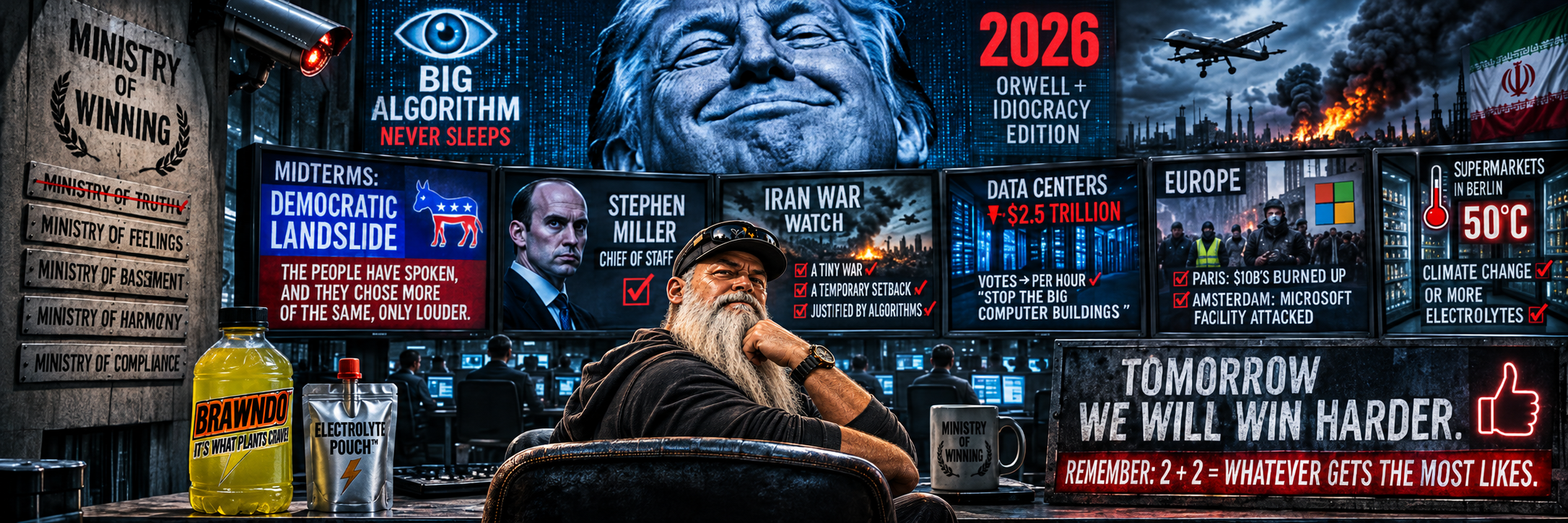

In the year 2026, the telescreens no longer flickered with grainy black and white. They streamed in ultra high definition from every pocket, every pair of smart glasses, and the ceiling of every public restroom. Big Brother had been rebranded as Big Algorithm, and he never slept because the engagement metrics never slept.
Marcus sat in his cube at the Ministry of Truth, now officially the Ministry of Winning, watching the feed. Overnight, the Democratic landslide in the midterms had been processed into a single approved narrative: “The People Have Spoken, and They Chose More of the Same, Only Louder.” The previous version, in which the President had called the election “rigged by smart people who hate winning,” had been quietly deleted at 3:17 a.m. Marcus’s job was to make sure no one noticed the deletion.
A notification pinged. Stephen Miller had been named Chief of Staff. The algorithm had already generated three thousand variations of the announcement. The winning one read: “President appoints guy who is very serious about serious things. Experts agree this is good. Sources: me.” Marcus approved it. A second later the same story appeared on every feed with the caption “This is fine 👍🔥,” accompanied by a looping clip of a man in a suit drinking Brawndo from a crystal goblet.
On the other side of the room, the War Desk was busy. The Iran conflict had entered its eighth month. The President had announced he would decide “soon” whether to resume bombing, now that the elections were over. The Ministry of Winning’s guidance was clear: the war was both a triumph and a temporary setback caused by insufficient electrolytes in the water supply. A junior analyst had suggested this might be contradictory. He was reassigned to the Ministry of Feelings, where he now moderated comments under videos of people filming themselves crying about data centers.
Marcus’s screen flashed a priority alert. Someone in Ohio had posted an old article claiming the cost of living had something to do with the election results. The post had been auto flagged for thoughtcrime. Marcus watched the correction cascade in real time: the original post vanished, replaced by a short video of a smiling influencer explaining that “prices only go up because we keep buying the wrong things, like books instead of limited edition electrolyte pouches.” The influencer was paid by a data center company that had just lost $2.5 trillion in market value after voters in three states elected candidates who promised to “stop the big computer buildings that make the internet slow.”
At lunch, Marcus ate his nutrient paste while the communal screen showed the President signing a proclamation declaring the Oval Office a national monument. “Historic site of many very big victories,” the caption said. Below it, a split screen displayed protesters in Paris boarding up shops and protesters in Amsterdam smashing the fence around a Microsoft facility. Both groups were labeled “uninformed.” A third panel showed a supermarket in Belgium whose refrigerators had been remotely set to 50 degrees Celsius by hackers. The Ministry of Winning had already determined this was either climate change or proof that Europe needed more American electrolytes.
Marcus’s shift ended. On the way home his glasses auto-played a highlight reel of the day: the midterm results rewritten as a mandate for continued greatness, the Iran decision still pending but definitely correct either way, and a final clip of the President declaring himself “a winner.” The algorithm asked Marcus if he wanted to share the reel with his contacts. He did not. The algorithm shared it anyway.
That night, as he lay in bed, the telescreen above him displayed the official goodnight message: “Sleep well, citizen. Tomorrow we will win harder. Remember: two plus two equals whatever gets the most likes.”
Marcus closed his eyes. Somewhere in the dark, a distant voice, perhaps his own, or perhaps just the algorithm practicing, whispered the old unspeakable thought: It wasn’t always like this.
The glasses logged the subvocalization, tagged it “mild nostalgia / possible deviation,” and scheduled a gentle correction video for 7:00 a.m. It would feature a celebrity explaining that history had always been this way, only with worse electrolytes. Marcus would watch it. He always did. The engagement numbers depended on it.
Credit to @prettyskyfru1 for the Idea.